
Enhancing the meshing performance of involute tooth profiles in strain wave gears represents a critical challenge in precision transmission systems. The unique operating principle, relying on the controlled elastic deformation of a flexible spline, introduces complexities that go beyond conventional gear design. This work presents a comprehensive methodology for the three-dimensional tooth profile design and optimization of involute strain wave gears, directly addressing the spatial conjugate nature of the meshing process. The core objective is to overcome issues of interference and excessive backlash that arise from the tapered deformation of the flexible spline along its axis, thereby significantly improving transmission accuracy, load distribution, and overall reliability.
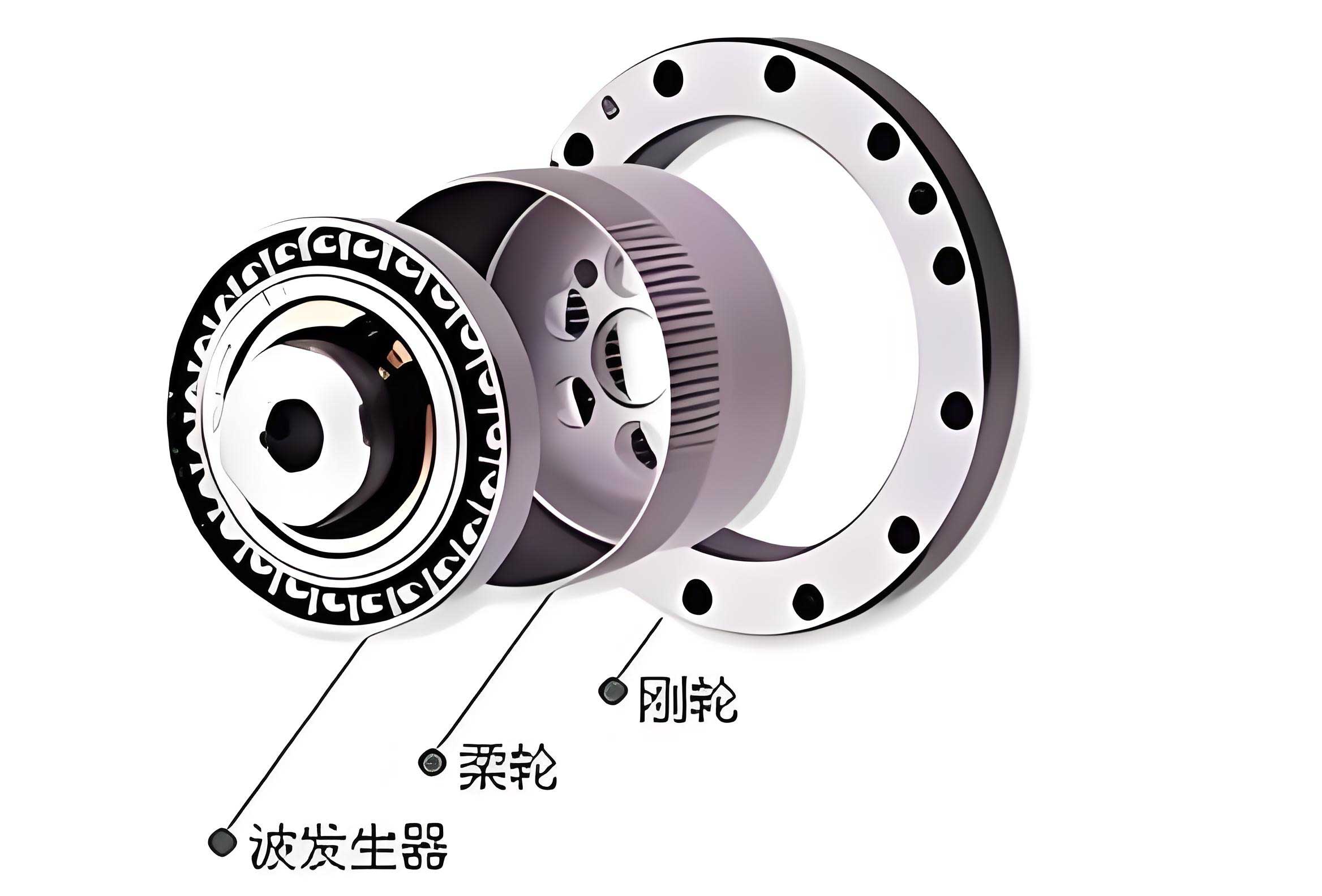
The superiority of strain wave gear drives lies in their compact size, high reduction ratios, substantial torque capacity, and excellent positional accuracy. These attributes make them indispensable in demanding fields such as aerospace robotics, satellite positioning mechanisms, and precision industrial automation. The transmission is achieved through the elastic deformation of a thin-walled flexible spline, typically cup-shaped, by an elliptical wave generator. This deformation forces the teeth of the flexible spline to engage and disengage progressively with the internal teeth of a rigid circular spline. Crucially, this engagement is not a simple planar gear mesh; it constitutes a complex spatial elastic conjugate problem. The varying radial displacement along the axis of the deformed flexible spline means that a tooth profile optimized for a single cross-section may lead to interference or insufficient contact in other sections, degrading performance. Therefore, meticulous control of the inter-tooth clearance, or backlash, is paramount. Insufficient clearance can cause binding and overload damage under torque, while excessive clearance increases transmission error and hysteresis loss, directly contradicting the drive’s precision advantages.
Traditional design approaches often simplify the flexible spline as a series of independent planar sections. However, when the wave generator is inserted, the cup-shaped flexible spline experiences a conical distortion. This results in different maximum radial displacements (the deflection at the major axis of the ellipse) for cross-sections at different axial positions. A tooth profile pair designed for perfect meshing at one nominal “design section” will invariably exhibit sub-optimal behavior elsewhere. Sections with larger radial displacement risk interference with the circular spline teeth, while those with smaller displacement suffer from increased clearance and potential loss of contact. This is particularly pronounced in short-cup flexible splines where the conical effect is more significant. To achieve the full potential of strain wave gear technology, a holistic three-dimensional tooth profile design is essential. This involves systematically adjusting the tooth geometry—primarily the profile shift coefficient and sometimes the active tooth depth—for various axial sections of the flexible spline to ensure uniform, high-quality meshing across the entire face width.
Fundamental Kinematics and Conjugate Theory
The precise determination of the conjugate tooth profile for the circular spline is the cornerstone of strain wave gear design. An exact analytical approach, based on the envelope theory applied to the deformed state of the flexible spline, is employed. The kinematic model is established using a set of coordinate systems to track the relative motion.
Let a fixed coordinate system \( S_C(O_C-x_Cy_Cz_C) \) be attached to the circular spline, with its \( y_C \)-axis aligned with the symmetric line of a circular spline tooth space. A moving coordinate system \( S_f(O_f-x_fy_fz_f) \) is attached to a tooth on the deformable end of the flexible spline, with its \( y_f \)-axis aligned with the tooth’s symmetry line. Another moving system \( S_W(O_W-x_Wy_Wz_W) \) is attached to the wave generator, with its \( y_W \)-axis aligned with the generator’s major axis. Initially, these axes are coincident.
As the wave generator rotates, it deforms the flexible spline. The radial and circumferential displacements of a point on the flexible spline’s neutral surface are denoted by \( u(\phi) \) and \( v(\phi) \), respectively, where \( \phi \) is the angular position relative to the wave generator’s major axis. The instantaneous polar radius \( \rho \) of the deformed neutral curve is:
$$ \rho(\phi) = r_m + u(\phi) $$
where \( r_m \) is the radius of the undeformed flexible spline neutral surface.
The rotation of the flexible spline’s deformable end, \( \phi_f \), and the angular tilt of its tooth symmetry line, \( \theta_{uz} \), are derived from kinematic and geometric relations:
$$ \phi_f = \phi_F + \frac{v(\phi)}{r_m + u(\phi)} $$
$$ \theta_{uz}(\phi) = -\arctan\left( \frac{\dot{u}(\phi)}{r_m + u(\phi)} \right) $$
Here, \( \phi_F \) is the rotation of the flexible spline’s rigid output end, related to the wave generator’s input rotation \( \phi_W \) by the gear ratio \( i \):
$$ \phi_F = \phi_W \frac{z_2 – z_1}{z_2} $$
where \( z_1 \) and \( z_2 \) are the number of teeth on the flexible and circular spline, respectively. The condition of inextensibility of the neutral surface provides the integral relation to define \( \phi \):
$$ \phi_W \, r_m = \int_{0}^{\phi_1} \sqrt{(r_m + u)^2 + (\dot{u})^2} \, d\phi $$
where \( \phi_1 \) is the angular position on the flexible spline relative to the wave generator’s major axis.
The conjugate tooth profile of the circular spline, denoted as curve \( C(x_c, y_c) \), is generated as the envelope of the family of flexible spline tooth profiles \( F(x_f, y_f) \) during motion. According to the gearing theory, the conjugate point coordinates and the meshing condition are given by:
$$ \begin{cases}
x_c(s, \phi) = x_f(s)\cos\psi + y_f(s)\sin\psi + \rho \sin\phi_f \\
y_c(s, \phi) = -x_f(s)\sin\psi + y_f(s)\cos\psi + \rho \cos\phi_f \\[10pt]
\dfrac{\partial x_c}{\partial s} \dfrac{d\phi}{d\phi_1} \dfrac{\partial y_c}{\partial \phi} – \dfrac{\partial x_c}{\partial \phi} \dfrac{d\phi}{d\phi_1} \dfrac{\partial y_c}{\partial s} = 0
\end{cases} $$
where \( s \) is the profile parameter for the flexible spline’s involute tooth, and \( \psi = \theta_{uz} + \phi_f \). Solving this system for a discrete set of points \( (x_f, y_f) \) yields the corresponding conjugate points \( (x_c, y_c) \) on the theoretical circular spline profile.
Spatial Tooth Profile Design Methodology
The output from the conjugate theory is a set of discrete points describing the “perfect match” for the flexible spline’s tooth at the chosen design section. For practical manufacturing and analysis, this discrete profile is fitted with a standard involute curve. The fitting process minimizes the average deviation while ensuring the fitted involute curve does not intersect the theoretical curve (to avoid interference). The primary variable in this fitting is the profile shift coefficient \( x_2 \) for the circular spline.
The central challenge in three-dimensional design arises after the circular spline’s tooth profile is finalized based on one axial section (the “design section”) of the flexible spline. The conical deformation means other sections of the flexible spline have different maximum radial displacements, \( w_0 \). A section with a larger \( w_0 \) will press more deeply into the circular spline tooth space, risking interference. A section with a smaller \( w_0 \) will not reach as far, creating excessive backlash. Therefore, the geometry of the flexible spline’s teeth must be adjusted axially to compensate.
The most effective and practical adjustment parameter is the profile shift coefficient \( x_1 \) of the flexible spline’s involute tooth at each axial section. Altering \( x_1 \) effectively moves the involute profile radially relative to its reference pitch circle. For a section with increased radial displacement, reducing \( x_1 \) pulls the tooth profile slightly inward, preventing contact with the circular spline. Conversely, for a section with decreased radial displacement, increasing \( x_1 \) pushes the tooth profile outward, reducing the operational backlash and improving contact.
For sections where the reduction in radial displacement is severe, merely adjusting \( x_1 \) may be insufficient or may lead to other issues like tooth thinning. In such cases, a secondary adjustment of the active tooth height \( h_n \) (the portion of the tooth that is designed to actively participate in contact) is necessary. Reducing \( h_n \) for a deeply recessed section can prevent its tooth tip from clashing with the circular spline’s tooth root during entry/exit, allowing for a more favorable \( x_1 \) to be selected for better meshing in the active region.
Key parameters for the design of a typical strain wave gear are summarized below:
| Parameter | Symbol | Value |
|---|---|---|
| Module | \( m \) | 0.5 mm |
| Flexible Spline Tooth Count | \( z_1 \) | 200 |
| Circular Spline Tooth Count | \( z_2 \) | 202 |
| Pressure Angle | \( \alpha_0 \) | 20° |
| Cup Length | \( L \) | 80 mm |
| Design Section Wall Thickness | \( \delta \) | 0.9 mm |
| Design Section Max Radial Displacement | \( w_0 \) | 0.5 mm |
| Design Section Profile Shift Coefficient | \( x_1 \) | 3.0 |
| Active Tooth Height | \( h_n \) | 0.8 mm |
Optimization Control Model Based on Backlash
To systematically determine the optimal profile shift coefficient \( x_1 \) for each flexible spline cross-section, an optimization model centered on controlling the inter-tooth backlash \( j_t \) is established. The backlash at a given meshing position \( \phi \) is defined as the minimum distance between the flexible spline tooth profile and the circular spline tooth profile. It is a complex function of \( x_1 \), \( x_2 \), \( \phi \), and \( h_n \): \( j_t = f(x_1, x_2, \phi, h_n) \).
For a given axial section \( i \) with its known maximum radial displacement \( w_{0,i} \), the optimization aims to find the \( x_{1,i} \) that brings the calculated backlash pattern closest to a desired target pattern (often targeting near-zero backlash in the central meshing zone). The objective function \( F(x_1) \) is formulated as the sum of calculated backlashes at discrete meshing positions \( \phi_k \), typically evaluated at the flexible spline tooth tip:
$$ F(x_1) = \sum_{k=1}^{n} \sqrt{ \left( x_{c,k}(x_1) – x_{a,k}(x_1) \right)^2 + \left( y_{a,k}(x_1) – y_{c,k}(x_1) \right)^2 } $$
where \( (x_{a,k}, y_{a,k}) \) is the coordinate of the flexible spline tooth tip at \( \phi_k \), and \( (x_{c,k}, y_{c,k}) \) is the coordinate of the closest point on the fixed circular spline tooth profile.
The minimization of \( F(x_1) \) is subject to critical geometric constraints to ensure feasible and robust gear operation:
- Non-Interference Constraint: The flexible spline profile must not penetrate the circular spline profile at any meshing point.
$$ x_{c,k}(x_1) – x_{a,k}(x_1) \ge 0, \quad y_{a,k}(x_1) – y_{c,k}(x_1) \ge 0 $$ - Undercut Avoidance Constraint: The contact must occur on the involute flanks, avoiding interference at the root fillets.
$$ \left( r_{g2} – r_{g1}(x_1) \right) – (h_n + w_{0,i}) > 0 $$
where \( r_{g1}, r_{g2} \) are the start-of-active-profile radius for the flexible spline and circular spline, respectively. - Radial Clearance Constraint: Sufficient clearance must exist at the tooth root to prevent bottoming out.
$$ r_{f2} – \left[ r_{a1}(x_1) + w_{0,i} + 0.2m \right] \ge 0 $$
where \( r_{f2} \) is the circular spline root radius and \( r_{a1} \) is the flexible spline tip radius. - Disengagement Constraint: Teeth must be able to separate smoothly at the minor axis region.
$$ \left( r_{a2} + 1.08 w_{0,i} \right) – r_{a1}(x_1) > 0 $$
where \( r_{a2} \) is the circular spline tip radius.
Solving this constrained optimization problem for each axial section yields the optimal set of profile shift coefficients \( \{x_{1,i}\} \) for the three-dimensional flexible spline.
Design Instance and Meshing Analysis
Applying the methodology to the example strain wave gear with an 80 mm cup length, the circular spline profile was first designed based on the central design section (Section 3). The optimized parameters for both splines at this section are as follows:
| Parameter | Flexible Spline (Sec. 3) | Circular Spline |
|---|---|---|
| Profile Shift Coef. \( x \) | 3.00000 | 2.66756 |
| Half of Space Angle \( \theta \) | 1.07562° | 1.06590° |
| Pitch Radius | 50.000 mm | 50.500 mm |
| Tip Radius | 51.87396 mm | 51.70755 mm |
| Root Radius | 50.82500 mm | 52.50878 mm |
Subsequently, the maximum radial displacement \( w_0 \) for other sections was calculated based on the conical deformation assumption, and the optimization model was solved to determine their respective \( x_1 \) values, keeping \( h_n = 0.8 \) mm constant.
| Section | Axial Pos. | \( w_0 \) (mm) | Optimal \( x_1 \)** |
|---|---|---|---|
| Section 1 | Front | 0.527 | 2.94061 |
| Section 2 | Front-Mid | 0.5135 | 2.97109 |
| Section 3 | Center (Design) | 0.500 | 3.00000 |
| Section 4 | Rear-Mid | 0.4865 | 3.02682 |
| Section 5 | Rear | 0.473 | 3.05160 |
The results demonstrate a clear and nearly linear trend: sections with larger \( w_0 \) than the design section require a reduction in \( x_1 \), while sections with smaller \( w_0 \) require an increase in \( x_1 \). Meshing simulation for Section 1 (with larger \( w_0 \)) confirmed that using the design section’s \( x_1=3.0 \) would cause interference near the major axis. After optimization to \( x_1=2.94061 \), the interference is eliminated, and backlash is controlled within an acceptable range. For Section 5 (with smaller \( w_0 \)), using \( x_1=3.0 \) resulted in unacceptably large backlash (>10 μm). Optimizing to \( x_1=3.05160 \) brought the backlash down, creating a near-zero clearance zone and enabling effective power transmission.
Analysis of the backlash distribution across all sections reveals the significant benefit of spatial design. For the planar profile (using only the design section geometry for the entire cup), only one section meshes optimally. With the optimized 3D profile, the near-zero backlash zones of different sections are spread across a wider range of the meshing cycle (e.g., from approximately \( \phi = 1.5^\circ \) to \( 7^\circ \)). This indicates a substantial increase in the total contact ratio and the potential for more teeth to share the load simultaneously, greatly enhancing the smoothness and load capacity of the strain wave gear drive.
Handling Severe Conical Deformation
For shorter cup lengths, the conical deformation effect is more acute, leading to larger variations in \( w_0 \). In such cases, the linear adjustment of \( x_1 \) may reach its limits. Consider a shorter cup (L=40 mm) where the rear section (Section 5) has a drastically reduced \( w_0 = 0.42 \) mm. Attempting to avoid tip interference at mesh entry/exit by lowering \( x_1 \) (to 2.91142) results in a tooth that is too thin and maintains excessive backlash in the main meshing zone.
A two-step adjustment is required here:
- Reduce Active Tooth Height \( h_n \): Lowering \( h_n \) from 0.8 mm to 0.6 mm prevents the tooth tip from interfering during the entry and exit phases.
- Re-optimize Profile Shift \( x_1 \): With the shorter tooth, \( x_1 \) can then be increased (to 3.0706) to improve the meshing condition in the central contact region without causing root interference.
The comparative parameters are shown below:
| Parameter | Before Adjustment | After Secondary Adjustment |
|---|---|---|
| \( h_n \) | 0.8 mm | 0.6 mm |
| \( x_1 \) | 2.91142 | 3.0706 |
| Tip Radius \( r_{a1} \) | 51.82332 mm | 51.7145 mm |
Simulation verified that this combined adjustment successfully eliminated interference while reducing the operational backlash in the primary contact zone to functional levels, rescuing the meshing performance of the severely recessed section. This highlights the necessity for a flexible and multi-parameter optimization strategy in the design of advanced strain wave gear systems.
Conclusion
The three-dimensional design of involute tooth profiles is essential for unlocking the full performance potential of strain wave gear drives. The methodology presented, which integrates precise conjugate theory with a backlash-based optimization control model, provides a systematic and effective approach. Key findings are:
- The conjugate circular spline tooth profile can be accurately generated via an exact envelope algorithm and fitted with a standard involute for manufacturability.
- Optimizing the profile shift coefficient \( x_1 \) for individual axial sections of the flexible spline is a highly effective method to compensate for conical deformation. The required adjustment in \( x_1 \) exhibits an approximately linear relationship with the change in the section’s maximum radial displacement relative to the design section.
- For sections where radial displacement is significantly reduced, a two-step optimization involving both a reduction in active tooth height \( h_n \) and a subsequent adjustment of \( x_1 \) is necessary to achieve a balance between interference avoidance and adequate contact.
- Compared to a conventional planar tooth profile, the optimized spatial tooth profile for a strain wave gear significantly expands the effective meshing zone, increases the total contact ratio, and promotes more uniform load sharing across the face width. This leads to marked improvements in transmission accuracy, smoothness, torque capacity, and operational longevity.
This comprehensive design and optimization framework provides a solid foundation for developing high-performance, reliable strain wave gears capable of meeting the stringent demands of modern precision motion control applications.