
In the realm of modern coal mining, the shearer stands as a pivotal piece of equipment within fully mechanized longwall faces, ensuring continuous and efficient coal extraction. The reliability of the shearer is paramount, and among its critical components, the rocker arm gearbox frequently emerges as a point of failure. Specifically, the gear shaft assembly, particularly the second-stage gear shaft, is often subjected to severe operational stresses, leading to common failures such as gear tooth pitting, spalling, and fracture. These failures not only halt production but also incur significant economic losses. As an engineer deeply involved in mining machinery analysis, I have undertaken a detailed investigation into the structural characteristics of this gear shaft. This article presents a thorough mechanical analysis, finite element modeling, and modal study of the gear shaft, aiming to identify root causes of failure and propose robust measures for improvement. By leveraging advanced simulation tools and engineering principles, this work seeks to provide a theoretical foundation for optimizing gear shaft design, thereby enhancing the overall reliability and productivity of shearer operations.
The rocker arm gearbox in a shearer is a complex transmission system responsible for transferring power from the cutting motor to the drum, enabling coal cutting and loading. Its design features multiple stages of gearing, including motor input shafts, idler gears, traction shafts, central gear sets, and planetary reducers. Within this assembly, the gear shaft of the second stage—often referred to as the second axle assembly—is particularly vulnerable due to its high load-bearing role and exposure to harsh underground conditions. The gear shaft integrates gears and bearings that are prone to wear and tear, making it a critical focus for reliability studies. Understanding the force distribution and stress concentrations within this gear shaft is essential for mitigating failures.
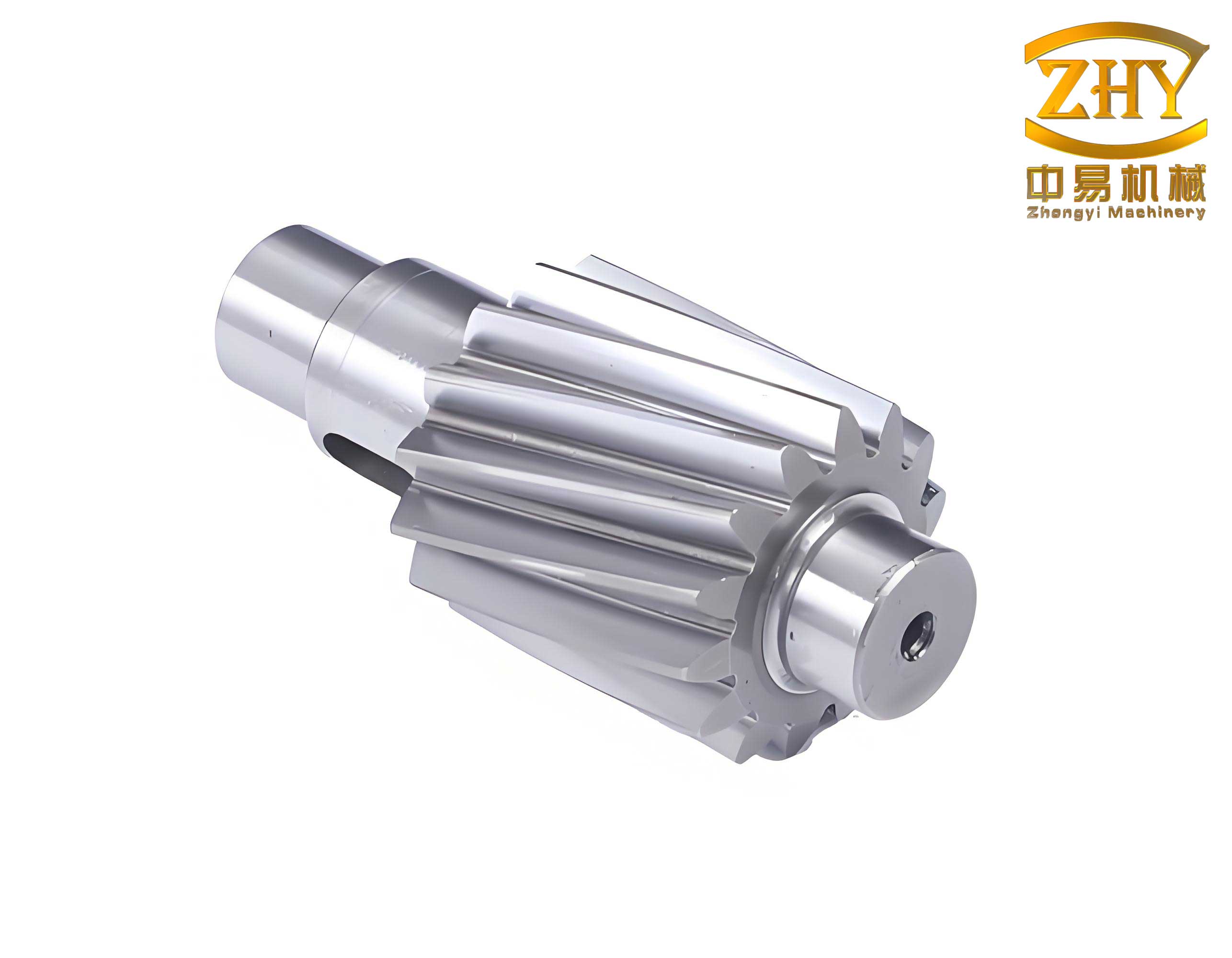
To begin the analysis, I first conducted a detailed mechanical assessment of the gear shaft. The gear shaft operates under combined bending and torsional loads, which are cyclical and dynamic in nature. Using the principle of superposition for bending and torsion, I derived the forces acting on the gear teeth. The tangential force \(F_t\) and radial force \(F_r\) on the gear are calculated using the following formulas:
$$F_t = \frac{2T}{d}$$
$$F_r = F_t \tan \alpha$$
where \(T\) is the transmitted torque, \(d\) is the pitch diameter of the gear, and \(\alpha\) is the pressure angle, typically 20° for standard gears. For the gear shaft in question, the torque \(T\) is 4.082 × 10⁶ N·mm. The pitch diameter for the gear is 272 mm, and for the pinion on the gear shaft, it is 207 mm. Substituting these values, I computed the forces:
| Component | Tangential Force \(F_t\) (N) | Radial Force \(F_r\) (N) |
|---|---|---|
| Gear | 30123 | 10884 |
| Pinion on Gear Shaft | 39456 | 14268 |
These forces were applied as concentrated loads at the midpoint of the gear face width in the computational model. The support reactions were determined based on bearing types and mounting configurations, which influence the boundary conditions. This initial force analysis provided the foundation for subsequent finite element simulations.
Next, I developed a three-dimensional model of the gear shaft assembly using Solidworks software. In modeling, certain simplifications were necessary to facilitate mesh generation and analysis without compromising accuracy. Key simplifications included omitting bolts and washers, retaining only essential components like the gear shaft, gears, end covers, and bearings, and removing minor features such as small fillets and chamfers that have negligible impact on overall stress distribution. The three-dimensional model accurately represents the geometry of the gear shaft assembly, ensuring that critical stress regions, like gear tooth roots, are preserved for detailed analysis.
With the 3D model complete, I proceeded to finite element analysis (FEA) using ANSYS software. The gear shaft assembly was discretized into finite elements to evaluate its structural behavior under operational loads. The SOLID45 element type, a 3D solid element, was selected due to its suitability for modeling complex geometries and stress analysis. Material properties were assigned based on typical alloy steel used in mining gearboxes: elastic modulus of 2.2 × 10¹¹ Pa, Poisson’s ratio of 0.27, and density of 7.91 × 10³ kg/m³. Mesh generation was performed using free meshing techniques with an element size of 10 mm, resulting in a well-balanced mesh that captures stress gradients effectively. The boundary conditions constrained translations in x, y, and z directions at the gear shaft ends, and rotations about x and y axes at the cylindrical surfaces, simulating realistic mounting conditions.
The static structural analysis revealed insightful stress and deformation patterns. The gear shaft assembly exhibited minimal deformation, with maximum stress occurring at the root of the pinion teeth on the gear shaft, measured at 10.3 MPa. However, when analyzing the gear shaft and gear individually under load, stresses increased significantly—56.4 MPa for the gear shaft and 139 MPa for the gear. This highlights the influence of structural stiffness on stress distribution; the integrated assembly provides better load sharing and reduced stress concentrations compared to isolated components. The results underscore the importance of considering both strength and stiffness in gear shaft design to prevent fatigue failures, as cyclic loading can lead to crack initiation and propagation over time.
To complement the static analysis, I performed a modal analysis on the gear shaft to assess its dynamic characteristics. The natural frequencies and mode shapes were extracted to evaluate resonance risks. The first eight natural frequencies of the gear shaft are listed below:
| Mode Number | Natural Frequency (Hz) | Mode Number | Natural Frequency (Hz) |
|---|---|---|---|
| 1 | 584.8 | 5 | 906.5 |
| 2 | 625.3 | 6 | 1162.8 |
| 3 | 692.6 | 7 | 1467.4 |
| 4 | 735.4 | 8 | 1702.1 |
Comparing these frequencies with the operational excitation frequencies—typically below 100 Hz for shearer gearboxes—it is evident that the gear shaft’s natural frequencies are sufficiently higher, minimizing the likelihood of resonance. This dynamic stability is crucial for preventing vibration-induced failures, but it does not negate the need for careful design against static and fatigue loads. The modal analysis confirms that the gear shaft’s inherent stiffness contributes to its dynamic performance, yet stress concentrations remain a primary concern.
Building on these analyses, I explored various strategies to enhance the structural performance of the gear shaft. From a design perspective, optimizing the gear shaft geometry can mitigate stress risers. For instance, incorporating larger fillet radii at tooth roots, using high-strength materials like carburized steels, and applying surface treatments such as shot peening can improve fatigue resistance. Additionally, finite element optimization techniques can be employed to iteratively refine the gear shaft shape, reducing weight while maintaining strength. I also recommend implementing probabilistic design methods to account for uncertainties in load conditions and material properties, ensuring a higher safety factor for the gear shaft.
In terms of assembly, precision is key to ensuring the gear shaft operates as intended. Misalignments during assembly can lead to uneven load distribution, accelerating wear and failure. Therefore, strict control over gear meshing parameters—such as backlash and tooth contact pattern—is essential. Bearing installation should follow manufacturer specifications, with proper preload adjustments to minimize deflections. Utilizing advanced alignment tools and training personnel on best practices can significantly reduce assembly-related issues for the gear shaft.
Regarding inspection and maintenance, proactive measures are vital for extending the gear shaft’s service life. Regular vibration monitoring can detect early signs of deterioration, such as imbalance or bearing defects. Thermographic surveys can identify overheating hotspots indicative of excessive friction. Scheduled disassembly for visual inspection of the gear shaft teeth and bearings allows for timely replacement of worn components. Moreover, adopting condition-based maintenance strategies, powered by IoT sensors and data analytics, can predict failures before they occur, minimizing downtime. For example, embedding vibration sensors near the gear shaft can provide real-time data on its health, enabling predictive interventions.
To further elaborate on the mechanical analysis, I delved into the stress calculation methodologies for the gear shaft. Using the distortion energy theory (von Mises stress), I evaluated the equivalent stress under combined loading. The von Mises stress \(\sigma_v\) is given by:
$$\sigma_v = \sqrt{\frac{1}{2}[(\sigma_1 – \sigma_2)^2 + (\sigma_2 – \sigma_3)^2 + (\sigma_3 – \sigma_1)^2]}$$
where \(\sigma_1, \sigma_2, \sigma_3\) are the principal stresses. For the gear shaft, these stresses arise from bending moments \(M_b\) and torsional moments \(M_t\). The bending stress \(\sigma_b\) and torsional shear stress \(\tau_t\) can be computed as:
$$\sigma_b = \frac{M_b \cdot c}{I}$$
$$\tau_t = \frac{M_t \cdot r}{J}$$
Here, \(c\) is the distance from the neutral axis, \(r\) is the radius, \(I\) is the area moment of inertia, and \(J\) is the polar moment of inertia. For a solid circular gear shaft, \(I = \frac{\pi d^4}{64}\) and \(J = \frac{\pi d^4}{32}\), where \(d\) is the diameter. Combining these, the von Mises stress for the gear shaft under combined loading becomes:
$$\sigma_v = \sqrt{\sigma_b^2 + 3\tau_t^2}$$
Applying these formulas to the gear shaft at critical sections, such as near gear teeth and bearing seats, allows for a more nuanced strength assessment. For instance, at the pinion tooth root of the gear shaft, stress concentrations factor \(K_t\) must be included, leading to \(\sigma_{max} = K_t \cdot \sigma_v\). Typical values of \(K_t\) for gear teeth range from 1.5 to 2.5, depending on geometry and load application. This analytical approach complements FEA results, providing cross-validation for the gear shaft stress state.
Another aspect I investigated is the thermal behavior of the gear shaft. During operation, frictional heat generated at gear meshes and bearings can cause thermal expansion, altering clearances and stress distributions. The temperature rise \(\Delta T\) in the gear shaft can be estimated using heat transfer principles. For steady-state conditions, the heat generation rate \(Q\) due to friction is:
$$Q = \mu F_t v$$
where \(\mu\) is the coefficient of friction, \(F_t\) is the tangential force, and \(v\) is the sliding velocity. This heat is dissipated through convection and conduction. The resulting thermal stress \(\sigma_{th}\) in the gear shaft, if constrained, is given by:
$$\sigma_{th} = E \alpha \Delta T$$
with \(E\) as Young’s modulus and \(\alpha\) as the coefficient of thermal expansion. In severe cases, thermal stresses can exacerbate fatigue damage on the gear shaft, necessitating cooling systems or material selections with low thermal expansion coefficients.
To present a comprehensive view, I have compiled a table comparing different gear shaft materials and their properties relevant to mining applications:
| Material | Yield Strength (MPa) | Fatigue Limit (MPa) | Thermal Conductivity (W/m·K) | Suitability for Gear Shaft |
|---|---|---|---|---|
| Alloy Steel AISI 4340 | 930 | 480 | 42 | High – Good strength and toughness |
| Carburized Steel 20MnCr5 | 1200 | 600 | 40 | Very High – Excellent surface hardness |
| Stainless Steel 17-4 PH | 1170 | 550 | 18 | Moderate – Corrosion resistance but lower conductivity |
| Ductile Iron | 550 | 250 | 36 | Low – Adequate for lighter loads |
This table aids in material selection for the gear shaft, balancing strength, fatigue resistance, and thermal properties. For high-load shearer applications, carburized steels are often preferred for the gear shaft due to their hardened surface layers, which resist pitting and wear.
Furthermore, I explored advanced manufacturing techniques for the gear shaft. Processes like grinding and honing can improve surface finish, reducing stress concentrations. Additive manufacturing offers potential for lightweight, optimized geometries, though it requires validation for dynamic loads. Quality control during production, such as ultrasonic testing for internal defects, ensures the integrity of the gear shaft before deployment.
In the context of system integration, the gear shaft interacts with other components like bearings and housings. Bearing selection directly affects the gear shaft’s performance. For example, using spherical roller bearings can accommodate misalignments, reducing bending moments on the gear shaft. Housing stiffness also plays a role; a rigid housing minimizes deflections that could misalign the gear shaft. Computational fluid dynamics (CFD) analyses of lubricant flow around the gear shaft can optimize cooling and reduce friction, extending service life.
To address fatigue life estimation, I applied the Palmgren-Miner rule for cumulative damage. The gear shaft undergoes variable amplitude loading during shearer operation. The fatigue damage \(D\) is calculated as:
$$D = \sum \frac{n_i}{N_i}$$
where \(n_i\) is the number of cycles at stress level \(\sigma_i\), and \(N_i\) is the cycles to failure at that level from the S-N curve. For the gear shaft material, the S-N curve can be approximated by Basquin’s equation:
$$\sigma_a = \sigma_f’ (2N_f)^b$$
with \(\sigma_a\) as stress amplitude, \(\sigma_f’\) as fatigue strength coefficient, \(N_f\) as cycles to failure, and \(b\) as fatigue exponent. By integrating load spectra from field data, the remaining life of the gear shaft can be predicted, enabling timely replacements.
In conclusion, this extensive analysis of the gear shaft in shearer rocker arm gearboxes underscores the multifaceted approach required for reliability enhancement. Through mechanical force calculations, finite element static and modal analyses, and consideration of thermal and fatigue aspects, I have identified that the gear shaft’s maximum stress occurs at tooth roots, with structural stiffness significantly influencing stress distribution. While dynamic resonance is unlikely, fatigue due to cyclic loading remains a critical concern. The proposed measures—encompassing optimized gear shaft design, precision assembly, and proactive maintenance—form a holistic strategy for improving performance. By iteratively refining the gear shaft geometry, selecting advanced materials, and implementing condition monitoring, mining operations can achieve higher uptime and safety. This work contributes to the broader goal of reliable shearer operation, emphasizing that the gear shaft is a cornerstone of transmission system integrity. Future research could focus on real-time digital twins of the gear shaft, integrating sensor data with AI-driven predictive models for unprecedented reliability in harsh mining environments.