
The pursuit of higher speed, greater thrust, and extended service life in linear motion systems has driven the adoption of advanced drive technologies. Among these, the planetary roller screw assembly stands out for its superior load capacity and durability, making it a preferred choice in demanding applications such as aerospace actuation, high-performance machine tools, and medical robotics. However, the very mechanism that enables its high performance—the multi-point rolling contact between the screw, planetary rollers, and nut—also generates significant frictional heat during operation. This heat generation, compounded by friction from support bearings, can lead to substantial temperature rise. Excessive temperatures degrade lubrication, induce thermal softening of contact surfaces, accelerate wear, and most critically, cause thermal expansion that directly impairs the system’s positioning accuracy and long-term reliability. To mitigate these thermal challenges, the hollow planetary roller screw assembly has been developed, incorporating an internal channel for circulating coolant. This study presents a comprehensive analysis of the thermal behavior and deformation in such an assembly, examining different cooling strategies and operational parameters to provide guidance for thermal design and error compensation.
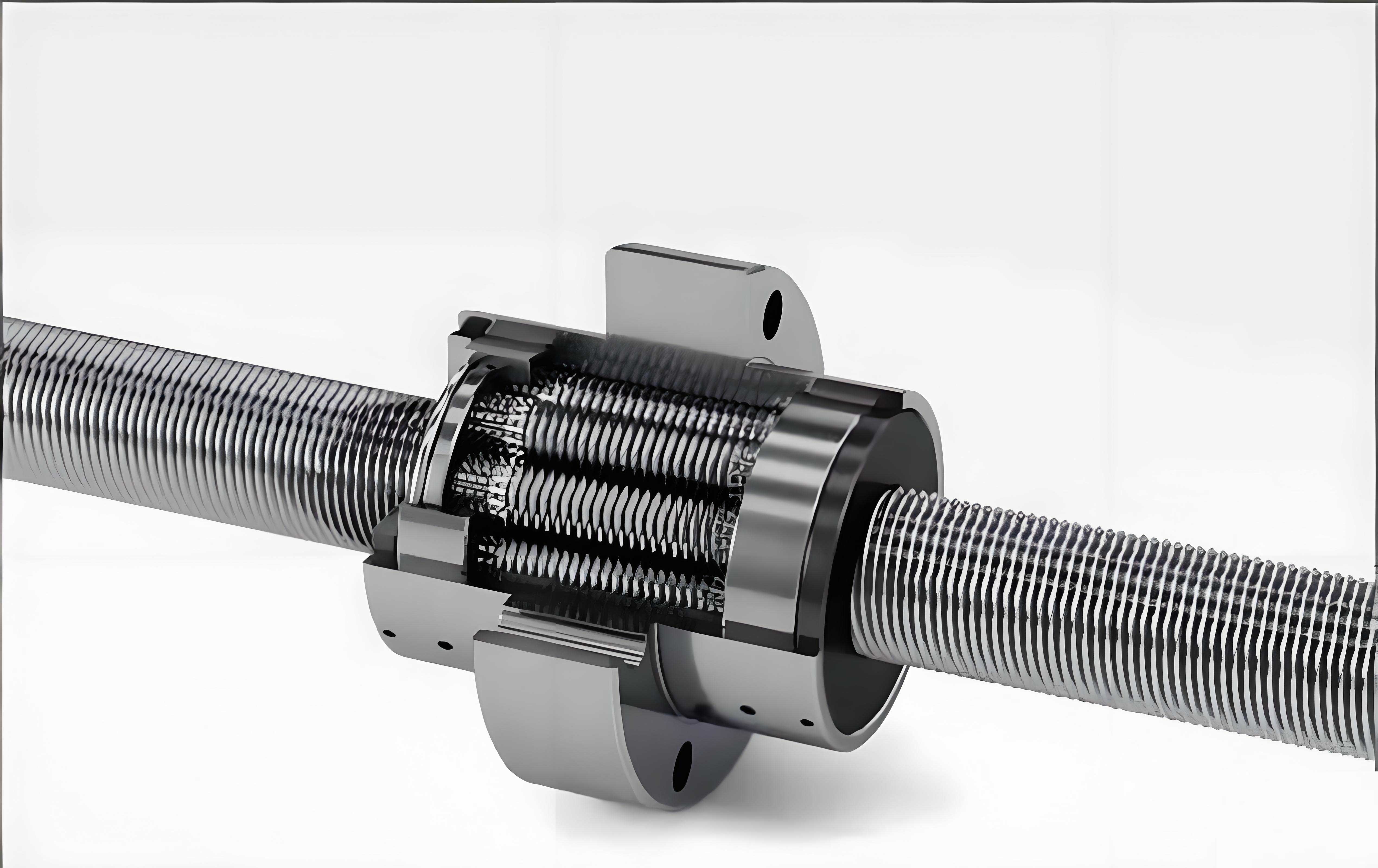
In a planetary roller screw assembly, thermal energy primarily originates from two sources: the frictional contacts within the screw-roller-nut meshing interface and the rotational friction within the support bearings. When operating at high speeds for prolonged periods, the cumulative heat can be substantial. A hollow core design offers an elegant thermal management solution by allowing a coolant (oil or water) to flow through the screw shaft, actively removing heat. To accurately predict the thermal performance and resulting deformations, a detailed thermal model is essential. This involves calculating the heat generation rates at the sources, modeling the heat transfer to the screw shaft and its subsequent dissipation to the coolant and ambient air, and finally, computing the thermally induced deformations. The core of this analysis lies in establishing accurate thermal boundary conditions and applying them within a robust numerical framework, such as the Finite Element Method (FEM).
Thermal Boundary Conditions for the Hollow Planetary Roller Screw Assembly
Accurate thermal modeling begins with a precise quantification of the heat inputs and the heat transfer coefficients governing dissipation. For the purpose of analyzing the screw shaft’s thermal distortion—the primary contributor to positioning error—the complex geometry of the nut and rollers can be simplified. The assembly is modeled with the following key assumptions to render the problem tractable while preserving physical fidelity:
- The threaded section of the screw is modeled as a smooth cylinder with a diameter equivalent to the thread pitch diameter.
- Heat generation from the nut assembly (nut and rollers) and from the support bearings is treated as constant under steady-state operating conditions.
- Convective heat transfer coefficients on the screw’s external surface (to air) and internal surface (to coolant) are assumed constant and independent of local temperature variations.
- The ambient temperature is held constant at 20°C.
1. Heat Flux from the Nut-Roller-Screw Interface
The primary heat source in a planetary roller screw assembly is the friction within the rolling contacts. The total frictional heat generation rate, \( H_n \), at the nut interface can be expressed as:
$$ H_n = 0.12 \pi n M_T $$
where \( n \) is the rotational speed of the screw (in rpm), and \( M_T \) is the total frictional torque of the screw assembly (in N·m). This total torque is a summation of components arising from different physical phenomena:
$$ M_T = M_{TS} + M_{TN} $$
Here, \( M_{TS} \) and \( M_{TN} \) represent the total frictional torque on the screw side and nut side, respectively. Each of these is composed of three elements:
- \( M_m \): Friction torque due to elastic hysteresis of the material.
- \( M_r \): Friction torque due to spin-sliding of the rollers.
- \( M_l \): Friction torque due to lubricant viscosity (drag loss).
Thus, for the screw side:
$$ M_{TS} = M_{ms} + M_{rs} + M_{ls} $$
And for the nut side:
$$ M_{TN} = M_{mn} + M_{rn} + M_{ln} $$
Detailed models for calculating each component \(M_m\), \(M_r\), and \(M_l\) are based on contact mechanics and lubrication theory, considering factors like load distribution, contact ellipse dimensions, and lubricant properties. Empirical coefficients derived from testing are often incorporated for accuracy.
Not all generated heat flows into the screw shaft. Experimental studies on similar power-dense mechanical contacts suggest that approximately 43% of the total frictional heat from the nut-roller-screw interface is conducted into the screw. Therefore, the heat flux \( q_n \) applied to the surface of the screw shaft at the contact zone with the nut is:
$$ q_n = \frac{0.43 H_n}{A_n} $$
where \( A_n \) is the nominal contact surface area between the screw shaft and the nut assembly.
2. Heat Flux from the Support Bearings
The support bearings are a significant secondary heat source. The heat generation rate from a bearing, \( H_b \), is given by:
$$ H_b = \frac{M_b n_b}{9550} $$
where \( n_b \) is the bearing rotational speed (often equal to the screw speed \( n \)), and \( M_b \) is the bearing’s total frictional torque (in N·m). The bearing torque is the sum of load-dependent and speed-dependent (viscous) components:
$$ M_b = M_p + M_0 $$
The load-dependent torque \( M_p \) is calculated as \( M_p = f_1 N_p d_m \), where \( f_1 \) is a factor dependent on bearing type and load, \( N_p \) is the equivalent dynamic load, and \( d_m \) is the bearing mean diameter.
The viscous torque \( M_0 \) depends on the lubrication condition. For a bearing lubricated with oil or grease, it is calculated differently based on the kinematic viscosity \( \nu \) (in cSt) and speed \( n_b \):
$$ \text{If } \nu n_b \geq 2000: \quad M_0 = 10^{-7} f_0 (\nu n_b)^{2/3} d_m^{3} $$
$$ \text{If } \nu n_b < 2000: \quad M_0 = 160 \times 10^{-7} f_0 d_m^{3} $$
Here, \( f_0 \) is a coefficient related to the bearing type and lubrication method. The heat flux into the screw shaft at the bearing seat, \( q_b \), is calculated analogously to \( q_n \), considering an appropriate heat partition factor (often taken as 0.5 for the inner ring) and the contact area \( A_b \):
$$ q_b = \frac{\eta H_b}{A_b} $$
where \( \eta \) is the fraction of bearing heat entering the shaft (typically ~0.5).
3. External Convective Cooling (Air)
The screw shaft dissipates heat to the surrounding air via convection. For a rotating cylinder, the convective heat transfer coefficient \( h_{air} \) is enhanced compared to a stationary one. It can be determined using the Nusselt number correlation for a rotating shaft:
$$ h_{air} = \frac{\lambda_{air} Nu}{L} $$
where \( \lambda_{air} \) is the thermal conductivity of air, and \( L \) is a characteristic length (often the shaft diameter). A common empirical correlation for the average Nusselt number is:
$$ Nu = 0.133 Re^{2/3} Pr^{1/3} $$
The Reynolds number \( Re \) is defined based on rotational speed: \( Re = \omega d_s^2 / \nu_{air} \), where \( \omega \) is the angular velocity (rad/s), \( d_s \) is the screw’s pitch diameter, and \( \nu_{air} \) is the kinematic viscosity of air. \( Pr \) is the Prandtl number for air.
4. Internal Convective Cooling (Coolant)
The key feature of the hollow planetary roller screw assembly is forced convection cooling through its internal bore. The heat transfer coefficient \( h_{coolant} \) depends on the coolant properties, flow rate, and bore geometry. For turbulent flow inside a pipe (a valid assumption for typical cooling flow rates), the Dittus-Boelter equation applies:
$$ Nu_f = 0.023 Re_f^{0.8} Pr_f^{0.4} $$
This is valid for \( Re_f \geq 10^4 \) and \( 0.7 \leq Pr_f \leq 120 \). The fluid Reynolds number is \( Re_f = \rho v D_h / \mu \), where \( v \) is the average flow velocity, \( D_h \) is the hydraulic diameter (equal to the bore diameter \( d_0 \) for a circular tube), and \( \mu \) is the dynamic viscosity. The convective coefficient is then:
$$ h_{coolant} = \frac{\lambda_f}{d_0} Nu_f $$
where \( \lambda_f \) is the thermal conductivity of the coolant.
The material and geometric parameters used for the analysis of a representative hollow planetary roller screw assembly are summarized below.
| Parameter | Value |
|---|---|
| Density, \( \rho \) | 7810 kg/m³ |
| Specific Heat, \( c_p \) (20°C) | 552.66 J/(kg·°C) |
| Thermal Conductivity, \( k \) (20°C) | 36.92 W/(m·°C) |
| Coefficient of Thermal Expansion, \( \alpha \) (20°C) | 11.8 × 10⁻⁶ /°C |
| Young’s Modulus, \( E \) (20°C) | 212 GPa |
| Poisson’s Ratio, \( \nu \) | 0.29 |
| Parameter | Value |
|---|---|
| Hollow Bore Diameter, \( d_0 \) | 7 mm |
| Bearing Seat Length | 22 mm |
| Bearing Seat Diameter | 17 mm |
| Screw Pitch Diameter (Threaded Section), \( d_s \) | 15 mm |
| Nut Travel Stroke | 80 mm |
Based on the formulas above and the operational parameters, the calculated thermal boundary conditions for various scenarios are compiled. The baseline screw speed is set at 600 rpm.
| Condition (Coolant / Flow / Speed) | Nut Heat Flux, \( q_n \) (W/m²) | Bearing Heat Flux, \( q_b \) (W/m²) | Air Convection, \( h_{air} \) (W/m²K) | Coolant Convection, \( h_{coolant} \) (W/m²K) |
|---|---|---|---|---|
| No Cooling / 600 rpm | 4,778 | 4,482 | 20 | — |
| Water Cooling / 9.2 L/min / 600 rpm | 4,778 | 4,482 | 20 | 4,944 |
| Oil Cooling (R134a) / 2.3 L/min / 600 rpm | 4,778 | 4,482 | 20 | 1,245 |
| Oil Cooling (R134a) / 9.2 L/min / 600 rpm | 4,778 | 4,482 | 20 | 3,765 |
| Oil Cooling (R134a) / 18.4 L/min / 600 rpm | 4,778 | 4,482 | 20 | 6,568 |
| Oil Cooling (R134a) / 23.0 L/min / 600 rpm | 4,778 | 4,482 | 20 | 7,854 |
| Oil Cooling (R134a) / 18.4 L/min / 300 rpm | 2,279 | 2,223 | 12.3 | 6,568 |
| Oil Cooling (R134a) / 18.4 L/min / 1200 rpm | 9,556 | 8,964 | 31 | 6,568 |
Finite Element Modeling and Thermal Deformation Analysis
1. Model Development
Using the commercial finite element analysis software ANSYS, a three-dimensional thermal model of the hollow screw shaft was constructed. The model simplifies the threaded section to a cylinder of pitch diameter. The SOLID70 element, an 8-node 3D thermal solid element, was used for meshing. The final mesh consisted of 23,652 elements and 5,848 nodes, ensuring a balance between computational efficiency and result accuracy.
The application of boundary conditions was carefully managed to simulate the dynamic nature of the nut’s motion. The heat flux from the nut (\( q_n \)) was applied as a moving load. Using the ANSYS Parametric Design Language (APDL), the load was stepped along the axial length of the screw’s threaded section in increments equal to the lead of the screw, simulating the reciprocating travel of the nut over its 80 mm stroke. During each load step where the nut was “in contact,” the convective cooling from air on that specific segment was suppressed. After the nut moved away, the air convection boundary condition was reinstated on that segment. This process was repeated for multiple nut travel cycles until a steady-state thermal equilibrium was achieved. The heat flux from the bearings (\( q_b \)) was applied statically at the corresponding bearing seat locations. The convective coefficients \( h_{air} \) and \( h_{coolant} \) were applied to the external and internal surfaces of the model, respectively, as per Table 3.
2. Influence of Cooling Method on Temperature Distribution
The first analysis compared three scenarios at 600 rpm screw speed: no active cooling, water cooling (9.2 L/min), and oil cooling (9.2 L/min). The simulation ran until the system reached thermal equilibrium, which for the cooled cases occurred after the nut completed 32 reciprocating cycles (approximately 51.2 seconds).
- No Cooling: The temperature continued to rise monotonically without reaching a steady state within the simulated timeframe. At the 51.2-second mark, the maximum screw temperature reached 28.46°C, corresponding to a significant temperature rise of 8.46°C from the 20°C ambient.
- Water Cooling: The system reached a steady thermal state. The maximum screw temperature stabilized at 22.54°C, a mere 2.54°C rise above ambient.
- Oil Cooling: Similarly, a steady state was achieved. The maximum screw temperature was slightly higher at 22.93°C (2.93°C rise).
The results clearly demonstrate the critical importance of active cooling for the hollow planetary roller screw assembly. Water cooling proved marginally more effective than oil cooling at the same flow rate due to its superior thermophysical properties (higher specific heat and thermal conductivity). However, oil is often preferred in industrial applications for its lubricity and corrosion protection for metal components. A consistent observation across all models was that the regions under the bearing seats exhibited the highest temperatures, identifying them as critical thermal “hot spots” that require careful attention in thermal management strategies.
3. Influence of Coolant Flow Rate on Thermal Deformation
Focusing on oil cooling at 600 rpm, the effect of varying the coolant flow rate was investigated. The thermal deformation (both total and axial) of the screw shaft at equilibrium is the key output, as it directly translates to positional error.
| Coolant Flow Rate (L/min) | Maximum Total Deformation (μm) | Maximum Axial Deformation (μm) |
|---|---|---|
| 2.3 | 2.90 | 2.57 |
| 9.2 | 1.52 | 1.52 |
| 18.4 | 0.805 | 0.796 |
| 23.0 | 0.727 | 0.683 |
The data reveals a strong, non-linear relationship. Increasing the flow rate from 2.3 L/min to 18.4 L/min reduces the total thermal deformation by over 72%, from 2.90 μm to 0.805 μm. This is because the higher flow rate increases the Reynolds number (\( Re_f \)), which in turn increases the Nusselt number (\( Nu_f \)) and the convective heat transfer coefficient (\( h_{coolant} \)), dramatically improving heat extraction from the screw core. However, the law of diminishing returns is evident. Doubling the flow rate from 9.2 to 18.4 L/min provides a substantial benefit, but a further increase to 23.0 L/min yields only a minor additional improvement (from 0.805 μm to 0.727 μm). This indicates that for a given system and operating condition, an optimal flow rate exists beyond which the gains in thermal performance are outweighed by the increased power required for pumping. For this specific hollow planetary roller screw assembly operating at 600 rpm, a flow rate around 18.4 L/min appears to be a highly effective design point. The maximum deformation consistently occurs at the unsupported “free end” of the screw shaft, opposite the constrained bearing end.
4. Influence of Screw Rotational Speed on Thermal Deformation
Finally, the impact of the operational speed of the planetary roller screw assembly was analyzed under a constant oil cooling flow rate of 18.4 L/min. Speed affects both the heat generation (linearly related to \( n \) and friction torque) and the external air convection coefficient.
| Screw Rotational Speed (rpm) | Maximum Total Deformation (μm) | Maximum Axial Deformation (μm) | Time to Reach Steady State |
|---|---|---|---|
| 300 | 0.443 | 0.337 | ~32.4 s |
| 600 | 0.805 | 0.796 | ~51.2 s |
| 1200 | 1.60 | 1.60 | >60 s |
The trend is unequivocal: higher speeds lead to greater thermal deformation. Doubling the speed from 300 rpm to 600 rpm nearly doubles the total deformation (0.443 μm to 0.805 μm). Doubling again to 1200 rpm approximately doubles the deformation once more. This quadratic-like growth is expected as heat generation from the nut interface (\( H_n \propto n M_T \)) increases significantly with speed (frictional torque \( M_T \) itself often has a speed-dependent component). Furthermore, the time required for the system to reach thermal equilibrium increases with speed, as more heat must be dissipated to reach a balance between generation and removal. At 300 rpm, equilibrium is reached quickly (~32.4 s), while at 1200 rpm, the system takes considerably longer to stabilize. This has important implications for machine warm-up cycles and dynamic error compensation strategies.
Conclusions
This comprehensive thermal analysis of a hollow planetary roller screw assembly yields several critical insights for design and application:
- Active Cooling is Essential: The implementation of an internal cooling channel is a highly effective strategy for thermal management. Compared to an uncooled assembly, active cooling reduces the steady-state temperature rise by over 70% under the studied conditions, directly preserving accuracy and component life.
- Coolant Selection and Flow Rate Optimization: While water provides slightly better cooling performance than oil, practical considerations like corrosion prevention often favor oil. The coolant flow rate is a powerful design variable. Increasing flow rate substantially reduces thermal deformation, but the benefits plateau at higher rates. For the modeled assembly at 600 rpm, an oil flow rate of approximately 18.4 L/min was identified as a cost-effective optimum.
- Bearing Zones are Thermal Critical Points: In all configurations, the highest temperatures were localized at the bearing support regions. This highlights the need for integrated thermal management of the bearings themselves, possibly through housing cooling or specific lubricant circulation.
- Speed-Dependent Thermal Error: The rotational speed of the planetary roller screw assembly is the most influential operational parameter on thermal deformation. Deformation increases significantly with speed, and the system’s thermal settling time also lengthens. This relationship must be carefully characterized for high-speed applications to implement effective real-time thermal error compensation.
In summary, the successful deployment of a high-performance hollow planetary roller screw assembly requires a holistic thermal design approach. This involves accurately modeling the dual heat sources from the screw-nut interface and bearings, selecting an appropriate coolant and flow rate, and understanding the profound impact of operational speed. The methodologies and results presented here provide a framework for predicting thermal behavior, enabling engineers to design more accurate, reliable, and efficient linear motion systems for the most demanding applications. Future work could integrate this thermal model with a thermo-mechanical stress analysis and experimental validation to further refine predictive accuracy.