
In modern industrial production, the reliance on mechanized systems to achieve large-scale and precise manufacturing tasks is paramount. Among these systems, the advent of gear mechanisms has infused modern machinery with enhanced capabilities, particularly through components like the gear shaft, which plays a critical role in transmitting torque and motion. From my perspective as a mechanical engineer, I have often encountered scenarios where gear shafts, such as those in transmission systems, fail due to various stresses, leading to operational downtime and safety concerns. This article delves into a detailed investigation of gear shaft fracture, drawing from experimental data and analytical methods to elucidate root causes and propose mitigation strategies. The focus is on a specific case where a transmission gear shaft fractured after a period of service, prompting a thorough examination to identify systemic defects and optimize design and maintenance protocols. Through this analysis, I aim to provide scientific data and theoretical foundations for failure analysis, emphasizing the importance of rigorous testing and material evaluation in ensuring mechanical integrity.
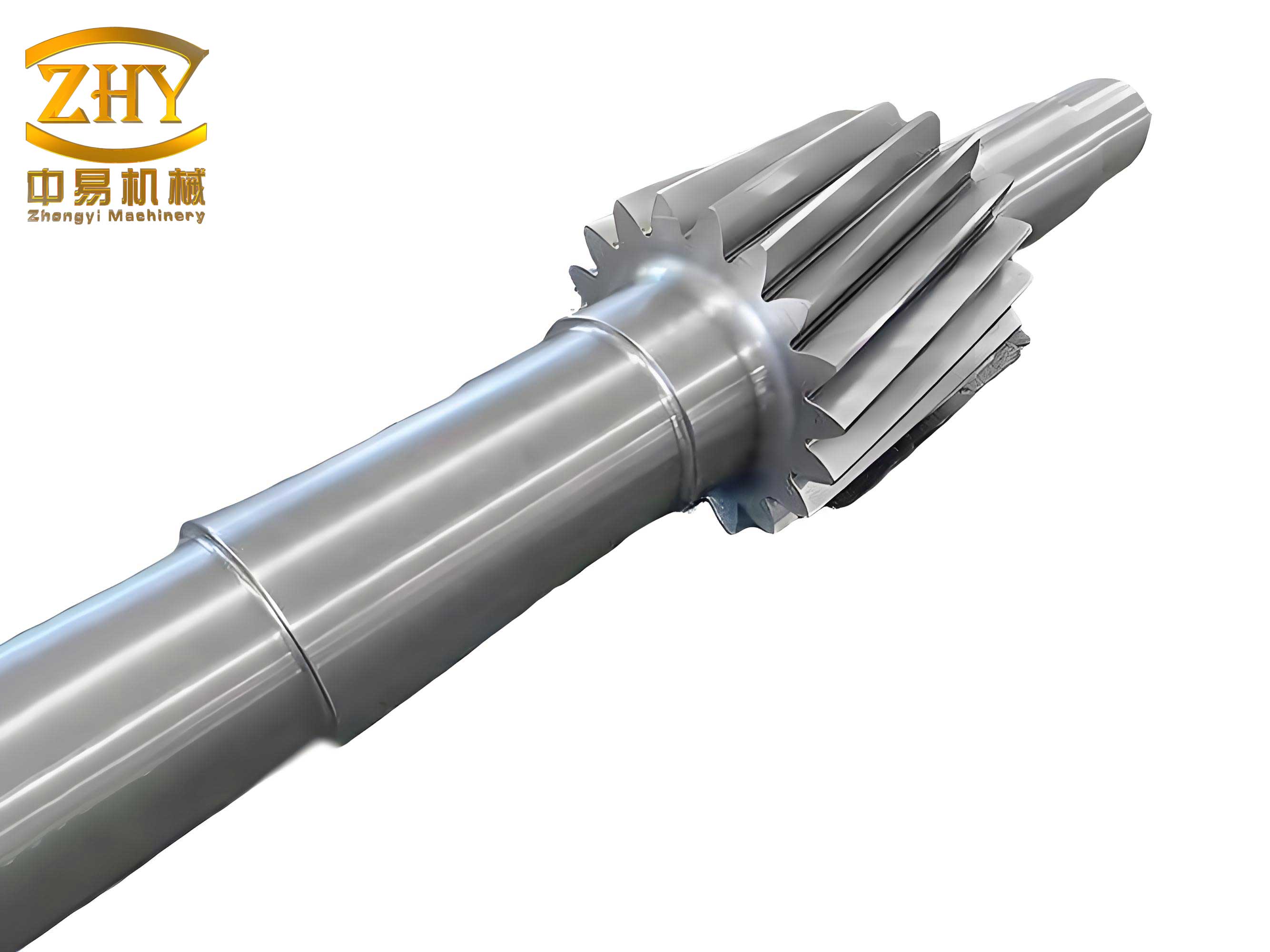
The gear shaft in question was fabricated from Grade 35 steel, a common material for such applications due to its strength properties. To initiate the analysis, I first conducted a macroscopic inspection of the fractured gear shaft, observing its overall morphology to pinpoint the fracture location and pattern. This involved visual examination of the shaft’s surface, where the fracture was identified near the thread root at the junction of the screw and nut connection. The fracture exhibited characteristics of fatigue failure, with crack origins stemming from the thread root on one side of the shaft surface. Under high stress, the crack propagated transversely across the cross-section and extended longitudinally, resulting in complete separation. The fatigue zone occupied approximately one-third of the fracture area, indicating significant cyclic stress during operation. No obvious plastic deformation or manufacturing defects were detected at this stage, suggesting that the failure might be linked to operational loads rather than material flaws. This macroscopic assessment set the stage for more detailed investigations, leveraging advanced techniques to uncover underlying factors.
Following the macroscopic evaluation, I proceeded with microscopic and chemical analyses to assess the gear shaft’s material properties. Using a scanning electron microscope (SEM), specifically a model similar to the FEI Quanta 200, I prepared samples from the fracture site through wire cutting, manual grinding, and mechanical polishing. The SEM images revealed detailed features of the fracture surface, including fatigue striations and dimpled patterns indicative of ductile tearing in certain regions. The microstructure was examined via metallographic microscopy, showing a tempered sorbitic structure without significant cracks or defects near the thread root. Chemical composition analysis was performed using plasma spectroscopy, confirming that the gear shaft’s material met national standards for Grade 35 steel, as summarized in Table 1. This table outlines the key chemical elements and their permissible ranges, highlighting compliance and ruling out compositional anomalies as a cause of fracture.
| Element | Content (wt%) | Standard Range (wt%) |
|---|---|---|
| Carbon (C) | 0.32 | 0.30-0.35 |
| Silicon (Si) | 0.25 | 0.20-0.40 |
| Manganese (Mn) | 0.65 | 0.60-0.90 |
| Phosphorus (P) | 0.020 | ≤0.035 |
| Sulfur (S) | 0.015 | ≤0.035 |
| Iron (Fe) | Balance | Balance |
In addition to chemical analysis, mechanical property tests were conducted to evaluate the gear shaft’s strength and toughness. I performed tensile and impact tests according to national standards, using samples machined into V-notched bars with dimensions of 10 mm × 10 mm × 55 mm. The tensile test results indicated an ultimate tensile strength of approximately 550 MPa, which aligns with the requirements for Grade 35 steel. The impact toughness, measured at room temperature, was found to be 40 J, suggesting adequate resistance to sudden loads. However, when considering the gear shaft’s performance under cyclic stresses, these static properties alone are insufficient to predict fatigue behavior. To address this, I incorporated fatigue life calculations using established models. For instance, the stress-life approach can be expressed as: $$ N_f = \frac{C}{\sigma^m} $$ where \( N_f \) is the number of cycles to failure, \( \sigma \) is the applied stress amplitude, and \( C \) and \( m \) are material constants. For this gear shaft, based on the observed fatigue zone, I estimated the stress amplitude using the formula for bending stress in a shaft: $$ \sigma_b = \frac{M y}{I} $$ where \( M \) is the bending moment, \( y \) is the distance from the neutral axis, and \( I \) is the area moment of inertia. Given the gear shaft’s geometry and load conditions, repetitive bending stresses at the thread root likely initiated the crack, leading to progressive failure.
Further microscopic examination of the fracture surface provided insights into the crack propagation mechanisms. The fatigue striations observed under SEM indicated incremental crack growth per cycle, with an average spacing of about 2 μm, correlating with the stress intensity factor. The presence of dimples in the final fracture zone suggested overload failure once the crack reached a critical size. I also analyzed the gear shaft’s microstructure near the fracture origin, confirming the absence of decarburization or inclusions, which could have accelerated fatigue. To quantify the material’s resistance to crack initiation, I applied fracture mechanics concepts, such as the stress intensity factor range \( \Delta K \), given by: $$ \Delta K = Y \Delta \sigma \sqrt{\pi a} $$ where \( Y \) is a geometry factor, \( \Delta \sigma \) is the stress range, and \( a \) is the crack length. For this gear shaft, initial microcracks at the thread root, exacerbated by stress concentrations, likely led to \( \Delta K \) values exceeding the threshold for fatigue crack growth. This analysis underscores the importance of design optimizations, such as fillet radii at thread roots, to reduce stress concentrations and enhance the gear shaft’s durability.
Expanding on the gear shaft fracture analysis, I draw parallels to other mechanical systems, such as automotive braking systems, where failure analysis is equally critical for safety. In my experience, the methodologies applied to gear shaft inspection can be adapted to assess brake components, though the focus shifts to friction and thermal properties. For example, in brake system technical鉴定, dynamic testing methods like roller bench tests or road tests are employed to evaluate braking performance. However, these methods have limitations: bench tests may not replicate real-world conditions, while road tests are influenced by environmental factors. To illustrate, I compare the two approaches in Table 2, highlighting their pros and cons in the context of gear shaft-like components where cyclic loads are prevalent.
| Test Method | Advantages | Disadvantages | Applicability to Gear Shaft Analysis |
|---|---|---|---|
| Roller Bench Test | Precise force measurement, controlled environment | Does not simulate dynamic loads fully, equipment-dependent | Useful for static load testing of gear shafts |
| Road Test | Real-world conditions, overall system performance | Weather and road surface variability, safety risks | Limited due to destructive nature for fractured gear shafts |
| SEM and Microscopy | Detailed fracture surface analysis, material insight | Sample preparation intensive, localized data | Essential for root cause analysis of gear shaft failures |
In the case of the gear shaft, the fracture was primarily attributed to fatigue accumulation at the thread root, a stress concentration point. This conclusion is supported by the absence of material defects and the consistent mechanical properties. To prevent such failures, I recommend design modifications, such as increasing the root radius or using surface treatments like shot peening to introduce compressive residual stresses. The effectiveness of these interventions can be modeled using the Goodman relation for mean stress effects: $$ \frac{\sigma_a}{S_e} + \frac{\sigma_m}{S_u} = 1 $$ where \( \sigma_a \) is the alternating stress, \( \sigma_m \) is the mean stress, \( S_e \) is the endurance limit, and \( S_u \) is the ultimate tensile strength. For this gear shaft, by reducing the alternating stress through design changes, the fatigue life can be extended significantly. Additionally, implementing non-destructive testing (NDT) methods, such as ultrasonic or magnetic particle inspection, during manufacturing and maintenance can detect early cracks before catastrophic failure.
Beyond the specific gear shaft case, I explore broader implications for mechanical system reliability. In automotive transmissions, multiple gear shafts interact under complex loads, and their failure modes can involve wear, pitting, or bending fatigue. To analyze such systems, I employ computational tools like finite element analysis (FEA) to simulate stress distributions. For a simplified gear shaft model, the von Mises stress can be computed as: $$ \sigma_{vm} = \sqrt{\frac{(\sigma_1 – \sigma_2)^2 + (\sigma_2 – \sigma_3)^2 + (\sigma_3 – \sigma_1)^2}{2}} $$ where \( \sigma_1, \sigma_2, \sigma_3 \) are principal stresses. By inputting operational loads, FEA can identify high-stress regions, guiding design improvements. Moreover, statistical methods like Weibull analysis can predict gear shaft failure probabilities based on historical data, using the cumulative distribution function: $$ F(t) = 1 – e^{-(t/\eta)^\beta} $$ where \( t \) is time, \( \eta \) is the scale parameter, and \( \beta \) is the shape parameter. This approach aids in preventive maintenance scheduling, reducing unplanned downtime.
In conclusion, the gear shaft fracture analysis revealed that fatigue initiated at the thread root due to cyclic stresses, despite compliant material properties. This insight underscores the need for holistic design, testing, and maintenance strategies in mechanical systems. From my perspective, integrating advanced analytical techniques—from microscopy to computational simulations—can enhance gear shaft reliability and overall system performance. Future work should focus on real-time monitoring of gear shaft conditions using sensors, coupled with machine learning algorithms to predict failures proactively. By emphasizing the keyword ‘gear shaft’ throughout this discussion, I highlight its centrality in mechanical integrity, and I hope this analysis contributes to safer and more efficient industrial operations.