
In the field of mechanical transmission systems, hypoid bevel gears play a critical role due to their ability to transmit motion between non-intersecting axes with high load capacity and smooth operation. These gears are extensively used in automotive applications, where efficiency and durability are paramount. However, achieving optimal meshing quality in hypoid bevel gears requires precise determination of the pinion control parameters during the manufacturing process. Traditional methods, such as the red lead paste technique, are tedious and inefficient. In contrast, Tooth Contact Analysis (TCA) offers a computational approach that allows for pre-manufacturing optimization, significantly enhancing productivity. In this paper, I present a comprehensive methodology for determining the final control parameters of the pinion for hypoid bevel gears, leveraging a TCA program developed in the Matlab environment. The approach is grounded in a mathematical model of tooth surface modification, and through iterative adjustment of initial parameter values, we achieve desirable tooth contact patterns and transmission error curves. This method proves effective in streamlining the design and manufacturing processes for hypoid bevel gears, ensuring robust performance in real-world applications.
The core of our methodology lies in establishing a mathematical model for tooth surface modification. In hypoid bevel gears, the pinion’s theoretical tooth surface and actual tooth surface may deviate due to manufacturing tolerances and design adjustments. To quantify this deviation, we consider the distance between these surfaces at a given point. Let the theoretical tooth surface be denoted as \( s^{(1)} \) and the actual tooth surface as \( s^{(2)} \). At a point \( M_0 \) on the surface, the distance \( \Delta \delta \) between the surfaces along a tangent direction \( \alpha \) can be approximated as:
$$ \Delta \delta = \delta_2 – \delta_1 = \frac{1}{2} (k_n^{(2)} – k_n^{(1)}) (\Delta s)^2 = \frac{1}{2} \Delta k_n (\Delta s)^2 $$
Here, \( k_n^{(1)} \) and \( k_n^{(2)} \) represent the normal curvatures of \( s^{(1)} \) and \( s^{(2)} \) along direction \( \alpha \), respectively, while \( \delta_1 = \frac{1}{2} k_n^{(1)} (\Delta s)^2 \) and \( \delta_2 = \frac{1}{2} k_n^{(2)} (\Delta s)^2 \) are the distances from the surfaces to the tangent plane. Based on experimental data from Gleason, a measurable contact imprint is detected when \( \Delta \delta \leq 0.00635 \, \text{mm} \). Using this threshold, we can derive corrections for the theoretical surface curvature to obtain the actual surface curvature. For hypoid bevel gears, the contact length along the tooth length direction is approximately \( b / \cos \beta \), where \( b \) is the face width and \( \beta \) is the spiral angle. If the contact ratio is \( f \), the contact length becomes \( f b / \cos \beta \). Thus, the induced curvature correction in the tooth length direction is:
$$ \Delta k_{nA} = 0.0508 \left( \frac{\cos \beta}{f b} \right)^2 $$
The sign of this correction is chosen to increase the curvature on the convex side and decrease it on the concave side of the pinion. Similarly, for the tooth height direction, assuming the contact width is half the tooth height \( h \), where \( h \approx 4 r \cos \beta / z \) (with \( r \) as the pitch radius and \( z \) as the number of teeth), the correction is:
$$ \Delta k_{nB} = 0.00254 K_p \left( \frac{z}{r \cos \beta} \right)^2 $$
Here, \( K_p \) is a tooth height curvature correction coefficient. For hypoid bevel gears with spiral angles typically exceeding \( 20^\circ \), \( K_p \) is often set to zero, so we focus on adjusting the tooth length contact coefficient \( f \) through TCA validation. These formulas form the basis for our tooth surface modification model, enabling controlled adjustments to optimize contact patterns in hypoid bevel gears.
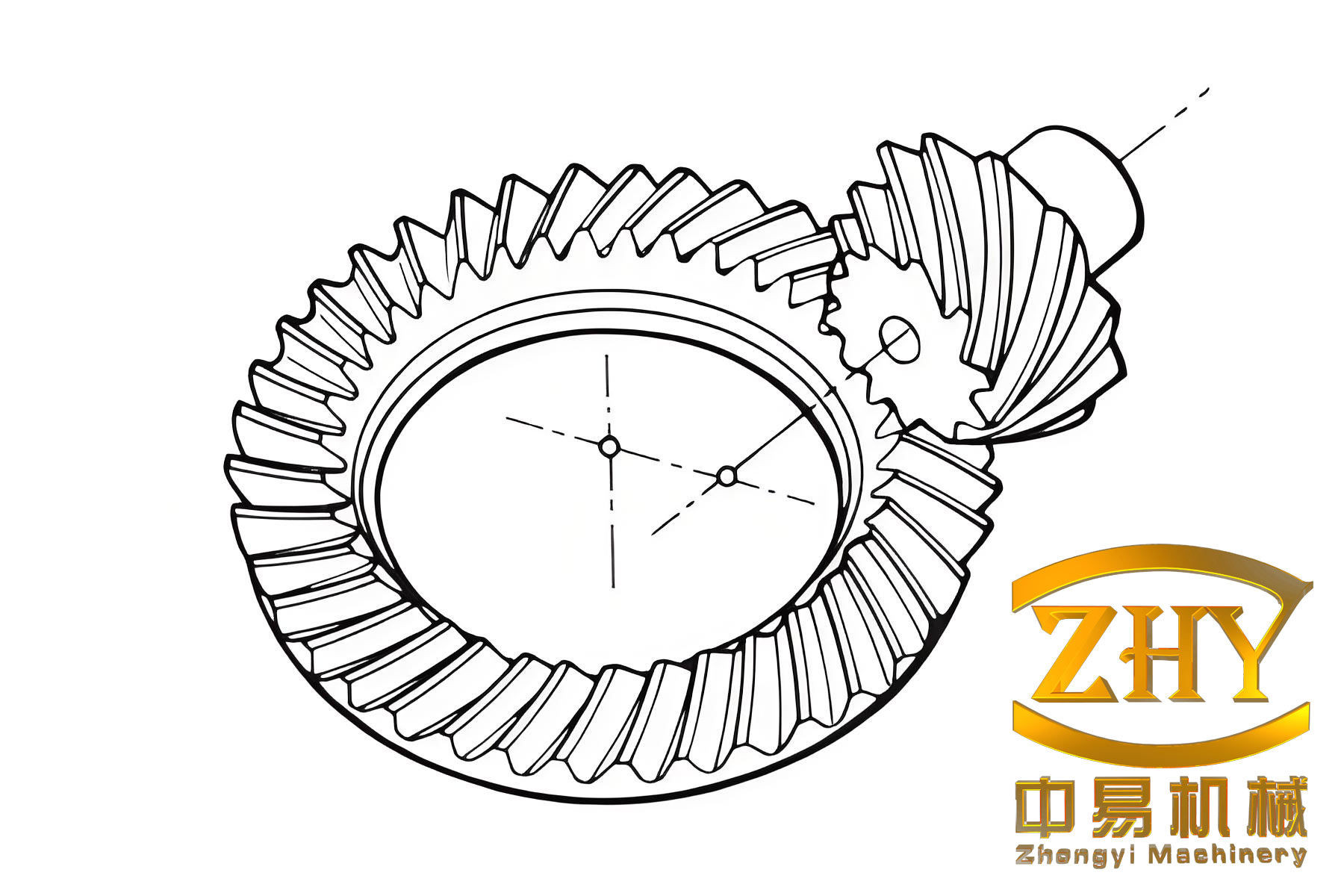
To implement this model, we develop a TCA program in Matlab. The fundamental idea of TCA is to simulate the meshing of point-contact conjugate tooth surfaces, where the set of contact points forms a contact path. Under conditions free of curvature interference, an contact ellipse can be determined at each point, and the collection of these ellipses constitutes the tooth contact area. By adjusting the pinion control parameters in the TCA program, we can modify the size, shape, and position of the contact area, as well as the transmission error, to achieve an ideal meshing performance for hypoid bevel gears. The coordinate systems are established as follows: let \( S_2 \) represent the gear coordinate system with tooth surface equations \( \mathbf{r}_2 \), \( \mathbf{n}_2 \), and \( \mathbf{t}_2 \), and \( S_1 \) represent the pinion coordinate system with equations \( \mathbf{r}_1 \), \( \mathbf{n}_1 \), and \( \mathbf{t}_1 \). The pinion is assembled into \( S_2 \) through transformations, accounting for installation errors such as offset and misalignment. The meshing condition requires that the position vectors and normal vectors coincide at contact points, leading to a system of equations:
$$ \mathbf{R}_2 = \mathbf{O}_2 \mathbf{O}_1 + \mathbf{R}_1 $$
$$ \mathbf{N}_2 = \mathbf{N}_1 $$
Here, \( \mathbf{R}_1 \) and \( \mathbf{R}_2 \) are the rotated position vectors, and \( \mathbf{O}_2 \mathbf{O}_1 \) is the offset vector. Parameters like the rotational angles \( \eta_1 \) and \( \eta_2 \) are expressed in terms of machine setting variables such as \( \Delta q_1 \), \( \Delta q_2 \), \( \theta_1 \), and \( \theta_2 \). The TCA process begins by specifying an initial contact point on the gear tooth surface, solved using Newton’s method. Then, by incrementally varying \( \Delta q_2 \) with a step size \( i \), we trace the contact path until boundaries are reached. The transmission error function is defined as:
$$ \Delta \varepsilon = (\varepsilon_1 – \varepsilon_{10}) – \frac{z_1}{z_2} (\varepsilon_2 – \varepsilon_{20}) $$
where \( \varepsilon_{10} \) and \( \varepsilon_{20} \) are the initial rotation angles at the first contact point. This TCA model allows us to visualize contact ellipses and transmission error curves, facilitating iterative parameter adjustments for hypoid bevel gears.
The determination of pinion control parameters is an iterative process guided by the TCA results. We start with initial design and machining parameters for the hypoid bevel gears, as summarized in the tables below. The pinion control parameters include eight items, but for illustration, we focus on four key ones: cutter blade angle \( a_{01} \), vertical wheel position correction \( E_{Mx} \), tooth length contact coefficient correction \( f_x \), and generating cone distance correction \( R_{01X} \). In the TCA program, these are expressed as modifications to the initial values. For example, the vertical wheel position is computed as \( E_{01} = E + E_{02} + E_{Mx} \), and the tooth length contact coefficient is set as \( f = 0.25 + f_x \) for modules \( m \geq 8 \) or \( f = 0.3 + f_x \) otherwise. The initial generating cone distance is adjusted as \( R_{011} = R_{f1} \tan(\alpha_{f1}) / (\tan n + \tan(\alpha_{f1})) + R_{01X} \).
| Gear Component | Pinion | Gear |
|---|---|---|
| Number of Teeth | 16 | 41 |
| Outer Pitch Diameter (mm) | 122.17 | 190.5 |
| Mean Pressure Angle (°) | 19 | |
| Offset Distance (mm) | 38.6 | |
| Face Width (mm) | 34.85 | 29.2 |
| Spiral Angle (°) | 49.96 | 25.92 |
| Pitch Cone Angle (°) | 25.36 | 62.57 |
| Parameter | Pinion Convex Side | Gear Concave Side |
|---|---|---|
| Cutter Blade Angle (°) | -28.5 | -25 |
| Blade Edge Distance (mm) | 1 | 2.25 |
| Cutter Tip Radius (mm) | 107 | 95.25 |
| Vertical Wheel Position (mm) | 26.68 | -11.92 |
| Radial Cutter Position (mm) | 96.36 | 86.79 |
| Angular Cutter Position (°) | 80.22 | 57.62 |
| Blank Installation Angle (°) | 24.60 | 57.95 |
First, we determine the cutter blade angle \( a_{01} \). The theoretical value is \( a’_{01} = -28.94^\circ \), but we test Gleason-recommended values: -28.5°, -31°, and -33°, with other parameters set to zero. The TCA results show that \( a_{01} = -31^\circ \) yields a contact area concentrated at the tooth tip with minimal root contact, providing a favorable basis for further adjustments. The transmission error curve for this value is smooth and non-intersecting, indicating stable meshing without edge contact. In contrast, \( a_{01} = -28.5^\circ \) causes severe inward bending of the contact path, while \( a_{01} = -33^\circ \) leads to inconsistent ellipse sizes and overlapping transmission error curves, suggesting multiple tooth engagement but less controllability. Thus, \( a_{01} = -31^\circ \) is selected for hypoid bevel gears.
Next, we adjust the vertical wheel position correction \( E_{Mx} \). With \( a_{01} = -31^\circ \) and other parameters zero, positive \( E_{Mx} \) values cause divergence in the TCA equations, whereas negative values improve convergence. As \( E_{Mx} \) decreases (e.g., -3 mm), the contact area tilts inward, optimizing the pattern. We find \( E_{Mx} = -3 \) mm produces a balanced contact region and acceptable transmission error for hypoid bevel gears.
Then, we modify the tooth length contact coefficient correction \( f_x \). Setting \( a_{01} = -31^\circ \) and \( E_{Mx} = -3 \) mm, we vary \( f_x \) from 0 to 0.08. At \( f_x = 0.04 \), the contact width increases slightly, validating the tooth surface modification model. However, at \( f_x = 0.08 \), the width narrows, indicating a limit to this adjustment. This demonstrates the nonlinear effect of \( f_x \) on contact geometry in hypoid bevel gears.
Finally, we tune the generating cone distance correction \( R_{01X} \). Based on the previous parameters, negative \( R_{01X} \) values cause the contact area to tilt inward, while positive values produce the opposite trend. At \( R_{01X} = 0.25 \) mm, the contact pattern becomes centered and symmetric, with a low transmission error magnitude. The iterative process, though detailed, follows systematic rules: for instance, \( a_{01} \) influences rhomboid contact, \( E_{Mx} \) affects fish-tail contact, and \( R_{01X} \) controls diagonal contact. These relationships are summarized below:
| Parameter | Primary Effect | Adjustment Rule |
|---|---|---|
| Cutter Blade Angle \( a_{01} \) | Rhomboid contact shape | Decrease \( |a_{01}| \) to reduce root contact width; increase to enlarge tip contact. |
| Vertical Wheel Position Correction \( E_{Mx} \) | Fish-tail contact curvature | For convex side, use negative values for rightward bending; positive for leftward. |
| Tooth Length Contact Coefficient Correction \( f_x \) | Contact area width | Increase to initially widen contact; beyond a point, it narrows. |
| Generating Cone Distance Correction \( R_{01X} \) | Diagonal contact orientation | For convex side, positive values correct inner diagonal; negative for outer diagonal. |
The TCA simulation results confirm the efficacy of this method. For the optimized parameter set, the contact area is evenly distributed across the tooth surface, avoiding edge contact and stress concentration. The transmission error curve remains within a narrow band, typically below 10 arc-seconds, ensuring smooth and quiet operation for hypoid bevel gears. These outcomes are critical for automotive applications, where noise, vibration, and harshness (NVH) performance is essential. The mathematical model and TCA program together provide a robust framework for designing hypoid bevel gears with enhanced meshing characteristics.
In conclusion, the determination of pinion control parameters for hypoid bevel gears via TCA is a powerful approach that replaces empirical trial-and-error with computational precision. The tooth surface modification model, based on curvature corrections, allows targeted adjustments to contact patterns. Through iterative TCA simulations, we can optimize parameters like cutter blade angle, vertical wheel position, tooth length contact coefficient, and generating cone distance. Each parameter has distinct effects on the contact geometry, as summarized in Table 3. This methodology not only improves efficiency in gear design but also ensures high-quality meshing performance for hypoid bevel gears in demanding applications. Future work could extend this approach to include load-tooth contact analysis (LTCA) for under-load conditions, further refining the parameter selection process. Overall, the integration of mathematical modeling and computational analysis represents a significant advancement in the manufacturing and optimization of hypoid bevel gears.