
In the field of automotive engineering, particularly for commercial vehicle drive axles, the hyperbolic gear has emerged as a critical component due to its high production efficiency and performance in power transmission. As the automotive industry advances toward higher standards of efficiency and environmental sustainability, improving the transmission efficiency of drive axles has become a pivotal pathway for energy savings and emission reduction. My research focuses on developing an optimal design methodology for the meshing efficiency of face-hobbed hyperbolic gears, leveraging advanced contact analysis techniques. This article details the comprehensive approach, from tooth surface modification to multi-objective optimization and experimental validation, all aimed at enhancing the operational efficiency of hyperbolic gear pairs under real driving conditions.
The hyperbolic gear, a type of spiral bevel gear with offset axes, is widely used in drive axles for its ability to transmit power between non-intersecting shafts smoothly. However, its complex tooth geometry and loading conditions make it susceptible to issues such as high contact stress, transmission error, and frictional losses, which directly impact meshing efficiency. Traditional design methods often rely on empirical adjustments, but these may not fully account for the dynamic effects of system deformation and friction under load. Therefore, I propose a systematic optimization framework that integrates tooth surface design, loaded tooth contact analysis with friction (FLTCA), and surrogate modeling to maximize meshing efficiency while ensuring durability and noise performance. The core of this work revolves around the hyperbolic gear, and this term will be emphasized throughout to highlight its central role.
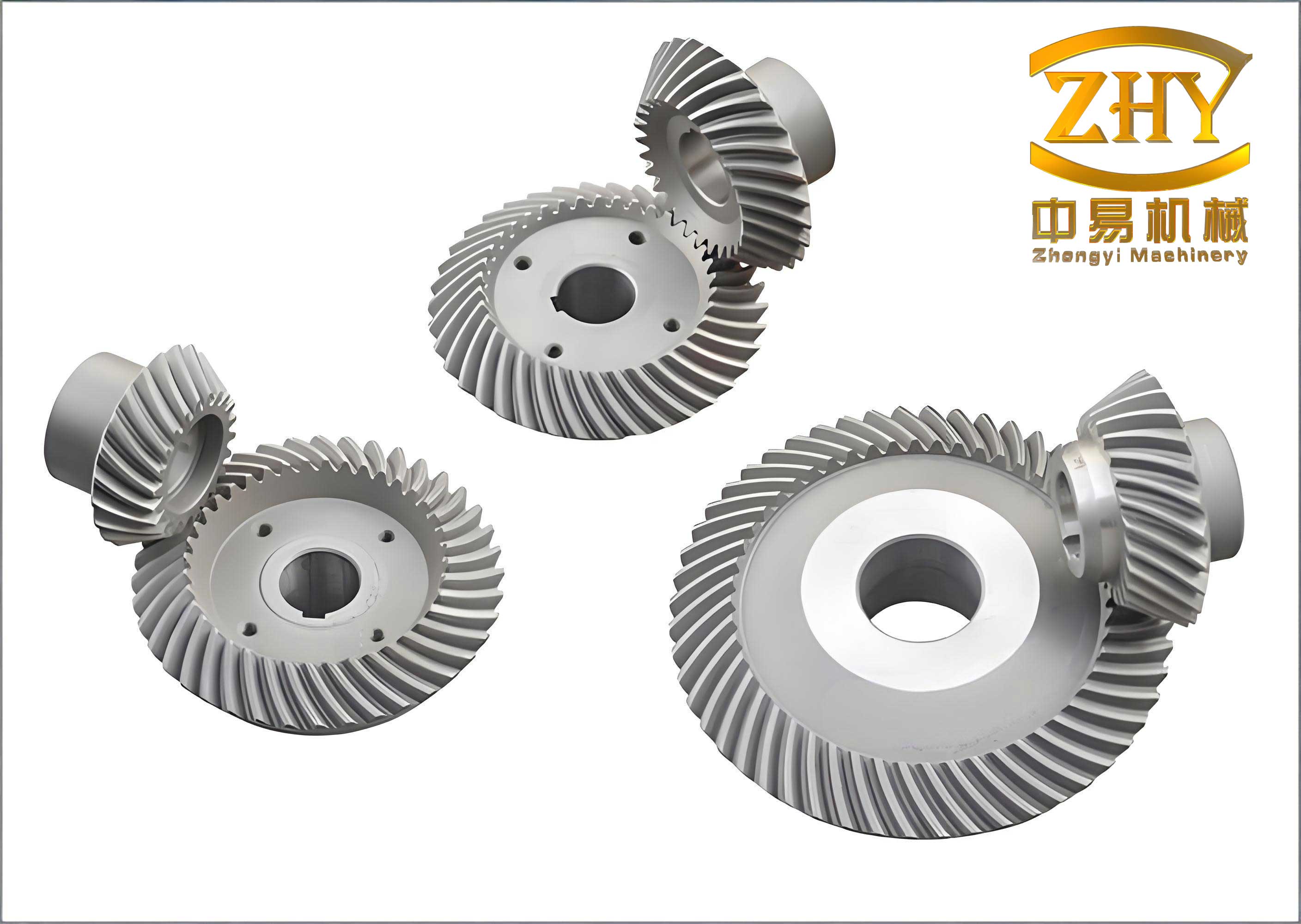
To begin, the tooth surface design for hyperbolic gears must consider both the drive and coast sides (positive and negative tooth surfaces) simultaneously, as they are manufactured in a single process. In my approach, I account for misalignment caused by system deformation under load, which is crucial for real-world performance. The design starts with defining the unloaded transmission error (UTE) peak-to-peak values and contact pattern positions for both sides. For a hyperbolic gear pair, the tooth surface coordinates are derived from machine tool settings and cutter parameters. Let the radial and normal coordinates of points on the driven gear tooth surface be given by:
$$ r_2 = f_r(\theta_d, \phi_d, \xi_c) $$
$$ n_2 = f_n(\theta_d, \phi_d, \xi_c) $$
where \( \theta_d \) is the cutter rotation angle, \( \phi_d \) is the cutter center rotation about the machine cradle, and \( \xi_c \) represents the machining parameters. To incorporate misalignment, these coordinates are transformed using matrices that account for axial, offset, and angular deviations, such as \( \Delta P \), \( \Delta W \), \( \Delta E \), and \( \Delta \Sigma \). The conjugate tooth surface of the driving gear is then determined by solving the kinematic relationship and meshing equation:
$$ \phi_2 – \phi_{20} = \frac{1}{i_{12}} (\phi_1 – \phi_{10}) $$
$$ n_{2\text{mis}} \cdot v_{12} = f(\theta_2, \phi_2, \phi_{d2}) = 0 $$
Here, \( \phi_1 \) and \( \phi_2 \) are the rotation angles of the driving and driven hyperbolic gears, \( i_{12} \) is the gear ratio, and \( v_{12} \) is the relative velocity vector. The unloaded transmission error is introduced as a parabolic function to define the ease-off topography, which helps control the contact pattern. The target modified tooth surfaces \( \Gamma_{\text{obj},c} \) and \( \Gamma_{\text{obj},v} \) for the drive and coast sides are established based on preset contact line slopes \( k_c \) and \( k_v \), contact ellipse semi-major axes \( b_c \) and \( b_v \), and contact center positions. This allows for active design of both tooth flanks, ensuring optimal performance under no-load conditions.
Building on this tooth surface design, I formulate an optimization problem aimed at maximizing the meshing efficiency of the hyperbolic gear pair under driving conditions. The meshing efficiency \( \eta \) is a key performance metric, as it directly affects fuel economy and power loss. However, other factors such as loaded transmission error (LTE), contact stress, and contact pattern must be constrained to ensure reliability. Thus, the optimization model is defined with six design variables: \( k_c, b_c, \text{PTE}_c \) for the drive side and \( k_v, b_v, \text{PTE}_v \) for the coast side, where PTE denotes the peak-to-peak unloaded transmission error. The objective is to maximize \( \eta \), subject to constraints on LTE peak-to-peak value, maximum contact stresses \( \sigma_{pc} \) and \( \sigma_{pv} \), and the area of contact pattern exceeding design boundaries \( \Delta S_c \) and \( \Delta S_v \). Mathematically, the optimization model is:
$$ \text{find } \{ k_c, b_c, \text{PTE}_c, k_v, b_v, \text{PTE}_v \} $$
$$ \max \eta $$
$$ \text{subject to: } P_{\text{LTE}} \leq P_{\text{LTE0}} $$
$$ \sigma_{pc}, \sigma_{pv} \leq \sigma_{pc0}, \sigma_{pv0} $$
$$ \Delta S_c, \Delta S_v \leq \Delta S_{c0}, \Delta S_{v0} $$
$$ k_{01} \leq k_c, k_v \leq k_{02} $$
$$ b_{01} \leq b_c, b_v \leq b_{02} $$
$$ \text{PTE}_{01} \leq \text{PTE}_c, \text{PTE}_v \leq \text{PTE}_{02} $$
To evaluate these performance metrics, I employ the friction loaded tooth contact analysis (FLTCA) method, which considers gear tooth bending, shear, and contact deformations, along with friction effects. The FLTCA solves for equilibrium conditions including deformation compatibility, torque balance, and contact stress convergence. For the hyperbolic gear pair, the deformation compatibility equation is:
$$ \| \delta_b + \delta_s + \delta_c – (Z – d_0) \|_2 < \varepsilon_1 $$
where \( \delta_b, \delta_s, \delta_c \) are bending, shear, and contact deformations, \( Z \) is the rigid body displacement, and \( d_0 \) is the initial tooth separation. The torque balance ensures that the sum of contact forces matches the applied load:
$$ \left| \sum_{i=1}^m \sum_{j=1}^n (F_{fij} + F_{Nij}) r_{ij} \cdot p – T_{\text{load}} \right| < \varepsilon_2 $$
Friction is modeled using a mixed lubrication friction coefficient \( \mu_{\text{ML}} \), which combines boundary and fluid film effects based on the film thickness ratio \( \lambda \). The friction coefficient is expressed as:
$$ \mu_{\text{ML}} = \mu_{\text{FL}} f_\lambda^{1.2} + \mu_{\text{DC}} (1 – f_\lambda) $$
$$ f_\lambda = \frac{1.21 \lambda^{0.64}}{1 + 0.37 \lambda^{1.26}}, \quad \lambda = \frac{h_0}{S} $$
Here, \( \mu_{\text{FL}} \) is the fluid lubrication friction coefficient derived from regression models, and \( S \) is the composite surface roughness. This friction model is essential for accurately predicting power losses in hyperbolic gear meshes. The FLTCA method iteratively solves these equations over a full meshing cycle to compute efficiency, LTE, contact stress, and contact pattern.
Directly solving the optimization model using FLTCA simulations is computationally expensive due to the high number of function evaluations. Therefore, I use a surrogate modeling approach based on Kriging to approximate the objective and constraint functions. The Kriging model combines a global trend function with a local deviation term:
$$ Y(X) = f(X) \beta + Z(X) $$
where \( f(X) \) is a basis function, \( \beta \) is the regression coefficient, and \( Z(X) \) is a Gaussian random process with zero mean and variance \( \sigma^2 \). The correlation function is chosen as Gaussian:
$$ R[X_i, X_j] = \exp\left( -\sum_{k=1}^t \theta_k |x_k^{(i)} – x_k^{(j)}|^2 \right) $$
To build the initial surrogate model, I generate samples using optimal Latin hypercube sampling (OLHS) across the design variable ranges. Each sample requires an FLTCA simulation to compute the performance metrics. Then, I apply the expected improvement (EI) criterion to iteratively add samples and refine the model. The EI for a point \( x \) is given by:
$$ E[I(x)] = \begin{cases}
(f_{\min} – \hat{y}) \Phi\left( \frac{f_{\min} – \hat{y}}{s} \right) + s \phi\left( \frac{f_{\min} – \hat{y}}{s} \right) & \text{if } s > 0 \\
0 & \text{if } s = 0
\end{cases} $$
where \( f_{\min} \) is the current best objective value, \( \hat{y} \) is the predicted mean, \( s \) is the predicted standard error, and \( \Phi \) and \( \phi \) are the cumulative and probability density functions of the standard normal distribution. Once the surrogate model meets accuracy requirements, I solve the optimization problem using a multi-island genetic algorithm (MIGA), which efficiently explores the design space for the hyperbolic gear pair.
To demonstrate the effectiveness of this optimization methodology, I apply it to a commercial drive axle hyperbolic gear pair. The basic parameters of the gear pair are summarized in the table below.
| Basic Parameter | Driving Gear | Driven Gear |
|---|---|---|
| Number of Teeth | 10 | 39 |
| Shaft Angle (°) | 90 | |
| Mean Pressure Angle (°) | 22.5 | |
| Offset Distance (mm) | 30 | |
| Face Width (mm) | 55.8 | 50.5 |
| Pitch Diameter (mm) | 77 | 300 |
| Midpoint Spiral Angle (°) | 44.0 | 30.8 |
The optimization constraints are set as: LTE peak-to-peak ≤ 50 μrad, contact stress ≤ 3300 MPa, and contact pattern overflow area ≤ 1 mm² for both sides. The design variable bounds are: \( k_c, k_v \in [3, 8] \), \( b_c, b_v \in [0.2, 0.3] \), and \( \text{PTE}_c, \text{PTE}_v \in [0.00008, 0.00012] \). Through the Kriging-based optimization, the optimal design variables are found as: \( k_c = 3.22 \), \( k_v = 6.532 \), \( b_c = 0.232 \), \( b_v = 0.256 \), \( \text{PTE}_c = 0.000112 \), and \( \text{PTE}_v = 0.00012 \). The corresponding machine tool settings for manufacturing the optimized hyperbolic gear pair are derived and listed in the following tables.
| Machining Parameter | Convex Side | Concave Side |
|---|---|---|
| Horizontal Cutter Distance (mm) | 113.7433 | |
| Vertical Cutter Distance (mm) | 123.5589 | |
| Horizontal Workpiece Distance (mm) | 3.6330 | |
| Machine Root Angle (°) | 70.2714 | |
| Blade Pressure Angle (°) | 20.3969 | 24.6017 |
| Machining Parameter | Convex Side | Concave Side |
|---|---|---|
| Angular Cutter Distance (°) | 51.3038 | |
| Radial Cutter Distance (mm) | 159.6998 | |
| Vertical Workpiece Distance (mm) | 24.3020 | |
| Machine Root Angle (°) | -2.7861 | |
| Blade Pressure Angle (°) | 26.2578 | 18.7908 |
The optimized hyperbolic gear pair is manufactured and tested to validate the design. First, no-load contact pattern tests are conducted, and the results show good agreement between theoretical predictions and experimental observations for both drive and coast sides. This confirms the accuracy of the tooth surface modification method. Next, the transmission efficiency of the entire drive axle is measured on a loaded test bench under various operating conditions, including loads from 20 kW to 80 kW and speeds from 10 km/h to 80 km/h. The efficiency and power loss are compared between the optimized design and a baseline design. The results indicate that the optimized hyperbolic gear pair reduces power loss and improves system efficiency. For instance, at the cruise condition of 80 kW load and 80 km/h speed, the power loss is reduced by approximately 300 W, corresponding to an efficiency improvement of about 0.4%. These experimental outcomes demonstrate the effectiveness of the optimization approach in enhancing the performance of hyperbolic gears.
Throughout this work, the hyperbolic gear remains the focal point, with its complex geometry and meshing behavior driving the need for advanced optimization techniques. The integration of FLTCA, surrogate modeling, and genetic algorithms provides a robust framework for designing high-efficiency hyperbolic gear pairs. The tables below summarize key results from the optimization and testing phases.
| Performance Metric | FLTCA Value | Kriging Model Value | Relative Error (%) |
|---|---|---|---|
| Power Loss (W) | 1476.4 | 1482.7 | 0.43 |
| LTE Peak-to-Peak (μrad) | 43.3 | 44.1 | 1.74 |
| Drive Side Contact Stress (MPa) | 3052.6 | 3014.2 | -1.26 |
| Coast Side Contact Stress (MPa) | 3076.6 | 3064.7 | -0.39 |
| Load Condition (kW) | Speed Range (km/h) | Average Efficiency Gain (%) | Power Loss Reduction (W) |
|---|---|---|---|
| 20 | 10-80 | 0.2-0.3 | 50-100 |
| 40 | 10-80 | 0.3-0.4 | 100-200 |
| 60 | 10-80 | 0.3-0.5 | 150-250 |
| 80 | 10-80 | 0.4-0.5 | 200-300 |
In conclusion, this article presents a comprehensive methodology for optimizing the meshing efficiency of hyperbolic gears in drive axles. By presetting unloaded transmission error and contact pattern parameters, I achieve controlled tooth surface modification for both drive and coast sides. The optimization model, which maximizes meshing efficiency under constraints for loaded transmission error, contact stress, and contact pattern, is efficiently solved using Kriging surrogate models and multi-island genetic algorithms. Experimental validation through no-load contact tests and full axle efficiency tests confirms that the optimized hyperbolic gear pair exhibits improved performance, with significant reductions in power loss. This approach not only enhances the efficiency of hyperbolic gear systems but also reduces reliance on empirical design, shortening development cycles. Future work could extend this methodology to other gear types or incorporate additional factors such as thermal effects and wear, further advancing the design of high-performance hyperbolic gears for automotive applications.
The hyperbolic gear, with its unique offset geometry, continues to be a vital component in power transmission systems, and optimizing its meshing efficiency is crucial for meeting modern energy and performance standards. Through this research, I demonstrate that integrating advanced analysis tools with optimization algorithms can lead to tangible improvements in hyperbolic gear design, contributing to more efficient and sustainable vehicle technologies. The repeated emphasis on hyperbolic gear throughout this article underscores its importance in the context of drive axle optimization, and the methods described here provide a scalable framework for future innovations in gear engineering.