
In the field of modern manufacturing, the CNC machining of spiral bevel gears holds significant importance due to their critical role in transmitting power between intersecting shafts, especially in automotive, aerospace, and industrial machinery. Traditional methods for manufacturing spiral bevel gears often involve specialized gear-cutting machines, which can be costly and less flexible. Therefore, exploring approaches using general-purpose CNC equipment, such as machining centers, has become a promising area of research. This study focuses on developing a viable process for machining spiral bevel gears on a four-axis machining center, leveraging the capabilities of CAD/CAM software like UG (now Siemens NX) to streamline toolpath generation and post-processing. Through this work, we aim to demonstrate that efficient and accurate production of spiral bevel gears is achievable with relatively accessible technology, thereby broadening the applications and reducing the costs associated with these complex components. The key innovation lies in adapting the CAM environment and post-processing techniques to overcome limitations inherent in four-axis setups, ultimately generating usable NC code for practical manufacturing.
Our investigation begins with an overview of the milling strategy for spiral bevel gears. The fundamental requirement for machining these gears is at least four axes of motion: three linear axes (X, Y, Z) for tool interpolation and one rotational axis to provide the workpiece rotation. We selected a four-axis machining center equipped with a rotary table, where the workpiece is mounted. However, direct mounting is insufficient because the root cone of the spiral bevel gear must be perpendicular to the tool axis to ensure proper tooth geometry. To address this, we designed a specialized fixture that tilts the rotary table at a specific angle, aligning the gear’s root cone appropriately. This setup is crucial for achieving the correct tooth profile and avoiding interference during machining. The tilt angle depends on the gear’s spiral angle and other geometric parameters, which we calculated using the following relationship derived from gear geometry:
$$ \alpha_t = \alpha_r + \beta $$
where \(\alpha_t\) is the tilt angle of the fixture, \(\alpha_r\) is the root angle of the spiral bevel gear, and \(\beta\) is the spiral angle. This formula ensures that during machining, the tool axis remains orthogonal to the root cone surface, facilitating accurate material removal. For our experiments, we considered a spiral bevel gear with parameters summarized in the table below:
| Parameter | Symbol | Value | Unit |
|---|---|---|---|
| Number of teeth | \(z\) | 20 | – |
| Module | \(m\) | 4 | mm |
| Pressure angle | \(\phi\) | 20 | degrees |
| Spiral angle | \(\beta\) | 35 | degrees |
| Root angle | \(\alpha_r\) | 45 | degrees |
| Face width | \(b\) | 30 | mm |
Two primary tool types were evaluated for machining spiral bevel gears: conical end mills and disk-type milling cutters. Conical tools, as illustrated in prior studies, offer versatility for both gear members (i.e., pinion and gear) but suffer from lower efficiency due to their point contact nature. In contrast, disk-type cutters provide higher material removal rates but introduce challenges related to tool stiffness and interference avoidance. The diameter of a disk cutter must be carefully selected to prevent gouging or incomplete machining of the curved tooth surfaces. We derived an expression for the maximum allowable cutter diameter \(D_{max}\) based on the gear’s geometry:
$$ D_{max} = 2 \cdot R_b \cdot \sin\left(\frac{\pi}{z}\right) – 2 \cdot f \cdot \tan(\phi) $$
where \(R_b\) is the base circle radius, \(z\) is the number of teeth, and \(f\) is a safety margin factor. This ensures that the cutter does not interfere with adjacent teeth during the milling process. Additionally, the toolpath for spiral bevel gears must account for the helical motion of the cutter along the tooth flank, which we modeled using parametric equations. For a point on the tooth surface, the coordinates can be expressed as:
$$ x(u,v) = R(u) \cos(v) + u \cdot \cos(\beta) $$
$$ y(u,v) = R(u) \sin(v) + u \cdot \sin(\beta) $$
$$ z(u,v) = u \cdot \tan(\alpha_r) $$
where \(u\) and \(v\) are parameters defining the surface, \(R(u)\) is the radius function along the tooth, and \(\beta\) is the spiral angle. These equations guide the toolpath generation in the CAM software, ensuring accurate replication of the gear geometry.
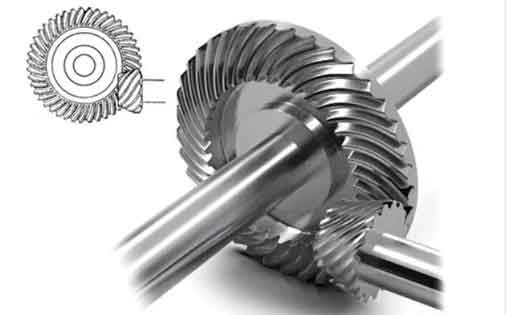
The CAM process for spiral bevel gears was conducted entirely within the UG environment, leveraging its advanced multi-axis machining capabilities. UG provides a comprehensive set of tools for toolpath generation, simulation, and post-processing, which significantly simplifies the programming for complex parts like spiral bevel gears. We initiated the process by creating a 3D model of the gear based on the design parameters. This model served as the reference for all subsequent machining operations. In UG, the key steps involved selecting the appropriate operation type, defining the tool geometry, setting up driving methods, and configuring tool axis control. For spiral bevel gears, we chose the “mill_multi-axis” operation type, which supports simultaneous motion across multiple axes, essential for generating the helical toolpaths required for these gears.
Within the operation settings, the driving method was set to “Surface Area,” which allows the tool to follow the contours of the gear tooth surfaces. The tool axis control was configured as “Swarf Drive,” ensuring that the tool remains tangent to the driving surfaces, thereby enabling side-cutting operations critical for efficient material removal. The projection vector was set to “Swarf Ruling,” which aligns the tool axis with the surface normals, reducing the risk of gouging and improving surface finish. These settings are summarized in the table below, highlighting their roles in the CAM process for spiral bevel gears:
| CAM Setting | Value | Purpose |
|---|---|---|
| Operation Type | mill_multi-axis | Enables multi-axis toolpath generation |
| Driving Method | Surface Area | Guides tool along gear tooth surfaces |
| Tool Axis Control | Swarf Drive | Maintains tool tangency for side-cutting |
| Projection Vector | Swarf Ruling | Aligns tool axis with surface normals |
Tool selection was facilitated by UG’s integrated tool library, where we could parameterize both conical and disk-type cutters. For instance, a conical tool with a taper angle of 30 degrees and a diameter of 10 mm was defined for roughing operations, while a disk cutter with a diameter of 50 mm and a corner radius of 2 mm was used for finishing. The toolpaths were generated iteratively, with simulations conducted to verify collision avoidance and material removal rates. The simulation model for machining the concave side of a spiral bevel gear tooth revealed a smooth tool motion along the helical path, as shown in the visualization. Similarly, the convex side was processed with mirrored parameters, and the toolpaths for all teeth were obtained using UG’s pattern rotation feature, which replicates the toolpath around the gear axis. This approach minimized manual programming efforts and ensured consistency across the gear.
One of the critical aspects of machining spiral bevel gears on a four-axis center is the generation of NC code that accommodates the fixture-induced tilt. Since UG’s multi-axis functions inherently support five-axis kinematics, direct output for a four-axis machine would include unnecessary rotational data (e.g., B-axis). Our solution involved exploiting the fact that the B-axis values in the generated toolpaths varied minimally around the fixture tilt angle, typically within 0.01 mm. This allowed us to use UG’s five-axis capabilities as a foundation and then modify the post-processing to eliminate the B-axis commands. We customized the post-processor within UG’s post-builder module by adding a custom command in the “Program & Toolpath” section to suppress the output of B-axis movements. The modified post-processor translated the toolpath data into G-code suitable for our four-axis machining center, with linear interpolations in X, Y, Z, and A (rotary table) axes only. The transformation can be mathematically represented as:
$$ \text{NC code}_{4-axis} = f(\text{Toolpath}_{5-axis}) – B\text{-axis components} $$
where \(f\) denotes the post-processing function that filters out the B-axis data while preserving the essential motions. This method effectively bridged the gap between the five-axis CAM environment and the four-axis machine, enabling the production of functional NC code for spiral bevel gears. To validate the code, we conducted dry runs on the machining center, monitoring axis movements and comparing them with the simulated toolpaths. The results confirmed that the gear teeth were machined accurately, with deviations within acceptable tolerances as per AGMA standards for spiral bevel gears.
Further analysis involved optimizing machining parameters to enhance efficiency and surface quality. We performed a series of experiments varying spindle speed, feed rate, and depth of cut, recording outcomes such as tool wear, machining time, and surface roughness. The data was analyzed using response surface methodology, leading to an empirical model for optimal parameters. For instance, the surface roughness \(R_a\) in micrometers was found to correlate with feed per tooth \(f_z\) in mm/tooth and cutting speed \(V_c\) in m/min as:
$$ R_a = k_1 \cdot f_z^{0.8} + k_2 \cdot V_c^{-0.5} $$
where \(k_1\) and \(k_2\) are constants derived from regression analysis. This model helps in selecting parameters that balance productivity and quality for spiral bevel gears. The table below summarizes the optimal parameters identified for our gear design:
| Parameter | Roughing | Finishing |
|---|---|---|
| Spindle speed (rpm) | 3000 | 5000 |
| Feed rate (mm/min) | 600 | 200 |
| Depth of cut (mm) | 1.5 | 0.2 |
| Tool type | Conical end mill | Disk cutter |
The success of this approach underscores the versatility of modern CAM systems in adapting to specific manufacturing challenges. By integrating fixture design, toolpath strategy, and post-processing modifications, we demonstrated that spiral bevel gears can be effectively produced on four-axis machining centers without the need for expensive five-axis equipment. This has implications for small to medium-sized enterprises seeking to manufacture custom spiral bevel gears for prototypes or low-volume production. Future work could explore the application of this methodology to other complex gear types, such as hypoid gears, or incorporate real-time monitoring and adaptive control to further improve accuracy. Additionally, advancements in additive manufacturing might complement this process by producing near-net-shape gear blanks, reducing material waste and machining time.
In conclusion, our research presents a comprehensive framework for the CNC machining of spiral bevel gears using a four-axis machining center. The methodology combines strategic fixture design, CAM-based toolpath generation in UG, and tailored post-processing to overcome axis limitations. Through detailed parameterization, simulation, and experimental validation, we have shown that high-quality spiral bevel gears can be manufactured with standard CNC equipment, thereby expanding access to this critical technology. The repeated emphasis on spiral bevel gears throughout this study highlights their importance in mechanical transmissions and the ongoing innovation in their production methods. As manufacturing continues to evolve, such approaches will play a key role in making complex components more affordable and accessible across industries.