
In the realm of power transmission, particularly for vehicle rear axle drives, hypoid gears are paramount due to their superior performance characteristics. Offering smoother operation, higher torque capacity, and the ability to achieve significant speed reduction ratios with non-intersecting axes, they represent a critical engineering component. The efficient and precise design and manufacture of these gears directly impact vehicle performance and production economics. While significant advancements have been made in the computer-aided design and manufacturing (CAD/CAM) of the gear teeth themselves—the tooth flanks and their complex geometry—the preceding stage of designing and producing the gear blank, the foundational body upon which teeth are cut, has often been a less automated or integrated process. This foundational stage is crucial, as inaccuracies in the blank dimensions directly propagate to the finished gear’s performance and durability. This article details the development and implementation of a dedicated, integrated CAD/CAM system focused specifically on the hypoid gear blank, aiming to bridge this gap and create a seamless digital thread from initial design parameters to a machined component.
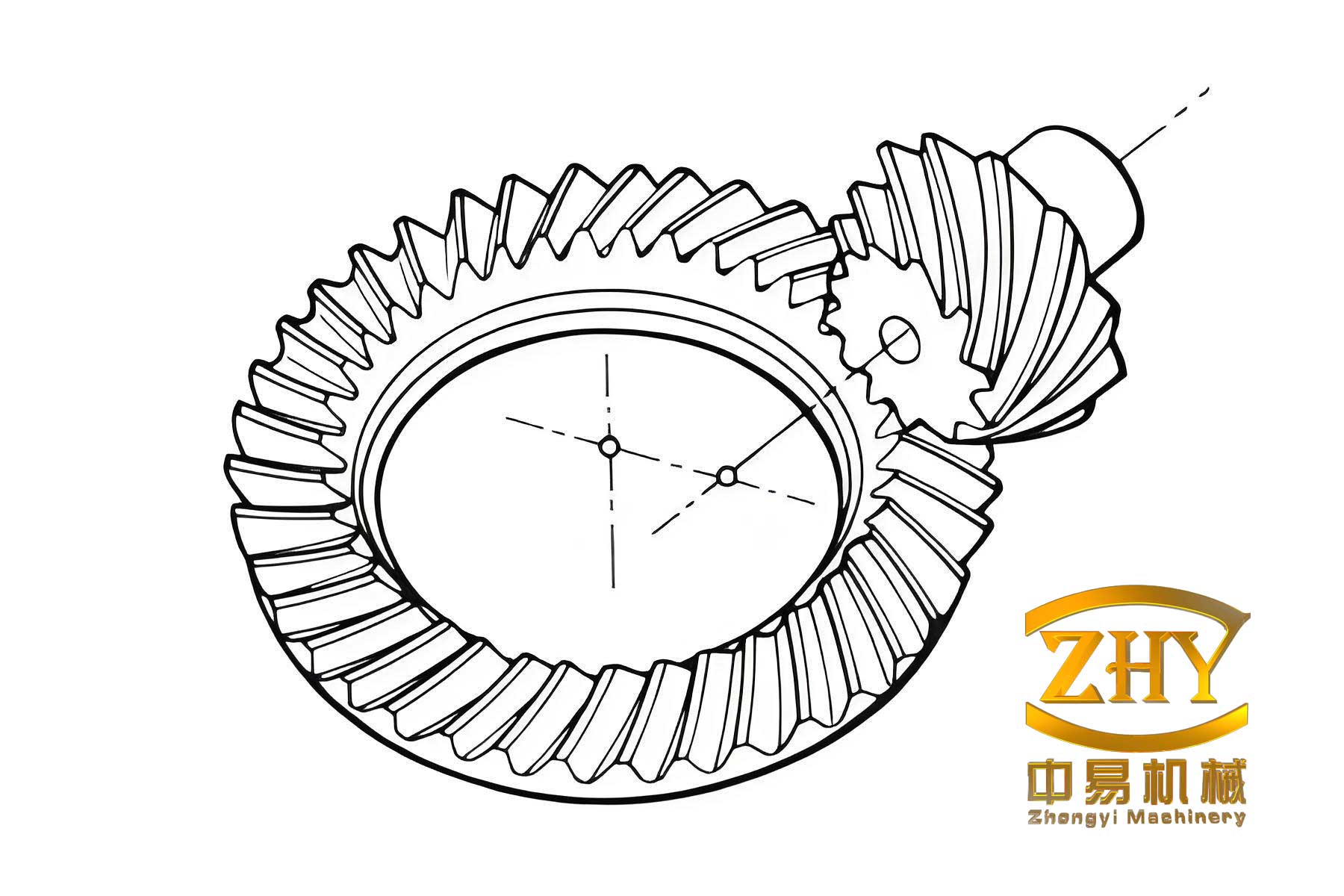
The traditional workflow for hypoid gear blank creation often involves manual calculations, separate drawing generation, and independent, manual or semi-automated CNC programming. This disjointed approach is prone to errors, consumes considerable engineering time, and elongates the product development cycle. Our system, developed on the principle of digital integration, seeks to consolidate these disparate steps into a unified software environment. The core objective is to enable the rapid, accurate, and validated transition from a set of functional gear requirements to a ready-to-machine gear blank model, its associated production drawings, and the direct machine tool instructions necessary for its fabrication.
The unique geometry of hypoid gears presents specific challenges for blank design. Unlike their simpler spur or bevel gear counterparts, the axes of the pinion and gear in a hypoid set are offset, leading to non-uniform tooth profiles and complex load distributions. The blank must, therefore, provide the correct foundational geometry—including pitch angles, face widths, mounting dimensions, and root form—to ensure the subsequent gear cutting process yields a functional and durable gear pair. This necessitates a system built upon robust geometrical algorithms specific to hypoid gear theory, capable of deriving all necessary blank dimensions from a minimal set of initial design inputs.
System Architecture and Functional Flow
The integrated system is architected using a modular paradigm, ensuring maintainability, scalability, and clear separation of concerns. It is primarily composed of two major, interconnected modules: the CAD Module and the CAM Module. Each module encapsulates specific sub-functions, communicating through a centralized parameter database. The overall system structure is designed for a logical, sequential workflow that guides the user from concept to manufacturing.
| Main Module | Sub-Module | Primary Function |
|---|---|---|
| CAD Module | Geometrical Calculation | Computes all blank dimensions from input parameters. |
| Strength Verification | Performs contact and bending stress checks against AGMA standards. | |
| Parametric Drawing | Automatically generates 2D engineering drawings in AutoCAD. | |
| CAM Module | NC Code Generation | Translates blank geometry into machine-specific G-code. |
| Communication Interface | Manages serial data transfer to the CNC machine tool. |
The operational flow of the system is designed to be intuitive and fail-safe. It begins with the user inputting the initial design parameters for the gear pair. These parameters typically include the number of teeth on the pinion (N_p) and gear (N_g), the module or diametral pitch, the shaft offset (E), the gear pitch angle (Γ), and the pinion pitch angle (γ). The system first validates these inputs against fundamental geometrical and manufacturing constraints for hypoid gears.
If an input is deemed invalid or outside recommended bounds, the system prompts the user for correction, often providing reference values based on established design handbooks. Upon successful validation, the geometrical calculation sub-module engages. Using established formulae for hypoid gear geometry, it computes the complete set of blank dimensions. Key calculated dimensions include the outer diameter (D_o), pitch diameter (D), face width (F), and the angles defining the blank’s conical shape: the root angle (δ_f), face angle (δ_a), and back angle. These are derived from the fundamental relations. For instance, the gear pitch diameter can be expressed as:
$$D_g = \frac{N_g}{P_d} \quad \text{or} \quad D_g = m_t \cdot N_g$$
where $P_d$ is the diametral pitch and $m_t$ is the transverse module. The pinion pitch diameter $D_p$ and other related dimensions are calculated considering the offset $E$.
Following geometrical design, the system proceeds to the critical stage of strength verification. The user is required to input the application’s operational conditions: transmitted power (H), input speed (n), desired service life, and application factor (K_a). The system then employs standardized stress calculation methods, such as those outlined by the American Gear Manufacturers Association (AGMA), to evaluate the bending and contact (pitting) strengths of the designed hypoid gear pair. The bending stress formula is generally of the form:
$$\sigma_b = \frac{W_t \cdot P_d}{F \cdot J} \cdot K_o \cdot K_v \cdot K_s \cdot \frac{K_m}{K_x}$$
where $W_t$ is the tangential load, $J$ is the geometry factor for bending strength, $K_o$ is the overload factor, $K_v$ is the dynamic factor, $K_s$ is the size factor, $K_m$ is the load distribution factor, and $K_x$ is the rim thickness factor. The calculated stress $\sigma_b$ is compared against the allowable bending stress $\sigma_{b,all}$ of the material. Similarly, the contact stress $\sigma_c$ is calculated and verified. If the design fails either check, the user is directed back to the parameter input stage to modify the design—for example, by increasing face width $F$ or selecting a stronger material—before proceeding.
Once a design passes all checks, the CAD module culminates in the automatic generation of a fully annotated, standards-compliant 2D engineering drawing. The CAM module then takes over. The user selects the target CNC machine tool type (e.g., specific lathe model). The system, using post-processor logic, converts the validated blank geometry into a corresponding set of ISO-standard G-code (NC code). This code defines the toolpaths, cutting speeds, feed rates, and depth of cuts required to machine the blank from a raw forging or bar stock. Finally, through an integrated serial communication interface, the system can establish a direct link with the CNC machine, upload the generated NC program, and initiate the machining cycle, thereby closing the digital loop from design to physical part.
In-Depth Module Functionality and Implementation
CAD Module: From Parameters to Drawings
The CAD module is the engineering core of the system, responsible for transforming functional requirements into a precise digital model and its documentation. Its development was carried out using ObjectARX, the powerful C++ API for extending AutoCAD, within the Microsoft Visual C++ development environment. This choice allows for deep integration with the AutoCAD platform, enabling the creation of native drawing entities and leveraging AutoCAD’s robust graphical database.
Geometrical Calculation Engine: This sub-module is built upon the foundational mathematical theory for hypoid gears. It handles not only standard cases but also validates for potential undercut and pointing conditions, which are critical for small pinion tooth counts. The calculations account for the offset, which leads to differing spiral angles on the driving and coast sides of the teeth, influencing the blank’s asymmetry. The algorithm ensures all derived dimensions are consistent and manufacturable.
Strength Verification Sub-Module: To ensure reliability, this module implements the AGMA strength rating equations tailored for hypoid gears. It incorporates a material database containing allowable stress numbers for common gear steels. The user inputs the application-specific factors, and the system performs a comprehensive check. A key feature is its ability to provide diagnostic feedback; if a failure occurs, it can indicate whether the issue is primarily bending or pitting and suggest which parameter (e.g., face width, material grade) would be most effective to modify.
Parametric and Automated Drawing Generation: This is the most complex sub-module, transforming calculated data into a visual technical drawing. “Parametric” here means the entire drawing is driven by the initial set of parameters. If any input dimension changes, the drawing updates automatically—all points, lines, dimensions, and annotations are recalculated and regenerated. The process involves several systematic steps:
- Drawing Environment Setup: The system programmatically initializes the AutoCAD drawing space: setting units to millimeters, defining layers for contours, centerlines, dimensions, and cross-hatching, and assigning appropriate colors and line types.
- Coordinate System Definition: A base point, typically the apex of the gear blank’s back cone, is set as the drawing origin (0,0,0). All other geometric points defining the blank’s profile—the outer diameter, inner hub, keyway, bolt circles, and chamfers—are calculated relative to this origin using the previously computed dimensions.
- Geometric Entity Creation: Using ObjectARX functions, the system creates and adds entities like lines, circles, and arcs to the AutoCAD database. For example, to draw the tapered face of a hypoid gear blank, the code calculates the start and end points and creates an
AcDbLineentity. The process is repeated for every feature. - Annotation and Detailing: After the轮廓 is drawn, the system adds all necessary dimensions, geometric tolerances (like runout), and surface finish symbols. A standard title block and a parameter table are inserted as attribute blocks. This table is automatically populated with the key design parameters for the hypoid gear blank, such as number of teeth, module, pressure angle, and shaft offset.
Since hypoid gears are always designed and used in pairs (a pinion and a gear), the CAD module is designed to generate the drawings for both the pinion blank and the gear blank in a single, batch operation, ensuring consistency and saving time.
CAM Module: Bridging Design and Manufacturing
The CAM module translates the static design into actionable manufacturing instructions. Its accuracy directly determines the quality of the final machined hypoid gear blank.
NC Code Generation Sub-Module: This module acts as a feature-specific post-processor. It extracts the precise geometrical data of the blank profile from the internal database populated by the CAD module. The user then interacts with a dialog to input manufacturing setup data: stock size, chuck jaw position, tool nose radius, and tool magazine assignments. The system accesses an integrated machining parameter database to assign appropriate cutting speeds (V_c in m/min), feed rates (f in mm/rev), and depth of cuts (a_p in mm) based on the workpiece material (e.g., AISI 8620 steel) and tool material (e.g., coated carbide).
The core task is to plan the toolpath. For a typical hypoid gear blank, which is largely rotational, a series of turning operations (roughing, finishing, facing, grooving) is planned. The algorithm determines the optimal sequence to minimize machining time while maintaining accuracy and surface finish. It calculates the coordinates for linear and circular interpolations. For instance, a finishing pass along a tapered face involves a linear interpolation command derived from the geometry. The final output is a text file containing standard G-code and M-code, structured for the selected machine controller.
| Parameter Category | Symbol | Example Value | Source/Logic |
|---|---|---|---|
| Workpiece Material | – | AISI 4140 | User Input / Material DB |
| Cutting Speed | $V_c$ | 220 m/min | Machining DB Query |
| Spindle Speed | $n$ | $n = \frac{1000 \cdot V_c}{\pi \cdot D}$ | Calculated from $V_c$ & work diameter $D$ |
| Feed Rate (Roughing) | $f_{rough}$ | 0.25 mm/rev | Machining DB Query |
| Depth of Cut (Roughing) | $a_{p,rough}$ | 2.0 mm | Machining DB Query |
| Tool Nose Radius | $r_\epsilon$ | 0.4 mm | Tooling DB / User Input |
Communication Interface Sub-Module: To achieve true integration, the system must communicate with the machine tool. This sub-module handles the serial (RS-232) or, in a modern implementation, Ethernet-based communication. Developed using multithreading techniques in Visual C++, it creates separate threads for sending and receiving data to prevent the user interface from freezing during file transfer. The sending thread reads the generated NC code file and transmits it line-by-line to the CNC controller. The receiving thread listens for status messages or error codes from the machine. This enables not just file upload but also basic machine monitoring, closing the digital manufacturing loop for the hypoid gear blank.
Mathematical Foundation and Formulae
The reliability of the entire system hinges on the correctness of its underlying mathematical models. For hypoid gears, the geometry is more complex than for bevel gears due to the offset. A simplified set of fundamental relations used in the geometrical calculation engine includes the pitch diameters, the virtual cylindrical gear equivalents, and key angles.
The mean spiral angle $\beta_m$ is a critical parameter influencing tooth contact and strength. The shaft offset $E$ is directly related to the gear and pinion pitch radii ($r_g$, $r_p$) and their pitch angles ($\Gamma$, $\gamma$):
$$E = r_g \sin \Gamma + r_p \sin \gamma$$
The calculation of the gear blank’s outer diameter $D_o$ must account for the addendum $a$ and the dedendum $b$, which are themselves functions of the module and any profile shift coefficients ($x$) applied to balance strength and avoid undercut in the pinion:
$$D_{o, gear} = D_g + 2a_g \quad \text{where} \quad a_g = m_n (1 + x_g)$$
$$D_{o, pinion} = D_p + 2a_p \quad \text{where} \quad a_p = m_n (1 + x_p)$$
Here, $m_n$ is the normal module. The face width $F$ is limited by practical constraints, often expressed as a fraction of the cone distance $A_0$ or the gear’s pitch diameter. A common rule for hypoid gears is:
$$F \leq 0.3 A_0 \quad \text{or} \quad F \leq 10 m_t$$
The strength verification module relies heavily on the AGMA approach. The fundamental tangential load $W_t$ is calculated from power $H$ (kW) and speed $n$ (rpm):
$$W_t = \frac{60000 H}{\pi D n}$$
The bending stress geometry factor $J$ for hypoid gears incorporates factors for tooth form, stress concentration, and the load-sharing between overlapping teeth. The contact stress calculation uses the formula:
$$\sigma_c = C_p \sqrt{ \frac{W_t K_o K_v K_s K_m}{F D_p I} }$$
where $C_p$ is the elastic coefficient, and $I$ is the geometry factor for pitting resistance, which depends on the radii of curvature of the contacting tooth surfaces—a value heavily influenced by the hypoid offset and spiral angles.
| Factor | Symbol | Description & Dependence for Hypoid Gears |
|---|---|---|
| Overload Factor | $K_o$ | Driven by prime mover and driven machine characteristics. |
| Dynamic Factor | $K_v$ | Depends on gear quality (AGMA class), pitch line velocity, and tooth stiffness. |
| Size Factor | $K_s$ | Related to tooth size; for module > 5mm, often > 1. |
| Load Distribution Factor | $K_m$ | Very critical. Accounts for misalignment, bearing clearances, and shaft/wheel body deflections under load. Higher for face widths > 25% of cone distance. |
| Rim Thickness Factor | $K_x$ | Applied when the rim supporting the teeth is relatively thin (< 1.2 times tooth whole depth). |
Advantages and Practical Implications
The implementation of this integrated CAD/CAM system for hypoid gear blanks delivers tangible benefits across the design and manufacturing workflow. Firstly, it dramatically reduces the time from concept to finished drawing and machine-ready code. What was once a multi-day process involving manual calculations, drafting, and separate CNC programming can be accomplished in a matter of hours. This acceleration is crucial for rapid prototyping and responding to market demands.
Secondly, it enforces consistency and drastically reduces human error. The parametric linkage ensures that any change in the design intent automatically and correctly propagates through the entire chain—dimensions update, strength is re-evaluated, and toolpaths are recalculated. This eliminates the common pitfall of mismatched dimensions between the drawing and the CNC program, a source of costly scrap and rework.
Thirdly, the system encapsulates and makes readily available specialized engineering knowledge. The complex formulae for hypoid gear geometry and AGMA strength ratings are built into the software, making best-practice design accessible to a broader range of engineers and reducing dependency on a few highly specialized experts. The integrated material and machining databases further guide users toward optimal and proven manufacturing parameters.
Finally, the system’s modular architecture makes it adaptable and extensible. It can serve as a standalone application for gear blank production or be integrated as a specialized sub-module within a larger, comprehensive digital manufacturing system for complete gear systems. The communication interface can be updated to support modern protocols like MTConnect for deeper shop-floor integration and data collection.
In conclusion, the development of a dedicated, integrated CAD/CAM system addresses a specific yet critical niche in the production of high-performance hypoid gears. By focusing on the gear blank—the foundational element—and creating a seamless digital thread from initial parameters to machine instructions, the system enhances accuracy, reduces lead time, and lowers the potential for error. It represents a practical step towards the full digitalization of complex mechanical component manufacturing, demonstrating how targeted software integration can yield significant efficiency and quality gains in specialized engineering domains. The principles demonstrated here—parametric design, automated validation, and direct CAM integration—are broadly applicable, underscoring the value of cohesive digital tools in advanced manufacturing.