
The manufacturing of hypoid gears, a cornerstone of modern automotive and industrial drivetrains, presents a unique set of challenges due to their complex, non-intersecting axis geometry. Unlike conventional bevel gears, the offset axis of hypoid gears introduces a combination of rolling and sliding motions that enable higher torque capacity and smoother operation, but at the cost of a highly intricate tooth surface geometry. This complexity precludes the use of standard generating methods, necessitating specialized machine tools, such as Gleason machines or advanced CNC systems, which cut the tooth flank point-by-point based on a calculated spatial model.
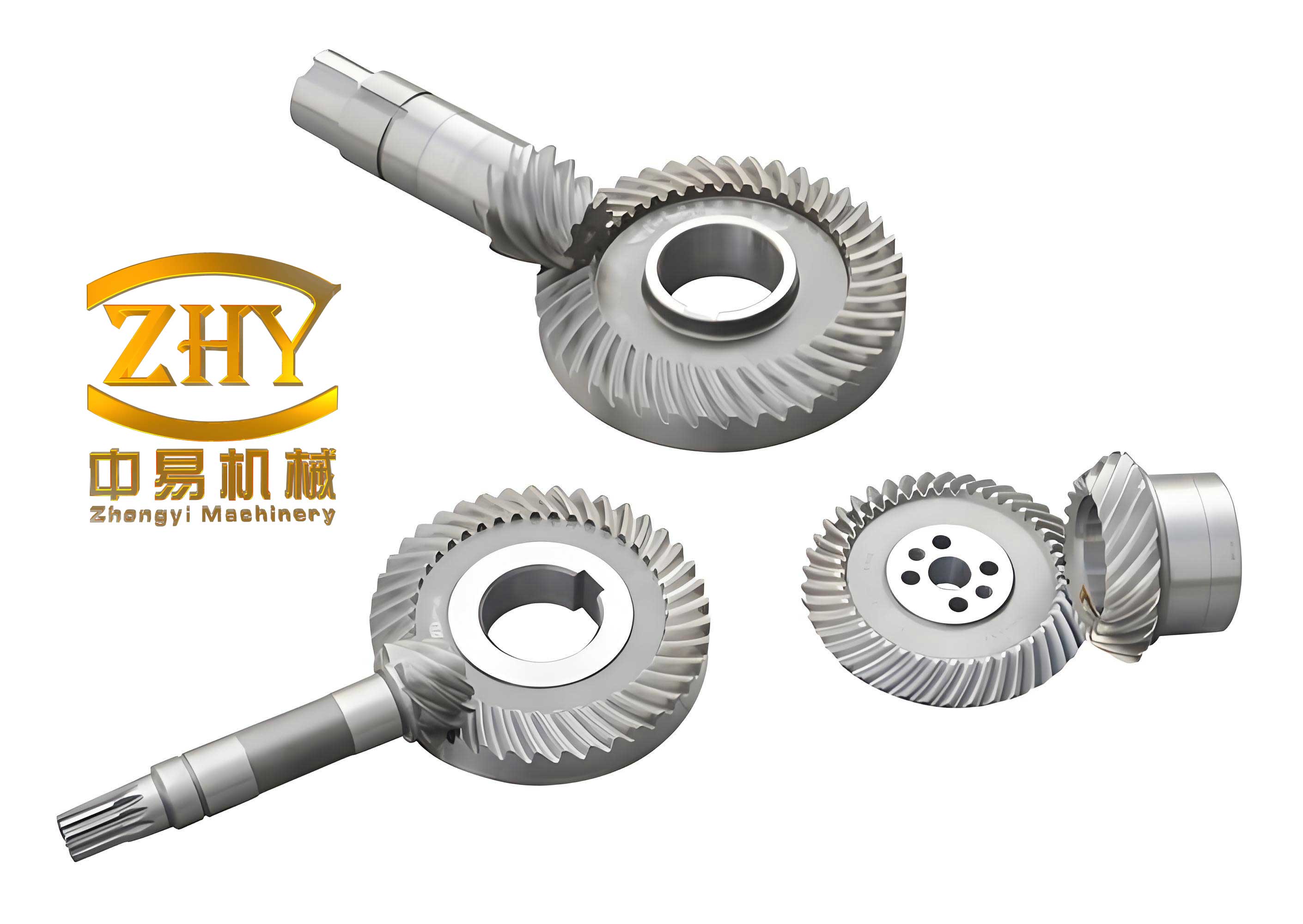
In practice, achieving optimal meshing performance—characterized by a controlled and ample contact pattern under load—requires meticulous and often iterative adjustments of numerous machine settings. These adjustments are typically informed by trial-and-error contact pattern checks (often called “roll tests”) on physical prototypes paired with their mating member. This process is not only time-consuming and costly but also inherently limits the interchangeability of manufactured hypoid gears, as each gear is essentially “tailored” to a specific mating member. This paper introduces and elaborates on a systematic methodology that leverages high-precision three-dimensional coordinate measuring machines (CMMs) to directly measure the manufactured tooth surface of a hypoid pinion (angular gear). Through rigorous mathematical analysis of this measurement data, the actual, as-cut machine tool settings are reverse-engineered. This data-driven approach provides a precise recipe for machine setup, significantly reducing the need for iterative trial cuts and contact pattern testing, thereby enhancing both manufacturing accuracy and efficiency for hypoid gears.
The Core Challenge in Hypoid Gear Production
The fundamental issue stems from the gap between theoretical design and physical realization. The mathematical model defining the ideal tooth surface of a hypoid gear is sophisticated, involving multiple coordinate transformations and kinematics of a virtual cutting process. When this model is translated into machine commands (e.g., cutter location, tilt angles, work and cutter rotation ratios), subtle discrepancies inevitably arise. These discrepancies can be attributed to several factors:
- Machine Kinematic Errors: Imperfections in the guideways, spindles, and scaling of the hypoid gear cutting machine.
- Tooling Imperfections: Deviations in the actual cutter profile (diameter, pressure angle, edge geometry) from its nominal specification.
- Workpiece Setup Errors: Inaccuracies in positioning and clamping the gear blank on the machine.
- System Deflections: Elastic deformations of the machine-tool-workpiece system under cutting forces.
Traditionally, a skilled operator compensates for these unknown cumulative errors by interpreting the contact pattern from a roll test and manually tweaking machine settings like the cutter radial position (\(S_R\)), machine center to back (\(L_p\)), or the ratio of roll (\(i\)). This “art” relies heavily on experience and lacks a direct, quantitative link to the actual geometry of the cut tooth. Our methodology aims to replace this qualitative art with a quantitative science by using the actual tooth surface itself as the primary source of truth for determining the effective manufacturing parameters.
Mathematical Representation of the Hypoid Pinion Tooth Surface
The foundation of this reverse-engineering process is a precise mathematical model that describes how the tooth surface of a hypoid pinion is generated on a specific machine tool configuration. We focus here on the common scenario of single-point cutting, often used for finishing operations on Gleason-type machines. The model establishes a functional relationship between any point on the tooth flank and the complete set of machine settings used to produce it.
The generation process involves two main coordinate systems: the machine coordinate system \(O-VHZ\) and the workpiece (pinion) coordinate system \(O_p-x_p y_p z_p\). The origin \(O_p\) is typically the apex of the pinion’s pitch cone, with the \(y_p\)-axis aligned along the pinion shaft. The cutter, represented as a circular blade with a specific pressure angle, is positioned and oriented in the \(O-VHZ\) system. The vector \(\mathbf{D}_p(V_p, H_p, -Z_p)\) defines the cutter center location, and the unit vector \(\mathbf{a}_p(a_{px}, a_{py}, a_{pz})\) defines the cutter axis orientation. These are parameterized by four fundamental machine adjustment angles \(\phi_1, \phi_2, \phi_3, \phi_4\), which control the cutter tilt and swivel. For a concave flank, these are given by:
$$
\begin{aligned}
a_{pz} &= \cos \phi_1 \sin \gamma + \cos \gamma \\
a_{py} &= \sqrt{1 – a_{pz}^2} \cdot \sin(\theta) \\
a_{px} &= \sqrt{1 – a_{pz}^2} \cdot \cos(\theta) \\
\text{where} \quad \theta &= \begin{cases}
\arctan\left( \frac{\tan \phi_2}{\sqrt{2}/2} \right), & -\pi/2 < \phi_2 < \pi/2 \\
\arctan\left( \frac{\tan \phi_2}{-\sqrt{2}/2} \right) + \pi, & \pi/2 < \phi_2 < 3\pi/2
\end{cases} \\
V_p &= \begin{cases}
H_p / \tan \phi_3, & -\pi/2 < \phi_3 < \pi/2 \\
-H_p / \tan \phi_3, & \pi/2 < \phi_3 < 3\pi/2
\end{cases} \\
H_p &= \begin{cases}
E_x, & -\pi/2 < \phi_3 < \pi/2 \\
-E_x, & \pi/2 < \phi_3 < 3\pi/2
\end{cases} \\
\theta’ &= \phi_4 – \pi/2 – \arctan\left( \frac{\cos \phi_1}{\sin \phi_1 \sin \gamma – \cos \gamma / \tan(\phi_3 – \pi/2)} \right)
\end{aligned}
$$
Here, \(E_x\) is a fixed machine eccentricity (e.g., 76.2 mm) and \(\gamma\) is the basic cutter blade angle (e.g., 15°00′).
During cutting, the cutter rotates about its own axis with angular speed \(\dot{\phi}\), while the workpiece rotates about the \(y_p\)-axis with a coordinated angular speed \(i \dot{\phi}\), where \(i\) is the machining ratio. As the cutter moves through an angle \(\phi\), its cutting edge sweeps out a line \(L\) on the workpiece. The position of a point on this cutting line, in the machine coordinates, for a given point \((u_p, v_p)\) on the cutter edge is:
$$
\mathbf{X}_{p\phi}(u_p, v_p; \phi) = \mathbf{C}(\phi) \mathbf{B}(\beta) \mathbf{A}(\alpha) \mathbf{X}_{pc}(u_p, v_p) + \mathbf{D}_p
$$
where \(\mathbf{A}(\alpha)\), \(\mathbf{B}(\beta)\), \(\mathbf{C}(\phi)\) are transformation matrices for rotations about different axes, and \(\alpha, \beta\) are derived from \(\mathbf{a}_p\).
The key to defining the final tooth surface is the condition of tangency between the cutter surface and the generated gear surface. This is expressed by the equation that the relative velocity vector \(\mathbf{W}\) between the cutter and the workpiece must be perpendicular to the common surface normal \(\mathbf{N}_{p\phi}\) at the point of contact:
$$
\mathbf{N}_{p\phi} \cdot \mathbf{W} = 0
$$
The relative velocity \(\mathbf{W} = \mathbf{V}_c – \mathbf{V}_p\) is calculated from the velocities of the cutter point and the corresponding workpiece point. Solving this equation yields the functional relationship \(v_p = v_p(u_p; \phi)\), which identifies the specific point on the cutter edge that is in cutting contact at each instant \(\phi\). Substituting this back gives the cutting line \(L\). The final tooth surface \(\mathbf{X}_p\) in the pinion coordinate system is then obtained by transforming \(L\) and accounting for the pinion’s axial position \(Y_p\) (the difference between the apex distance and \(L_p\)):
$$
\begin{aligned}
L(u_p; \phi) &= \mathbf{X}_{p\phi}(u_p, v_p(u_p; \phi); \phi) \\
\mathbf{X}_p(u_p; \phi) &= \mathbf{A}^{-1}(i\phi) \mathbf{B}^{-1}(\lambda_p) L(u_p; \phi) – [0, Y_p, 0]^T
\end{aligned}
$$
where \(\lambda_p\) is the relative angle between the gear and cutter axes. This model \(\mathbf{X}_p(u_p; \phi; C_1, C_2, …, C_n)\) is inherently a function of all the machine setting parameters \(C_i\), which include \(V_p, H_p, Z_p, \gamma, i, E_x, \lambda_p\), etc.
Three-Dimensional Coordinate Measurement and Data Acquisition
To capture the as-manufactured geometry, a high-precision CMM is employed. The pinion is mounted on the CMM table, and its axis is carefully aligned with one of the CMM’s coordinate axes, say \(y_t\). The relationship between the CMM coordinate system \(O_t-x_t y_t z_t\) and the pinion’s design coordinate system \(O_p-x_p y_p z_p\) involves a simple rotation \(\psi\) about the common \(y\)-axis. The CMM does not measure the tooth surface directly but uses a spherical probe of known radius \(r_0\). When the probe touches the tooth surface at point \(\mathbf{X}\) with unit normal \(\mathbf{N}\), the center of the probe sphere is at location \(\mathbf{P}\):
$$
\mathbf{P} = \mathbf{X} + r_0 \mathbf{N}
$$
The CMM records the coordinates of \(\mathbf{P}\). It is advantageous to convert these Cartesian coordinates \((x_t, y_t, z_t)\) into cylindrical coordinates \((r_t, \theta_t, z_t)\) with respect to the pinion axis. This transformation removes the dependency on the unknown rotational alignment angle \(\psi\) from the radial \(r_t\) and axial \(z_t\) components, simplifying subsequent analysis. We denote the measured cylindrical coordinates of the probe center as \(P_r, P_z, P_\theta\).
Reverse Engineering of Machine Settings via Least Squares Analysis
The core of the methodology is to find the set of actual machine parameters \(C_i\) and the alignment angle \(\psi\) that minimize the difference between the measured tooth surface and the theoretical surface generated by the mathematical model. Let the theoretical model, which also includes the probe radius compensation, predict a probe center location \(\mathbf{M}(C_i, \psi; u_p, \phi)\). In cylindrical coordinates, this is \(M_r, M_z, M_\theta\).
For a given measured point \(j\), the residual error, particularly in the angular coordinate which is most sensitive to parameter variations, is defined as:
$$
E_j(\psi, C_1, C_2, …, C_n) = M_{\theta j}(\psi, C_i; u_{pj}, \phi_j) – P_{\theta j}
$$
We collect a large number of measurement points (e.g., 40-50 points) distributed across the tooth flank, both on the concave and convex sides. The optimal parameters are those that minimize the sum of squared residuals for all \(N\) points:
$$
\min_{\psi, C_i} S = \sum_{j=1}^{N} [E_j(\psi, C_1, C_2, …, C_n)]^2
$$
Given the nonlinear nature of the model \(\mathbf{X}_p\), this is a nonlinear least squares problem. A practical solution approach involves a sequential or iterative search. Since the machine setting errors are typically small and independent, one can often identify the most sensitive parameter for a given type of error. For instance, the machine center to back (\(e\) for concave, \(e’\) for convex) and the cutter radial setting (\(R_{sp}\), \(R’_{sp}\)) are often the primary culprits for contact pattern shifts. The analysis can proceed by first solving for the pair \((\psi, C_k)\) that gives the smallest residual for a specific parameter \(C_k\), holding others at their nominal values. The alignment angle \(\psi\) is solved concurrently because it is unknown. The quality of the fit is evaluated by a conformity error \(\Delta_t\), often the root-mean-square (RMS) of the residuals.
$$
\Delta_t = \sqrt{\frac{1}{N} \sum_{j=1}^{N} (E_j)^2}
$$
Once the most influential parameter is corrected, the process can be repeated or extended using multi-variable optimization to refine other parameters. The result is a set of “as-used” machine settings that accurately reflect what the machine actually did to produce the measured tooth surface on the sample hypoid gear.
Practical Application and Result Analysis
To demonstrate this methodology, consider a hypoid pinion with the following design specifications:
| Parameter | Value |
|---|---|
| Number of Teeth | 7 |
| Pitch Diameter (mm) | 28.06 |
| Module | 3.7 |
| Outer Cone Distance (mm) | 92.04 |
| Spiral Angle | 47°37′ |
| Face Width (mm) | 26.89 |
A sample pinion, known to have a good contact pattern with its mating gear, was measured on a CMM. A total of 43 points were taken on the concave flank and a similar number on the convex flank. The nominal machine settings from the Gleason machine setup sheet were used as the starting point \(C_{i,\text{nom}}\).
The nonlinear least squares analysis was performed. For the concave flank, the parameters \(e\) (machine center to back) and \(\psi\) (alignment) were solved for simultaneously. The analysis yielded an optimized value of \(e = 17.270 \text{ mm}\) and \(\psi = 323^\circ 36’\), with a conformity error \(\Delta_t = 6.8 \mu m\). For the convex flank, the parameters \(R’_{sp}\) (cutter radial distance) and \(\psi\) were optimized, yielding \(R’_{sp} = 71.501 \text{ mm}\) and \(\psi = 250^\circ 48’\), with a superior conformity error of \(\Delta_t = 2.8 \mu m\).
The complete set of deduced machine settings for both flanks is compared to the nominal settings in the tables below.
| Parameter | Nominal Setting | Deduced Setting | Conformity Error \(\Delta_t\) |
|---|---|---|---|
| Machine Center to Back, \(e\) (mm) | 17.08 | 17.27 | 6.8 µm |
| Cutter Radial Setting, \(R_{sp}\) (mm) | 67.98 | 67.98 | |
| Cutter Offset Angle, \(A_{sp}\) | 8°58′ | 8°58′ | |
| Sliding Distance, \(Z_p\) (mm) | 2.72 | 2.72 | |
| Cutter Diameter, \(R_p\) (mm) | 73.65 | 73.65 | |
| Machine Center to Back (axial), \(L_p\) (mm) | 82.78 | 82.78 | |
| Cutter Blade Angle, \(\gamma_{1p}\) | 15°59′ | 15°59′ | |
| Ratio of Roll, \(i\) | 6.19 | 6.19 |
| Parameter | Nominal Setting | Deduced Setting | Conformity Error \(\Delta_t\) |
|---|---|---|---|
| Cutter Radial Setting, \(R’_{sp}\) (mm) | 71.66 | 71.501 | 2.8 µm |
| Machine Center to Back, \(e’\) (mm) | 17.73 | 17.92 | |
| Cutter Offset Angle, \(A’_{sp}\) | 12°58′ | 12°58′ | |
| Sliding Distance, \(Z’_p\) (mm) | 6.59 | 6.59 | |
| Cutter Diameter, \(R’_p\) (mm) | 79.38 | 79.38 | |
| Machine Center to Back (axial), \(L’_p\) (mm) | 87.02 | 87.02 | |
| Cutter Blade Angle, \(\gamma’_{2p}\) | 20°00′ | 20°00′ | |
| Ratio of Roll, \(i’\) | 6.33 | 6.33 |
The results are highly informative. They show that for this specific pinion, the primary deviations from the nominal program occurred in the machine center to back setting \(e\) for the concave flank (increased by 0.19 mm) and in the cutter radial setting \(R’_{sp}\) for the convex flank (decreased by 0.159 mm). All other parameters, including complex angles like the cradle angle and the ratio of roll, were found to be remarkably close to their nominal values. The slightly higher conformity error on the concave flank (6.8 µm vs. 2.8 µm) could be attributed to factors like greater probe wear during measurement or inherent differences in surface finish.
The ultimate validation lies in the contact pattern. When a new pinion is manufactured using the standard nominal settings, it often requires several adjustment loops to achieve a good pattern. However, if a new pinion is cut using the deduced settings (\(e = 17.270 \text{ mm}, R’_{sp} = 71.501 \text{ mm}\)) with all other parameters at their original nominal values, it produces a tooth surface geometry that is virtually identical to the original sample pinion. Consequently, when meshed with the original mating gear, it immediately exhibits a large, well-centered, and optimal contact pattern. This demonstrates that the deduced settings effectively capture the “correct” manufacturing recipe for this specific gear pair geometry and machine tool combination.
Implications for Hypoid Gear Manufacturing and Quality Control
The implications of this methodology for the production of hypoid gears are profound:
- Reduction of Setup Time and Cost: The most immediate benefit is the drastic reduction or even elimination of the iterative trial-cutting and roll-testing cycle. By measuring a first-article or master gear and reverse-engineering its parameters, the optimal setup for subsequent production runs is determined directly.
- Enhanced Process Control and Capability Analysis: The method provides quantitative data on which machine parameters are most prone to variation (\(e\) and \(R_{sp}\) in our case). This knowledge allows for focused maintenance and calibration of the gear cutting machine, improving overall process capability for manufacturing hypoid gears.
- Path Towards Interchangeability: While true full interchangeability of hypoid gears remains challenging due to their sensitive conjugate nature, this method moves in that direction. If the mating gear’s geometry is also precisely controlled and known, the pinion can be manufactured to a “virtual mate” defined by the deduced parameters, rather than a physical one. This decouples the manufacturing processes.
- Digital Twin and Process Documentation: The deduced parameter set creates a precise digital record of how a specific good part was made. This “digital twin” of the manufacturing process can be archived, used for quality audits, or transferred to another identical machine tool to replicate the process exactly, aiding in multi-site production.
- Root Cause Analysis for Defects: If a production batch shows poor contact patterns, a sample can be measured and analyzed. The deduced parameters will reveal exactly how the machine settings deviated from the optimal “golden” set, guiding swift and accurate corrective action.
Conclusion
The manufacturing of high-performance hypoid gears has long relied on a blend of sophisticated engineering and skilled artisan adjustment. The methodology presented here, based on high-precision three-dimensional coordinate metrology and nonlinear least squares analysis of the tooth surface geometry, introduces a powerful paradigm shift. It replaces subjective pattern reading with objective, quantitative measurement of the gear itself. By reverse-engineering the actual machine tool settings from a proven-good sample, it provides a direct, accurate, and reliable recipe for setting up production machines. This not only streamlines the manufacturing process, reducing time and cost, but also elevates the consistency and quality of the produced hypoid gears. As metrology and computing power continue to advance, this data-driven approach is poised to become an integral part of the digital thread in advanced gear manufacturing, ensuring that the complex geometry of hypoid gears is realized with unprecedented precision and efficiency.