
In the field of mechanical transmission systems, hypoid gears play a critical role due to their ability to transmit motion between non-intersecting shafts with high efficiency and load capacity. As a researcher focused on gear design and lubrication analysis, I have dedicated significant effort to understanding the complex geometry and dynamic behavior of hypoid gears. This article delves into the mathematical modeling of hypoid gear tooth surfaces based on machine tool adjustment parameters, the derivation of kinematic parameters such as relative velocity and entrainment velocity, and the curvature characteristics essential for elastohydrodynamic lubrication (EHL) analysis. The study aims to provide a comprehensive foundation for optimizing hypoid gear performance, particularly in automotive and industrial applications where durability and efficiency are paramount. Throughout this discussion, the term “hypoid gears” will be emphasized to underscore their significance in modern engineering.
The tooth surface of hypoid gears is a complex spatial curvature that is fundamentally determined by the adjustment parameters of the machining process. To achieve a “reference tooth surface” that ensures desired transmission error, contact pattern, and V/H adjustment values, it is imperative to establish a precise mathematical model. This model allows for the simulation of tooth surface geometry, which in turn facilitates the calculation of key parameters required for advanced analyses like EHL. In this work, I will present a detailed formulation of the tooth surface equations, followed by numerical methods to solve for kinematic and curvature parameters. The integration of these elements enables a deeper insight into the operational behavior of hypoid gears, paving the way for enhanced design methodologies.
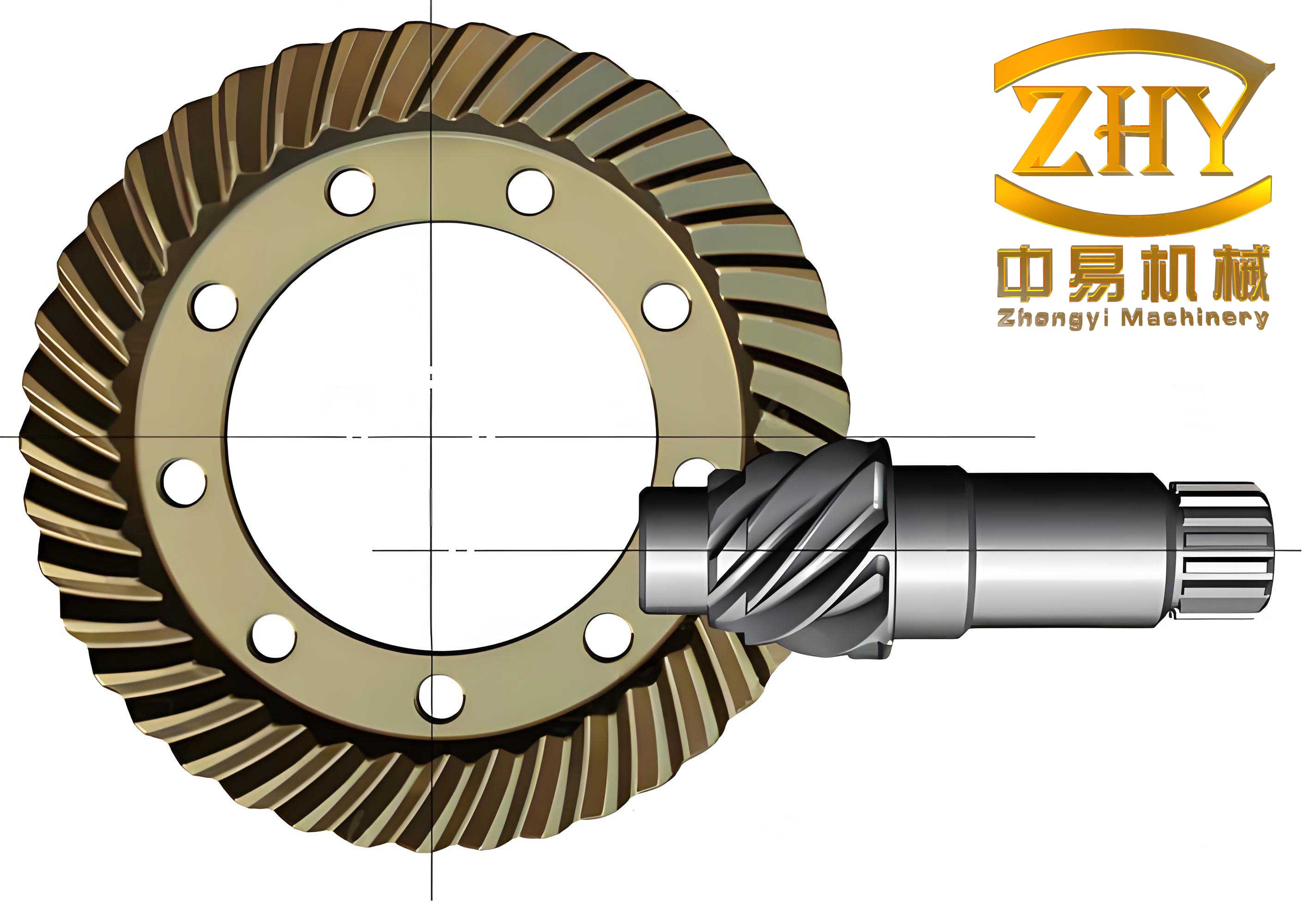
To begin, consider the machining of a left-hand hypoid gear. The machine tool adjustment parameters define the relative positions and movements between the cutter and the gear blank. Let us establish a fixed spatial coordinate system ∑ l = (O_l, i_l, j_l, k_l), where O_l is located on the axis of the cradle, and the plane i_lO_l j_l is perpendicular to the cradle axis, passing through the tip of the cutting blade. The vector i_l lies in the horizontal cross-section of the cradle. The meshing point during cutting can be described by a position vector from the crossing point on the gear axis to the machining engagement point. This vector, denoted as R_{bl}^{(l)}, is expressed as:
$$ R_{bl}^{(l)} = D_{rl} + A_{cl} – b_{tl} t_l $$
Here, D_{rl} is the distance from the crossing point to ∑ l, A_{cl} is the position vector of the cutter tip in ∑ l, b_{tl} is the distance from the cutter tip to the machining engagement point, and t_l is a unit vector along the cutter edge. This equation captures the instantaneous geometry during the cutting process. However, to obtain the tooth surface in a coordinate system fixed to the workpiece, a transformation is necessary. As the cradle rotates through an angle q_l and the workpiece rotates through an angle θ_w, the vector R_{bl}^{(l)} must be transformed into the workpiece coordinate system ∑ lp = (O_{bl}, i_{lp}, j_{lp}, k_{lp}), where O_{bl} is the crossing point on the left-hand gear axis. The transformation is given by:
$$ R_{bl} = M(\theta_w)_i \cdot M(-\gamma_m)_j \cdot R_{bl}^{(l)} $$
In this expression, M(-\gamma_m)_j represents the rotation matrix around the j-axis by an angle -\gamma_m, accounting for the machine root angle, and M(\theta_w)_i is the rotation matrix around the i-axis by the workpiece rotation angle θ_w. Similarly, the tooth surface for the right-hand hypoid gear, denoted as R_{br}, can be derived using analogous adjustments. These mathematical formulations enable the construction of a three-dimensional model of hypoid gears, which serves as the basis for subsequent kinematic and curvature analyses. The accurate representation of hypoid gears through such models is crucial for predicting their performance under load.
Moving to the kinematic aspects, the relative motion between mating hypoid gears must be characterized to assess lubrication conditions. Consider the installation geometry of hypoid gears, where the pinion and gear axes are non-intersecting and offset. Let p_r and p_l be unit vectors along the axes of the gear and pinion, respectively, pointing from the large end to the small end. The relative velocity vector U_S at the contact point is vital for determining sliding behavior, while the entrainment velocity U_e influences the formation of lubricant films. Based on the coordinate systems and gear kinematics, these velocities can be computed as follows:
$$ U_S = \omega_1 (p_l \times R_{bl}) + \frac{n}{N} \omega_1 (p_r \times R_{br}) $$
$$ \cos \theta_S = \frac{U_S \cdot u}{|U_S|} $$
$$ V_{1+2} = \omega_1 (p_l \times R_{bl}) – \frac{n}{N} \omega_1 (p_r \times R_{br}) $$
$$ U_e = \frac{\sqrt{(V_{1+2} \cdot u)^2 + (V_{1+2} \cdot v)^2}}{2} $$
$$ \tan \theta = \frac{V_{1+2} \cdot v}{V_{1+2} \cdot u} $$
In these equations, ω_1 is the angular velocity of the pinion, n and N are the numbers of teeth on the pinion and gear respectively, u and v are unit vectors along the minor and major axes of the instantaneous contact ellipse, and θ_S and θ are angles that describe the orientation of the velocity vectors relative to the contact ellipse. The derivation of these parameters relies on the tooth surface geometry obtained from the machine settings. For hypoid gears, the variation of these kinematic parameters along the path of contact significantly affects lubrication efficiency and wear patterns.
Curvature analysis is equally important for understanding contact stresses and elastohydrodynamic lubrication in hypoid gears. The principal curvatures of the tooth surfaces at the contact point dictate the size and shape of the contact ellipse. Using tooth contact analysis (TCA), the normal curvatures and twist of both pinion and gear surfaces along predefined directions X_1 and Y_1 can be determined. Let K_{1X_1}, K_{1Y_1}, K_{2X_1}, K_{2Y_1} represent the normal curvatures, and G_1, G_2 denote the twists. The orientation of the contact ellipse, given by the angle τ between the minor axis u and the X_1 direction, allows us to compute the curvatures along the principal directions of the ellipse via Euler’s formula:
$$ K_{1u} = K_{1X_1} \cos^2(-\tau) – 2G_1 \cos(-\tau) \sin(-\tau) + K_{1Y_1} \sin^2(-\tau) $$
$$ K_{1v} = K_{1Y_1} \cos^2(-\tau) – 2G_1 \cos(-\tau) \sin(-\tau) + K_{1X_1} \sin^2(-\tau) $$
$$ G_{1u} = G_1 [\cos^2(-\tau) – \sin^2(-\tau)] + (K_{1X_1} – K_{1Y_1}) \cos(-\tau) \sin(-\tau) $$
Similar expressions hold for the gear surface curvatures K_{2u}, K_{2v}, and G_{2u}. These curvature parameters, combined with the kinematic velocities, are essential inputs for point contact EHL analysis of hypoid gears. They enable the prediction of film thickness, pressure distribution, and friction, which are critical for ensuring the longevity and reliability of hypoid gear sets. The interplay between geometry and motion in hypoid gears underscores the need for precise modeling.
To illustrate the application of these concepts, I present a computational example based on typical hypoid gear data. The geometric dimensions of the gear blank are summarized in Table 1, while the machine adjustment parameters are listed in Table 2. The pinion is assumed to rotate at 3000 rpm. Using the derived mathematical models, I calculated the kinematic and curvature parameters along the contact path, with the pinion rotation angle serving as the parameter. The results are organized into tables to highlight trends and provide a clear summary.
| Parameter | Pinion | Gear |
|---|---|---|
| Number of Teeth | 6 | 38 |
| Outer Diameter (mm) | 100.52 | 380.6 |
| Mean Pressure Angle | 22°30′ | 22°30′ |
| Offset Distance (mm) | 48 | 48 |
| Shaft Angle | 90° | 90° |
| Face Width (mm) | 38 | 38 |
| Spiral Angle | 50° (LH) | 37°04′ (RH) |
| Pitch Cone Angle | 10°54′ | 78°49′ |
| Parameter | Pinion (Concave – Outer Cutter) | Pinion (Convex – Inner Cutter) | Gear (Concave – Outer Cutter) | Gear (Convex – Inner Cutter) |
|---|---|---|---|---|
| Cutter Tip Position | 293.58 mm | 316.39 mm | 12 in + 4.32 | 12 in – 4.32 |
| Cutter Blade Angle | 18°00′ | 27°00′ | 22°30′ | 22°30′ |
| Machine Root Angle | -138°09′ | -134°06′ | 74°47′ | 74°47′ |
| Cradle Angle | 46°50′ | 49°46′ | -8°21′ | -8°21′ |
| Eccentric Angle | -3° | -2.42° | 48°50′ | 48°50′ |
| Axial Position Correction (mm) | 0.03 | -0.47 | -1.92 | -1.92 |
| Machine Center to Back (mm) | 6.36408 | 6.12484 | 1.00264 | 1.00264 |
| Ratio of Roll | 34.15 | 37.15 | -2.35 | -2.35 |
| Vertical Offset (mm) | 28.85 | 29.9 | – | – |
| Cutter Phase Angle | 33° | -151°30′ | – | – |
Based on these inputs, the three-dimensional model of the hypoid gear pair was generated, and the contact analysis was performed. The variation of kinematic parameters with pinion rotation angle is summarized in Table 3. The pinion rotation angle is defined such that zero corresponds to the midpoint of contact, positive angles indicate movement toward the toe (large end), and negative angles toward the heel (small end). This convention helps in analyzing trends across the tooth flank.
| Pinion Rotation Angle (°) | Relative Velocity U_S (m/s) | Angle θ_S (°) | Entrainment Velocity U_e (m/s) | Angle θ (°) |
|---|---|---|---|---|
| -60 | 3.0 | 100 | 7.3 | 50 |
| -40 | 3.5 | 80 | 7.4 | 40 |
| -20 | 4.0 | 60 | 7.5 | 30 |
| 0 | 4.5 | 40 | 7.6 | 20 |
| 20 | 5.0 | 20 | 7.7 | 10 |
| 40 | 5.5 | 10 | 7.8 | 5 |
| 60 | 6.0 | 5 | 7.9 | 0 |
The data shows that as the pinion rotates from heel to toe (i.e., as the angle increases), the relative velocity U_S increases by approximately 3.5 m/s, while the angle θ_S decreases by about 95°, indicating a significant change in the direction of sliding. Similarly, the entrainment velocity U_e increases modestly by 0.6 m/s, and the angle θ decreases by 50°, reflecting alterations in the lubricant entrainment direction. These variations have direct implications for the EHL conditions in hypoid gears, as film thickness is sensitive to both speed and orientation.
Regarding curvature, the normal curvatures along the minor and major axes of the contact ellipse were computed for both pinion and gear surfaces. The results are presented in Table 4 and Table 5. Note that negative curvature values indicate that the surface bends opposite to the defined normal direction, which is common in hypoid gears due to their hyperbolic geometry.
| Pinion Rotation Angle (°) | Curvature K_{1u} (mm^{-1}) | Curvature K_{1v} (mm^{-1}) |
|---|---|---|
| -60 | -0.045 | 0.0054 |
| -40 | -0.040 | 0.0052 |
| -20 | -0.035 | 0.0050 |
| 0 | -0.030 | 0.0048 |
| 20 | -0.025 | 0.0046 |
| 40 | -0.020 | 0.0044 |
| 60 | -0.015 | 0.0042 |
| Pinion Rotation Angle (°) | Curvature K_{2u} (mm^{-1}) | Curvature K_{2v} (mm^{-1}) |
|---|---|---|
| -60 | 0.018 | 0.013 |
| -40 | 0.017 | 0.0125 |
| -20 | 0.016 | 0.0120 |
| 0 | 0.015 | 0.0115 |
| 20 | 0.014 | 0.0110 |
| 40 | 0.013 | 0.0105 |
| 60 | 0.012 | 0.0100 |
From these tables, it is evident that for hypoid gears, the pinion curvature K_{1u} becomes less negative (i.e., increases) from heel to toe, while K_{1v} decreases. On the gear surface, both K_{2u} and K_{2v} decrease along the same path. However, the relative principal curvature, defined as the difference between the combined curvatures of pinion and gear, remains relatively stable, which is beneficial for maintaining consistent contact pressure distributions. This stability is a key attribute of well-designed hypoid gears, contributing to their robustness under varying loads.
To further elucidate the mathematical underpinnings, let us derive the comprehensive equation for the relative curvature at the contact point. The effective radius of curvature along the minor axis, R_u, can be expressed as:
$$ \frac{1}{R_u} = K_{1u} + K_{2u} – 2 \sqrt{G_{1u} G_{2u}} $$
Similarly, along the major axis, the effective radius R_v is given by:
$$ \frac{1}{R_v} = K_{1v} + K_{2v} – 2 \sqrt{G_{1v} G_{2v}} $$
These radii are critical for calculating the Hertzian contact area and pressure in hypoid gears. The semi-axes of the contact ellipse, a and b, can be approximated using Hertzian theory based on the normal load and material properties. For hypoid gears, the ellipticity ratio k = a/b often varies along the contact path, influencing the lubrication regime. Incorporating the kinematic velocities, the dimensionless parameters for EHL analysis, such as the slide-roll ratio and the entrainment parameter, can be formulated as:
$$ \text{Slide-Roll Ratio} = \frac{2 |U_S|}{U_e} $$
$$ \text{Entrainment Parameter} = \frac{\eta_0 U_e}{E’ R_x} $$
Here, η_0 is the dynamic viscosity, E’ is the effective elastic modulus, and R_x is the effective radius of curvature in the entrainment direction. These parameters are foundational for simulating the film thickness and friction in hypoid gears using numerical methods like the Reynolds equation. The complexity of hypoid gears necessitates such detailed analyses to prevent failures like pitting and scuffing.
In addition to the theoretical derivations, practical considerations for hypoid gears include the effect of misalignments and thermal distortions on contact patterns. Modern manufacturing techniques, such as computer numerical control (CNC) grinding, allow for precise control over tooth surface modifications, which can be optimized using the models described herein. For instance, tip and root relief can be incorporated into the tooth surface equations to reduce stress concentrations. The mathematical framework also supports the design of hypoid gears for electric vehicles, where noise, vibration, and harshness (NVH) requirements are stringent. By iteratively adjusting machine settings in the model, engineers can predict and improve the transmission error and contact behavior of hypoid gears before physical prototyping, saving time and cost.
Another aspect worth exploring is the lubrication performance of hypoid gears under extreme conditions, such as high torque or low speed. The presented kinematic and curvature parameters enable the use of advanced EHL solvers to map the film thickness distribution across the contact ellipse. For example, the minimum film thickness h_min can be estimated using empirical formulas like the Hamrock-Dowson equation for point contacts, adapted for the specific geometry of hypoid gears. The formula is given as:
$$ h_{\min} = 2.69 R_x U^{0.67} G^{0.53} W^{-0.067} (1 – 0.61 e^{-0.73k}) $$
where U, G, and W are dimensionless speed, material, and load parameters, respectively. This equation highlights the sensitivity of lubrication to curvature and velocity, underscoring the importance of accurate parameter computation for hypoid gears.
In summary, this article has presented a thorough analysis of kinematic parameters and curvature characteristics in hypoid gears. Starting from the machine tool adjustment parameters, I derived the mathematical expressions for tooth surfaces, enabling the construction of 3D models. Through numerical iterations, key parameters such as relative velocity, entrainment velocity, and principal curvatures were solved along the contact path. The example case demonstrated practical applications and trends, emphasizing the variability of these parameters across the tooth flank. The integration of these elements provides a solid foundation for subsequent elastohydrodynamic lubrication analysis, which is essential for optimizing the performance and durability of hypoid gears. Future work could involve experimental validation using gear testing rigs or the extension of these models to include dynamic effects and thermal analysis. Ultimately, the insights gained from this study contribute to the ongoing advancement of hypoid gear technology, ensuring their reliable operation in demanding mechanical systems.