
In the field of power transmission, the design of hypoid gear sets presents a significant engineering challenge due to their complex geometry and demanding operating conditions. My extensive work in this area has focused on addressing the inherent uncertainties within the design process. Traditional design methods often rely on deterministic values from handbooks and charts, overlooking the subjective and imprecise nature of many influencing factors, such as material quality, manufacturing tolerances, and application-specific importance. To bridge this gap, I have developed and applied a fuzzy optimization methodology specifically for hypoid gear design, which formally accounts for these ambiguities. This approach has yielded designs that are not only more economical but also more realistically aligned with practical engineering constraints.
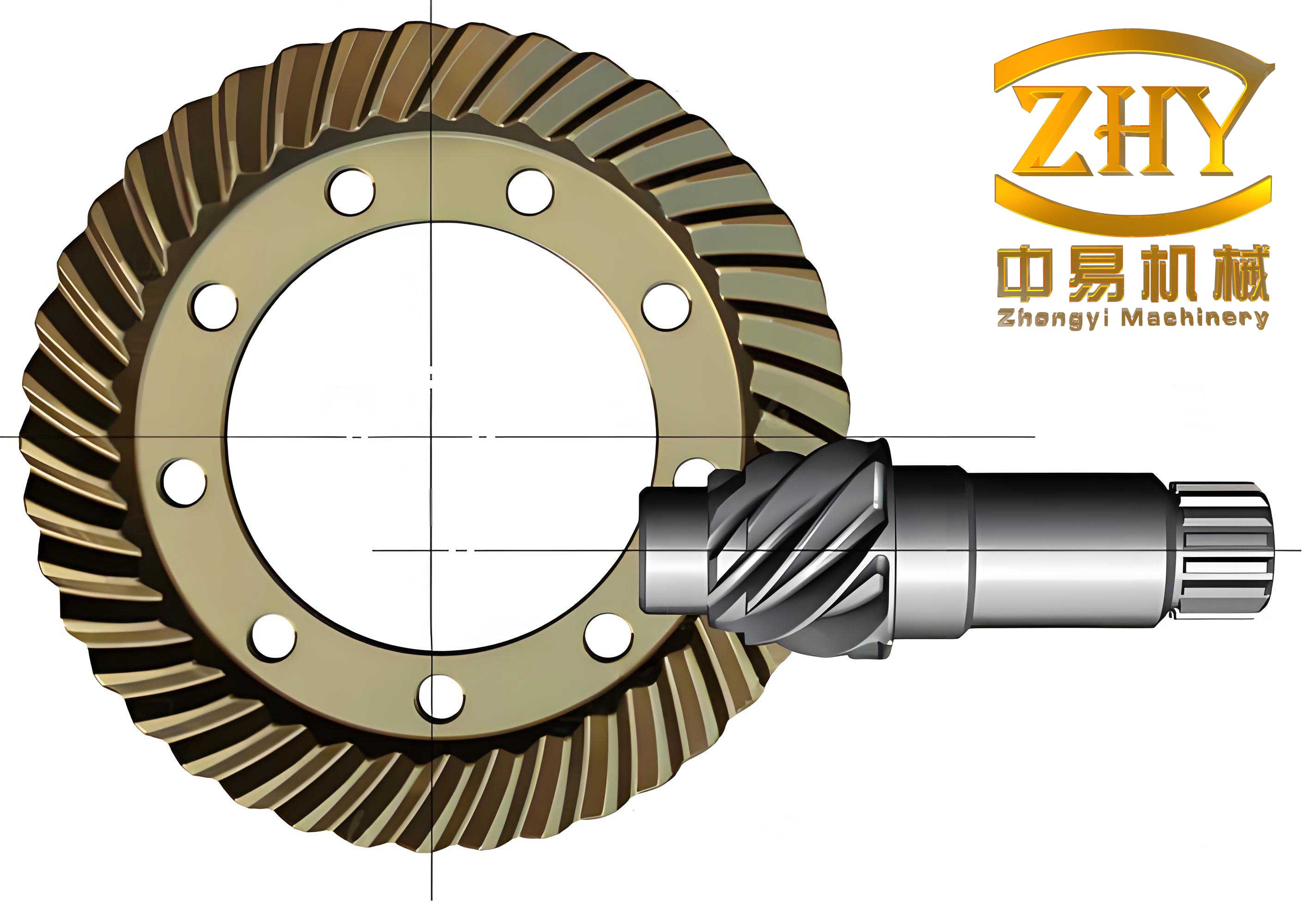
The primary objective of my optimization model is to minimize the overall volume of the hypoid gear pair. This target is crucial for applications like compact machinery, aerospace components, or the KZ32-19 pneumatic steel strapping machine mentioned in prior work, where weight and space are at a premium. The volume is approximated by calculating the combined volume of the two truncated cones defined by the gear blanks from the toe to the heel, based on the pitch circles. The objective function is formulated as follows:
$$ F(\mathbf{x}) = f_1(\mathbf{x}) + f_2(\mathbf{x}) = \frac{\pi}{3} b \cos \delta_1 \left[ \left( \frac{m_{e} Z_1}{2} \right)^2 + \left( \frac{m_{e} Z_1}{2} \cdot \frac{R-b}{R} \right)^2 + \left( \frac{m_{e} Z_1}{2} \right) \left( \frac{m_{e} Z_1}{2} \cdot \frac{R-b}{R} \right) \right] + \frac{\pi}{3} b \cos \delta_2 \left[ \left( \frac{m_{e} Z_2}{2} \right)^2 + \left( \frac{m_{e} Z_2}{2} \cdot \frac{R-b}{R} \right)^2 + \left( \frac{m_{e} Z_2}{2} \right) \left( \frac{m_{e} Z_2}{2} \cdot \frac{R-b}{R} \right) \right] $$
where:
- $f_1(\mathbf{x}), f_2(\mathbf{x})$ are the volumes of the pinion and gear, respectively.
- $b$ is the face width.
- $R$ is the pitch cone distance.
- $m_e$ is the outer module.
- $Z_1, Z_2$ are the numbers of teeth on the pinion and gear.
- $\delta_1, \delta_2$ are the pitch angles.
The design variables for optimizing a hypoid gear set are carefully selected from parameters that are not fixed by primary design inputs like torque, speed, ratio, or offset. The active design variables and their engineering implications are summarized below:
| Design Variable | Symbol | Engineering Influence & Trade-offs |
|---|---|---|
| Outer Module / Gear Pitch Diameter | $m_e$ | Primary factor for contact strength. A larger $m_e$ increases contact area, reducing contact stress but increasing gear volume. Can be compensated by reducing the outer diameter or increasing the back cone angle. |
| Face Width | $b$ | Increases contact area, potentially lowering contact stress. However, excessive width leads to a thin tooth at the toe, causing manufacturing difficulties and increasing risk of failure under load concentration. Also affects assembly space. |
| Mean Spiral Angle | $\beta_m$ | A highly active variable. A larger $\beta_m$ improves smoothness and contact ratio but increases axial thrust and sliding. A smaller $\beta_m$ increases the normal module, reduces sliding, improves efficiency, and increases tooth bending strength, but may reduce the contact line length and contact area. |
| Pinion Tooth Number | $Z_1$ | Affects gear ratio, smoothness, and size. Fewer teeth reduce overlap ratio and increase noise. More teeth increase volume for a given module. |
| Mean Working Depth Coefficient | $K$ | Governs the meshing depth at the midpoint. Increasing $K$ enlarges the working depth, increasing the potential contact area and lowering contact stress, thus improving contact strength. |
| Tangential Addendum Modification Coefficient | $x_t$ | Used for strength balancing between the pinion and gear. A positive $x_t$ increases pinion tooth thickness while decreasing gear tooth thickness proportionally, promoting equal service life. |
The constraints in hypoid gear design are not sharp, binary conditions but possess a transition zone from fully allowable to fully forbidden. My model treats these as fuzzy sets. The constraints include performance limits (stresses) and geometric boundaries, all denoted with a tilde (~) to indicate fuzziness.
1. Performance Constraints:
• Contact Stress Constraint (based on standards like GB10062-88):
$$ \sigma_H = Z_H Z_E Z_\epsilon Z_\beta Z_K \sqrt{ \frac{K_A K_V K_{H\alpha} K_{H\beta} F_{mt}}{d_{m1} b_{eH}} \cdot \frac{\sqrt{u^2 + 1}}{u} } \leq \tilde{\overline{\sigma}}_{HP} $$
• Bending Stress Constraint (for pinion and gear):
$$ \sigma_F = \frac{F_{mt}}{b_{eF} m_{mn}} Y_{F\alpha} Y_{S\alpha} Y_\epsilon Y_\beta Y_K K_A K_V K_{F\alpha} K_{F\beta} \leq \tilde{\overline{\sigma}}_{FP} $$
2. Geometric & Side Constraints:
$$ m_e \geq \underset{\sim}{3} $$
$$ \underset{\sim}{4}m_e \leq b \leq \underset{\sim}{10}m_e \quad \text{and} \quad b \leq \underset{\sim}{\frac{1}{3}} R_e $$
$$ \underset{\sim}{35^\circ} \leq \beta_m \leq \underset{\sim}{50^\circ} $$
$$ \underset{\sim}{40} \leq Z_1 + Z_2 \leq \underset{\sim}{60} $$
$$ \underset{\sim}{3.5} \leq K \leq \underset{\sim}{4.0} $$
$$ \underset{\sim}{\underline{X}_t} \leq x_t \leq \underset{\sim}{\overline{X}_t} $$
The boundaries $\underline{X}$ and $\overline{X}$ represent the lower and upper limits of the transition interval. Their specific values are determined by fuzzy statistical methods, considering factors like design standards, manufacturing capability, material quality, and operational criticality.
To mathematically handle these fuzzy constraints, I employ linear membership functions, which define the degree of satisfaction ($\mu$) for a given constraint value. For a performance constraint like stress, where “smaller is better,” the membership function is defined as:
$$ \mu_{\sigma} =
\begin{cases}
1, & \sigma \leq \overline{\sigma}^L \\
\dfrac{\overline{\sigma}^U – \sigma}{\overline{\sigma}^U – \overline{\sigma}^L}, & \overline{\sigma}^L < \sigma < \overline{\sigma}^U \\
0, & \sigma \geq \overline{\sigma}^U
\end{cases} $$
Here, $\overline{\sigma}^L$ is the stress value at which membership is fully 1 (completely allowable), and $\overline{\sigma}^U$ is the stress value at which membership drops to 0 (completely forbidden). The interval $[\overline{\sigma}^L, \overline{\sigma}^U]$ is the fuzzy transition zone.
For geometric and side constraints, which have both lower and upper fuzzy limits, the membership function is piecewise linear:
$$ \mu_{x} =
\begin{cases}
\dfrac{x – \underline{X}^L}{\underline{X}^U – \underline{X}^L}, & \underline{X}^L \leq x \leq \underline{X}^U \\
1, & \underline{X}^U \leq x \leq \overline{X}^L \\
\dfrac{\overline{X}^U – x}{\overline{X}^U – \overline{X}^L}, & \overline{X}^L \leq x \leq \overline{X}^U \\
0, & \text{otherwise}
\end{cases} $$
Where $\underline{X}^L, \underline{X}^U$ are the lower and upper bounds of the fuzzy lower limit, and $\overline{X}^L, \overline{X}^U$ are the bounds of the fuzzy upper limit.
The complete fuzzy optimization model for the hypoid gear is:
$$ \text{Find: } \mathbf{x} = [m_e, b, \beta_m, Z_1, K, x_t]^T = [x_1, x_2, x_3, x_4, x_5, x_6]^T $$
$$ \text{Minimize: } F(\mathbf{x}) $$
$$ \text{Subject to: } \sigma_i(\mathbf{x}) \leq \tilde{\overline{\sigma}}_{ip} \quad (i=H, F_1, F_2) $$
$$ \quad \quad \quad \quad \underset{\sim}{\underline{H}_j} \leq H_j(\mathbf{x}) \leq \underset{\sim}{\overline{H}_j} \quad (j=1,2) $$
$$ \quad \quad \quad \quad \underset{\sim}{\underline{x}_k} \leq x_k \leq \underset{\sim}{\overline{x}_k} \quad (k=1,2,…,6) $$
To solve this fuzzy model, I apply the optimal level-cut method. According to the decomposition theorem of fuzzy sets, a fuzzy set can be converted into a series of ordinary sets (level-cuts) at different membership levels $\lambda \in [0,1]$. A higher $\lambda$ represents a more conservative, safer design, while a lower $\lambda$ leans towards economy. The core task is to find an optimal $\lambda^*$ that balances both aspects. Using this method, the fuzzy model transforms into an equivalent non-fuzzy optimization model at the optimal level $\lambda^*$:
$$ \text{Find: } \mathbf{x} = [x_1, x_2, x_3, x_4, x_5, x_6]^T $$
$$ \text{Minimize: } F(\mathbf{x}) $$
$$ \text{Subject to: } \sigma_i(\mathbf{x}) \leq \overline{\sigma}_i^U – \lambda^*(\overline{\sigma}_i^U – \overline{\sigma}_i^L) \quad (i=H, F_1, F_2) $$
$$ H_j^L + \lambda^*(H_j^U – H_j^L) \leq H_j(\mathbf{x}) \leq H_j^U – \lambda^*(H_j^U – H_j^L) \quad (j=1,2) $$
$$ x_k^L + \lambda^*(x_k^U – x_k^L) \leq x_k \leq x_k^U – \lambda^*(x_k^U – x_k^L) \quad (k=1,2,…,6) $$
Determining the optimal $\lambda^*$ is itself a decision influenced by multiple fuzzy factors such as the consequence of failure, manufacturing maturity, and cost sensitivity. I employ a two-level fuzzy comprehensive evaluation to synthesize these factors. For a typical industrial hypoid gear application, this process yielded an optimal level value of $\lambda^* = 0.526$. The transition interval bounds (like $\overline{\sigma}^L, \overline{\sigma}^U$) are typically found by applying expansion coefficients of 0.80–0.95 to the deterministic lower bound and 1.05–1.30 to the deterministic upper bound, based on experimental and empirical data statistics.
With the model defined and $\lambda^*$ determined, I solve the non-fuzzy optimization problem (for both $\lambda=1$, representing conventional deterministic optimization, and $\lambda=\lambda^*=0.526$, representing fuzzy optimization) using the Complex Method, a direct search algorithm suitable for nonlinear constrained problems. Starting from an initial conventional design point, the optimization yields the following comparative results:
| Parameter | Symbol | Initial Design | Deterministic Optimum ($\lambda=1$) | Fuzzy Optimum ($\lambda^*=0.526$) | Fuzzy Optimum (Rounded) |
|---|---|---|---|---|---|
| Outer Module (mm) | $x_1 = m_e$ | 4.000 | 3.812 | 3.706 | 3.750 |
| Face Width (mm) | $x_2 = b$ | 30.000 | 32.074 | 32.781 | 32.800 |
| Mean Spiral Angle (°) | $x_3 = \beta_m$ | 45.000 | 41.368 | 38.139 | 38.000 |
| Pinion Tooth Count | $x_4 = Z_1$ | 12 | 11.468 | 11.104 | 11 |
| Depth Coefficient | $x_5 = K$ | 3.700 | 3.807 | 3.892 | 3.900 |
| Addendum Mod. Coeff. | $x_6 = x_t$ | 0.000 | 0.263 | 0.241 | 0.241 |
| Gear Pair Volume (mm³) | $F(\mathbf{x})$ | 107,187.179 | 86,642.190 | 74,284.915 | 74,877.408 |
The results clearly demonstrate the superiority of the fuzzy optimization approach for hypoid gear design. The fuzzy optimal solution achieves a remarkable volume reduction compared to both the initial and deterministically optimized designs. The percentage improvements are calculated as follows:
• Volume reduction of Fuzzy Optimum vs. Initial Design:
$$ \frac{F_0 – F^*}{F_0} \times 100\% = \frac{107187.179 – 74284.915}{107187.179} \times 100\% \approx 30.6\% $$
• Volume reduction of Deterministic Optimum vs. Initial Design:
$$ \frac{F_0 – F_1}{F_0} \times 100\% = \frac{107187.179 – 86642.190}{107187.179} \times 100\% \approx 19.2\% $$
• Superiority of Fuzzy over Deterministic Optimum:
$$ \frac{F_1 – F^*}{F_1} \times 100\% = \frac{86642.190 – 74284.915}{86642.190} \times 100\% \approx 14.2\% $$
Even after rounding the continuous variables (like tooth count) to practical manufacturing values, the fuzzy-optimized hypoid gear set still shows a substantial 30.1% volume reduction from the original design. This underscores the method’s robustness and practical utility.
The success of fuzzy optimization lies in its ability to formally incorporate the engineer’s experience and the real-world vagueness that deterministic methods ignore. By allowing constraints to be “soft” within a transition region, the algorithm explores a broader, more realistic design space. In this case, it found a design point with a smaller module, a slightly larger but permissible face width, and a significantly reduced spiral angle. This combination effectively minimizes material usage while still satisfying all strength and geometric requirements at an appropriate level of safety defined by $\lambda^*$.
In conclusion, the fuzzy optimization model I developed for minimizing the volume of hypoid gear pairs provides a powerful and practical design tool. It translates subjective engineering judgments into a rigorous mathematical framework, yielding designs that are significantly more economical than those from conventional or standard optimization methods. The core methodology—defining fuzzy constraints with membership functions and solving via the optimal level-cut approach—is highly versatile. It can be directly adapted for other critical objectives in hypoid gear design, such as maximizing efficiency, minimizing noise and vibration, or optimizing for durability, simply by changing the objective function and relevant constraints. This approach represents a meaningful step towards more intelligent and realistic computer-aided engineering for complex mechanical systems.