
In my experience as a mechanical engineer, I have often encountered the challenges associated with designing spiral bevel gears. These components are crucial in transmission systems due to their high重合度, reliability, and compact structure. However, their complex geometry necessitates significant time and effort in calculation and drafting. To address this, we developed a design system based on AutoCAD, leveraging二次开发 to automate and streamline the process. This system integrates tooth profile design, gear structure design, and standard drawing sheet creation, all within the familiar AutoCAD environment. Throughout this article, I will detail how our system works, emphasizing the use of formulas and tables to enhance accuracy and efficiency. The keyword ‘spiral bevel gear’ will be frequently mentioned as it is central to our discussion.
The inspiration for this project came from the widespread use of spiral bevel gears in industries such as automotive, aerospace, and heavy machinery. Despite advances in 3D modeling, 2D engineering drawings remain the standard for manufacturing. Therefore, we chose AutoCAD for its robust二次开发 capabilities and universal adoption. Our system utilizes ObjectARX2007 and Microsoft Visual Studio2005 to extend AutoCAD2007, enabling interactive design based on input parameters. This approach minimizes manual calculations and drafting, allowing designers to focus on functional aspects. In the following sections, I will explain each module of our system, starting with the drawing sheet layout design.
| Sheet Code | A0 | A1 | A2 | A3 | A4 |
|---|---|---|---|---|---|
| Sheet Dimensions B×L (mm) | 841×1189 | 594×841 | 420×594 | 297×420 | 210×297 |
| Border Dimensions a (mm) | 25 | ||||
| Border Dimensions c (mm) | 10 | 10 | 10 | 5 | 5 |
| Border Dimensions e (mm) | 20 | 20 | 20 | 10 | 10 |
In our design system, the drawing sheet module is essential for producing standardized engineering drawings. We incorporated common sheet sizes like A0, A1, A2, A3, and A4, with options for预留装订边 and不留装订边 formats. Additionally, to accommodate pre-printed sheets, we allowed for both X-type (short edge horizontal) and Y-type (long edge horizontal) orientations. The module sets the inner frame’s lower-left corner as the origin, calculates key point coordinates based on standard dimensions, and connects them with appropriate line types to form the frame. A generic title block is placed at the bottom-right corner, as shown in the interface. This automation saves considerable time, especially when multiple drawings are required for spiral bevel gear designs. The table above summarizes the dimensions, which are hard-coded into the system for quick retrieval.
Moving to the core of spiral bevel gear design, the tooth profile parameters must be meticulously calculated. Our system requires inputs such as pinion tooth count \(N_1\), gear tooth count \(N_2\), tooth width coefficient \(\phi_R\), module at the large end \(m_e\), and radial displacement coefficient \(x\). From these, we compute essential dimensions for drafting, including addendum, dedendum, and cone angles. The relationships are derived from established gear theory, ensuring accuracy for spiral bevel gears. Below, I present the key formulas used in our module:
The gear ratio is given by:
$$u = \frac{N_1}{N_2}$$
The pitch cone angle, critical for spiral bevel gear orientation, is:
$$\delta = \arctan\left(\frac{N_1}{N_2}\right)$$
The outer cone distance, which influences tooth width, is calculated as:
$$R_e = \frac{d_{e2}}{\sin\delta} = \frac{N_1 m_e}{2 \sin\left(\arctan\frac{N_1}{N_2}\right)} = \frac{1}{2} m_e \sqrt{N_1^2 + N_2^2}$$
The tooth width, a key parameter for spiral bevel gear strength, is:
$$b = \phi_R R_e = \frac{1}{2} \phi_R m_e \sqrt{N_1^2 + N_2^2}$$
The addendum at the large end, considering the addendum coefficient \(h_a^* = 0.85\) and displacement, is:
$$h_a = (h_a^* + x) m_e$$
The dedendum at the large end, with dedendum coefficient \(c^* = 0.188\), is:
$$h_f = (h_a^* + c^* – x) m_e$$
For the small end, the dedendum adjusts based on tooth width:
$$h_{f1} = h_f (1 – \phi_R)$$
And the addendum at the small end is:
$$h_{a1} = (h_a^* + c^* + x) m_e (1 – \phi_R) – c^* m_e$$
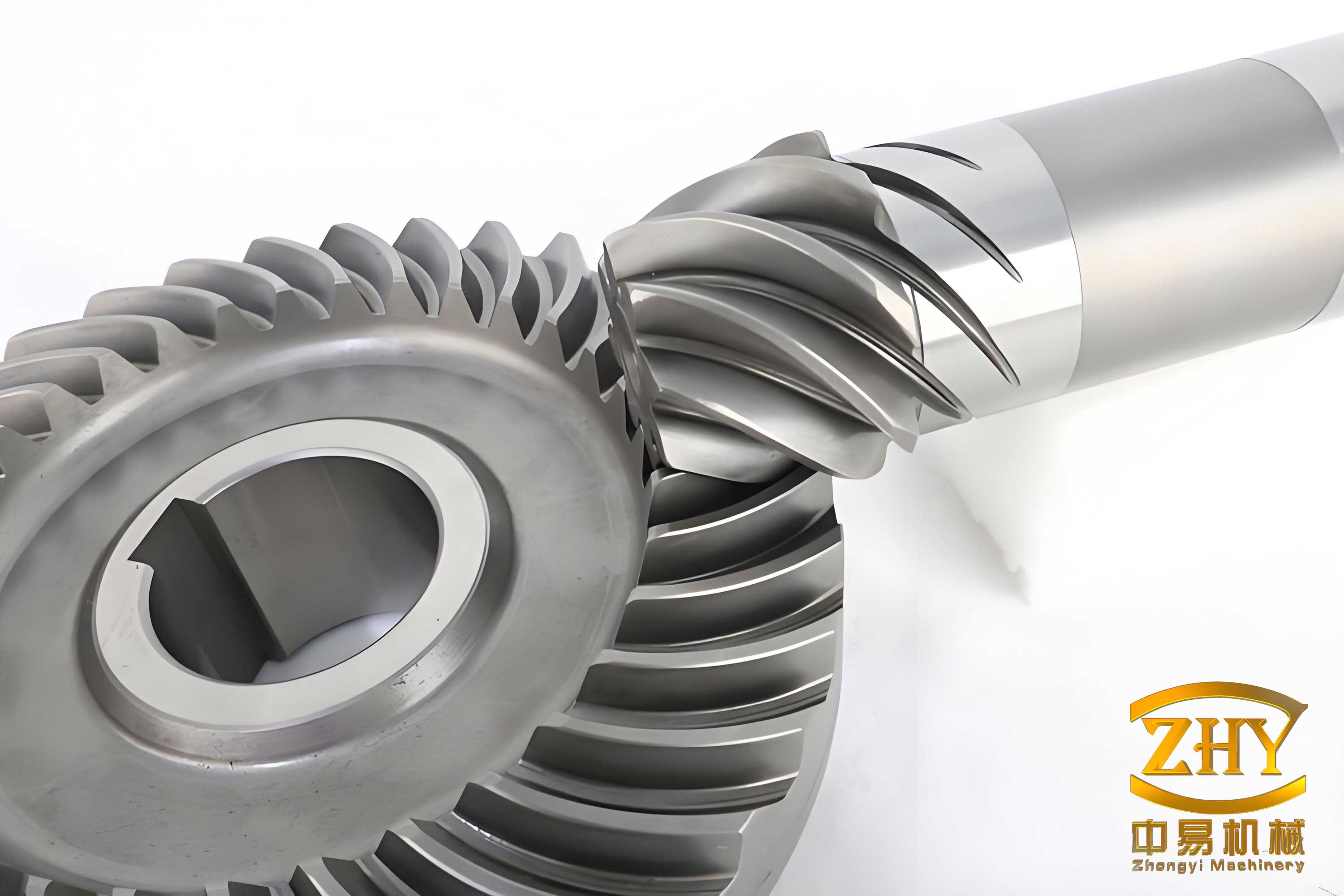
These formulas are embedded in our system to automatically generate dimensions for drafting. To visualize the spiral bevel gear tooth profile, we include an image below that illustrates the complex curvature typical of these gears.
Beyond tooth profile, the structure of the spiral bevel gear is vital for integration with shafts and overall mechanical integrity. Our system offers three common structural styles: gear shaft type, solid type, and combined type. The gear shaft type is used for small gears or pinions in large gear sets, where the gear and shaft are integrated. The solid type applies to gears with moderate sizes, providing robustness. The combined type, involving separate web and gear components, is suitable for large-diameter spiral bevel gears. Each style is designed to adapt to the tooth profile automatically, based on calculated parameters. For instance, in gear shaft designs, we check if the back face diameter satisfies \(L_{pt10pta10} \geq D + m_e\) to decide between standard and alternative configurations. Similarly, for solid types, warnings are issued if keyway proximity to the tooth root is insufficient. This flexibility ensures that our system caters to diverse application needs for spiral bevel gears.
The drafting methodology in our system relies on a coordinate-based approach to automate drawing. We define a coordinate system with an origin point O(0,0) and number key points on the spiral bevel gear, including those for tooth profile and structure. Using input parameters, the system computes relative coordinates for each point. For tooth profile, we first calculate points in a horizontal辅助 position, then rotate them by the pitch cone angle \(\delta\) to achieve the actual orientation. This reduces trigonometric errors and simplifies coding. The coordinates for辅助齿形 points are as follows, where \(X_i\) and \(Y_i\) represent coordinates for point \(i\):
$$X_0 = 0; \quad Y_0 = 0$$
$$X_5 = X_0 + R_e = X_0 + \frac{1}{2} m_e \sqrt{N_1^2 + N_2^2}; \quad Y_5 = 0$$
$$X_4 = X_5 – b = X_5 – \frac{1}{2} \phi_R m_e \sqrt{N_1^2 + N_2^2} = X_0 + \frac{1}{2} (1 – \phi_R) m_e \sqrt{N_1^2 + N_2^2}; \quad Y_4 = 0$$
$$X_3 = X_4 – m_e; \quad Y_3 = 0$$
$$X_6 = X_5 + m_e; \quad Y_6 = 0$$
$$X_1 = X_4; \quad Y_1 = Y_4 + h_{a1} = Y_4 + (h_a^* + c^* + x) m_e (1 – \phi_R) – c^* m_e$$
$$X_7 = X_4; \quad Y_7 = Y_4 – h_{f1} = Y_4 – (h_a^* + c^* – x) m_e (1 – \phi_R)$$
$$X_8 = X_5; \quad Y_8 = Y_5 + h_f = Y_5 – (h_a^* + c^* – x) m_e$$
$$X_2 = X_5; \quad Y_2 = Y_2 + h_a = Y_2 + (h_a^* + x) m_e$$
$$X_9 = X_7; \quad Y_9 = Y_7 – 0.5 m_e$$
$$X_{10} = X_8; \quad Y_{10} = Y_8 – 3.5 m_e$$
After rotation, the lower half points are derived using symmetry: \(Y_{ptai} = -Y_{pti}\) and \(X_{ptai} = X_{pti}\). For structural points, similar calculations are performed based on the chosen style. In combined types, dimensions like web thickness are adjustable, with default values set to \(L = b \cos\delta + 3 m_e \sin\delta\). The system also adjusts bolt hole placements, ensuring compliance with mechanical standards. Once all points are determined, lines are drawn using AutoCAD commands, and dimensions are automatically annotated. This method streamlines the creation of detailed drawings for spiral bevel gears, as shown in sample outputs.
To illustrate the practical application, consider the following table summarizing key design parameters for a typical spiral bevel gear set. This table is generated interactively in our system based on user inputs:
| Parameter | Symbol | Value | Unit |
|---|---|---|---|
| Pinion Tooth Count | \(N_1\) | 20 | – |
| Gear Tooth Count | \(N_2\) | 40 | – |
| Module at Large End | \(m_e\) | 5 | mm |
| Tooth Width Coefficient | \(\phi_R\) | 0.3 | – |
| Radial Displacement Coefficient | \(x\) | 0.2 | – |
| Pitch Cone Angle | \(\delta\) | 26.565° | degrees |
| Outer Cone Distance | \(R_e\) | 111.803 | mm |
| Tooth Width | \(b\) | 33.541 | mm |
In conclusion, our AutoCAD-based design system for spiral bevel gears significantly enhances design efficiency by automating calculations and drafting. The integration of tooth profile and structural design modules, along with standard drawing sheets, provides a comprehensive tool for engineers. By reducing manual effort, it allows for more focus on optimization and innovation in spiral bevel gear applications. Future improvements could include support for more gear types or integration with finite element analysis. Nonetheless, this system represents a step forward in CAD二次开发 for mechanical design, particularly for complex components like spiral bevel gears. I believe that such tools are essential for advancing manufacturing industries, where precision and time savings are paramount.
Throughout this article, I have emphasized the importance of spiral bevel gears in modern machinery and how our system addresses their design complexities. The use of formulas, tables, and automated drafting ensures accuracy and consistency. As a developer, I have seen firsthand how this system reduces errors and speeds up project timelines. For anyone working with spiral bevel gears, leveraging such二次开发 solutions can be transformative. I encourage further exploration of AutoCAD’s capabilities to tailor tools for specific needs, always keeping in mind the critical role of spiral bevel gears in transmission systems.
Finally, it is worth noting that while our system is built on AutoCAD2007, the principles apply to newer versions with updated APIs. The object-oriented approach in ObjectARX allows for scalable and maintainable code. As spiral bevel gear designs evolve, our system can be extended to incorporate new standards or manufacturing constraints. This adaptability is key to its long-term utility. In summary, by combining theoretical gear design with practical CAD automation, we have created a robust platform for designing spiral bevel gears, contributing to more efficient engineering processes.