
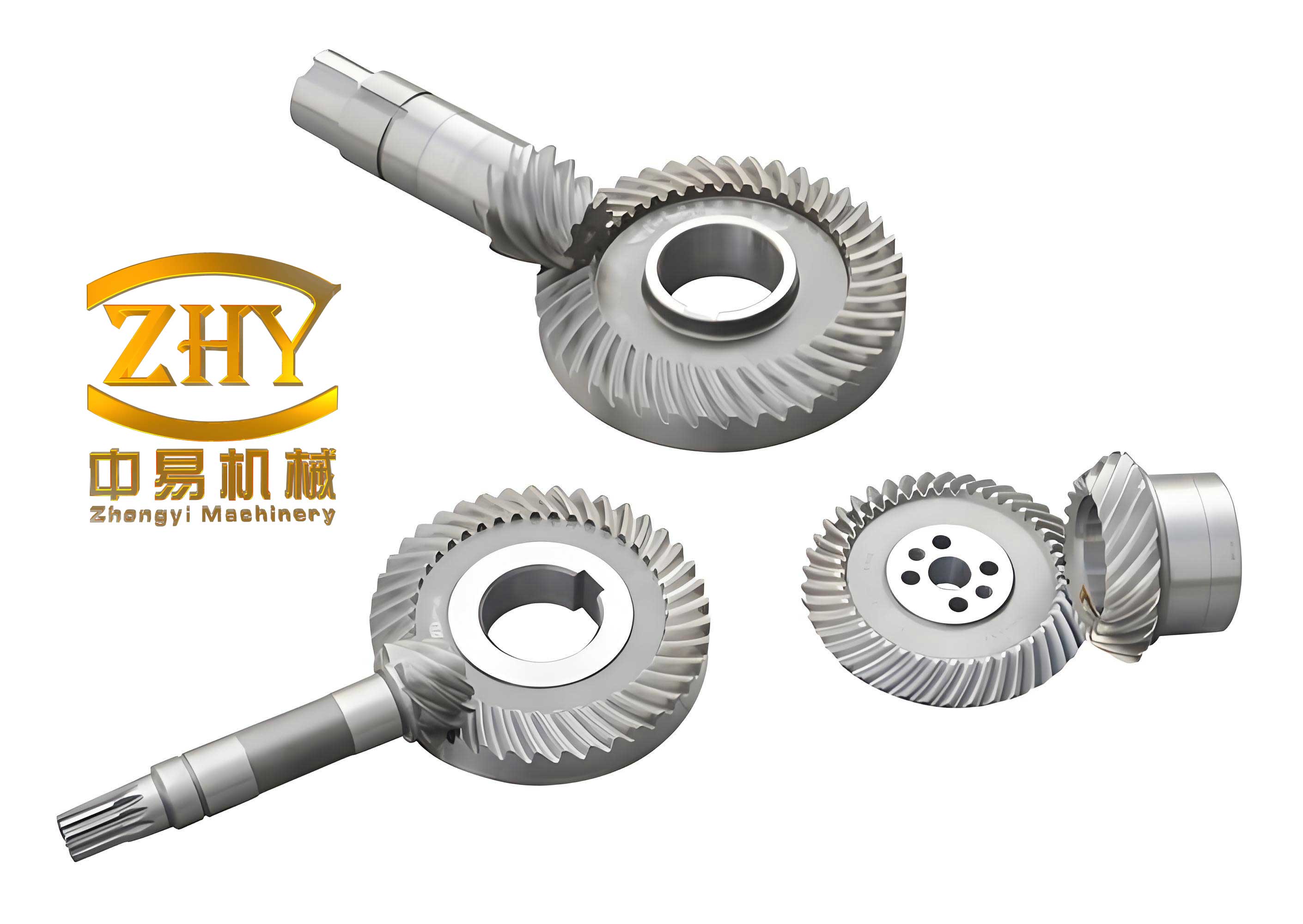
In the field of mechanical transmission, hypoid gears play a critical role due to their superior dynamic performance and ability to handle high loads with smooth operation. Traditionally, the manufacturing of hypoid gears has been a complex and time-consuming process, heavily reliant on specialized machinery and extensive trial-and-error adjustments. The intricate geometry of hypoid gear tooth surfaces requires precise control over cutting parameters, and conventional methods involve numerous iterative steps of cutting, testing, and parameter tuning. This not only prolongs the production cycle but also demands high expertise from operators, leading to increased costs and inefficiencies. However, the advent of numerical control (NC) technology and computer-aided design (CAD) has revolutionized this domain. By integrating CAD into the NC manufacturing process, it is possible to simulate cutting operations, perform virtual tooth contact analysis, and optimize parameters before physical machining. This approach significantly reduces the dependency on empirical adjustments, minimizes trial cuts, and accelerates the design-to-production timeline. In this article, I will delve into the application of CAD in the numerical control manufacturing of hypoid gears, covering system architecture, motion transformation algorithms, graphical simulation techniques, and advanced tooth contact analysis methods. The focus will be on demonstrating how these computational tools enhance precision, flexibility, and efficiency in hypoid gear production.
The integration of CAD into hypoid gear manufacturing begins with a structured system that replaces traditional manual adjustments with digital workflows. A typical computer-aided design and manufacturing system for hypoid gears consists of several interconnected modules: gear blank design, cutting parameter calculation, NC motion transformation, graphical simulation, and tooth contact analysis. Unlike conventional processes where physical trial cuts are essential, this system uses virtual simulations to predict outcomes and refine parameters. The core idea is to generate initial cutting parameters based on design specifications, such as gear dimensions and tooth geometry. These parameters are then converted into tool path data through NC motion transformation, which defines the relative movements between the cutting tool and the workpiece. Subsequently, a graphical simulation module visually replicates the cutting process, allowing for collision detection and program verification without material waste. Finally, a tooth contact analysis module evaluates the meshing behavior of the gear pair under simulated conditions, providing insights into contact patterns and transmission errors. If the results are unsatisfactory, feedback loops enable parameter adjustments until optimal performance is achieved. This closed-loop system ensures that the final NC code sent to the machine tool produces high-quality hypoid gears with minimal physical iterations. The entire framework underscores the shift from experience-based craftsmanship to data-driven manufacturing, leveraging computational power to handle the complexities of hypoid gear geometry.
To facilitate understanding, I summarize the key components of the CAD system for hypoid gear manufacturing in the following table:
| Module | Function | Output |
|---|---|---|
| Gear Blank Design | Calculates basic gear dimensions and tooth form based on design requirements. | Gear blank specifications and initial cutting parameters. |
| Cutting Parameter Calculation | Determines machine adjustment settings (e.g., tool inclination, offset) for tooth generation. | Set of adjustment parameters for traditional or NC machines. |
| NC Motion Transformation | Converts adjustment parameters into tool position and orientation data relative to the workpiece. | Tool path files (e.g., cutter location data) suitable for NC programming. |
| Graphical Simulation | Simulates the cutting process in 3D using computer graphics, enabling visual verification. | Visual representation of gear teeth and detection of potential errors or collisions. |
| Tooth Contact Analysis | Analyzes the meshing of gear pairs virtually to assess contact patterns and transmission errors. | Contact ellipse diagrams and transmission error curves for performance evaluation. |
The transformation of cutting parameters into NC-compatible tool paths is a fundamental step in the digital manufacturing of hypoid gears. In traditional gear cutting machines, complex mechanical linkages control the relative motion between the cutter and the workpiece. However, in NC systems, these motions are governed by programmed instructions derived from mathematical models. The NC motion transformation module computes the tool’s position and orientation—referred to as tool location—based on adjustment parameters such as tool inclination angles, offset distances, and workpiece rotations. For hypoid gears, this involves defining coordinate systems attached to the machine bed and the workpiece, and then applying homogeneous transformation matrices to express tool movements. Consider a setup where the tool cutter is represented in a machine coordinate system $\Sigma_m = \{O – \mathbf{i}_m, \mathbf{j}_m, \mathbf{k}_m\}$, and the workpiece in a coordinate system $\Sigma_w = \{O_o – \mathbf{i}_w, \mathbf{j}_w, \mathbf{k}_w\}$. Key adjustment parameters include the tool inclination angle $i$, tool rotation angle $j$, workpiece axis direction $\mathbf{P}$, root cone installation angle $\delta_m$, offset distance $E$, axial correction $x$, bed distance $x_b$, angular tool position $q$, and radial tool position $S$. The tool center position $\mathbf{R}_m$ and tool axis direction $\mathbf{c}_m$ in $\Sigma_m$ are given by:
$$
\mathbf{R}_m = \begin{bmatrix} S \cos q \\ 0 \\ S \sin q \\ 1 \end{bmatrix}, \quad \mathbf{c}_m = \begin{bmatrix} \sin i \sin (q – j) \\ \sin i \cos (q – j) \\ -\cos i \\ 0 \end{bmatrix}.
$$
To express these in the workpiece coordinate system $\Sigma_w$, we use transformation matrices. First, define an intermediate coordinate system $\Sigma’_m = \{O_o – \mathbf{i}’_m, \mathbf{j}’_m, \mathbf{k}’_m\}$ aligned with the workpiece axis. The transformation from $\Sigma_m$ to $\Sigma’_m$ is:
$$
\mathbf{M}_{mm’} = \begin{bmatrix}
\cos \delta_m & 0 & \sin \delta_m & -x – x_b \sin \delta_m \\
0 & 1 & 0 & E \\
-\sin \delta_m & 0 & \cos \delta_m & -x_b \cos \delta_m \\
0 & 0 & 0 & 1
\end{bmatrix}.
$$
Then, the transformation from $\Sigma’_m$ to $\Sigma_w$ involves a rotation by the workpiece angle $\phi$:
$$
\mathbf{M}_{m’w} = \begin{bmatrix}
1 & 0 & 0 & 0 \\
0 & \cos \phi & -\sin \phi & 0 \\
0 & \sin \phi & \cos \phi & 0 \\
0 & 0 & 0 & 1
\end{bmatrix}.
$$
The tool location in the workpiece coordinate system is then computed as:
$$
\mathbf{R}_w = \mathbf{M}_{m’w} \mathbf{M}_{mm’} \mathbf{R}_m, \quad \mathbf{c}_w = \mathbf{M}_{m’w} \mathbf{M}_{mm’} \mathbf{c}_m.
$$
These equations yield the tool path data essential for NC programming. The relationship between $q$ and $\phi$ depends on the generation method, such as tool tilting or modified roll techniques. By automating these calculations, the NC motion transformation module ensures accurate and flexible tool positioning, which is crucial for machining the complex curved surfaces of hypoid gears. This mathematical foundation allows for the generation of precise NC code, enabling multi-axis machining centers to produce hypoid gears with high consistency.
Graphical simulation of the hypoid gear cutting process provides a powerful tool for visualizing and verifying NC programs before actual machining. This simulation leverages computer graphics techniques to create a virtual representation of the workpiece and the cutting tool, and then performs Boolean subtraction operations to simulate material removal. The core algorithms involve constructing a Z-buffer model of the workpiece and generating the swept volume of the moving cutter. The Z-buffer, a common depth-buffering technique in computer graphics, represents the workpiece as a grid of depth values along viewing rays. Each grid point stores the distance to the workpiece surface, allowing efficient rendering and Boolean operations. For hypoid gear simulation, the workpiece is initially modeled as a solid gear blank, and the cutter is represented as a rotating tool that moves along the computed tool paths. The swept volume of the cutter—the region of space it covers during motion—is calculated using analytical methods based on the tool geometry and trajectory. Then, a Boolean subtraction operation removes the swept volume from the workpiece model, updating the Z-buffer to reflect the newly cut tooth surfaces. This process is repeated for each cutting pass, gradually shaping the hypoid gear teeth. The simulation enables detection of potential issues such as tool collisions, gouging, or incomplete cuts, thereby allowing programmers to correct NC code virtually. Moreover, with advanced lighting models like Phong shading, realistic 3D visuals can be generated, enhancing the user’s ability to inspect the gear geometry. The benefits are substantial: it eliminates costly physical trial cuts, reduces material waste, and shortens lead times. For hypoid gears, where tooth surfaces are highly sensitive to cutting parameters, graphical simulation ensures that the NC program produces the desired tooth form without errors.
Tooth contact analysis (TCA) is a critical aspect of hypoid gear design and manufacturing, as it predicts the meshing behavior and performance of gear pairs under load. Traditional TCA methods rely on analytical tooth surface equations derived from generation principles, but these can be limiting when dealing with measured or simulated tooth surfaces. In CAD-integrated systems, a more general approach called fitted tooth contact analysis is used. This method involves sampling points from the tooth surfaces—obtained from simulation, coordinate measuring machines (CMM), or theoretical equations—and fitting them with a mathematical representation, such as B-spline surfaces. For hypoid gears, the tooth surface is typically sampled uniformly: for example, 9 points along the tooth length direction (parameter $u$) and 5 points along the tooth height direction (parameter $v$). To avoid boundary effects, additional points are often included, resulting in 11 points in the $u$ direction and 7 points in the $v$ direction. The sampled points are then fitted using a bicubic B-spline surface, expressed as:
$$
\mathbf{S}_i(u, v) = \mathbf{U}(u) \mathbf{M}_s \mathbf{CP}_i \mathbf{M}_t^T \mathbf{V}(v)^T,
$$
where $\mathbf{U}(u) = [u^3, u^2, u, 1]$, $\mathbf{V}(v) = [v^3, v^2, v, 1]$, $\mathbf{M}_s$ and $\mathbf{M}_t$ are basis matrices for cubic B-splines, and $\mathbf{CP}_i$ is a $4 \times 4$ matrix of control points derived from the sampled data. This representation allows for smooth and continuous tooth surfaces, facilitating subsequent contact calculations. The surface normal at any point is computed as the cross product of partial derivatives:
$$
\mathbf{N}_i = \frac{\partial \mathbf{S}_i}{\partial u} \times \frac{\partial \mathbf{S}_i}{\partial v} \bigg/ \left\| \frac{\partial \mathbf{S}_i}{\partial u} \times \frac{\partial \mathbf{S}_i}{\partial v} \right\|.
$$
Once the tooth surfaces of both the pinion and gear are fitted, the contact point between them is determined by solving a system of equations that ensures positional and normal vector alignment during meshing. Assuming the pinion is fixed and the gear rotates, for a given pinion rotation angle $\phi_1$, the corresponding gear rotation angle $\phi_2$ and contact point parameters $(u_1, v_1)$ and $(u_2, v_2)$ are found iteratively. The conditions for contact are:
$$
\mathbf{R}_1 = \mathbf{M}(\phi_2, \mathbf{P}_2) \otimes \mathbf{R}_2, \quad \mathbf{N}_1 = \mathbf{M}(\phi_2, \mathbf{P}_2) \otimes \mathbf{N}_2,
$$
where $\mathbf{R}_1$ and $\mathbf{R}_2$ are position vectors, $\mathbf{N}_1$ and $\mathbf{N}_2$ are unit normal vectors, and $\mathbf{M}(\phi_2, \mathbf{P}_2)$ denotes a rotation matrix around the gear axis $\mathbf{P}_2$ by angle $\phi_2$. This nonlinear system is solved using numerical methods, with initial guesses taken from previous contact points to ensure convergence. After finding a contact point, the contact ellipse—representing the area of contact under load—is calculated based on surface curvatures. The first and second fundamental forms of the surfaces provide the necessary curvature information. For a surface $\mathbf{S}_i$, the first fundamental form coefficients are:
$$
E_i = \left\| \frac{\partial \mathbf{S}_i}{\partial u} \right\|^2, \quad F_i = \frac{\partial \mathbf{S}_i}{\partial u} \cdot \frac{\partial \mathbf{S}_i}{\partial v}, \quad G_i = \left\| \frac{\partial \mathbf{S}_i}{\partial v} \right\|^2.
$$
The second fundamental form coefficients are:
$$
L_i = \mathbf{N}_i \cdot \frac{\partial^2 \mathbf{S}_i}{\partial u^2}, \quad M_i = \mathbf{N}_i \cdot \frac{\partial^2 \mathbf{S}_i}{\partial u \partial v}, \quad N_i = \mathbf{N}_i \cdot \frac{\partial^2 \mathbf{S}_i}{\partial v^2}.
$$
From these, the normal curvatures $K_{ui}$ and $K_{vi}$ along the $u$ and $v$ directions, and the geodesic torsions $\tau_{ui}$ and $\tau_{vi}$, are derived. Using Euler’s and Bertrand’s formulas, the relative curvatures between the pinion and gear surfaces are computed, leading to the principal relative curvatures $K_1$ and $K_2$. The dimensions of the contact ellipse are then given by:
$$
L_1 = \sqrt{\frac{0.0127}{|K_1|}}, \quad L_2 = \sqrt{\frac{0.0127}{|K_2|}},
$$
where $L_1$ and $L_2$ are the semi-major and semi-minor axes, respectively, assuming a load of 0.0127 units (e.g., inches or millimeters). The orientation of the ellipse is determined from the principal directions. This analysis produces contact patterns that can be visualized as elliptical areas on the tooth surface, indicating how the hypoid gear pair will mesh in reality. Additionally, the transmission error—the deviation from ideal uniform motion—is calculated as the difference between the actual gear rotation and the theoretical rotation based on the gear ratio. Plotting transmission error against rotation angle yields curves that reveal the dynamic performance of the hypoid gears, such as noise and vibration characteristics. By iteratively adjusting cutting parameters based on TCA results, designers can optimize tooth contact for desired traits like low noise, high strength, or efficient power transmission.
The application of CAD in hypoid gear manufacturing extends beyond simulation to include optimization and quality control. For instance, the fitted tooth contact analysis method is particularly valuable when dealing with measured tooth surfaces from CMM data. After machining a hypoid gear, CMM measurements can be taken to capture actual tooth geometry, which may deviate from theoretical designs due to machine errors or tool wear. By fitting B-spline surfaces to this measured data and performing TCA, manufacturers can assess the quality of produced gears and identify necessary corrections. This feedback loop enhances process control and ensures consistent production of high-precision hypoid gears. Moreover, the integration of CAD with NC systems enables adaptive manufacturing strategies. For example, tool path corrections can be automatically generated based on TCA results to compensate for errors, reducing the need for manual intervention. The table below summarizes the advantages of CAD-driven hypoid gear manufacturing compared to traditional methods:
| Aspect | Traditional Manufacturing | CAD-Integrated NC Manufacturing |
|---|---|---|
| Parameter Adjustment | Relies on operator experience and physical trial cuts. | Based on virtual simulations and computational analysis. |
| Design Cycle | Long due to iterative cutting and testing. | Shortened through digital prototyping and feedback loops. |
| Cost | High due to material waste and machine downtime. | Reduced by minimizing physical iterations and optimizing tool paths. |
| Precision | Variable, dependent on skill and machine condition. | Consistently high, enabled by precise NC control and simulation. |
| Flexibility | Limited to specific machine setups and tooling. | High, as NC programs can be easily modified for different designs. |
In conclusion, the integration of computer-aided design into the numerical control manufacturing of hypoid gears represents a significant advancement in gear production technology. By leveraging algorithms for NC motion transformation, graphical simulation, and fitted tooth contact analysis, manufacturers can overcome the complexities associated with hypoid gear geometry. The use of mathematical models, such as homogeneous transformation matrices and B-spline surface fitting, provides a robust foundation for generating accurate tool paths and predicting gear performance. Graphical simulation eliminates the need for costly trial cuts, while tooth contact analysis enables optimization of meshing behavior before physical machining. This CAD-driven approach not only reduces reliance on empirical expertise but also enhances efficiency, precision, and flexibility in hypoid gear production. As NC technology continues to evolve, further integration with CAD systems will likely enable even more sophisticated manufacturing capabilities, such as real-time adaptive control and digital twin simulations. Ultimately, the synergy between CAD and NC paves the way for smarter, more responsive manufacturing processes that meet the growing demands for high-performance hypoid gears in industries like automotive, aerospace, and heavy machinery. The ongoing development of these computational tools promises to make hypoid gear manufacturing more accessible, reliable, and cost-effective, driving innovation in mechanical transmission systems.
To further illustrate the mathematical details, let me expand on the curvature calculations used in tooth contact analysis for hypoid gears. The relative curvature between two surfaces at a contact point is essential for determining the contact ellipse. Given two surfaces $\mathbf{S}_1$ and $\mathbf{S}_2$ with respective curvatures, the relative normal curvature in a direction $\theta$ on the tangent plane is computed using the formula:
$$
K_{rel}(\theta) = K_1(\theta) – K_2(\theta),
$$
where $K_1(\theta)$ and $K_2(\theta)$ are the normal curvatures of the surfaces in that direction. From the fundamental forms, the normal curvature for a surface $\mathbf{S}_i$ in a direction defined by the differentials $du$ and $dv$ is:
$$
K_i = \frac{L_i du^2 + 2M_i du dv + N_i dv^2}{E_i du^2 + 2F_i du dv + G_i dv^2}.
$$
By aligning coordinate systems, the relative principal curvatures $K_1$ and $K_2$ can be found by solving the eigenvalue problem derived from the relative curvature matrix. This involves computing the relative curvature tensor, which combines the second fundamental forms of both surfaces. For hypoid gears, due to the complex surface geometry, these calculations are performed numerically within the CAD system. The resulting contact ellipse dimensions provide insights into load distribution and stress concentrations, which are critical for durability assessment. Additionally, the transmission error curve, which plots angular deviation versus rotation, is derived from the sequence of contact points. If $\Delta \phi_1$ and $\Delta \phi_2$ are the rotation increments of the pinion and gear from a reference position, the transmission error $\Delta \epsilon$ is given by:
$$
\Delta \epsilon = \Delta \phi_2 – \frac{Z_1}{Z_2} \Delta \phi_1,
$$
where $Z_1$ and $Z_2$ are the numbers of teeth. A smooth transmission error curve indicates minimal vibration and noise, which are key quality metrics for hypoid gears. By iteratively refining tooth surface modifications through CAD-based TCA, designers can achieve optimal transmission error characteristics, enhancing the overall performance of hypoid gear sets.
The future of hypoid gear manufacturing lies in the continued integration of CAD with emerging technologies like artificial intelligence and additive manufacturing. AI algorithms could be used to automatically optimize cutting parameters based on simulation data, further reducing human intervention. Additive manufacturing might enable rapid prototyping of hypoid gears for testing, though traditional cutting will remain dominant for mass production due to material strength requirements. Nonetheless, the core principles discussed here—digital simulation, precise motion control, and advanced contact analysis—will remain foundational. As computational power increases, real-time simulation and analysis will become more feasible, allowing for even faster design iterations. For hypoid gears, which are pivotal in applications requiring high torque and smooth motion, these advancements will ensure that they continue to meet evolving engineering challenges. The marriage of CAD and NC manufacturing not only streamlines production but also opens new possibilities for custom gear designs and performance optimization, solidifying the role of hypoid gears in modern machinery.