
In modern mechanical transmission systems, the pursuit of higher power density, reduced noise and vibration, and improved efficiency is relentless. Among various gear types, the helical gear stands out due to its inherent advantages of higher contact ratio, smoother engagement, and greater load-carrying capacity compared to spur gears. However, even with these benefits, unmodified helical gear pairs can suffer from undesirable dynamic excitations, edge loading, and excessive frictional losses, especially under heavy loads or misalignment conditions. To address these issues, tooth surface modification—the intentional deviation of the gear tooth surface from its perfect theoretical geometry—has become an indispensable part of high-performance gear design. While much research has focused on using modifications to minimize transmission error and contact stress, their significant impact on meshing efficiency, particularly frictional power loss, warrants deeper investigation. This analysis delves into the methodologies for profile, lead, and topological modifications of helical gears and establishes a comprehensive framework for modeling their frictional power loss under the practical and prevalent regime of mixed elastohydrodynamic lubrication (mixed-EHL).
Theoretical and numerical analysis forms the backbone of understanding gear behavior. The foundation for studying modified gears lies in Tooth Contact Analysis (TCA) and Loaded Tooth Contact Analysis (LTCA). TCA simulates the kinematic meshing of unloaded gear pairs, identifying the contact path, transmission error, and principal curvatures at potential contact points. LTCA extends this by solving the elastic contact problem under load, determining the real contact pattern, load distribution along the contact ellipse, and subsurface stresses. For a helical gear pair, the instantaneous contact is theoretically a line. Modifications and deflections under load transform this into a complex point contact or a shortened contact patch, making LTCA crucial for accurate performance prediction.
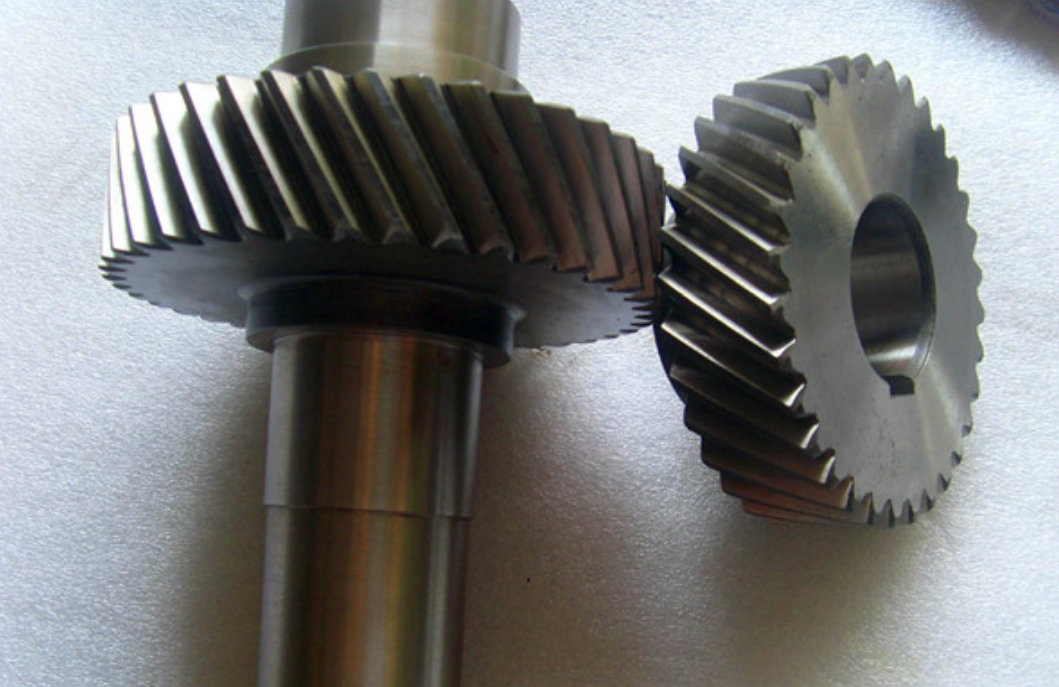
The geometry of a modified helical gear tooth surface is typically defined in the manufacturing process. Three primary modification strategies are employed:
1. Profile Modification (Tip/ Root Relief): This involves altering the tooth profile, primarily near the tip and root, to mitigate edge contacts and reduce mesh-in/mesh-out impacts. A common method uses a cutting tool with a curved cutting edge in its normal plane instead of a straight line. The modified profile can be represented in the tool coordinate system. If we define a coordinate system \( S_{c10}(x_{c10}, y_{c10}, z_{c10}) \) fixed to the cutting tool at the center of its face width, the tool surface vector for a circular arc profile modification is given by:
$$
\mathbf{r_{c10}} = \begin{bmatrix} u_1 \\ R – \sqrt{R^2 – u_1^2} \\ v_1 \\ 0 \end{bmatrix}
$$
where \( u_1 \) is the coordinate along the profile direction, \( v_1 \) is the coordinate along the lead direction, and \( R \) is the radius of the circular arc. A smaller \( R \) results in a larger modification amplitude. The modification is usually asymmetric, with less relief at the root than at the tip to preserve bending strength.
2. Lead Modification (Crowning): This modification alters the tooth surface along its face width to localize contact and accommodate misalignment or shaft deflection. A symmetric barrel-shaped (crowned) profile is often used, featuring a central straight portion and crowned ends. A fourth-order polynomial is a common choice for a smooth crown curve. The lead modification amount \( \delta \) at a distance \( L \) from the tooth center is defined as:
$$
\delta = \delta_{max} \left( \frac{L}{L_{max}} \right)^4
$$
where \( \delta_{max} \) is the maximum crown amount at the ends and \( L_{max} \) is the distance from the center to the start of the full crown.
3. Topological Modification: This is the most general form, combining both profile and lead modifications. It creates a fully three-dimensionally modified surface, often optimized to achieve a specific loaded contact pattern under prescribed operating conditions. For a helical gear, this can be achieved by employing a tool with a curved profile (for profile mod) and simultaneously moving the tool or workpiece along a crowned path during generation (for lead mod).
The frictional power loss in a gear mesh is primarily caused by sliding between the contacting tooth surfaces. The instantaneous frictional power loss \( W_f \) at a single contact point can be calculated as the product of the friction force and the sliding velocity:
$$
W_f(\psi) = \mu_{ML}(\psi) \cdot F_n(\psi) \cdot v_s(\psi)
$$
where \( \psi \) is the pinion rotation angle, \( \mu_{ML}(\psi) \) is the friction coefficient under mixed-EHL conditions, \( F_n(\psi) \) is the normal load at the contact point, and \( v_s(\psi) \) is the sliding velocity. For a helical gear pair with a contact ratio greater than one, multiple tooth pairs may be in contact simultaneously. The total instantaneous power loss \( W_{f,tot} \) is the sum over all \( m \) contacting pairs:
$$
W_{f,tot}(\psi) = \sum_{n=1}^{m} \mu_{ML, \psi, n}(\psi) \cdot F_{n, \psi, n}(\psi) \cdot v_{s, \psi, n}(\psi)
$$
The most critical and complex parameter in this equation is the friction coefficient \( \mu_{ML} \). Under realistic operating conditions, gears often operate in the mixed-EHL regime, where the load is carried partly by a fluid film and partly by asperity contact. The friction coefficient in this regime is commonly modeled as a weighted average of the boundary lubrication coefficient \( \mu_{BDR} \) and the full-film EHL coefficient \( \mu_{FL} \):
$$
\mu_{ML}(i) = \mu_{FL}(i) \cdot f_{\lambda}(i) + \mu_{BDR} \cdot [1 – f_{\lambda}(i)]
$$
The weighting function \( f_{\lambda}(i) \) depends on the film thickness ratio \( \lambda(i) \), which is the ratio of the central film thickness \( h_c(i) \) to the composite surface roughness \( R_a \):
$$
f_{\lambda}(i) = \frac{1.21 \lambda(i)^{0.64}}{1 + 0.37 \lambda(i)^{1.26}}, \quad \lambda(i) = \frac{h_c(i)}{R_a}
$$
For point contact in a modified helical gear, the central film thickness can be estimated using the Hamrock-Dowson formula:
$$
h_c(i) = 2.69 R_x(i) U(i)^{0.67} G^{0.53} Q(i)^{-0.067} (1 – 0.61e^{-0.73\kappa(i)}) \Phi_t(i)
$$
where:
\( R_x(i) \) is the effective radius of curvature at the contact point,
\( U(i) = \frac{\eta_0 v_r(i)}{E’ R_x(i)} \) is the dimensionless speed parameter,
\( G = \alpha E’ \) is the dimensionless materials parameter,
\( Q(i) = \frac{W(i)}{E’ R_x^2(i)} \) is the dimensionless load parameter,
\( \kappa(i) \) is the ellipticity ratio of the contact ellipse,
\( \Phi_t(i) \) is a thermal correction factor.
Here, \( v_r(i) \) is the rolling velocity, \( \eta_0 \) is the ambient viscosity, \( E’ \) is the effective elastic modulus, \( \alpha \) is the pressure-viscosity coefficient, and \( W(i) \) is the normal load.
The full-film EHL friction coefficient \( \mu_{FL} \) itself is a function of operating conditions. A widely used empirical formula is:
$$
\mu_{FL}(i) = e^{f(\dots)} P_h(i)^{b_2} |S_{r}(i)|^{b_3} v_e(i)^{b_6} \eta^{b_7} R_x(i)^{b_8}
$$
$$
f( \dots ) = b_1 + b_4 |S_{r}(i)| P_h(i) \log_{10}(\eta) + b_5 e^{-|S_{r}(i)| P_h(i) \log_{10}(\eta)} + b_9 R_a
$$
where \( S_{r}(i) = v_s(i)/v_r(i) \) is the slide-to-roll ratio, \( P_h(i) \) is the Hertzian contact pressure, \( v_e(i) \) is the entrainment velocity, \( \eta \) is the dynamic viscosity, and \( b_1 \) to \( b_9 \) are empirical constants.
To analyze the impact of different modifications, a case study is performed on a helical gear pair. The basic gear parameters and lubricant properties used in the simulation are summarized below:
| Parameter | Pinion | Gear |
|---|---|---|
| Number of Teeth | 30 | 45 |
| Normal Module (mm) | 6 | |
| Normal Pressure Angle (°) | 20 | |
| Helix Angle (°) | 15 (Right Hand) | |
| Face Width (mm) | Assume based on \( L_{max} \) | |
| Operating Pinion Speed (rpm) | 5000 | |
| Input Torque (Nm) | 450 | |
| Surface Roughness, \( R_a \) (μm) | 0.35 | |
| Lubricant (Environmental) Viscosity, \( \eta_0 \) (Pa·s) | 0.135 | |
| Pressure-Viscosity Coefficient, \( \alpha \) (GPa⁻¹) | 9.68 | |
Using TCA and LTCA, the key parameters for each potential contact point across the path of contact are extracted. For a helical gear with a theoretical contact ratio around 2, up to three tooth pairs may be in contact. The contact path on the pinion tooth surface is discretized into 15 potential contact points, representing the meshing sequence from root to tip. The analysis examines three distinct modification scenarios.
Scenario 1: Profile Modification Only. A circular arc profile modification is applied to the pinion. Two modification amplitudes are compared by setting the arc radius \( R \) to \( 150m_n \) and \( 250m_n \). The parameter \( c \) (the distance from the pitch point to the start of the modification curve) is fixed at 0.5 mm, resulting in more relief at the tip than the root.
| Observation | Result for Profile Modification |
|---|---|
| Load Distribution | Contact points at the very beginning and end of the theoretical path of contact (root and tip) carry negligible load, effectively reducing the number of concurrently loaded pairs from 3 to 2. |
| Film Thickness Ratio \( \lambda \) | The unloaded end points have a high \( \lambda \) (\( f_{\lambda} \approx 1 \)), indicating full-film conditions. The central loaded region operates in mixed-EHL with \( f_{\lambda} \) between 0.71 and 0.81. |
| Friction Coefficient \( \mu_{ML} \) | The unloaded points have near-zero friction. The variation in modification amplitude (R=150m_n vs. 250m_n) shows a minimal effect on the friction coefficient in the loaded zone. |
| Frictional Power Loss | The total power loss fluctuation over a mesh cycle is relatively small. The change in modification amplitude has a minor influence on the magnitude of the power loss. |
Scenario 2: Lead (Crowning) Modification Only. A symmetric fourth-order crowning is applied with a fixed \( \delta_{max} = 25 \mu m \) and two different crowning lengths: \( L_{max} = 0.1b \) and \( L_{max} = 0.5b \), where \( b \) is the face width.
| Observation | Result for Lead Modification |
|---|---|
| Load Distribution | A larger crowning length (\( L_{max}=0.5b \)) significantly localizes the contact, reducing the number of load-carrying contact points across the face width. The load on the central points increases while the load on points toward the edges decreases sharply. |
| Film Thickness Ratio \( \lambda \) | The edges are in full-film separation (\( f_{\lambda} = 1 \)). The central contact region operates in mixed-EHL with \( f_{\lambda} \) between 0.74 and 0.87. |
| Friction Coefficient \( \mu_{ML} \) | The friction coefficient is highest in the heavily loaded center of the contact path. The localized high pressure in the center with large crowning can increase \( \mu_{ML} \) there. |
| Frictional Power Loss | The change in crowning length has a pronounced effect. A larger \( L_{max} \) leads to greater fluctuation in instantaneous power loss over the mesh cycle. While loss may be lower at some roll angles (e.g., where sliding is minimal), it can be significantly higher at others due to the concentrated load, potentially adversely affecting transmission smoothness. |
Scenario 3: Topological Modification. This combines the profile modification (\( R=250m_n, c=0.5mm \)) with the lead crowning (\( \delta_{max} = 25 \mu m \)). The same two crowning lengths (\( L_{max}=0.1b \) and \( 0.5b \)) are analyzed.
| Observation | Result for Topological Modification |
|---|---|
| Load Distribution | Combines effects of both modifications: contact is avoided at the profile extremes (tip/root) and localized across the face width. |
| Film Thickness Ratio \( \lambda \) | Similar to individual cases, with full-film at unloaded edges and mixed-EHL (\( f_{\lambda} \approx 0.75-0.85 \)) in the central loaded region. |
| Frictional Power Loss | For a large crowning length (\( L_{max}=0.5b \)), the topological modification results in a lower fluctuation of power loss over the mesh cycle compared to the lead-only modification with the same \( L_{max} \). The profile modification helps manage the load transition more smoothly, mitigating some of the unfavorable fluctuations induced by severe crowning. |
The analysis reveals distinct trends regarding the influence of modification parameters for a helical gear on frictional power loss under mixed-EHL conditions. Profile modification, while essential for reducing engagement impact, shows a relatively minor direct influence on the magnitude and fluctuation of frictional losses. Its primary benefit for efficiency is indirect, via the favorable load distribution it promotes. In contrast, lead crowning parameters, especially the crowning length \( L_{max} \), have a decisive and non-linear impact. Excessive crowning, while useful for mitigating misalignment, can lead to highly localized contact, increased contact pressure, and consequently larger fluctuations in instantaneous friction and power loss, which may be detrimental to smooth operation and thermal management. Topological modification emerges as a more comprehensive strategy. By synergistically combining profile and lead corrections, it can achieve the desired localization and edge-load prevention while offering better control over the friction loss characteristics, particularly in reducing the undesirable power loss fluctuations associated with strong crowning alone.
The interplay between modification geometry, resultant load distribution (from LTCA), and the mixed-EHL friction model is complex. Modification changes the equivalent radius of curvature \( R_x \) at each contact point, which directly affects the predicted EHL film thickness \( h_c \) and the Hertzian pressure \( P_h \). These, in turn, influence the friction coefficient \( \mu_{ML} \) and the weighting function \( f_{\lambda} \). Furthermore, the sliding/rolling velocities vary along the path of contact, adding another layer of dependency. Therefore, the optimization of a helical gear tooth surface for minimum and stable frictional power loss requires a multi-disciplinary approach integrating precise geometrical modeling, accurate elastic contact analysis, and a realistic tribological model. Future work should focus on exploring higher-order lead modification curves and performing multi-objective optimization that simultaneously minimizes transmission error, contact pressure, and frictional power loss across the operational envelope of the helical gear drive.
In summary, the design of high-efficiency helical gear transmissions must carefully consider tooth surface modification not only as a tool for durability and noise reduction but also as a critical parameter for managing meshing efficiency. The mixed-EHL regime is the reality for most operating conditions, and models that account for it are essential for accurate predictions. This comprehensive analysis provides a framework and insights for engineers to balance the often-competing goals of load distribution, misalignment accommodation, and minimal frictional loss in advanced helical gear design.
| Symbol | Description |
|---|---|
| \( \mu_{ML}, \mu_{FL}, \mu_{BDR} \) | Friction coefficient (Mixed-EHL, Full-film EHL, Boundary) |
| \( f_{\lambda}, \lambda \) | Weighting function and Film thickness ratio |
| \( h_c \) | Central EHL film thickness |
| \( R_x \) | Effective radius of curvature |
| \( U, G, Q \) | Dimensionless speed, material, and load parameters |
| \( \kappa \) | Ellipticity ratio |
| \( S_r \) | Slide-to-roll ratio |
| \( v_r, v_s, v_e \) | Rolling, Sliding, and Entrainment velocity |
| \( P_h \) | Hertzian contact pressure |
| \( W_f \) | Frictional power loss |