
In my extensive experience within the metallurgical and mining sectors, the successful execution of large-scale Engineering, Procurement, and Construction (EPC) projects hinges on two fundamental pillars: meticulous schedule control and the deployment of highly reliable, efficient mechanical drive systems. This article, from my professional perspective, delves into the sophisticated application of Single-Code Overlap Network Planning for project scheduling and the transformative impact of modern helical gear-based减速电动机. I will explore these domains in detail, employing formulas and tables to crystallize key concepts, and consistently highlight the critical role of helical gear technology in advancing industrial machinery.
The cornerstone of effective project management in complex industrial environments like air separation plants is a dynamic and accurate schedule model. The Single-Code Overlap Network Planning method is particularly powerful as it explicitly models the intricate, overlapping logical relationships between consecutive tasks, which are commonplace in EPC work streams. Unlike traditional critical path methods, it accounts for various搭接 constraints such as Start-to-Start (SS), Finish-to-Start (FS), Start-to-Finish (SF), and Finish-to-Finish (FF) with specific time lags.
Let me define the core parameters. For any work activity i, we have its earliest start time $ES_i$, earliest finish time $EF_i$, latest start time $LS_i$, latest finish time $LF_i$, total float $TF_i$, and free float $FF_i$. The fundamental calculation logic, considering a搭接 relationship from activity i to activity j with a lag time $LAG_{ij}$, can be generalized. For a Start-to-Start relationship with a minimum lag $SS_{min}$, the constraint is:
$$ ES_j \geq ES_i + SS_{min} $$
Similarly, for a Finish-to-Start relationship with lag $FS_{min}$:
$$ ES_j \geq EF_i + FS_{min} $$
The forward pass calculation determines earliest times:
$$ ES_j = \max( \text{all applicable } (ES_i \text{ or } EF_i) + \text{corresponding lag}) $$
$$ EF_j = ES_j + D_j $$
where $D_j$ is the duration of activity j. The backward pass yields latest times:
$$ LF_i = \min( \text{all applicable } (LS_j \text{ or } LF_j) – \text{corresponding lag}) $$
$$ LS_i = LF_i – D_i $$
Total float for activity i is then:
$$ TF_i = LS_i – ES_i = LF_i – EF_i $$
Free float, the delay possible without affecting any immediate successor, requires careful evaluation based on the specific搭接 types to the succeeding activities.
| Deviation Condition (Δ = Actual Lag – Planned Lag) | Impact on Subsequent Tasks | Impact on Total Project Duration | Required Action |
|---|---|---|---|
| $Δ \leq TF_i$ (Total Float) | No Impact | No Impact | Monitor; no adjustment needed. |
| $TF_i < Δ \leq TF_i + FF_i$ (approx.) | Impacted | No Impact | Adjust resources for subsequent tasks if necessary. |
| $Δ > TF_i + FF_i$ | Severely Impacted | Impacted | Mandatory optimization: compress critical path后续 tasks. |
This tabular framework, derived from my project analyses, allows for rapid diagnosis. For instance, if a task’s actual progress lags behind its plan by a deviation Δ, comparing it to the calculated floats immediately reveals the severity. The true power lies in identifying the critical chain where total float is zero. Compressing durations on this chain, often involving long-lead equipment fabrication and installation, is paramount for recovery. In one air separation EPC project I managed, applying this model pinpointed that delays in the foundation work (which had a Finish-to-Start搭接 with a 5-day lag to structural steel erection) required immediate intervention on the subsequent compressor alignment tasks, which were on the critical path. The mathematical clarity of the network plan prevented misallocation of resources to non-critical activities.
Shifting focus to the physical hardware that such projects install and depend upon, the heart of countless material handling, mixing, and processing lines is the gear减速电动机. Here, the evolution of the helical gear design represents a quantum leap in performance. The inherent advantage of a helical gear over a spur gear is its angled teeth, which engage gradually rather than all at once. This leads to smoother operation, higher load capacity, and significantly reduced noise—a critical factor in mining and metallurgical plants where equipment runs continuously. The contact ratio for helical gears is given by:
$$ \epsilon_{\gamma} = \epsilon_{\alpha} + \frac{b \cdot \sin\beta}{\pi \cdot m_n} $$
where $\epsilon_{\alpha}$ is the transverse contact ratio, $b$ is the face width, $\beta$ is the helix angle, and $m_n$ is the normal module. This higher contact ratio directly translates to greater torque transmission capability and durability.
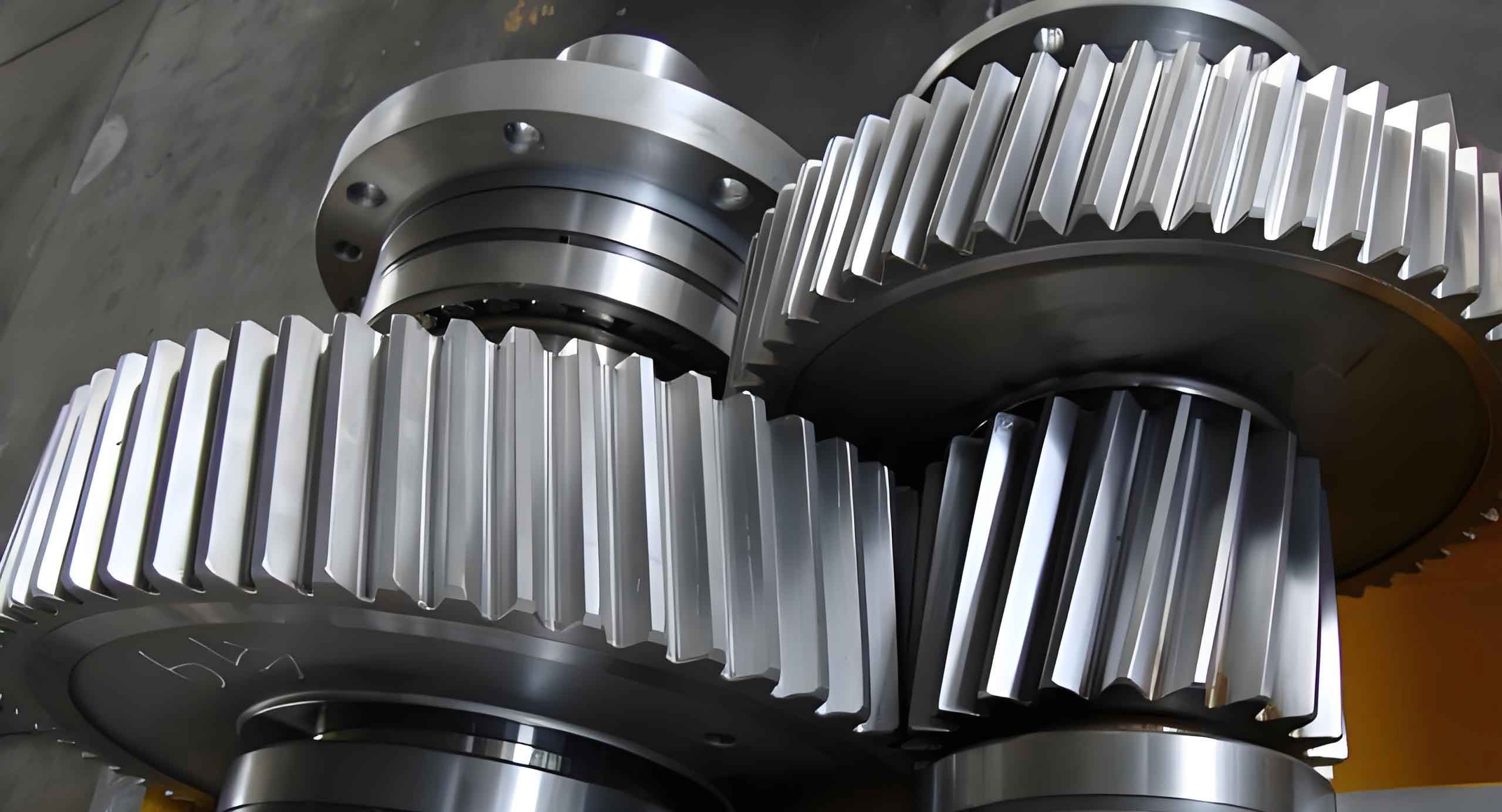
The image above illustrates the precise geometry of a modern helical gear. In my specification reviews for conveyor drives and crusher systems, I consistently prioritize units utilizing hardened helical gears. Their performance is not merely about power transmission; it influences overall plant availability. Consider a rotary kiln drive: a failure in the primary减速电动机 can halt production for days. The robust design of a helical gear set, with its optimized load distribution, minimizes such risks. The bending stress at the root of a helical gear tooth can be calculated using the Lewis formula modified for helix angle:
$$ \sigma_b = \frac{F_t}{b \cdot m_n \cdot Y} \cdot K_A \cdot K_V \cdot K_{\beta} $$
where $F_t$ is the tangential force, $Y$ is the Lewis form factor, and $K_A$, $K_V$, $K_{\beta}$ are application, dynamic, and face load factors respectively. Designing for lower $\sigma_b$ extends service life dramatically.
Modern iterations, such as the latest single-stage helical gear减速电动机 I have evaluated, integrate these principles with advanced manufacturing. The one-piece UNICASE housing, optimized via Finite Element Method (FEM), ensures exceptional torsional stiffness—a property vital for maintaining precise alignment under fluctuating loads common in mill applications. The absence of joints or covers on the housing, a feature now prevalent in high-end helical gear units, eliminates leak paths and facilitates hygiene, making them ideal for mineral processing lines where washdowns are frequent.
| Gear Type | Typical Efficiency Range | Noise Level | Load Capacity | Axial Thrust | Primary Industrial Application |
|---|---|---|---|---|---|
| Spur Gear | 94-98% | High | Moderate | Negligible | Light-duty conveyors, simple transfers |
| Helical Gear | 97-99% | Low to Moderate | High | Significant (requires thrust bearings) | Crushers, heavy-duty conveyors, mixers, kilns |
| Double Helical/Herringbone | 98-99.5% | Very Low | Very High | Self-cancelling | Large rolling mills, main winders |
| Worm Gear | 50-90% | Moderate | High (for size) | Depends on setup | High-ratio, intermittent duty |
The superiority of the helical gear in balanced performance is clear from Table 2. Its high efficiency directly reduces operational energy costs—a major consideration for power-intensive operations like grinding and pumping. The quiet operation of a well-machined helical gear pair also contributes to a better workplace environment, complying with increasingly stringent noise regulations in mining.
The synergy between advanced schedule management and reliable hardware is profound. During the construction phase managed via Single-Code Overlap Network Planning, the delivery and installation of critical helical gear驱动 equipment often lies on the critical path. Any delay in the manufacturing of these custom helical gear units, which involves precise hobbing, heat treatment, and grinding, can ripple through the entire project. Therefore, my scheduling models always include detailed sub-networks for major equipment procurement, with specific milestones for gearbox assembly and testing. The lead time for a large custom helical gear减速电动机 can be modeled as a probabilistic function:
$$ T_{lead} = \mu_{base} + \sum_{k=1}^{n} (X_k \cdot t_k) $$
where $\mu_{base}$ is the mean baseline duration, and $X_k$ are random variables representing delays in raw material sourcing (for high-grade gear steel), precision machining of the helical gear teeth, or bearing availability. Using Monte Carlo simulation integrated into the network plan allows for risk-adjusted schedule forecasting.
Once operational, the performance of these helical gear systems directly affects plant throughput, which is the ultimate measure of project success. Predictive maintenance schedules for helical gear减速电动机 are derived from vibration analysis and lubricant condition monitoring. The fundamental meshing frequency of a helical gear pair is:
$$ f_m = \frac{N \cdot RPM}{60} $$
where $N$ is the number of teeth on the pinion. Sidebands around this frequency in vibration spectra indicate potential faults like misalignment or wear. By tracking these parameters, maintenance can be planned during planned plant shutdowns, the timing of which is optimized using the same network planning principles to minimize production loss. This creates a closed-loop system where project control informs operational reliability.
Let me further elaborate on the design nuances that make contemporary helical gear units so indispensable. The helix angle $\beta$ is a master parameter. A higher $\beta$ increases smoothness and overlap but also amplifies axial thrust forces, demanding more robust bearing arrangements. In the single-stage helical gear减速电动机 designs I frequently specify, a compromise angle between 15° and 25° is common, offering an excellent balance. The normal module $m_n$ and face width $b$ are selected based on transmitted power $P$, pinion speed $n_1$, and application factor $K_A$ using the power rating equation:
$$ P = \frac{\pi \cdot m_n \cdot b \cdot z_1 \cdot n_1 \cdot \sigma_{HP} \cdot Y}{60 \times 10^9 \cdot K_A \cdot K_V \cdot K_{\beta}} \cdot \cos^2\beta $$
where $z_1$ is pinion teeth count, $\sigma_{HP}$ is permissible contact stress, and $Y$ is a geometry factor. This equation underscores the multi-variable optimization behind every helical gear set.
| Design Parameter | Symbol | Typical Range (Industrial Units) | Primary Influence | Trade-off Consideration |
|---|---|---|---|---|
| Helix Angle | $\beta$ | 10° – 30° | Smoothness, Axial Thrust, Contact Ratio | Higher angle = Smoother but needs stronger bearings |
| Normal Module | $m_n$ | 3 mm – 20 mm+ | Tooth Strength, Size, Load Capacity | Larger module = Stronger but larger & heavier gear |
| Face Width | $b$ | 50 mm – 400 mm+ | Load Capacity, Bending Stiffness | Wider face = Higher capacity but potential misalignment issues |
| Number of Teeth (Pinion) | $z_1$ | 17 – 40 (min. to avoid undercutting) | Speed Ratio, Size, Smoothness | More teeth = Smoother but larger pitch diameter |
| Profile Shift Coefficient | $x$ | -0.5 to +0.5 | Tooth Strength, Avoidance of Interference | Positive shift strengthens pinion but may weaken gear |
The integration of these helical gear减速电动机 into plant-wide control systems adds another layer of efficiency. Variable Frequency Drives (VFDs) are now commonly paired with helical gear units to provide soft starts and speed modulation for pumps and fans, yielding significant energy savings. The network schedule for implementing such a drive system must account for the engineering, communication wiring, and software commissioning tasks, all with specific搭接 relationships to the mechanical installation.
In conclusion, from my vantage point, the marriage of rigorous, mathematically grounded project scheduling techniques like Single-Code Overlap Network Planning and the relentless mechanical innovation embodied in modern helical gear technology forms the backbone of successful industrial project delivery and operation. The former provides the roadmap, identifying and protecting the critical path, while the latter delivers the reliable, efficient, and durable muscle to drive production. The helical gear, with its superior engineering characteristics, is not merely a component; it is a catalyst for operational excellence in the demanding environments of metallurgy and mining. By continuously applying and refining these tools—the software of schedule networks and the hardware of precision-engineered helical gear drives—we can build and operate facilities that are not only completed on time and within budget but also sustain peak performance throughout their lifecycle, maximizing return on investment and ensuring safety and reliability in some of the world’s most challenging industrial settings.