
In the realm of mechanical transmission systems, the helical gear stands as a pivotal component, renowned for its efficiency, compact structure, and smooth operation. This article delves into the comprehensive machining process design for helical gears, focusing on their structural analysis, material selection, heat treatment, process planning, cutting parameters, and fixture design. The helical gear, with its angled teeth, offers superior performance in high-speed and high-load applications, making its precision machining crucial for optimal functionality. Throughout this discussion, the term “helical gear” will be emphasized to underscore its significance. The design approach integrates theoretical principles with practical manufacturing techniques, utilizing tables and formulas for clarity. By exploring each stage—from raw material to finished product—this guide aims to provide a detailed framework for producing high-quality helical gears that meet stringent industrial standards.
The helical gear is a type of cylindrical gear with teeth cut at an angle to the axis of rotation, which allows for gradual engagement and reduced noise compared to spur gears. Its primary function is to transmit power and motion between parallel or crossed shafts, with applications ranging from automotive transmissions to industrial machinery. The structure of a helical gear includes key features such as the helix angle, face width, and tooth profile, all of which influence its mechanical properties. Understanding the working principle of helical gears involves analyzing their meshing behavior, where the contact line moves diagonally across the tooth face, leading to higher load capacity and smoother operation. This characteristic makes the helical gear indispensable in systems requiring high torque and precision.
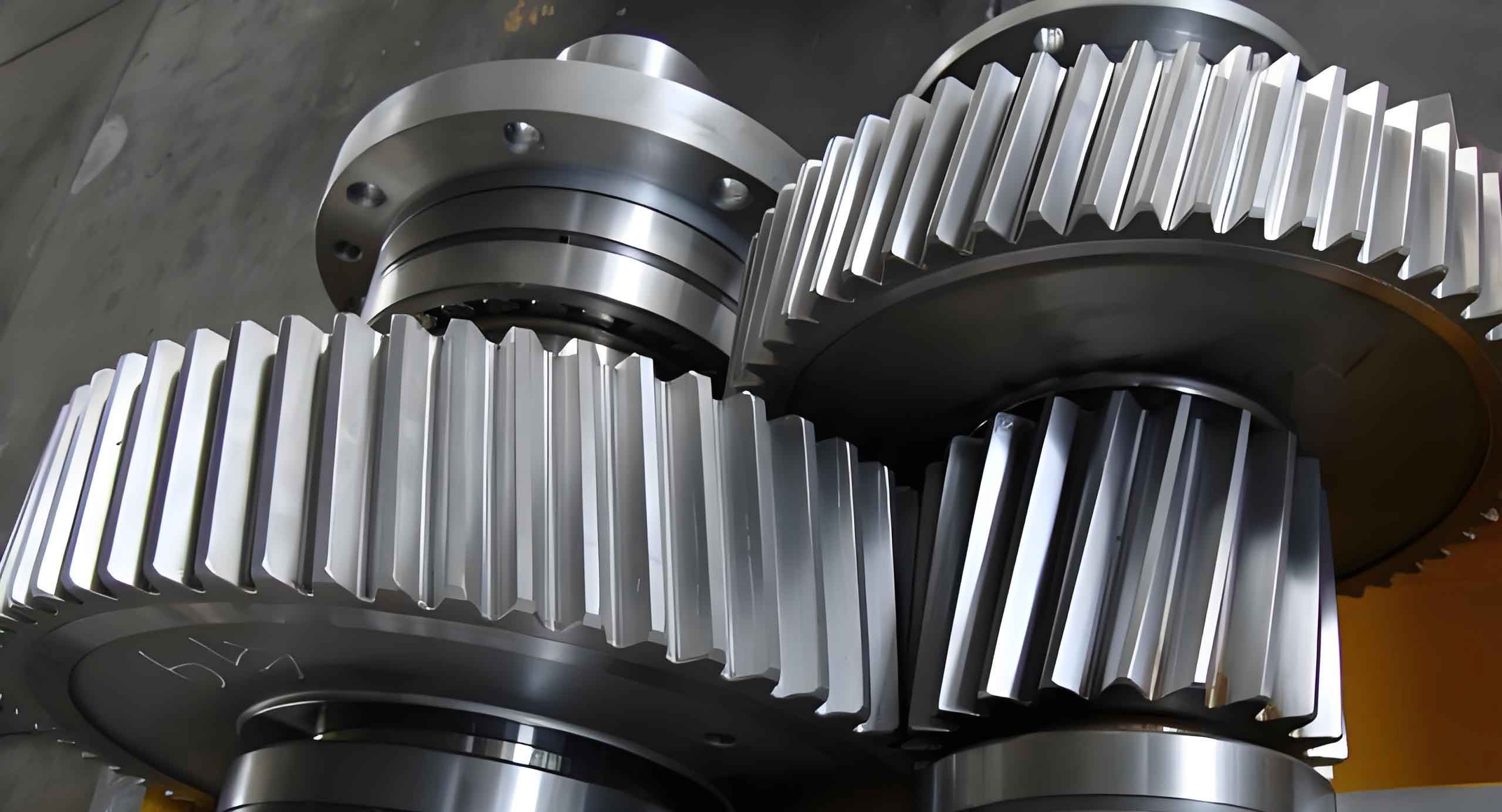
To begin the machining process, a thorough analysis of the helical gear’s design is essential. The gear teeth are typically generated based on specific meshing laws, such as the involute profile, which ensures constant velocity ratio and minimal wear. The basic parameters of a standard helical gear include the module (m), pressure angle (α), number of teeth (z), helix angle (β), and face width (b). These parameters determine the geometric dimensions, which can be calculated using the following formulas:
The normal module is related to the transverse module by the helix angle: $$ m_n = m_t \cos \beta $$ where \( m_n \) is the normal module, \( m_t \) is the transverse module, and \( \beta \) is the helix angle. The pitch diameter (d) is given by: $$ d = \frac{z \cdot m_t}{\cos \beta} $$ The addendum (h_a) and dedendum (h_f) are typically derived from the module: $$ h_a = 1 \cdot m_n $$ $$ h_f = 1.25 \cdot m_n $$ These formulas guide the initial design phase, ensuring that the helical gear meets functional requirements. Additionally, factors like contact ratio and tooth thickness must be considered to prevent transmission failures such as pitting or bending. For a helical gear, the contact ratio is higher than that of spur gears due to the overlapping action, which enhances durability.
In terms of material selection, helical gears are often fabricated from alloy steels to withstand high stresses. Common materials include 20CrMnTi, a case-hardening steel known for its excellent toughness and wear resistance. The choice of material directly impacts the gear’s performance, especially in applications involving high speeds or heavy loads. The raw material is usually in the form of forged blanks, which provide a dense grain structure and improved mechanical properties. Forging aligns the grain flow with the gear contour, enhancing strength and fatigue life. The selection of blanks for helical gears depends on factors like gear size, production volume, and cost considerations. A summary of material properties is presented in Table 1.
| Material | Yield Strength (MPa) | Hardness (HRC) | Application |
|---|---|---|---|
| 20CrMnTi | 1100 | 58-62 after carburizing | High-speed, heavy-duty helical gears |
| 42CrMo | 950 | 50-55 | General industrial helical gears |
| SAE 4340 | 1000 | 55-60 | Aerospace helical gears |
Heat treatment plays a critical role in enhancing the properties of helical gears. The process typically involves two stages: preliminary heat treatment and final heat treatment. Preliminary treatments, such as normalizing or annealing, are performed on the forged blank to soften the material, improve machinability, and relieve internal stresses. For helical gears made from 20CrMnTi, normalizing is common to achieve a uniform microstructure. Final heat treatment, including carburizing and quenching, is applied after rough machining to develop a hard, wear-resistant surface while maintaining a tough core. The carburizing depth, often referred to as case depth, is crucial for gear durability. It can be calculated based on service conditions: $$ \delta = k \sqrt{t} $$ where \( \delta \) is the case depth in millimeters, \( k \) is a material constant, and \( t \) is the carburizing time in hours. This ensures that the helical gear can resist surface fatigue and abrasion.
The machining process for helical gears is divided into several stages to achieve the required accuracy and surface finish. These stages include blank preparation, rough machining, semi-finishing, gear teeth generation, and finishing. Each stage must be meticulously planned to control dimensions and tolerances. The process flow adheres to principles such as “datum first,” “rough before finish,” “primary before secondary,” and “surface before hole.” For instance, the outer diameter of the helical gear is often used as a datum for initial operations, while the inner bore serves as a reference for subsequent steps. The machining sequence is outlined in Table 2, which summarizes key operations and their objectives.
| Stage | Operations | Purpose |
|---|---|---|
| Blank Preparation | Forging, normalizing | Obtain near-net shape and improve machinability |
| Rough Machining | Turning outer diameter, drilling center hole | Remove excess material and establish datums |
| Semi-Finishing | Turning features, chamfering | Achieve close tolerances for critical surfaces |
| Gear Teeth Generation | Hobbing or shaping of helical gear teeth | Form the tooth profile with required helix angle |
| Finishing | Grinding, honing, lapping | Attain final dimensions and surface roughness |
Positioning and datum selection are vital in helical gear machining to minimize errors. Initially, the outer cylindrical surface is used as a rough datum for turning operations. As the process advances, the inner bore becomes the precision datum for gear hobbing and grinding. This conversion ensures concentricity and reduces radial run-out. For example, during hobbing, the helical gear is mounted on a mandrel that fits into the bore, guaranteeing accurate tooth alignment. The concept of “datum first” is applied throughout: the outer diameter is machined first to provide a reference for boring the inner hole, which in turn is used for tooth cutting. This iterative approach maintains geometric integrity across all features of the helical gear.
Determining machining allowances and process dimensions involves calculating the amount of material to be removed at each stage. The allowance depends on factors like material hardness, gear size, and desired finish. For a helical gear made from 20CrMnTi, typical allowances can be derived from handbooks or empirical data. The total allowance is distributed among roughing, semi-finishing, and finishing operations. For instance, the outer diameter might have a roughing allowance of 3 mm, a semi-finishing allowance of 0.5 mm, and a finishing allowance of 0.1 mm. These values ensure that final grinding can achieve the required tolerance of IT5 to IT6 and surface roughness of Ra 0.8 μm or better. The allowance for gear teeth generation is particularly important, as insufficient material can lead to incomplete tooth profiles. A general formula for machining allowance (A) is: $$ A = C \cdot \sqrt[3]{V} $$ where \( C \) is a constant based on material and process, and \( V \) is the gear volume in cubic millimeters. This heuristic helps in planning efficient material removal for helical gears.
Cutting parameters, including cutting speed (v), feed rate (f), and depth of cut (a_p), are critical for optimizing the machining of helical gears. These parameters influence tool life, surface quality, and productivity. For turning operations on a helical gear blank, the cutting speed can be calculated using: $$ v = \frac{\pi \cdot d \cdot n}{1000} $$ where \( v \) is in meters per minute, \( d \) is the workpiece diameter in millimeters, and \( n \) is the spindle speed in revolutions per minute. The feed rate is selected based on surface roughness requirements; for example, a finer feed is used for finishing. Depth of cut is determined by the machining allowance. In gear hobbing, the feed per revolution of the hob is crucial for tooth accuracy. Table 3 provides typical cutting parameters for machining helical gear components on a CA6140 lathe, assuming material 20CrMnTi with ultimate tensile strength of 1200 MPa.
| Operation | Tool Material | Cutting Speed (m/min) | Feed Rate (mm/rev) | Depth of Cut (mm) |
|---|---|---|---|---|
| Rough Turning Outer Diameter | YT15 | 80-120 | 0.3-0.5 | 2-3 |
| Drilling Center Hole | W18Cr4V | 20-30 | 0.1-0.2 | – |
| Semi-Finishing Turning | YT15 | 100-150 | 0.1-0.3 | 0.5-1 |
| Hobbing Helical Gear Teeth | High-Speed Steel Hob | 40-60 | 0.5-1.25 (axial feed) | – |
| Grinding Outer Diameter | Aluminum Oxide Wheel | 25-35 | 0.005-0.02 (cross-feed) | 0.02-0.05 |
During hobbing, the generation of helical gear teeth requires precise synchronization between the hob rotation and workpiece movement. The hob, a cutting tool with helical grooves, is fed axially across the gear blank while both rotate in a timed manner. The relationship between hob lead and gear helix angle is given by: $$ \tan \beta = \frac{L}{\pi \cdot d} $$ where \( L \) is the lead of the hob, and \( d \) is the pitch diameter of the helical gear. This ensures that the teeth are cut at the correct angle. Hobbing parameters must be optimized to avoid defects like chatter or tooth profile errors. For high-precision helical gears, subsequent grinding or shaving may be employed to improve surface finish and accuracy. The grinding process uses abrasive wheels to remove minute amounts of material, achieving tolerances within microns. The grinding force can be modeled as: $$ F_g = k_g \cdot a_e \cdot v_w $$ where \( F_g \) is the grinding force, \( k_g \) is a specific grinding energy constant, \( a_e \) is the depth of cut, and \( v_w \) is the workpiece speed. This helps in selecting appropriate grinding conditions for helical gears.
Fixture design is paramount for holding the helical gear securely during machining operations. A well-designed fixture maintains positional accuracy, reduces setup time, and minimizes vibrations. For helical gears, common fixtures include mandrels for hobbing and grinding, and chucks for turning. The fixture must accommodate the gear’s geometry, such as the inner bore and keyway, without causing distortion. In hobbing, a mandrel with a taper or collet mechanism is used to center the gear precisely. The fixture should also allow for easy loading and unloading to enhance productivity. Principles of locating and clamping are applied: the inner bore serves as the primary locating surface, while a keyway or flat surface provides anti-rotation. The clamping force must be sufficient to resist cutting forces but not so high as to deform the helical gear. Finite element analysis can be used to optimize fixture design, ensuring stiffness and stability. For instance, the natural frequency of the fixture-workpiece system should be away from the machining frequency to avoid resonance.
In summary, the machining process design for helical gears integrates multiple disciplines, including material science, mechanics, and manufacturing engineering. Each step—from blank forging to final inspection—must be carefully planned to produce gears that meet performance criteria. The helical gear’s unique characteristics, such as its helix angle and tooth profile, demand specialized processes like hobbing and grinding. By applying systematic approaches to process planning, cutting parameter selection, and fixture design, manufacturers can achieve high efficiency and precision. Future advancements in CNC technology and tool materials may further enhance the production of helical gears, enabling even higher speeds and loads. Ultimately, a robust machining process ensures the reliability and longevity of helical gears in diverse applications, underscoring their importance in modern machinery.
To illustrate the complexity of helical gear design, consider the contact stress calculation, which is vital for preventing pitting failures. The Hertzian contact stress for helical gears can be approximated by: $$ \sigma_H = Z_E \cdot \sqrt{ \frac{F_t}{b \cdot d_1} \cdot \frac{u+1}{u} \cdot K_A \cdot K_V \cdot K_{H\beta} \cdot K_{H\alpha} } $$ where \( Z_E \) is the elasticity factor, \( F_t \) is the tangential load, \( b \) is the face width, \( d_1 \) is the pitch diameter of the pinion, \( u \) is the gear ratio, and \( K \) factors account for application, dynamic, load distribution, and transverse load effects. This formula highlights the interdependence of geometric parameters and load conditions in helical gear performance. Additionally, bending stress at the tooth root must be checked using the Lewis formula modified for helical gears: $$ \sigma_F = \frac{F_t}{b \cdot m_n} \cdot Y_F \cdot Y_S \cdot Y_\beta \cdot K_A \cdot K_V \cdot K_{F\beta} \cdot K_{F\alpha} $$ where \( Y_F \) is the form factor, \( Y_S \) is the stress correction factor, and \( Y_\beta \) is the helix angle factor. These calculations ensure that the helical gear can withstand operational stresses without failure.
In practice, quality control measures such as gear testing and inspection are essential. Parameters like tooth thickness, pitch error, and helix angle deviation are measured using coordinate measuring machines or gear testers. Statistical process control can be applied to monitor production consistency. For example, control charts for key dimensions of helical gears help in detecting process variations early. The use of advanced metrology ensures that each helical gear conforms to design specifications, thereby guaranteeing optimal performance in the field. This comprehensive approach to machining process design not only enhances product quality but also reduces waste and cost, making it a cornerstone of modern manufacturing.