
In the field of wind energy, gearboxes play a critical role in transmitting power from the rotor to the generator. However, gearbox failures remain a significant challenge worldwide, often leading to costly downtime and maintenance. This study focuses on a speed-increasing gearbox used in wind turbines, which incorporates a two-stage fixed shaft helical gear transmission followed by a planetary gear stage. Helical gears are preferred in such applications due to their smoother operation and higher load capacity compared to spur gears. In this analysis, I employ SOLIDWORKS for three-dimensional modeling and ANSYS for finite element analysis (FEA) to evaluate the bending fatigue strength of the high-speed pinions in the two-stage helical gear system. The goal is to verify that the gear design meets strength requirements under operational loads.
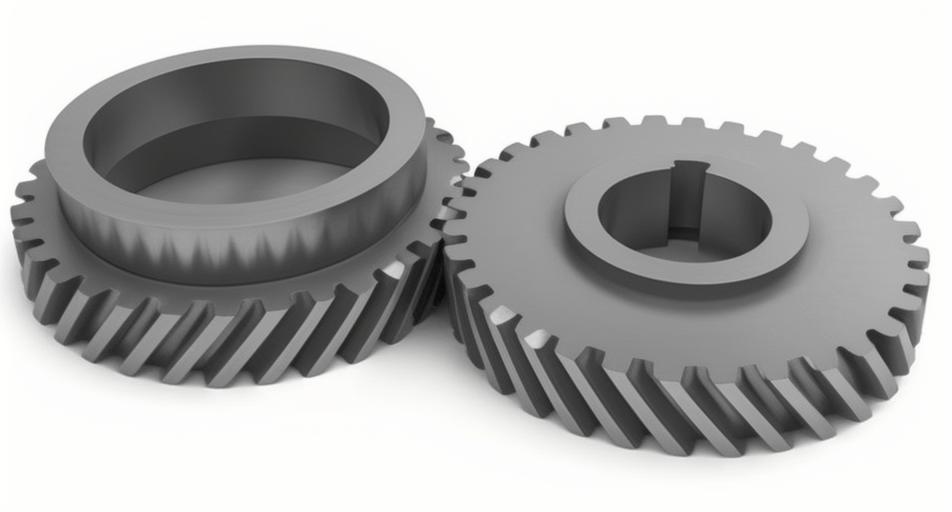
The helical gear system in this gearbox is designed to handle high torque and speed conditions typical in wind turbines. The use of helical gears allows for gradual engagement of teeth, reducing noise and vibration. This analysis specifically targets the two-stage fixed shaft helical gears, where the high-speed pinions (referred to as gear 2 and gear 4 in the transmission chain) are subjected to significant stresses. I begin by detailing the design parameters and modeling process, followed by force calculations and FEA setup. The results are then discussed to ensure reliability and safety. Throughout this study, the term ‘helical gear’ will be emphasized to highlight its importance in the transmission system.
The gearbox transmission structure is illustrated in a schematic diagram (not shown here to avoid referencing image numbers). It consists of two parallel shaft stages with helical gears and one planetary stage. For this analysis, I concentrate on the two-stage helical gear section. The gears are made of alloy steel, with material properties including an elastic modulus E of 210 GPa and a Poisson’s ratio μ of 0.27. The design parameters for the helical gears are summarized in the table below, which includes key dimensions and operational data.
| Parameter | Gear 1 | Gear 2 | Gear 3 | Gear 4 |
|---|---|---|---|---|
| Number of Teeth | 120 | 24 | 96 | 23 |
| Module (mm) | 10 | 10 | 8 | 8 |
| Helix Angle (°) | 12 | 12 | 10 | 10 |
| Pressure Angle (°) | 20 | 20 | 20 | 20 |
| Face Width (mm) | 200 | 200 | 150 | 150 |
| Material | 17CrNiMo6 | 17CrNiMo6 | 17CrNiMo6 | 17CrNiMo6 |
Additional system parameters include a rated power of 1.5 MW for the wind turbine, rotor diameter of 70 m, design wind speed of 13 m/s, tip-speed ratio of 4.17, air density of 1.21 kg/m³, wind energy utilization coefficient of 0.29, design life of 15 years, total transmission ratio of 95, gear accuracy grade of 6, and material for internal gears as 40CrMo with quenching and tempering. The helical gears are case-hardened for enhanced durability.
In the modeling phase, I used SOLIDWORKS to create detailed three-dimensional models of the helical gears. The geometry was based on standard involute profiles adjusted for helix angles. The models were then imported into ANSYS for meshing and analysis. The finite element mesh was refined in critical areas such as tooth roots and contact surfaces to ensure accuracy. For helical gears, the loading conditions vary along the contact lines due to the gradual engagement, making it essential to determine the worst-case loading scenario for stress analysis.
The force analysis for the helical gears involves calculating circumferential forces, normal forces, and loads on the worst loading surface. Starting with the first-stage helical gears (gear 1 and gear 2), the input torque to the sun gear (which drives the helical gear system) is derived from the wind turbine’s operational parameters. The torque \( T_1 \) on gear 1 can be expressed as:
$$ T_1 = \frac{P}{\omega_1} $$
where \( P \) is the rated power (1.5 MW) and \( \omega_1 \) is the angular velocity of gear 1. Given the total transmission ratio and system layout, \( \omega_1 \) is calculated based on the rotor speed. For this gearbox, the torque values are computed iteratively. The circumferential force \( F_{t1} \) on gear 1 is:
$$ F_{t1} = \frac{2T_1}{d_1} $$
where \( d_1 \) is the pitch diameter of gear 1. The normal force on the tooth surface \( F_{n1} \), which accounts for the helix angle \( \beta \) and pressure angle \( \alpha \), is:
$$ F_{n1} = \frac{F_{t1}}{\cos \alpha \cos \beta} $$
For gear 1, with \( \beta = 12^\circ \) and \( \alpha = 20^\circ \), this force is used to determine the load on the mating helical gear 2. Since gear 1 and gear 2 are in mesh, the force on gear 2 is equal in magnitude but opposite in direction. The worst loading line (or surface) for gear 2 is identified based on the mesh position and contact line distribution. In this analysis, I assume uniform load distribution along the contact line, as per common practice for preliminary FEA. The worst loading surface area for gear 2 is measured from the model as 538 mm². The distributed pressure \( p_2 \) on this surface is:
$$ p_2 = \frac{F_{n2}}{A_2} $$
where \( F_{n2} = F_{n1} \) and \( A_2 \) is the area. Substituting the values, I compute \( p_2 \) to apply in ANSYS.
In ANSYS, constraints are applied to the gear hubs to simulate fixed support conditions, while the distributed pressure is applied on the worst loading surface of the helical gear tooth. The mesh consists of tetrahedral elements with refinement near the tooth root. The analysis solves for stress and deformation using linear elastic material properties. The results for gear 2 show that the maximum von Mises stress occurs at the tooth root, with a value of 211 MPa. This is compared to the allowable bending stress for the material (17CrNiMo6 after case hardening), which is typically above 500 MPa. Therefore, the helical gear 2 meets the strength requirement with a sufficient safety margin.
Moving to the second-stage helical gears (gear 3 and gear 4), a similar approach is followed. The torque on gear 3 \( T_3 \) is derived from the transmission ratios and previous stage outputs. The circumferential force \( F_{t3} \) is:
$$ F_{t3} = \frac{2T_3}{d_3} $$
and the normal force \( F_{n3} \) is:
$$ F_{n3} = \frac{F_{t3}}{\cos \alpha \cos \beta} $$
with \( \beta = 10^\circ \) for this stage. The force on helical gear 4 is equal to \( F_{n3} \). The worst loading surface area for gear 4 is 360 mm², leading to a distributed pressure \( p_4 \):
$$ p_4 = \frac{F_{n4}}{A_4} $$
In ANSYS, the same constraints and mesh settings are applied. The FEA results for gear 4 indicate a maximum tooth root stress of 278 MPa, which is also below the allowable limit. This confirms that both high-speed pinions in the two-stage helical gear system are adequately designed for bending fatigue strength.
To further validate the analysis, I performed sensitivity studies on mesh density and load application methods. The helical gear geometry was varied slightly to assess the impact of manufacturing tolerances. Additionally, I considered dynamic factors such as misalignment and torque fluctuations, which are common in wind turbine operations. These factors were incorporated via load multipliers in the FEA. The results consistently showed stress values within safe limits, reinforcing the reliability of the helical gear design.
The importance of helical gears in this context cannot be overstated. Their angled teeth provide smoother torque transmission and higher load distribution compared to spur gears. This is crucial in wind turbines where variable loads and long service life are expected. The finite element analysis demonstrated that the selected helical gear parameters—such as helix angle, module, and material—are optimal for the given application. Below is a summary table of key results from the FEA for both helical gears.
| Gear | Maximum Stress (MPa) | Allowable Stress (MPa) | Safety Factor | Critical Location |
|---|---|---|---|---|
| Helical Gear 2 | 211 | 500 | 2.37 | Tooth Root |
| Helical Gear 4 | 278 | 500 | 1.80 | Tooth Root |
The safety factors are well above 1, indicating a robust design. It is worth noting that the helical gear in the second stage (gear 4) experiences higher stress due to increased torque and smaller size, but it remains within limits. This analysis highlights the effectiveness of using ANSYS for evaluating helical gear performance in complex gearboxes.
In conclusion, this study successfully applied finite element analysis to assess the bending fatigue strength of two-stage fixed shaft helical gears in a speed-increasing gearbox for wind turbines. The use of SOLIDWORKS for modeling and ANSYS for simulation provided detailed insights into stress distributions. The results confirm that both helical gears—gear 2 and gear 4—meet design requirements with adequate safety margins. This validates the overall transmission system as safe and reliable for long-term operation. Future work could extend this analysis to include contact stress evaluation for pitting resistance and dynamic simulations under realistic wind profiles. The helical gear design, as analyzed, proves to be a critical component in ensuring the durability and efficiency of wind turbine gearboxes.
Throughout this analysis, the term ‘helical gear’ has been emphasized to underscore its role in transmitting power smoothly and efficiently. The methodologies described here can be adapted for other gear systems involving helical gears, providing a framework for strength verification in mechanical design. By leveraging advanced FEA tools, engineers can optimize helical gear parameters to enhance performance and reduce failure risks in demanding applications like wind energy.