
The dynamic performance of feed drive systems is a critical determinant of machining accuracy in CNC machine tools. While ball screw drives are prevalent in most studies, the helical rack and pinion mechanism offers superior advantages for large-scale machines, such as mirror milling machines, due to its high load capacity, long travel range, and smooth operation. However, its dynamic characteristics within an electromechanically coupled system are not sufficiently explored. This article delves into the dynamic error analysis of a feed system comprising an AC synchronous servo motor driving a helical gear and rack. I will develop comprehensive mathematical models for both the mechanical transmission and the motor control, couple them to simulate the system’s behavior, and validate the findings through experimental investigation, focusing on identifying the primary sources of dynamic error.
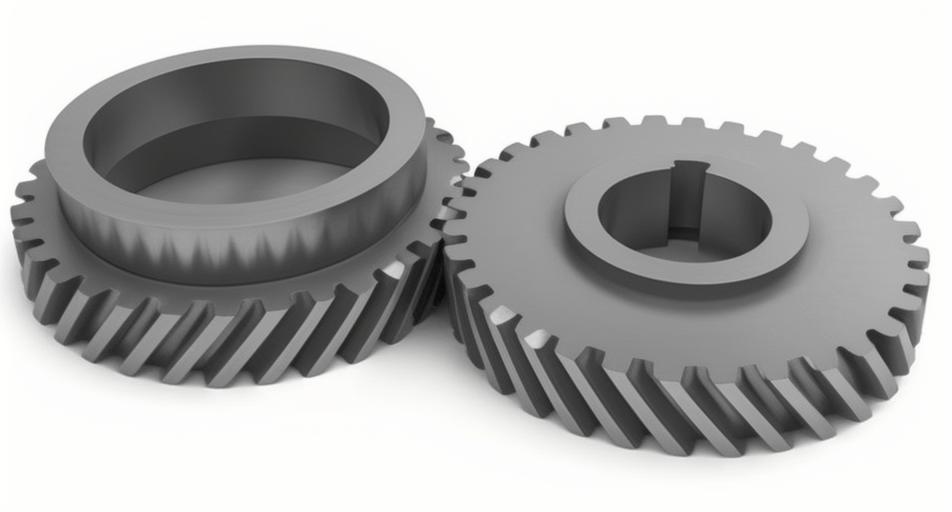
1. Dynamic Modeling of the Helical Rack and Pinion Transmission
The mechanical structure of the feed system can be conceptually simplified into a lumped-parameter model. The system consists of a servo motor, a gearbox (reducer), the pinion gear, and the moving load. The motor provides torque, which is transmitted and amplified through the gearbox to rotate the helical gears. The rotating pinion, meshing with a fixed rack, consequently translates, driving the load. The following differential equations describe this dynamics:
$$
\begin{aligned}
J_m \ddot{\theta}_m &= T_e – k_r (\theta_m – i \theta_g) – c_r (\dot{\theta}_m – i \dot{\theta}_g) \\
J_g \ddot{\theta}_g &= i \left[ k_r (\theta_m – i \theta_g) + c_r (\dot{\theta}_m – i \dot{\theta}_g) \right] – F_n r_g \\
m_g \ddot{x}_g &= F_n – k_s (x_g – x_l) – c_s (\dot{x}_g – \dot{x}_l) \\
m_l \ddot{x}_l &= k_s (x_g – x_l) + c_s (\dot{x}_g – \dot{x}_l) – F_l
\end{aligned}
$$
Here, \(T_e\) is the motor’s electromagnetic torque, \(k_r\) and \(c_r\) are the gearbox’s torsional stiffness and damping, \(i\) is the gear ratio, and \(F_n\) is the dynamic meshing force of the helical gears and rack. The parameters \(r_g\), \(J_g\), and \(m_g\) are the pinion’s pitch radius, moment of inertia, and mass, respectively. \(k_s\) and \(c_s\) represent the support stiffness and damping between the gear housing and the load of mass \(m_l\), and \(F_l\) is the external load force.
The dynamic meshing force \(F_n\) is central to the model and is expressed as:
$$
F_n = k_m(t) \cos\alpha_n (r_g \theta_g – x_g – e(t) \cos\alpha_n) + c_m \cos\alpha_n (r_g \dot{\theta}_g – \dot{x}_g – \dot{e}(t) \cos\alpha_n)
$$
Where \(k_m(t)\) is the time-varying mesh stiffness, \(c_m\) is the mesh damping, \(\alpha_n\) is the normal pressure angle, and \(e(t)\) is the static transmission error acting as a primary internal excitation.
1.1 Time-Varying Mesh Stiffness of Helical Gears
The presence of the helix angle in helical gears results in a gradual engagement and disengagement process. To accurately capture this, the potential energy method combined with a slicing-integration technique is employed. The rack is treated as a gear with an infinite radius for calculation purposes. The total mesh stiffness per slice is a combination of several compliances:
$$
\frac{1}{k_{slice}} = \frac{1}{k_b} + \frac{1}{k_s} + \frac{1}{k_a} + \frac{1}{k_h} + \frac{1}{k_f}
$$
The bending (\(k_b\)), shear (\(k_s\)), axial compressive (\(k_a\)), Hertzian contact (\(k_h\)), and fillet foundation (\(k_f\)) stiffness for a single slice are calculated using the following integrals and formulas, considering the geometry of a cantilever beam representing the tooth:
$$
\begin{aligned}
k_b^{-1} &= \int_{\alpha_1}^{\alpha_2} \frac{3\cos\alpha (\alpha_2 – \alpha)[1+\cos\alpha_1′((\alpha_2-\alpha)\sin\alpha – \cos\alpha)]^2}{2E \Delta z [\sin\alpha + (\alpha_2-\alpha)\cos\alpha]^3} d\alpha \\
k_s^{-1} &= \int_{\alpha_1}^{\alpha_2} \frac{1.2(1+\nu)(\alpha_2 – \alpha)\cos\alpha \cos^2\alpha_1′}{E \Delta z [\sin\alpha + (\alpha_2-\alpha)\cos\alpha]} d\alpha \\
k_a^{-1} &= \int_{\alpha_1}^{\alpha_2} \frac{(\alpha_2 – \alpha)\cos\alpha \sin^2\alpha_1′}{2E \Delta z [\sin\alpha + (\alpha_2-\alpha)\cos\alpha]} d\alpha \\
k_h^{-1} &= \frac{4(1-\nu^2)}{\pi E L_{ct}} \\
k_f^{-1} &= \frac{\cos^2\alpha_1′}{E \Delta z} \left[ L\left(\frac{u_f}{s_f}\right)^2 + M\left(\frac{u_f}{s_f}\right) + P(1+Q\tan^2\alpha_1′) \right]
\end{aligned}
$$
The total mesh stiffness \(k_m(t)\) is obtained by summing the stiffness contributions from all contacting tooth pairs across the face width, integrated over the meshing cycle. The parameters for the helical gears system studied are listed below.
| Parameter | Symbol | Value |
|---|---|---|
| Normal Module | \(m_n\) | 2 mm |
| Normal Pressure Angle | \(\alpha_n\) | 20° |
| Helix Angle | \(\beta\) | 19.5283° |
| Number of Teeth (Pinion) | \(Z\) | 30 |
| Face Width | \(B\) | 28 mm |
| Young’s Modulus | \(E\) | 206 GPa |
| Poisson’s Ratio | \(\nu\) | 0.25 |
| Pinion Mass | \(m_g\) | 0.7 kg |
The calculated time-varying mesh stiffness exhibits periodic fluctuations. Its average value was verified against standard ISO calculations, showing an error of only 1.67%, confirming the model’s accuracy.
1.2 Meshing Error Excitation
The static transmission error \(e(t)\) is modeled as a superposition of harmonic functions related to the rotational frequency and the mesh frequency:
$$
e(t) = 0.5 F_p \sin(2\pi f_a t + \phi_a) + 0.5 f’ \sin(2\pi f_m t + \phi_n)
$$
Here, \(F_p\) is the total cumulative pitch deviation, \(f’\) is the single pitch deviation, \(f_a\) is the pinion rotational frequency (shaft frequency), and \(f_m\) is the gear mesh frequency. For a Grade 6 accuracy helical gears pair, typical values are \(F_p = 26 \mu m\) and \(f’ = 10.24 \mu m\).
2. Dynamic Modeling of the AC Synchronous Servo Motor with Vector Control
To accurately represent the electromechanical coupling, a model for the AC permanent magnet synchronous motor (PMSM) with field-oriented vector control is essential. This control strategy decouples the complex motor dynamics by transforming the three-phase stator currents into a two-axis rotating reference frame (d-q frame) aligned with the rotor flux.
The key transformations are the Clarke and Park transforms:
$$
\mathbf{T}_{Clark} = \frac{2}{3} \begin{bmatrix}
1 & -\frac{1}{2} & -\frac{1}{2} \\
0 & \frac{\sqrt{3}}{2} & -\frac{\sqrt{3}}{2} \\
\frac{1}{\sqrt{2}} & \frac{1}{\sqrt{2}} & \frac{1}{\sqrt{2}}
\end{bmatrix}, \quad \mathbf{T}_{Park} = \begin{bmatrix}
\cos\theta_e & \sin\theta_e \\
-\sin\theta_e & \cos\theta_e
\end{bmatrix}
$$
where \(\theta_e\) is the electrical rotor angle. The motor’s electromagnetic torque in the d-q frame is given by:
$$
T_e = \frac{3}{2} p_n i_q [ i_d (L_d – L_q) + \psi_f ]
$$
where \(p_n\) is the number of pole pairs, \(i_d\) and \(i_q\) are the direct and quadrature axis currents, \(L_d\) and \(L_q\) are the corresponding inductances, and \(\psi_f\) is the permanent magnet flux linkage.
The mechanical equation governing the motor shaft is:
$$
J_m \frac{d\omega_m}{dt} = T_e – T_l – B\omega_m
$$
where \(J_m\) is the motor rotor inertia, \(\omega_m\) is the mechanical speed, \(T_l\) is the load torque, and \(B\) is the viscous damping coefficient. The control system typically employs cascaded proportional-integral (PI) controllers for the current, speed, and position loops. The specific motor parameters used are summarized in the following table.
| Parameter | Symbol | Value |
|---|---|---|
| d-axis Inductance | \(L_d\) | 26.82 mH |
| q-axis Inductance | \(L_q\) | 26.82 mH |
| Stator Resistance | \(R_s\) | 18.7 Ω |
| Rotor Inertia | \(J_m\) | 1.7e-5 kg·m² |
| Pole Pairs | \(p_n\) | 2 |
| Flux Linkage | \(\psi_f\) | 0.1717 V·s/rad |
| Speed Loop PI (P/I) | \(P_{\omega}/I_{\omega}\) | 0.013 / 1.3 |
| Current Loop PI (P/I) | \(P_i/I_i\) | 200 / 10,000 |
3. Electromechanically Coupled System Integration and Simulation
The complete feed system model is formed by coupling the mechanical and electrical domains. The input to the coupled system is the motor’s speed command. The output from the mechanical model—the motor’s actual speed \(\omega_m\) and the reflected load torque \(T_l\)—is fed back to the motor control model. Conversely, the electromagnetic torque \(T_e\) from the motor model serves as the input to the mechanical subsystem. This closed-loop structure is implemented in a simulation environment for analysis.
Simulations were conducted with a constant speed command corresponding to a 50 mm/s table feed rate. The dynamic transmission error (DTE), defined as the difference between the commanded and simulated load positions, was analyzed. The results under two conditions—with and without the gear meshing error \(e(t)\)—are telling.
When meshing error is neglected, the DTE is very small, primarily representing the system’s following error due to inertia. When the realistic meshing error is included, the DTE exhibits significant periodic oscillations with an amplitude in the order of micrometers. Spectral analysis of the load acceleration reveals prominent frequency components:
- The pinion rotational frequency (\(f_a\)).
- The gear mesh frequency (\(f_m\)).
- The motor’s electrical fundamental frequency (\(f_{elec}\)) and its harmonics.
- Modulation sidebands around \(f_m\) at offsets of \(\pm f_{elec}\).
However, in the displacement error spectrum, the amplitudes at the mechanical frequencies (\(f_a\) and \(f_m\)) dominate, while those related to the motor dynamics are negligible. This strongly indicates that for this feed system, the internal excitations from the helical gears and rack pair—namely, the time-varying stiffness and, more critically, the manufacturing-related meshing error—are the predominant sources of dynamic error, overshadowing the effects from the well-regulated servo motor dynamics.
4. Experimental Validation and Dynamic Characteristic Analysis
Experimental tests were performed on a physical CNC machine tool’s x-axis feed drive, which utilizes the studied helical gears and rack system. The setup consisted of the machine tool, its numerical controller, and a host PC for command generation and data acquisition. The load (table) was commanded to move at constant velocities over a set distance, and its actual position was recorded.
For a 50 mm/s feed rate, the measured position consistently lagged behind the commanded position, with an average following error. The dynamic component of this error, after removing the DC offset, was analyzed. Its frequency spectrum is presented below, clearly identifying the key contributors.
| Identified Frequency | Value (Hz) | Probable Source |
|---|---|---|
| f1 | 0.2494 | Pinion Shaft Frequency (\(f_a\)) |
| f2 | 7.481 | Gear Mesh Frequency (\(f_m\)) |
| f3 | 3.741 | Sub-harmonic (0.5\(f_m\)) |
| f4 | 14.96 | Second Mesh Harmonic (2\(f_m\)) |
The spectrum conclusively shows that the largest spectral peaks correspond precisely to the theoretical shaft frequency and mesh frequency of the helical gears pair. Peaks at sub-harmonics and higher harmonics of the mesh frequency are also visible, which can be attributed to nonlinearities and assembly imperfections not captured in the linear model. The frequencies associated with the motor’s control dynamics, while present in the acceleration signal, are not dominant in the positioning error. This experimental evidence solidly corroborates the simulation conclusion.
To generalize the finding, experiments were repeated at different feed rates: 30, 40, 50, 60, and 70 mm/s. In every case, the two most prominent frequencies in the dynamic error signal were the shaft frequency and the mesh frequency corresponding to that specific operating speed, as summarized below.
| Feed Rate (mm/s) | Dominant Freq. 1 (Hz) [Shaft Freq.] | Dominant Freq. 2 (Hz) [Mesh Freq.] |
|---|---|---|
| 30 | 0.149 | 4.471 |
| 40 | 0.1996 | 5.998 |
| 50 | 0.2494 | 7.481 |
| 60 | 0.3021 | 9.063 |
| 70 | 0.3717 | 10.41 |
5. Conclusion
Through integrated dynamic modeling, simulation, and experimental analysis of a motor-helical gears rack coupled feed system, this work provides significant insights into its dynamic error characteristics. The primary conclusions are:
- The meshing error of the helical gear and rack pair is the dominant source of dynamic transmission error in the feed system. Its influence decisively shapes the amplitude and spectral content of the positioning error, overshadowing other potential sources under normal operating conditions.
- The dynamic error spectrum is primarily composed of mechanical excitation frequencies. The pinion rotational frequency (shaft frequency) and the gear mesh frequency are the most significant components. While frequencies from the motor drive and modulation sidebands exist, their contribution to the overall positional accuracy is minimal compared to the mechanical excitations.
Therefore, for the design of high-dynamic-precision feed systems employing helical gears and rack, the paramount focus should be on minimizing the manufacturing and assembly errors of the gear pair to reduce the static transmission error excitation. Furthermore, optimizing the mesh stiffness characteristics and implementing advanced control strategies that can actively compensate for these predictable periodic errors could lead to substantial improvements in contouring accuracy.