
The accurate measurement of geometric parameters in power transmission components is paramount for ensuring the performance, reliability, and longevity of mechanical systems. Among these components, helical gears are widely favored for their superior meshing characteristics, which result in smoother operation, reduced vibration, and lower acoustic noise compared to their spur gear counterparts. A critical parameter defining the performance of helical gears is the helix angle. This angle, formed between the gear tooth trace and an element of its pitch cylinder, directly influences the contact ratio, load distribution, and axial thrust generated during operation. Ensuring that mating pairs of helical gears possess identical and correctly specified helix angles is therefore essential for optimal power transmission.
Traditional methods for measuring the helix angle of helical gears often involve contact-based techniques using specialized tools like gear roll testers, coordinate measuring machines (CMMs), or manual methods employing calipers and protractors. While capable, these approaches can be time-consuming, require skilled operators, and are susceptible to errors from probe force or manual reading inaccuracies. Furthermore, they are not ideally suited for rapid, in-line inspection in high-volume manufacturing environments. Consequently, there is a significant and growing interest in developing fast, accurate, and non-contact measurement solutions. Machine vision, with its advantages of speed, consistency, and lack of physical contact, presents an ideal technological foundation for this task.
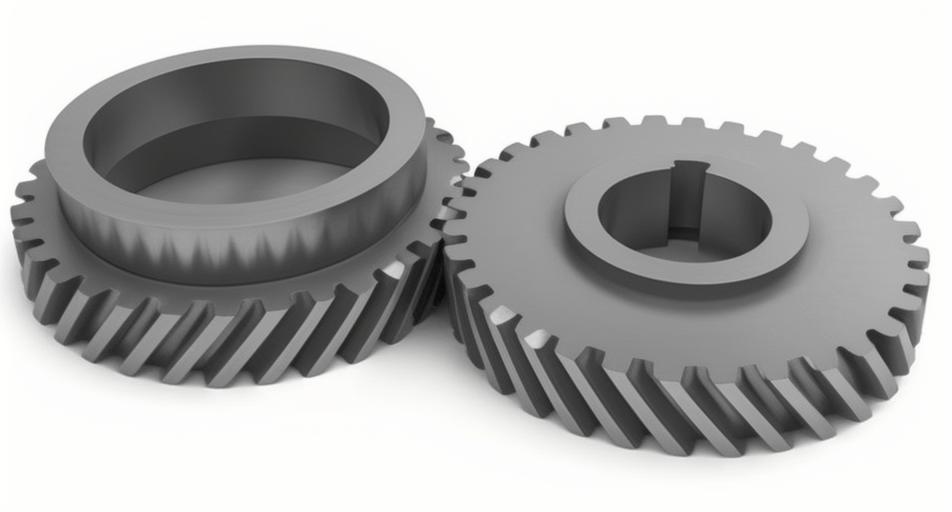
This article details a novel vision-based methodology I have developed for the precise and efficient measurement of the helix angle in helical gears. The core innovation lies in utilizing a dual-camera setup to simultaneously capture orthogonal views of the gear: one camera images the end face, while the other images the side profile. By processing these two complementary images, we can extract all necessary geometric primitives—such as the tip diameter, root diameter, and the apparent lead on the tip cylinder—to compute the fundamental helix angle at the reference circle. This approach eliminates the need for manual parameter input or complex mechanical staging, enabling a fully automated and rapid measurement cycle. The following sections will elaborate on the measurement system architecture, the detailed image processing algorithms for both views, the mathematical derivation of the helix angle, and a comprehensive experimental validation comparing the proposed method against conventional techniques.
1. The Dual-Camera Vision Measurement System
The proposed measurement system is designed for robustness, simplicity, and speed. Its primary components include illumination, imaging hardware, and processing software, all configured to facilitate the extraction of precise geometric data from the helical gears.
System Configuration: The core of the imaging setup involves two industrial CMOS cameras mounted orthogonally to each other on a stable platform. One camera is positioned directly above the gear, aligned perpendicular to its axis of rotation, to capture a clear view of the entire end face. The second camera is positioned horizontally, at the same height as the gear’s axis, to capture a side profile view. The gear under inspection is placed on a flat, neutral background. For optimal image contrast, a hybrid lighting scheme is employed. A diffused backlight illuminates the gear from behind, creating a high-contrast silhouette ideal for accurately detecting the outer and inner contours of the end face. A front light, typically a ring light or dome light, illuminates the side of the gear, enhancing the visibility of the tooth flank edges on the side profile by creating gradients and highlights. The cameras are connected to a host computer which controls image acquisition and executes the processing algorithms.
Measurement Workflow: The measurement process follows a sequential, automated workflow. First, both cameras are triggered simultaneously or in rapid succession to capture the end-face and side-profile images. These images are then transferred to the computer for processing. The end-face image is analyzed to determine key diameters: the tip circle diameter (\(d_a\)), the root circle diameter (\(d_f\)), and subsequently the reference (pitch) circle diameter (\(d\)) and the number of teeth (\(z\)). Concurrently, the side-profile image is processed to measure the lead of the tooth trace on the tip cylinder, from which the tip helix angle (\(\beta_a\)) is calculated. Finally, using the geometric relationship between the tip cylinder and the reference cylinder, the fundamental helix angle (\(\beta\)) at the reference circle is computed. This entire process, from image capture to result output, is completed in a matter of seconds.
2. End-Face Image Processing for Primary Gear Parameters
The end-face image provides the planar geometric data necessary for calculating the reference diameter, which is crucial for the final helix angle calculation. The processing pipeline for this view is meticulous to ensure sub-pixel accuracy.
2.1 Image Pre-processing
The raw color image from the end-face camera is first converted to an 8-bit grayscale image to simplify processing and reduce computational load. To mitigate the effects of sensor noise and minor imperfections in the background, a Gaussian filter is applied. A 5×5 kernel is typically effective in smoothing noise while adequately preserving the critical edge information of the gear contour. The next critical step is segmentation. Using global or adaptive thresholding, the grayscale image is converted into a binary image. The goal is to cleanly separate the dark gear silhouette (foreground) from the bright background created by the backlight. This results in a white gear shape on a black background, or vice versa, with high contrast.
2.2 Morphological Processing and Center Determination
Helical gears often have central features like mounting holes or keyways which disrupt the continuity of the inner contour. To accurately find the geometric center, these internal features must be filled. A seed-fill or flood-fill algorithm is used to identify and fill all holes within the main gear boundary, resulting in a solid, connected region. The geometric center of the gear (\(O\)) is a fundamental reference point. It is determined by extracting the sub-pixel edge points of the filled silhouette and then fitting a circle to these points using a least-squares method. The center of this best-fit circle is taken as the gear’s center coordinates \((x_c, y_c)\).
2.3 Diameter and Parameter Extraction
With the gear center established, the tip and root diameters can be measured precisely. The tip diameter (\(d_a\)) is found by determining the smallest circle centered at \(O\) that circumscribes all the edge points (Minimum Circumscribed Circle). Conversely, the root diameter (\(d_f\)) is found by determining the largest circle centered at \(O\) that is inscribed within all the edge points (Maximum Inscribed Circle). These algorithms, often based on iterative optimization or computational geometry techniques like rotating calipers, provide robust diameter measurements directly in pixel units. Using the known calibration factor (mm/pixel), these values are converted to physical dimensions.
The number of teeth (\(z\)) is determined by analyzing the pattern between the tip and root circles. A virtual circle with a diameter of \((d_a + d_f)/2\) is superimposed. The region between this virtual circle and the actual gear contour highlights the tooth spaces. Performing a connected-components analysis on this intersected region yields a count of the tooth gaps, which equals the number of teeth. Finally, the transverse module (\(m_t\)) and the reference diameter (\(d\)) are calculated using fundamental gear geometry formulas:
$$ m_t = \frac{d_a – d_f}{4.5} $$
$$ d = m_t \cdot z $$
These parameters, derived solely from the end-face image, form the first essential set of inputs for helix angle calculation.
3. Side-Profile Image Processing for Helix Angle Measurement
The side-profile image captures the three-dimensional nature of the helical gears by showing the inclination of the tooth trace across the gear’s width. The objective here is to measure the angle of this trace on the visible surface, which corresponds to the tip cylinder.
3.1 Image Pre-processing and Region of Interest (ROI) Selection
To improve processing speed and accuracy, a Region of Interest (ROI) encompassing a single, well-defined tooth flank on the side of the gear is first selected manually or via automated detection. This ROI image undergoes similar pre-processing as the end-face image: grayscale conversion and Gaussian filtering. Thresholding is then applied to segment the tooth from the background. Given the side lighting, the thresholding may need to be adaptive to account for shading gradients along the tooth flank. The resulting binary image is cleaned using morphological operations, typically an opening operation, to remove small spurious pixels and smooth the tooth boundary without altering its overall shape. Any internal holes are filled to create a solid tooth region.
3.2 Feature Point Detection and Helix Angle Calculation
The key to measuring the angle is to accurately locate the endpoints of the tooth trace within the ROI. A corner detection algorithm (such as Harris, Shi-Tomasi, or a sub-pixel corner finder) is applied to the processed binary tooth image. This detects the four principal vertices of the visible parallelogram-shaped tooth flank: two on the top (tip) edge and two on the bottom (root or near-root) edge. Let these corner coordinates be denoted as \(P_{TL}, P_{TR}, P_{BL}, P_{BR}\) (Top-Left, Top-Right, Bottom-Left, Bottom-Right). The midpoints of the top and bottom edges are calculated:
$$ E = \left( \frac{x_{TL} + x_{TR}}{2}, \frac{y_{TL} + y_{TR}}{2} \right) $$
$$ F = \left( \frac{x_{BL} + x_{BR}}{2}, \frac{y_{BL} + y_{BR}}{2} \right) $$
Points \(E\) and \(F\) lie on the tooth trace at the tip and root levels, respectively, as seen in the side projection. In the side view, the horizontal pixel distance between \(E\) and \(F\), when converted to millimeters using the side camera’s calibration factor, represents the axial displacement (\(h_{EF}\)) of the tooth trace over the visible gear face width. The corresponding arc length on the tip circle for this axial travel is not directly visible. However, if the gear is positioned such that the side view shows a true projection (i.e., the camera axis is parallel to the gear axis and the gear face is parallel to the image plane), the horizontal distance in the image between the vertical projections of lines through \(E\) and \(F\) can be related to a portion of the lead. A more direct method is to calculate the angle of the line \(\overline{EF}\) itself relative to the vertical axis of the image. This angle (\(\beta_{a, image}\)) is the projection of the tip helix angle. The tangent of this angle is given by the ratio of the horizontal component to the vertical component of the vector from \(E\) to \(F\):
$$ \tan(\beta_{a, image}) = \frac{|x_F – x_E|}{|y_F – y_E|} $$
This \(\beta_{a, image}\) is the helix angle as measured on the tip cylinder from the side profile. To obtain the standard helix angle at the reference circle (\(\beta\)), we use the fundamental geometric relationship in helical gears that the lead (\(L\)) is constant for all coaxial cylinders:
$$ L = \pi d \cot(\beta) = \pi d_a \cot(\beta_a) $$
From this relationship, we can derive the formula to convert the measured tip helix angle (\(\beta_a\)) to the reference circle helix angle (\(\beta\)):
$$ \tan(\beta) = \frac{d}{d_a} \cdot \tan(\beta_a) $$
All parameters on the right-hand side are now known: \(d_a\) and \(d\) from end-face processing, and \(\beta_a\) (equivalent to \(\beta_{a, image}\) under proper alignment) from side-image processing. Therefore, the definitive helix angle \(\beta\) of the helical gear is computed.
4. Experimental Validation and Comparative Analysis
To evaluate the performance of the proposed dual-camera vision method, a controlled experiment was conducted. The subject was a standard nylon helical gear with a known, machined helix angle. Five different teeth on the same gear were measured to account for minor manufacturing variations. The proposed method was compared against two established approaches: a traditional manual measurement method using precision calipers and a protractor (representing conventional practice), and a previously published single-camera vision method which required manual rotation of the gear between two end-face captures. The results, including measured helix angles, relative errors, and average measurement time, are summarized in the table below.
| Tooth Index | Actual Helix Angle (°) | Manual Measurement (°) | Relative Error (%) | Single-Camera Method (°) | Relative Error (%) | Proposed Dual-Camera Method (°) | Relative Error (%) |
|---|---|---|---|---|---|---|---|
| 1 | 14.90 | 14.41 | 3.30 | 14.8102 | 0.60 | 14.7854 | 0.77 |
| 2 | 14.90 | 14.88 | 0.13 | 14.7739 | 0.85 | 14.8370 | 0.42 |
| 3 | 14.90 | 14.72 | 1.20 | 14.8057 | 0.63 | 14.7963 | 0.70 |
| 4 | 14.90 | 14.95 | 0.34 | 14.7605 | 0.94 | 14.8085 | 0.61 |
| 5 | 14.90 | 14.65 | 1.68 | 14.7556 | 0.97 | 14.7906 | 0.73 |
| Average | 14.90 | — | 1.33% | — | 0.80% | — | 0.65% |
| Avg. Time (s) | — | 18.35 | — | 9.42 | — | 4.58 | — |
The experimental data clearly demonstrates the advantages of the proposed dual-camera vision system for measuring helical gears. In terms of accuracy, the method achieved an average relative error of 0.65%, which is superior to both the manual method (1.33%) and the single-camera vision method (0.80%). The manual method suffers from inherent observer error and the accumulation of uncertainties from multiple measurement steps. The single-camera method, while more accurate than manual measurement, still introduces potential alignment errors during the manual rotation stage between the two required end-face captures.
The most striking advantage is in measurement speed. The proposed system completes the entire measurement cycle in an average of 4.58 seconds. This is significantly faster than the 9.42 seconds required by the semi-automated single-camera method and dramatically faster than the 18.35 seconds needed for careful manual measurement. This speed is achieved because the dual-camera system captures all necessary data (end and side views) in a single, synchronized step without any need for operator intervention or gear manipulation between shots. This makes the method exceptionally suitable for high-throughput industrial inspection of helical gears.
5. Discussion and Future Work
The methodology presented herein establishes a robust framework for the non-contact, vision-based measurement of the helix angle in helical gears. By intelligently combining the planar geometric data from an end-face view with the axial inclination data from a side-profile view, the system circumvents the limitations of single-view techniques and the complexities of multi-stage mechanical setups. The use of a dual-camera orthogonal arrangement is key to its efficiency, enabling parallel data acquisition. The image processing pipeline, incorporating sub-pixel edge detection, robust circle fitting, and precise corner detection, ensures that the geometric primitives are extracted with high fidelity.
The method’s primary strengths are its accuracy, speed, and automation potential. The sub-pixel processing algorithms minimize quantization error, while the simultaneous capture eliminates errors associated with gear repositioning. The entire process can be easily integrated into a programmable automation sequence, requiring minimal operator skill once the system is calibrated.
Future work will focus on enhancing the system’s robustness and applicability. One avenue is the development of more adaptive and noise-immune edge detection algorithms to maintain accuracy in less-controlled industrial environments with varying lighting conditions or surface finishes on the helical gears. Furthermore, extending the algorithm to automatically identify and measure multiple teeth on the side profile and statistically combine the results could improve measurement reliability by averaging out local tooth-to-tooth variations. The integration of deep learning models for initial gear detection, pose estimation, and ROI selection could further streamline the process and reduce setup requirements. Finally, expanding the system’s capability to measure other critical gear parameters simultaneously, such as tooth profile deviation or pitch error, from the same set of images would create a comprehensive, multi-parameter vision inspection station for helical gears.
In conclusion, the dual-camera image processing method represents a significant step forward in the metrology of helical gears. It offers a compelling blend of precision, efficiency, and practicality, making it a viable and attractive solution for quality control in the modern manufacturing of these essential power transmission components.