
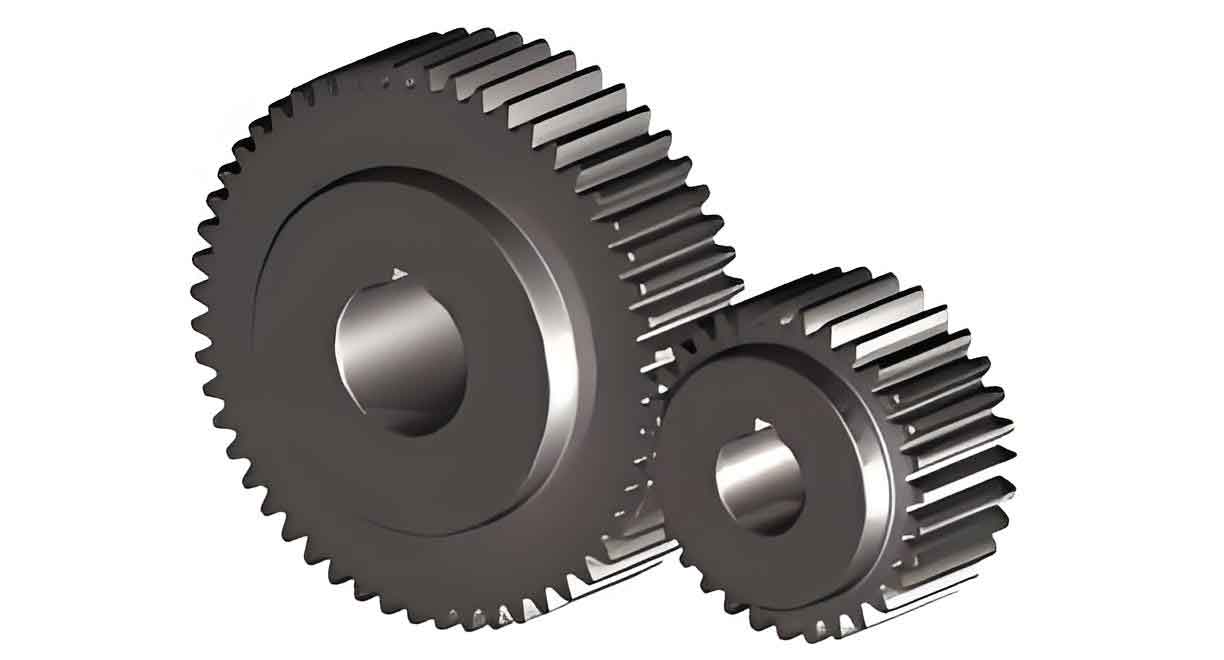
Spur gears are fundamental components in power transmission systems across various industries such as automotive, aerospace, and heavy machinery. A primary concern in their design and application is their tendency to fail due to fatigue under prolonged cyclic loading. This failure typically manifests as pitting, spalling, or plastic deformation on the tooth surface, directly linked to contact stress. Therefore, a comprehensive analysis of contact strength and fatigue life is crucial for ensuring reliability and durability. In this study, I conduct a detailed investigation into the static, dynamic, and fatigue behavior of a pair of involute spur gears. I employ Finite Element Analysis (FEA) to simulate stress distributions under various loads and speeds, followed by a fatigue life prediction based on material properties and cumulative damage theory. The objective is to validate the design methodology and provide insights into how key operational parameters influence the lifespan of spur gears, offering a reference for optimization in industrial applications.
Theoretical Background for Spur Gears Analysis
The interaction between meshing spur gears is theoretically a line contact. However, from the perspective of elasticity, the contact occurs over a small elliptical area due to deformation under load. The fundamental forces acting on a spur gear tooth during meshing are derived from the transmitted torque. These include the tangential force \(F_t\), the radial force \(F_r\), and the resultant normal force \(F_n\). For a pinion (gear 1) with torque \(T_1\) and pitch diameter \(d_1\), these forces are calculated as follows:
$$F_{t1} = \frac{2T_1}{d_1}$$
$$F_{r1} = F_{t1} \cdot \tan\alpha$$
$$F_{n1} = \frac{F_{t1}}{\cos\alpha}$$
Where \(\alpha\) is the pressure angle, typically 20° for standard spur gears. The same forces, with opposite directions, act on the driven gear.
The core of gear design involves ensuring that the contact stress \(\sigma_H\) on the tooth flank does not exceed the permissible contact stress \(\sigma_{HP}\) of the material. According to standard mechanical design theory, the contact stress at the pitch point for a pair of spur gears is calculated using a refined formula that accounts for various influencing factors:
$$\sigma_{H0} = Z_H Z_E Z_\varepsilon \sqrt{\frac{F_t}{b d_1} \cdot \frac{u+1}{u}}$$
Where:
\(Z_H\) is the zone factor, accounting for the geometry of the tooth at the pitch point:
$$Z_H = \sqrt{\frac{2 \cos\beta_b}{\cos^2\alpha_t \sin\alpha_{wt}}}$$
(For spur gears with \(\beta=0\), this simplifies).
\(Z_E\) is the elasticity factor, which depends on the material properties of both gears (Young’s modulus \(E\) and Poisson’s ratio \(\nu\)):
$$Z_E = \sqrt{\frac{1}{\pi \left( \frac{1-\nu_1^2}{E_1} + \frac{1-\nu_2^2}{E_2} \right)}}$$
\(Z_\varepsilon\) is the contact ratio factor.
\(b\) is the face width.
\(u\) is the gear ratio (\(z_2/z_1\)).
\(F_t\) is the nominal tangential load.
The final calculated contact stress \(\sigma_H\) is then obtained by applying several application factors:
$$\sigma_H = \sigma_{H0} \sqrt{K_A K_V K_{H\alpha} K_{H\beta}} \leq \sigma_{HP}$$
Where \(K_A\) is the application factor, \(K_V\) is the dynamic factor, \(K_{H\alpha}\) is the transverse load factor, and \(K_{H\beta}\) is the face load factor. These factors adjust the nominal stress to account for real-world conditions like load fluctuations, manufacturing inaccuracies, and dynamic effects.
Finite Element Modeling and Static Analysis of Spur Gears
To complement and validate the theoretical calculations, I developed a three-dimensional model of a spur gear pair. The primary parameters of the designed spur gears are summarized in the table below.
| Parameter | Pinion (Gear 1) | Gear (Gear 2) |
|---|---|---|
| Normal Module, \(m_n\) (mm) | 1.75 | 1.75 |
| Number of Teeth, \(z\) | 26 | 77 |
| Pressure Angle, \(\alpha\) (°) | 20 | 20 |
| Face Width, \(b\) (mm) | 22 | 22 |
| Material | 40Cr Alloy Steel | |
The material chosen for the spur gears is 40Cr alloy steel, a common choice for high-strength components. Its key properties used in the analysis are listed here.
| Property | Value |
|---|---|
| Density, \(\rho\) (kg/m³) | 7870 |
| Young’s Modulus, \(E\) (GPa) | 211 |
| Poisson’s Ratio, \(\nu\) | 0.27 |
| Yield Strength, \(\sigma_y\) (MPa) | 805 |
| Tensile Strength, \(\sigma_u\) (MPa) | 940 |
The static structural analysis aimed to determine the stress distribution under a constant applied torque, simulating a quasi-static loading condition. The pinion was fixed in all degrees of freedom except rotation about its axis. A specified torque was applied to the gear, and a frictional contact (with a static coefficient of 0.1) was defined between the mating tooth flanks. I analyzed several torque levels common in automotive applications, ranging from 80 N·m to 150 N·m.
The FEA results showed that the maximum contact stress, as expected, occurred near the pitch line on the tooth flank, where single-pair contact often leads to higher loads. The von-Mises stress distribution clearly highlighted the contact path. A comparison between the FEA results and the theoretical calculations using the standard formula shows good agreement, with an average error of approximately 5.17%. This discrepancy is acceptable and can be attributed to the various correction factors used in the analytical formula and inherent discretization errors in FEA. The results confirm the validity of the finite element model for the spur gears.
| Case | Applied Torque (N·m) | FEA Max Contact Stress (MPa) | Theoretical Stress (MPa) | Error (%) |
|---|---|---|---|---|
| 1 | 80 | 255.68 | 269.61 | -5.16 |
| 2 | 100 | 304.26 | 318.15 | -4.37 |
| 3 | 120 | 352.93 | 374.11 | -5.66 |
| 4 | 150 | 426.02 | 452.52 | -5.86 |
As evident from the table, the contact stress in the spur gears increases linearly with the applied torque. The increase from 80 N·m to 150 N·m results in a stress increase of about 66.6%, underscoring the direct and significant impact of load on the stress state of the gear teeth.
Transient Dynamic Analysis of Spur Gears
Static analysis provides a valuable snapshot, but spur gears in operation are subject to dynamic effects due to rotation, variable loading, and impact from tooth meshing. To capture these effects, I performed a transient dynamic analysis. In this simulation, rotational velocity was applied to the pinion, and a corresponding torque (load) was applied to the gear, simulating power transmission under motion. The analysis tracked the stress variation over a short period encompassing several meshing cycles.
I investigated the influence of three key parameters: torque (T), rotational speed (\(\omega\)), and the kinetic coefficient of friction (\(\mu_k\)). The base case was set at T=80 N·m, \(\omega\)=26.18 rad/s (≈250 rpm), and \(\mu_k\)=0.1. The results, presented as time-history curves of contact stress, show a cyclical pattern corresponding to the meshing of individual teeth. The peak stress in each cycle is higher than the static stress for the same load due to dynamic amplification.
| Case | Torque, T (N·m) | Speed, \(\omega\) (rad/s) | Friction, \(\mu_k\) | Dynamic Max Stress (MPa) |
|---|---|---|---|---|
| A | 80 | 26.18 | 0.1 | 301.52 |
| B | 100 | 26.18 | 0.1 | 320.65 |
| C | 120 | 26.18 | 0.1 | 338.01 |
| D | 150 | 26.18 | 0.1 | 367.72 |
| E | 150 | 31.40 | 0.1 | 406.63 |
| F | 150 | 41.89 | 0.1 | 408.08 |
| G | 80 | 41.89 | 0.15 | 317.83 |
| H | 80 | 41.89 | 0.2 | 320.94 |
The analysis of the dynamic results reveals important trends for the operational life of spur gears. Comparing cases A through D, with increasing torque, the dynamic contact stress rises steadily. The increase from 80 N·m to 150 N·m (cases A vs. D) causes a 21.9% rise in stress. Comparing cases D, E, and F shows the effect of speed. Increasing speed from 26.18 rad/s to 41.89 rad/s leads to an approximately 11% increase in peak dynamic stress, primarily due to inertial and impact effects becoming more pronounced. Finally, comparing cases F, G, and H illustrates the influence of friction. Increasing the kinetic friction coefficient from 0.1 to 0.2 results in about a 6.7% increase in the dynamic contact stress, as higher friction generates greater shear forces on the tooth surface.
Fatigue Life Prediction for Spur Gears
The ultimate goal of this analysis is to predict the fatigue life of the spur gears under cyclic loading. Fatigue failure is a progressive, localized structural damage that occurs when a material is subjected to cyclic stresses. I employed the linear cumulative damage rule, known as Miner’s Rule, for life prediction. This theory posits that the total damage \(D\) from variable amplitude loading is the sum of the damage fractions from individual stress cycles:
$$D = \sum_{i=1}^{k} \frac{n_i}{N_i}$$
Where \(n_i\) is the number of cycles at a specific stress level \(\sigma_i\), and \(N_i\) is the number of cycles to failure at that stress level, as defined by the material’s S-N curve. Failure is predicted when \(D \geq 1\).
The S-N curve for 40Cr steel was essential for this analysis. The curve relates the stress amplitude \(S\) to the number of cycles to failure \(N\). The fitted equation for the material’s high-cycle fatigue region is:
$$\log N = 27.7952 – 8.174014 \log S$$
To perform the fatigue analysis, I integrated the finite element stress results with the material S-N data and a defined load history using dedicated fatigue analysis software.
Fatigue Life Under Static Load Mapping
First, I analyzed fatigue life based on the static stress results. Since static analysis yields a single stress value, a load spectrum must be applied to simulate cyclic loading. I used a symmetrical, sinusoidal load spectrum with an amplitude factor of 0.5 and a period of 1 second. This spectrum, combined with the static stress field \(\sigma_{FEA}\), creates a time-varying stress \(S(t)\) at every node in the model:
$$S(t) = \frac{ScaleFactor \times P(t) \times \sigma_{FEA} + Offset}{Divider}$$
Where \(P(t)\) is the load multiplier from the spectrum. The minimum fatigue life (at the critical node) for different static torque levels is summarized below.
| Static Torque (N·m) | Minimum Fatigue Life (Cycles) | Critical Node |
|---|---|---|
| 80 | 1.410 × 10¹¹ | 35363 |
| 100 | 8.398 × 10⁹ | 35363 |
| 120 | 6.429 × 10⁸ | 32902 |
| 150 | 1.709 × 10⁷ | 32902 |
The results are striking. The predicted life decreases dramatically with increasing torque. The life at 150 N·m is approximately four orders of magnitude lower than at 80 N·m. The critical location (node) for fatigue under this static-based analysis aligns with the area of maximum contact stress found in the static FEA, typically on the active flank near the pitch line.
Fatigue Life Under Dynamic Load Mapping
A more realistic fatigue assessment uses the transient dynamic stress results directly. In this approach, the time-history stress output from the transient analysis serves as the loading input, inherently containing the dynamic effects of meshing. No additional load spectrum is needed. The fatigue analysis software calculates the damage for each stress cycle in the time history. The predicted minimum lives under various dynamic conditions are presented below.
| Case | Torque (N·m) | Speed (rad/s) | Friction, \(\mu_k\) | Minimum Fatigue Life (Cycles) |
|---|---|---|---|---|
| A | 80 | 26.18 | 0.1 | 4.236 × 10¹⁴ |
| B | 100 | 26.18 | 0.1 | 1.020 × 10¹³ |
| C | 120 | 26.18 | 0.1 | 4.590 × 10¹¹ |
| D | 150 | 26.18 | 0.1 | 1.815 × 10¹¹ |
| E | 150 | 31.40 | 0.1 | 7.473 × 10¹⁰ |
| F | 150 | 41.89 | 0.1 | 2.981 × 10¹⁰ |
| G | 80 | 41.89 | 0.15 | 1.352 × 10¹⁴ |
| H | 80 | 41.89 | 0.2 | 8.794 × 10¹³ |
The dynamic-based fatigue life predictions show even more sensitivity to operational parameters than the static-based ones. Several key conclusions can be drawn regarding the lifespan of these spur gears:
- Torque is the Dominant Factor: Increasing torque has a catastrophic effect on fatigue life. Comparing cases A to D, life decreases by over three orders of magnitude as torque increases from 80 N·m to 150 N·m. This is consistent with the high power-law dependence of life on stress in the S-N equation.
- Speed has a Significant Negative Impact: Comparing cases D, E, and F, increasing rotational speed reduces fatigue life substantially. Higher speeds increase dynamic loads and the rate of stress cycling, both contributing to faster accumulation of damage.
- Friction Adversely Affects Life: Comparing cases F, G, and H, an increase in the coefficient of friction leads to a clear reduction in predicted life. Higher friction increases the shear stress component on the tooth surface, promoting crack initiation and propagation.
- Critical Location Shift: Under dynamic loading, the critical node for minimum fatigue life often shifts from the pure contact point on the flank to the transition region between the tooth root fillet and the face width, or at the edge of the contact path. This highlights the importance of considering stress concentrations and multi-axial stress states in dynamic fatigue analysis of spur gears.
Conclusions
This comprehensive study on the contact strength and fatigue life of spur gears under different operating conditions leads to several significant conclusions. The finite element analysis successfully simulated both static and dynamic loading scenarios, with static stress results showing good correlation with classical theoretical calculations. The transient dynamic analysis provided crucial insights into the amplified stresses due to rotational and meshing impacts.
The fatigue life analysis, based on Miner’s linear cumulative damage rule and the material S-N curve, quantitatively revealed the profound influence of key operational parameters on the durability of spur gears. The applied torque was identified as the most critical factor, with even moderate increases leading to orders-of-magnitude reductions in predicted life. Rotational speed and the coefficient of friction between mating teeth also play substantial roles in accelerating fatigue damage. Furthermore, the analysis indicated that the location most prone to fatigue failure can differ between static and dynamic loading conditions. Under dynamic loads, stress concentrations at geometric transitions become critical.
This integrated approach, combining theoretical mechanics, finite element simulation, and fatigue life prediction, provides a robust framework for evaluating and optimizing the design of spur gears. The findings underscore the necessity of considering real dynamic operating conditions rather than just static loads during the design phase to ensure long-term reliability and prevent premature failure in power transmission systems.