
The study of dynamic characteristics in gear transmission systems is of paramount importance for ensuring reliability, stability, and low noise operation in modern machinery. Among various gear types, helical gears are extensively employed in demanding applications such as aerospace, marine propulsion, and high-performance automotive systems due to their superior load-carrying capacity, smooth and quiet operation, and ease of manufacture and adjustment. As industrial demands push towards higher rotational speeds and power densities, understanding the dynamic behavior of helical gears under high-speed conditions becomes critically important. Many systems, including those in helicopters, naval vessels, and electric vehicles, now operate with helical gears exceeding 10,000 rpm, often traversing through or operating above resonance regions. Therefore, a comprehensive analysis of their dynamics is essential for optimal design and avoidance of detrimental vibrations.
A key internal excitation mechanism in gear dynamics is the Time-Varying Mesh Stiffness (TVMS). Unlike a constant average stiffness, the TVMS fluctuates periodically as the number of teeth in contact changes during the meshing cycle. This fluctuation acts as a parametric excitation, potentially amplifying dynamic loads and vibrations. Early research often simplified analyses by using a constant average mesh stiffness. However, with the development of more refined calculation methods—such as the improved potential energy method and techniques based on Loaded Tooth Contact Analysis (LTCA)—the significant influence of TVMS on dynamic response has been widely recognized. While numerous studies have investigated this effect for helical gears at low and medium speeds, its implications for ultra-high-speed operation remain less explored. This work aims to bridge this gap by developing a detailed dynamic model that incorporates a high-fidelity TVMS, derived from an LTCA-based approach, to analyze the vibration characteristics of high-speed helical gears.
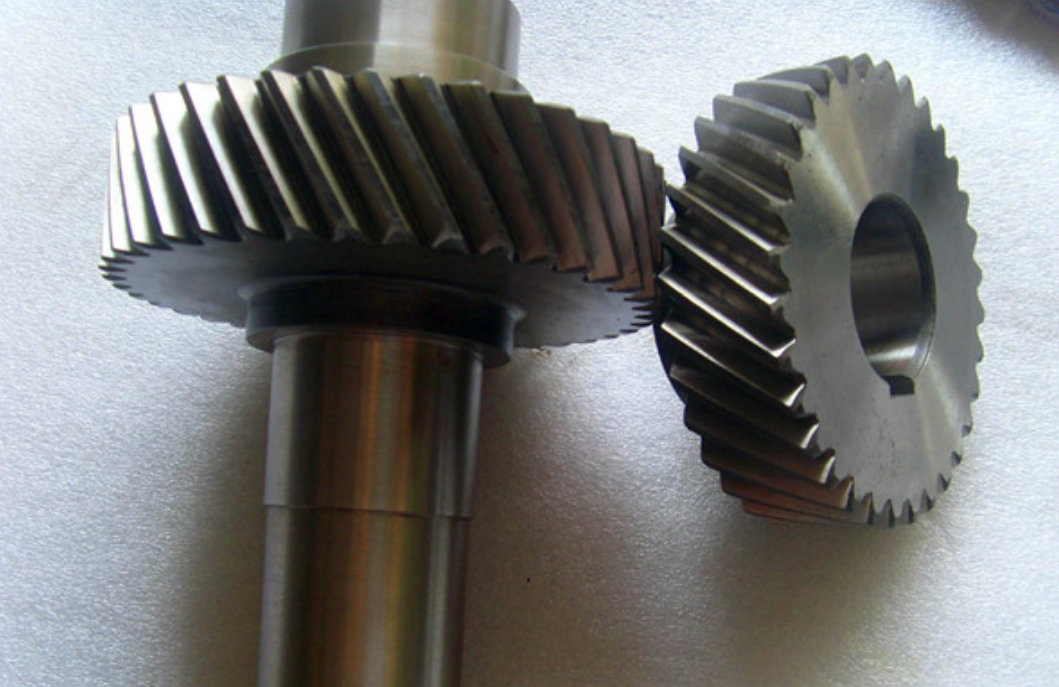
1. Dynamic Modeling of Helical Gear Pairs
To accurately capture the complex vibratory behavior, a six-degree-of-freedom (6-DOF) lumped-parameter model is established for a pair of meshing helical gears. This model considers the coupling between bending, torsional, and axial vibrations, which is inherent to helical gears due to their spiral tooth geometry. The model represents the pinion and gear as rigid bodies with masses and moments of inertia, connected to ground via linear spring-damper elements representing bearing supports in the transverse (y) and axial (z) directions. The gear mesh is modeled as a spring-damper element acting along the line of action, with its stiffness being a prescribed time-varying function, \( k_m(t) \).
The generalized displacement vector for the system is defined as:
$$ \mathbf{q} = [y_1, z_1, \theta_1, y_2, z_2, \theta_2]^T $$
where \( y_i \), \( z_i \), and \( \theta_i \) (with \( i=1 \) for pinion, \( i=2 \) for gear) represent the translational displacements in the radial and axial directions, and the rotational displacement, respectively.
Applying Newton’s second law, the equations of motion are derived. The dynamic mesh force components in the transverse (y) and axial (z) directions at the mesh interface are crucial and are given by:
$$
\begin{aligned}
F_y &= \cos\beta \left\{ c_m \left[ \cos\beta (\dot{y}_1 – \dot{y}_2 + R_{b1}\dot{\theta}_1 – R_{b2}\dot{\theta}_2) + \sin\beta (\dot{z}_1 – \dot{z}_2) \right] \right. \\
&\quad + \left. k_m(t) \left[ \cos\beta (y_1 – y_2 + R_{b1}\theta_1 – R_{b2}\theta_2) + \sin\beta (z_1 – z_2) \right] \right\} \\
F_z &= \sin\beta \left\{ c_m \left[ \cos\beta (\dot{y}_1 – \dot{y}_2 + R_{b1}\dot{\theta}_1 – R_{b2}\dot{\theta}_2) + \sin\beta (\dot{z}_1 – \dot{z}_2) \right] \right. \\
&\quad + \left. k_m(t) \left[ \cos\beta (y_1 – y_2 + R_{b1}\theta_1 – R_{b2}\theta_2) + \sin\beta (z_1 – z_2) \right] \right\}
\end{aligned}
$$
Here, \( \beta \) is the helix angle, \( R_{b1} \) and \( R_{b2} \) are the base circle radii, and \( c_m \) is the mesh damping, often calculated as:
$$ c_m = 2 \zeta \sqrt{\frac{k_{m,mean} I_1 I_2}{I_1 R_{b2}^2 + I_2 R_{b1}^2}} $$
where \( \zeta \) is the damping ratio (typically 0.05-0.1), \( k_{m,mean} \) is the average mesh stiffness, and \( I_1, I_2 \) are the mass moments of inertia.
The complete system of equations is:
$$
\begin{aligned}
m_1 \ddot{y}_1 + c_{1y} \dot{y}_1 + k_{1y} y_1 &= -F_y \\
m_1 \ddot{z}_1 + c_{1z} \dot{z}_1 + k_{1z} z_1 &= -F_z \\
I_1 \ddot{\theta}_1 &= -F_y R_{b1} + T_1 \\
m_2 \ddot{y}_2 + c_{2y} \dot{y}_2 + k_{2y} y_2 &= F_y \\
m_2 \ddot{z}_2 + c_{2z} \dot{z}_2 + k_{2z} z_2 &= F_z \\
I_2 \ddot{\theta}_2 &= F_y R_{b2} – T_2
\end{aligned}
$$
where \( m_i, k_{iy}, k_{iz}, c_{iy}, c_{iz} \) are the masses, bearing support stiffnesses, and damping coefficients, and \( T_i \) are the input/output torques.
To eliminate the rigid-body rotation and focus on vibratory motion, a relative displacement coordinate \( q \) along the line of action is often introduced:
$$ q = R_{b1}\theta_1 – R_{b2}\theta_2 + (y_1 – y_2)\cos\beta + (z_1 – z_2)\sin\beta $$
This coordinate simplifies the torsional equations into a single equation describing the dynamic transmission error, which is a primary indicator of mesh vibration.
2. Calculation of Time-Varying Mesh Stiffness (TVMS) for Helical Gears
Accurate representation of \( k_m(t) \) is critical. For helical gears, the mesh stiffness varies due to changing contact lines and the number of tooth pairs in contact. An effective method for calculating TVMS, especially for gears with modifications or errors, is based on Loaded Tooth Contact Analysis (LTCA). LTCA combines precise geometric modeling with elastic deformation calculations to determine the load distribution and transmission error under load.
The fundamental relationship for mesh stiffness at a given roll position is:
$$ k_m = \frac{P}{\delta_{total}} $$
where \( P \) is the total applied load, and \( \delta_{total} \) is the total composite deflection at the mesh, comprising:
- Geometric Transmission Error (\( \delta_g \)): A kinematic displacement error independent of load, determined by manufacturing and design modifications.
- Bending and Shear Deflection (\( \delta_b \)): The deflection of the tooth as a cantilever beam, proportional to load.
- Contact Deflection (\( \delta_c \)): The local Hertzian contact deformation, proportional to the load raised to the power of 2/3.
Thus, the total deflection can be modeled as:
$$ \delta_{total}(P) = \delta_g + \delta_b(P) + \delta_c(P) = C_1 + C_2 P + C_3 P^{2/3} $$
The constants \( C_1, C_2, C_3 \) are determined for each discrete meshing position (e.g., at 50-100 points across one mesh cycle) by performing LTCA under three different load levels. Once these constants are known, the mesh stiffness for any load \( P \) at that position is:
$$ k_m(P) = \frac{P}{C_1 + C_2 P + C_3 P^{2/3}} $$
Repeating this process for all positions yields the complete periodic TVMS function, \( k_m(t) \), which can be approximated by a Fourier series:
$$ k_m(t) = k_{m,mean} + \sum_{n=1}^{N} [a_n \cos(n\omega_m t) + b_n \sin(n\omega_m t)] $$
where \( \omega_m \) is the gear mesh frequency.
3. Parametric Study and Dynamic Response Analysis
The dynamic model is solved using numerical integration methods (e.g., Runge-Kutta) to obtain the time-domain response. A key vibration metric for helical gears is the dynamic transmission error or the relative acceleration along the line of action, \( a(t) \), defined as:
$$ a(t) = \cos\beta (\ddot{y}_1 – \ddot{y}_2 + R_{b1}\ddot{\theta}_1 – R_{b2}\ddot{\theta}_2) + \sin\beta (\ddot{z}_1 – \ddot{z}_2) $$
The Root Mean Square (RMS) value of \( a(t) \) is a useful indicator of overall vibration severity.
3.1. Effect of Rotational Speed
Under a specific TVMS excitation, the system’s response is analyzed across a wide speed range. A frequency-speed diagram (or Campbell diagram) can be constructed by plotting the RMS of \( a(t) \) against the pinion rotational speed. For high-speed helical gears, several phenomena are observed:
- Resonance Peaks: Primary resonance occurs when the mesh frequency \( f_m \) coincides with a major natural frequency of the system \( f_n \), i.e., \( f_m = f_n \). For a pinion with \( Z_1 \) teeth rotating at \( N \) (rpm), \( f_m = N Z_1 / 60 \). The critical speed is \( N_{crit} = 60 f_n / Z_1 \).
- Super-Harmonic Resonance: Significant vibration can also occur at fractions of the critical speed, such as \( N_{crit}/2 \) or \( N_{crit}/3 \), where \( 2f_m = f_n \) or \( 3f_m = f_n \), respectively.
- Non-Resonant Operation: In speed regions far from these critical and super-harmonic speeds, the vibration level (RMS acceleration) does not show a strong, monotonic increase with speed when the excitation is purely parametric (TVMS). This is because the amplitude and mean of the TVMS excitation are independent of speed.
This highlights a crucial aspect of high-speed helical gear design: avoiding operation at or near these critical speeds is essential, while operation in the non-resonant zones between them can be relatively stable even at very high rpm.
3.2. Effect of TVMS Mean Value
The influence of the average mesh stiffness \( k_{m,mean} \) is investigated by scaling the mean of the calculated TVMS while keeping its fluctuating amplitude constant. The following table summarizes a parametric study:
| Stiffness Case | Scale Factor (Mean) | Effect on Natural Frequency | Effect on Vibration Amplitude (Non-Resonant) | Effect on Critical Speed |
|---|---|---|---|---|
| Low | 0.6 | Decreases | Increases | Decreases |
| Medium-Low | 0.8 | Decreases moderately | Increases moderately | Decreases moderately |
| Baseline | 1.0 | Baseline \( f_n \) | Baseline amplitude | Baseline \( N_{crit} \) |
| Medium-High | 1.2 | Increases moderately | Decreases moderately | Increases moderately |
| High | 1.4 | Increases | Decreases | Increases |
The governing relationship can be understood from a simplified single-degree-of-freedom model for the gear mesh:
$$ m_{eq} \ddot{q} + c_m \dot{q} + k_{m,mean} q = F_{exc}(t) $$
where \( m_{eq} \) is the equivalent mass. The undamped natural frequency is \( f_n = \frac{1}{2\pi} \sqrt{k_{m,mean} / m_{eq}} \). Therefore:
- Critical Speed Shift: Increasing \( k_{m,mean} \) directly increases \( f_n \), which in turn raises the primary critical speed \( N_{crit} \). This is a vital design consideration for high-speed helical gears; increasing mesh stiffness (e.g., via larger face width, higher modulus) moves the resonance to a higher operational speed, potentially out of the operating range.
- Vibration Amplitude: For a forced vibration system, the dynamic magnification factor near resonance is inversely related to damping. Away from resonance, the response amplitude is often proportional to the excitation force and inversely proportional to stiffness. Since the parametric excitation amplitude is held constant in this study, a higher mean stiffness generally results in lower dynamic transmission error and vibration levels in non-resonant regions, as the system becomes “stiffer.”
3.3. Effect of TVMS Fluctuation Amplitude
The influence of the dynamic component of TVMS is studied by scaling the fluctuation amplitude \( \Delta k_m \) around a fixed mean value \( k_{m,mean} \). The TVMS can be expressed as \( k_m(t) = k_{m,mean} [1 + \epsilon(t)] \), where \( \epsilon(t) \) is a periodic function with amplitude \( \alpha \). We scale \( \alpha \).
| Fluctuation Case | Scale Factor (Amplitude) | Effect on Natural Frequency | Effect on Vibration Amplitude | Effect on Critical Speed |
|---|---|---|---|---|
| Small Fluctuation | 0.6 | No change | Low vibration | No change |
| Moderate Fluctuation | 0.8 | No change | Moderate vibration | No change |
| Baseline Fluctuation | 1.0 | No change | Baseline vibration | No change |
| Large Fluctuation | 1.2 | No change | High vibration | No change |
| Very Large Fluctuation | 1.4 | No change | Very high vibration | No change |
The key insights are:
- No Shift in Critical Speed: The mean stiffness, which governs the system’s natural frequency, remains unchanged. Therefore, the primary resonance speed \( N_{crit} \) stays constant.
- Increased Vibration Excitation: The amplitude \( \alpha \) of the parametric excitation \( \epsilon(t) \) directly influences the strength of the dynamic forcing. A larger fluctuation amplitude injects more energy into the system, leading to higher vibration levels across all speed ranges, including at resonance and in non-resonant zones. This underscores the importance of design strategies for helical gears that reduce TVMS fluctuation, such as optimizing profile modifications, lead crowning, and ensuring appropriate contact ratios to minimize the variation in the number of contacting tooth pairs.
The dynamic response can exhibit complex nonlinear behavior, including subharmonic oscillations, especially when the fluctuation amplitude is large, even if the mean stiffness is high.
4. Mathematical Representation of Key Dynamics
The interplay between system parameters can be further elucidated through dimensionless analysis. Defining a dimensionless time \( \tau = \omega_n t \), where \( \omega_n = \sqrt{k_{m,mean}/m_{eq}} \), and a dimensionless displacement \( Q = q / b \), where \( b \) is a nominal displacement, the simplified equation can be written as:
$$ Q” + 2\zeta Q’ + [1 + \alpha \Gamma(\Omega \tau)] Q = \Delta(\tau) $$
Here:
- \( \zeta = c_m / (2 m_{eq} \omega_n) \) is the damping ratio.
- \( \alpha \) is the dimensionless TVMS fluctuation amplitude.
- \( \Gamma(\cdot) \) is a periodic function with zero mean and unit amplitude describing the stiffness variation shape.
- \( \Omega = \omega_m / \omega_n \) is the dimensionless excitation frequency ratio.
- \( \Delta(\tau) \) represents other static transmission error excitations.
This Mathieu-Hill type equation clearly shows that the stability and amplitude of the solution depend critically on the parameters \( \zeta \), \( \alpha \), and \( \Omega \). Regions of parametric instability (leading to unbounded growth) occur near \( \Omega \approx 2/n \), for \( n=1,2,3,… \), which correspond to the super-harmonic and sub-harmonic resonances observed in the frequency-speed diagram. Adequate damping \( \zeta \) is essential to suppress these instabilities in high-speed helical gear systems.
5. Conclusion and Engineering Implications
This analysis of high-speed helical gears considering detailed time-varying mesh stiffness leads to several important conclusions with direct engineering relevance:
- Speed Regimes: For helical gears operating under primarily parametric (TVMS) excitation, increasing rotational speed in non-resonant regions does not inherently lead to a significant increase in vibration levels. The primary design challenge is to navigate through or avoid critical speeds.
- Resonance Identification: Besides the primary resonance, significant super-harmonic resonances (e.g., at 1/2 and 1/3 of the primary critical speed) are prominent and must be accounted for in the design and operational run-up/run-down schedules of high-speed machinery.
- Role of Mean Stiffness: Increasing the average mesh stiffness of helical gears is a double-edged sword. It beneficially reduces vibration amplitudes in off-resonance operation and raises the system’s natural frequency, potentially moving critical speeds above the operating range. However, it also increases the mesh forces for a given error and may affect tooth bending stress.
- Role of Stiffness Fluctuation: Reducing the amplitude of the TVMS fluctuation is unequivocally beneficial. It decreases vibration levels across the entire speed spectrum without altering the system’s critical speeds. This can be achieved through advanced gear geometry optimization, precise manufacturing, and tailored micro-geometry modifications (profile and lead corrections).
- Design Philosophy: For ultra-high-speed helical gear applications, the dynamic design should focus on: (a) accurately predicting TVMS using methods like LTCA, (b) tailoring gear micro-geometry to minimize TVMS fluctuation amplitude \( \alpha \), (c) selecting system parameters (mass, stiffness) to place critical speeds away from the operating range, and (d) ensuring sufficient system damping to mitigate response at unavoidable excitations.
The methodology and findings presented provide a valuable framework for analyzing and improving the dynamic performance of helical gears in demanding high-speed applications, contributing to more reliable, quiet, and efficient power transmission systems.