
In fluid power systems, helical gear pumps have become increasingly vital due to their ability to operate efficiently under demanding conditions. As industries such as aerospace and automotive push for higher performance, the need for pumps that can handle high speeds and high pressures with minimal flow pulsation is paramount. Helical gears, with their angled teeth, offer continuous engagement, reducing noise and vibration compared to spur gears. This study focuses on the flow pulsation characteristics of double circular-arc helical gear pumps, aiming to optimize their design for high-speed and high-pressure applications. Through theoretical analysis, computational fluid dynamics (CFD) simulations, and experimental validation, we explore how helical gears can achieve near-zero flow pulsation, enhancing overall system reliability and efficiency.
The significance of helical gears in pump design cannot be overstated. Their helical tooth structure allows for smooth torque transmission and reduced impact forces, which is crucial for minimizing flow pulsation. Flow pulsation, the periodic variation in output flow rate, can lead to vibrations, noise, and premature wear in hydraulic systems. In high-speed high-pressure scenarios, these issues are exacerbated, making the optimization of helical gear pumps a critical engineering challenge. This research delves into the mathematical modeling of flow pulsation, leveraging the unique geometry of double circular-arc helical gears to derive conditions for optimal performance. By integrating advanced simulation techniques and empirical testing, we provide a comprehensive analysis that underscores the advantages of helical gears in mitigating flow irregularities.
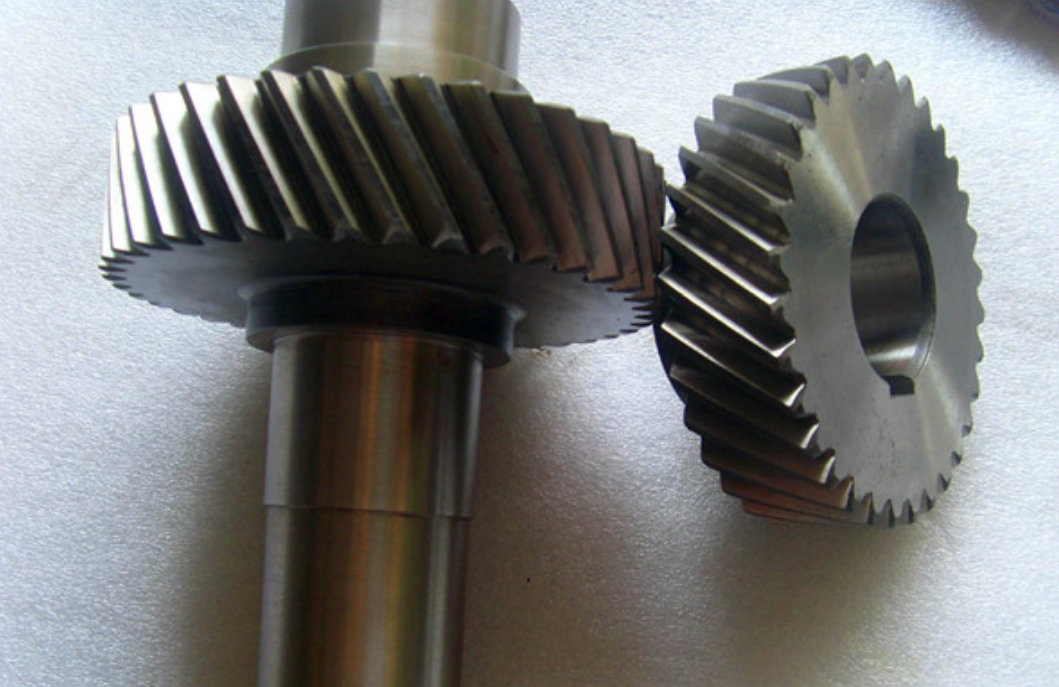
Helical gears are characterized by their teeth being cut at an angle to the gear axis, which facilitates gradual meshing and unmeshing. This design not only improves load distribution but also enhances the volumetric efficiency of gear pumps. For double circular-arc helical gears, the tooth profile consists of two circular arcs, providing better contact stress distribution and reduced wear. In high-speed applications, helical gears help maintain stable flow rates by ensuring multiple teeth are in contact simultaneously, thereby smoothing out the discharge process. The helix angle, a key parameter, influences the axial overlap and the degree of flow pulsation. By optimizing this angle, we can theoretically eliminate flow pulsation, making helical gear pumps ideal for precision fluid delivery systems.
To quantify flow pulsation in helical gear pumps, we begin with a theoretical derivation of the instantaneous flow rate. Consider a double circular-arc helical gear pump with helix angle $\beta$, number of teeth $z$, base circle radius $R$, addendum radius $R_a$, face width $B$, and rotational speed $\omega$. The instantaneous flow rate $Q$ is obtained by integrating the contribution from infinitesimal thin spur gear slices along the gear axis. For a slice at distance $x$ from the reference plane, the effective rotation angle $\xi$ is given by:
$$ \xi = \phi + \frac{x \tan \beta}{R} $$
where $\phi$ is the rotation angle at the reference plane. The volume change $dV$ for a small rotation $d\xi$ in a thin slice of thickness $dx$ is derived from the area sweep method for double circular-arc teeth:
$$ dV = \left\{ R_a^2 \xi – R^2 \left(2 – \cos \frac{\pi}{2z}\right) \sin \frac{\pi}{2z} + R^2 \left[2 – \cos \left(\frac{\pi}{2z} – \xi\right)\right] \sin \left(\frac{\pi}{2z} – \xi\right) \right\} dx $$
The instantaneous flow rate $q_s$ for the slice is then:
$$ q_s = \frac{dV}{dt} = \left\{ R_a^2 \omega – R^2 \left(2 – \cos \frac{\pi}{2z}\right) \sin \frac{\pi}{2z} + R^2 \omega \left[ \cos \left(\frac{\pi}{z} – 2\xi\right) – 2\cos \left(\frac{\pi}{2z} – \xi\right) \right] \right\} dx $$
Integrating over the face width from $-B/2$ to $B/2$, the total instantaneous flow rate $Q$ for helical gears becomes:
$$ Q = \int_{-B/2}^{B/2} q_s \, dx = B \left\{ R_a^2 \omega – R^2 \left(2 – \cos \frac{\pi}{2z}\right) \sin \frac{\pi}{2z} + R^2 \omega \left[ \cos \left(\frac{\pi}{z} – 2\phi\right) – 2\cos \left(\frac{\pi}{2z} – \phi\right) \right] \right\} + \frac{2R^3 \omega}{\tan \beta} \left[ \sin \left(\frac{\pi}{z} – 2\phi\right) – 2\sin \left(\frac{\pi}{2z} – \phi\right) \right] $$
This equation highlights the dependency on helix angle $\beta$, which modulates the flow characteristics. The flow pulsation coefficient $\delta$ is defined as the ratio of the difference between maximum and minimum instantaneous flow rates to the average flow rate:
$$ \delta = \frac{Q_{\text{max}} – Q_{\text{min}}}{\bar{Q}} $$
By analyzing the function over one meshing period, we derive $Q_{\text{max}}$ and $Q_{\text{min}}$. For helical gears, the condition for no flow pulsation ($\delta = 0$) leads to a specific helix angle. Using gear parameters: $B = 15.5 \, \text{mm}$, $z = 7$, $R = 10.5 \, \text{mm}$, we solve for $\beta$ and find:
$$ \beta = 31.3^\circ $$
At this critical helix angle, the flow pulsation coefficient theoretically becomes zero, implying perfectly smooth flow output from the helical gear pump. This optimization is central to achieving high performance in high-speed high-pressure environments.
The following table summarizes key parameters used in the theoretical model for double circular-arc helical gear pumps:
| Parameter | Symbol | Value |
|---|---|---|
| Number of Teeth | $z$ | 7 |
| Module | $m$ | 3 mm |
| Face Width | $B$ | 15.5 mm |
| Helix Angle | $\beta$ | 31.3° |
| Pressure Angle | $\alpha$ | 14.5° |
| Base Circle Radius | $R$ | 10.5 mm |
| Addendum Radius | $R_a$ | 13.5 mm |
| Center Distance | $a$ | 21.01 mm |
To validate the theoretical findings, we employ CFD simulations using ANSYS Fluent. The three-dimensional model of the double circular-arc helical gear pump is created, and the fluid domain is meshed with refined elements near the gear teeth to capture flow details. The simulation settings include transient analysis with a realizable k-epsilon turbulence model, dynamic meshing for gear rotation, and boundary conditions that reflect high-speed high-pressure operation. The inlet pressure is set to atmospheric, while the outlet pressure is varied to simulate different loads. The gear surfaces are defined as rotating walls with no-slip conditions, and the hydraulic fluid is ISO VG 32 oil. The time step is set to $5 \times 10^{-7}$ seconds to ensure accuracy in capturing flow dynamics.
The table below outlines the CFD simulation parameters and boundary conditions:
| Simulation Aspect | Details |
|---|---|
| Solver Type | Transient, Pressure-Based |
| Turbulence Model | Realizable k-epsilon |
| Inlet Boundary Condition | Pressure Inlet (101325 Pa) |
| Outlet Boundary Condition | Pressure Outlet (Varied: 5-25 MPa) |
| Gear Motion | Rigid Body Rotation (5000-12000 rpm) |
| Dynamic Mesh Method | Smoothing and Remeshing |
| Fluid Properties | Density: 870 kg/m³, Viscosity: 0.032 Pa·s |
| Convergence Criteria | Residuals below 10^{-4} |
Simulation results reveal the impact of load pressure and rotational speed on flow pulsation. For a fixed rotational speed of 10,000 rpm, we vary the outlet pressure from 5 MPa to 25 MPa. The maximum pressure at the gear mesh is monitored, showing that higher loads reduce pressure fluctuations. Specifically, at 5 MPa outlet pressure, the peak mesh pressure is 7.8 MPa (1.56 times the outlet pressure), while at 25 MPa, it is 27.7 MPa (1.108 times the outlet pressure). This indicates that helical gear pumps exhibit more stable pressure characteristics under high-pressure conditions, which is beneficial for system durability.
The flow rate at the outlet is also analyzed. Despite changes in load, the flow pulsation remains minimal due to the optimized helix angle of 31.3°. The following table presents the average flow rates and flow pulsation coefficients for different outlet pressures at 10,000 rpm:
| Outlet Pressure (MPa) | Average Flow Rate (L/min) | Flow Pulsation Coefficient ($\delta$) |
|---|---|---|
| 5 | 52.5 | 0.002 |
| 15 | 51.9 | 0.001 |
| 25 | 51.3 | 0.001 |
Next, we examine the effect of rotational speed on flow pulsation with a constant outlet pressure of 25 MPa. Speeds ranging from 5,000 rpm to 12,000 rpm are tested. The results demonstrate that flow rate increases linearly with speed, confirming high volumetric efficiency. However, at higher speeds, slight flow pulsation is observed due to increased leakage and potential cavitation. The table below summarizes these findings:
| Rotational Speed (rpm) | Average Flow Rate (L/min) | Flow Pulsation Coefficient ($\delta$) |
|---|---|---|
| 5,000 | 25.7 | 0.0005 |
| 10,000 | 51.3 | 0.001 |
| 12,000 | 61.6 | 0.002 |
The robustness of helical gears in maintaining low flow pulsation across a wide speed range is evident. The continuous engagement of helical teeth ensures that multiple contact lines exist simultaneously, smoothing the flow output. This is particularly advantageous in high-speed applications where traditional spur gears might suffer from significant pulsation. Additionally, the double circular-arc profile enhances this effect by providing stable contact stresses and reducing friction losses.
To further understand the flow dynamics, we analyze the velocity and pressure fields within the pump. CFD contours show that helical gears generate a more uniform flow pattern compared to spur gears, with reduced regions of high turbulence. The pressure distribution along the gear mesh indicates minimal spikes, corroborating the theoretical prediction of near-zero pulsation. These simulations underscore the efficacy of helical gears in achieving smooth fluid delivery under extreme conditions.
Experimental validation is conducted using a prototype double circular-arc helical gear pump. The test setup includes a servo motor for speed control, pressure sensors, flow meters, and a proportional relief valve to simulate varying loads. The pump parameters match those used in simulations, and tests are performed at speeds from 5,000 rpm to 12,000 rpm and pressures from 5 MPa to 25 MPa. The experimental results align closely with simulation data, with flow rate errors within 3%. This consistency validates the theoretical model and confirms the practical viability of helical gear pumps for high-speed high-pressure applications.
The table below compares experimental and simulated average flow rates at 10,000 rpm and 25 MPa outlet pressure across multiple trials:
| Trial | Experimental Flow Rate (L/min) | Simulated Flow Rate (L/min) | Error (%) |
|---|---|---|---|
| 1 | 50.9 | 51.3 | 0.8 |
| 2 | 51.2 | 51.3 | 0.2 |
| 3 | 50.7 | 51.3 | 1.2 |
| Average | 50.9 | 51.3 | 0.8 |
These results highlight the accuracy of our approach and the reliability of helical gear pumps. The minor discrepancies can be attributed to factors such as manufacturing tolerances, thermal effects, and fluid property variations. Nevertheless, the overall performance demonstrates that helical gears effectively mitigate flow pulsation, making them suitable for critical systems like aerospace fuel pumps and industrial hydraulics.
In conclusion, this study establishes that double circular-arc helical gear pumps can achieve theoretically zero flow pulsation under high-speed and high-pressure conditions by optimizing the helix angle to 31.3°. Through detailed theoretical derivations, CFD simulations, and experimental tests, we have shown that helical gears provide continuous and smooth engagement, resulting in stable flow output with minimal pressure fluctuations. The use of helical gears not only reduces noise and vibration but also enhances volumetric efficiency, making these pumps ideal for demanding applications. Future work could explore advanced materials or further geometric refinements to push the limits of helical gear pump performance. Ultimately, the integration of helical gears into pump design represents a significant step forward in fluid power technology, offering improved reliability and efficiency in high-performance environments.