
This paper presents a comprehensive investigation into the fatigue crack initiation and propagation behavior in the root region of spur gears. The primary objective is to establish a predictive model for estimating the remaining useful life (RUL) of a spur gear once a root crack has initiated. The methodology integrates Finite Element Analysis (FEA), Linear Elastic Fracture Mechanics (LEFM), and empirical crack growth laws. The study focuses on determining the critical location for crack initiation, simulating the crack propagation path, calculating the governing fracture parameters, and ultimately developing a life estimation model. Spur gears, due to their widespread use in power transmission systems, are the central subject of this research, and understanding their failure mechanisms is crucial for predictive maintenance and reliability enhancement.
1. Introduction
Cracks are among the most common and critical failure modes in gear systems. They often serve as precursors to more severe failures such as tooth breakage or spalling. The propagation of a crack from the tooth root can lead to catastrophic failure, resulting in unplanned downtime and significant economic losses. Therefore, predicting the path and rate of crack growth in spur gears is of paramount importance for structural integrity assessment and lifecycle management. The ability to accurately estimate the remaining life of a cracked gear enables condition-based maintenance strategies, improving system safety and availability.
Extensive research has been conducted on gear crack propagation. Previous studies have utilized Finite Element Methods (FEM) to simulate crack paths and calculate Stress Intensity Factors (SIFs) for spur and helical gears. Common approaches involve determining the initial crack location based on stress concentration analysis and applying criteria like the maximum circumferential stress theory to predict the crack growth direction. Life prediction models often rely on the well-established Paris’ law, which correlates the crack growth rate with the range of the SIF. This work builds upon these foundations, employing the eXtended Finite Element Method (XFEM) within ABAQUS for efficient crack propagation simulation without the need for re-meshing. A key contribution of this analysis is the systematic derivation of the functional relationship between crack length and SIF range for spur gears, followed by the integration of this relationship into the Paris law to compute the number of loading cycles to failure.
2. Theoretical Foundation: Fracture Mechanics for Spur Gears
The analysis of crack growth in spur gears is rooted in Linear Elastic Fracture Mechanics (LEFM). The fundamental parameter governing the stability and growth of a crack is the Stress Intensity Factor (SIF), denoted as $K$. For a mode-I (opening mode) crack, which is predominant in gear tooth bending fatigue, the SIF is defined as:
$$ K_I = Y \sigma \sqrt{\pi a} $$
where $a$ is the crack length, $\sigma$ is the applied far-field stress, and $Y$ is a geometric correction factor that depends on the component and crack geometry. In the complex geometry of a gear tooth root, $Y$ is not constant and varies significantly as the crack propagates.
The crack growth rate under cyclic loading is empirically described by Paris’ law, which is expressed as:
$$ \frac{da}{dN} = C (\Delta K)^m $$
where:
- $da/dN$ is the crack growth rate (crack extension per loading cycle),
- $\Delta K$ is the range of the stress intensity factor during a load cycle ($\Delta K = K_{max} – K_{min}$),
- $C$ and $m$ are material constants obtained from experimental data.
To estimate the total life (number of cycles, $N_f$) from an initial crack size $a_0$ to a critical crack size $a_{cr}$, Paris’ law is integrated:
$$ N_f = \int_{a_0}^{a_{cr}} \frac{1}{C (\Delta K)^m} da $$
The primary challenge in applying this formula to spur gears lies in accurately defining $\Delta K$ as a function of crack length $a$, i.e., $\Delta K = f(a)$. Once this relationship is established, the integral can be evaluated, either analytically or numerically, to provide a life estimate.
3. Finite Element Modeling and Simulation of Spur Gears
3.1. Gear Pair Modeling and Material Properties
A three-dimensional model of a spur gear pair was created. The key geometric and material parameters are summarized in Table 1. The material chosen for both gears is a common gear steel, 20CrNiMo, with its associated Paris law constants.
| Parameter | Pinion | Gear |
|---|---|---|
| Number of Teeth, $z$ | 18 | 27 |
| Module, $m_n$ (mm) | 2 | 2 |
| Pressure Angle, $\alpha$ (°) | 20 | 20 |
| Young’s Modulus, $E$ (GPa) | 205 | 205 |
| Poisson’s Ratio, $\nu$ | 0.29 | 0.29 |
| Paris Constant, $C$ (MPa√m, m/cycle) | $4.77 \times 10^{-9}$ | |
| Paris Exponent, $m$ | 2.06 | |
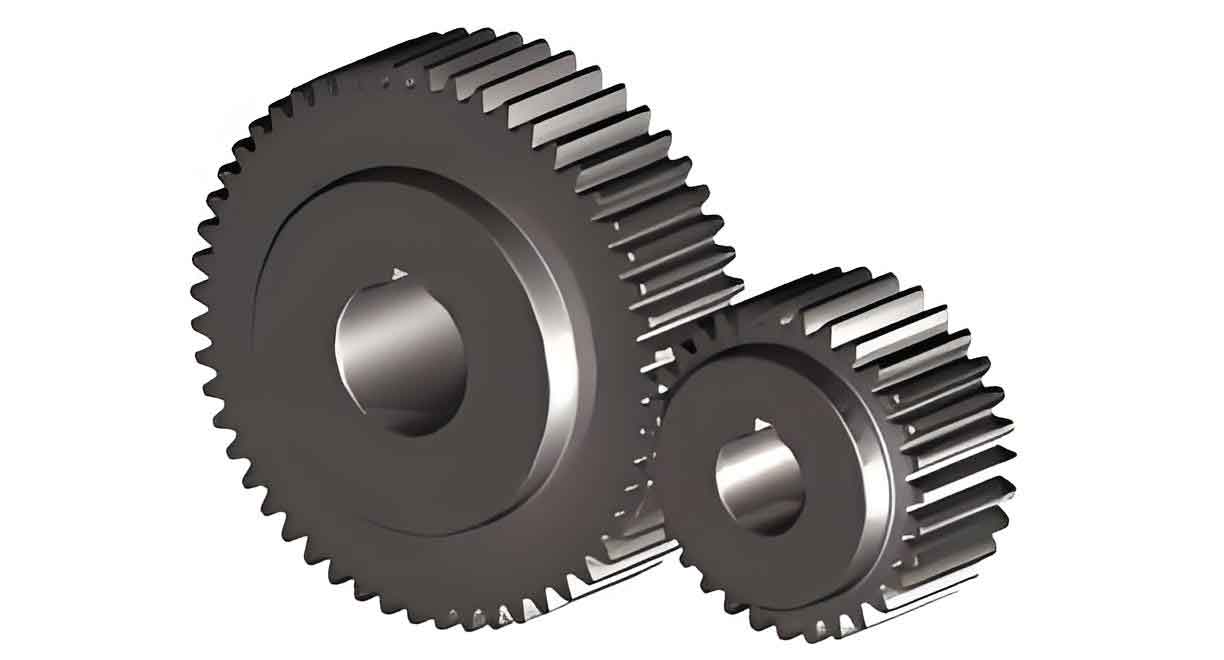
The model was imported into ABAQUS/Standard for finite element analysis. A static, quasi-rotational analysis was performed to simulate a single-tooth contact scenario. A constant rotational velocity was applied to the pinion, and a resistive torque of 10,000 N·mm was applied to the gear to simulate the working load.
3.2. Determination of Crack Initiation Site
Fatigue cracks typically initiate at locations of high stress concentration subjected to cyclic loading. For spur gears under bending load, the highest tensile stress occurs at the root fillet region on the side of the tooth where load is applied. The finite element stress analysis confirms this theory. The results, visualized via contour plots, clearly show a significant stress concentration at the root fillet of the loaded gear tooth, while the contact region on the tooth flank also shows high compressive stresses. Since fatigue crack growth is driven by cyclic tensile stresses, the root fillet is identified as the most probable site for crack initiation in spur gears.
3.3. Crack Propagation Simulation using XFEM
To model the crack growth from the identified root fillet, the eXtended Finite Element Method (XFEM) capability in ABAQUS was employed. XFEM allows for the modeling of arbitrary crack paths independent of the underlying mesh by enriching the displacement field with discontinuous functions. An initial seed crack was defined at the highest stress point on the tensile-side root fillet of one tooth on the gear. The simulation was set up to calculate the crack propagation direction based on the maximum principal stress criterion, which is suitable for mode-I dominated growth. The simulation proceeds incrementally, with the crack extending at each step based on the computed stress state at the crack tip.
The simulated crack propagation path is curvilinear, starting from the root fillet and progressing downwards and slightly towards the gear center. This path is consistent with experimental observations and previous studies on spur gear tooth fractures. The simulation provides a realistic prediction of how a crack would evolve under continued cyclic loading.
3.4. Calculation of Stress Intensity Factors
At various stages of the simulated crack growth, the stress intensity factor at the crack tip was calculated. As the crack in this configuration is primarily subjected to opening mode (Mode-I), the focus was on obtaining $K_I$. ABAQUS computes SIFs using the interaction integral method, which is accurate and robust. The crack length $a$ (measured from the initial notch) and the corresponding maximum SIF $K_{I, max}$ from a single load cycle were extracted at multiple propagation steps. The minimum SIF $K_{I, min}$ in a cycle is assumed to be negligible (or zero) for unidirectional bending, thus $\Delta K_I \approx K_{I, max}$. The collected data forms the essential link between crack geometry and the driving force for propagation. A subset of this data is presented in Table 2.
| Step | Crack Length, $a$ (mm) | SIF Range, $\Delta K$ (MPa√m) |
|---|---|---|
| 1 | 0.10 | 31.5 |
| 2 | 0.25 | 35.8 |
| 3 | 0.40 | 38.9 |
| 4 | 0.55 | 42.7 |
| 5 | 0.70 | 47.1 |
| 6 | 0.85 | 52.3 |
| 7 | 1.00 | 58.1 |
| 8 | 1.15 | 64.9 |
| 9 | 1.30 | 72.5 |
| 10 | 1.45 | 80.1 |
| 11 | 1.60 | 89.0 |
| 12 | 1.75 | 99.5 |
| 13 | 1.90 | 111.8 |
4. Construction of the Life Estimation Model for Spur Gears
4.1. Functional Relationship between $\Delta K$ and Crack Length $a$
The core of the life estimation model is the function $\Delta K = f(a)$. Based on the data in Table 2, different candidate functions were fitted. The goal was to find a simple yet accurate representation suitable for analytical or numerical integration in Paris’ law. The following functions were considered:
- Linear Function: $\Delta K = p_1 a + p_2$
- Power-Law Function: $\Delta K = \alpha a^{\beta}$
- Exponential Function: $\Delta K = \gamma e^{\delta a}$
- Polynomial Function (Cubic): $\Delta K = q_1 a^3 + q_2 a^2 + q_3 a + q_4$
The first 10 data points were used for fitting the model parameters, and the last 5 points were reserved for validation. The goodness-of-fit was evaluated using the coefficient of determination ($R^2$) and the relative error ($RE$) on the validation set, defined as:
$$ RE_i = \left( \frac{\Delta K_{pred,i} – \Delta K_{FEA,i}}{\Delta K_{FEA,i}} \right) \times 100\% $$
The results of the fitting process are summarized in Table 3 and Table 4.
| Function Type | Fitted Equation | $R^2$ (Fitting Set) |
|---|---|---|
| Exponential | $\Delta K = 30.36 \cdot e^{0.456 a}$ | 0.9502 |
| Power-Law | $\Delta K = 46.47 \cdot a^{0.220}$ | 0.9176 |
| Cubic Polynomial | $\Delta K = -24.04a^3 + 24.27a^2 + 13.54a + 29.27$ | 0.9487 |
| Linear | $\Delta K = 18.66a + 29.28$ | 0.9400 |
| Crack Length, $a$ (mm) | Exponential | Power-Law | Cubic Polynomial | Linear |
|---|---|---|---|---|
| 1.60 | -0.38 | -0.38 | -3.46 | 0.47 |
| 1.75 | 7.36 | 5.86 | 0.79 | 7.91 |
| 1.90 | 0.97 | -1.73 | -8.42 | 1.14 |
| 2.05* | -2.01 | -5.95 | -14.79 | -2.25 |
| 2.20* | -0.76 | -6.12 | -17.95 | -1.45 |
* Extrapolated data points for trend validation.
Analysis of the results shows that the exponential function provides the best overall performance. It has the highest $R^2$ value on the fitting set and consistently low relative errors across the validation set, including for points slightly beyond the fitted range. The cubic polynomial, while having a good $R^2$, shows significantly larger errors on validation, indicating potential overfitting. Therefore, the exponential relationship is selected for the life estimation model:
$$ \Delta K(a) = \alpha e^{\beta a} $$
with $\alpha = 30.36$ MPa√m and $\beta = 0.456$ mm$^{-1}$.
4.2. Integration for Life Estimation
Substituting the exponential $\Delta K(a)$ relationship into the Paris law integral yields the model for estimating the remaining life of the cracked spur gear:
$$ N_f = \int_{a_0}^{a_{cr}} \frac{1}{C \left( \alpha e^{\beta a} \right)^m} da = \frac{1}{C \alpha^m} \int_{a_0}^{a_{cr}} e^{-m\beta a} da $$
This integral has a straightforward analytical solution:
$$ N_f = \frac{1}{C \alpha^m} \left[ \frac{e^{-m\beta a_0} – e^{-m\beta a_{cr}}}{m\beta} \right] $$
To perform the calculation, the following parameters are defined:
- Initial Crack Size ($a_0$): Assumed to be 0.01 mm, representing a detectable flaw or micro-crack.
- Critical Crack Size ($a_{cr}$): Defined as 2.0 mm. At this length, the crack growth is assumed to enter unstable, rapid propagation, posing an imminent risk of tooth fracture.
- Material Constants ($C$, $m$): As listed in Table 1 ($C=4.77\times10^{-9}$, $m=2.06$).
- Fitted Parameters ($\alpha$, $\beta$): 30.36 MPa√m and 0.456 mm$^{-1}$, respectively.
Inserting all values into the life equation:
$$ N_f = \frac{1}{(4.77\times10^{-9}) \times (30.36)^{2.06}} \times \left[ \frac{e^{-2.06 \times 0.456 \times 0.01} – e^{-2.06 \times 0.456 \times 2.0}}{2.06 \times 0.456} \right] $$
Performing the calculation stepwise:
$$ \alpha^m = 30.36^{2.06} \approx 1085.6 $$
$$ C \alpha^m \approx (4.77\times10^{-9}) \times 1085.6 \approx 5.176 \times 10^{-6} $$
$$ m\beta = 2.06 \times 0.456 \approx 0.939 $$
$$ e^{-m\beta a_0} = e^{-0.939 \times 0.01} \approx e^{-0.00939} \approx 0.9907 $$
$$ e^{-m\beta a_{cr}} = e^{-0.939 \times 2.0} = e^{-1.878} \approx 0.1529 $$
$$ \text{Numerator} = 0.9907 – 0.1529 = 0.8378 $$
$$ \text{Integral Term} = \frac{0.8378}{0.939} \approx 0.892 $$
Finally,
$$ N_f \approx \frac{0.892}{5.176 \times 10^{-6}} \approx 172,300 \text{ cycles} $$
This result indicates that once a crack of approximately 0.01 mm initiates at the root of the spur gear, it will propagate to the critical size of 2.0 mm in roughly 172,000 loading cycles under the specified operating conditions. This remaining life is significantly shorter than the typical design life for gears (often on the order of $10^7$ cycles), highlighting the severe impact of a root crack on the longevity of spur gears.
5. Conclusion
This study has developed a systematic methodology for predicting the crack propagation path and estimating the remaining useful life of spur gears with root cracks. The key findings and contributions are summarized as follows:
- The root fillet region on the tensile side of a loaded spur gear tooth is confirmed as the primary site for fatigue crack initiation due to stress concentration.
- The eXtended Finite Element Method (XFEM) is an effective tool for simulating the curvilinear propagation path of root cracks in spur gears without complex re-meshing procedures.
- The relationship between the stress intensity factor range ($\Delta K$) and crack length ($a$) for the studied spur gear is best described by an exponential function of the form $\Delta K = \alpha e^{\beta a}$.
- An analytical life estimation model was derived by integrating the exponential $\Delta K(a)$ function into Paris’ law. For the specific case studied, the model predicts a remaining life of approximately 172,000 cycles from a small initial crack to a critical size, demonstrating a drastic reduction in lifespan compared to an uncracked gear.
The proposed framework provides a practical approach for condition-based maintenance of gearboxes. By combining non-destructive inspection (to estimate current crack size $a_0$) with the developed model, engineers can make informed decisions about the continued operation or replacement of damaged spur gears. Future work could involve experimental validation of the crack path and growth rates, investigation of the effects of variable amplitude loading, and extension of the model to helical gears or gears with profile modifications.