
In the realm of mechanical transmission systems, helical gears play a pivotal role due to their ability to transmit motion and power smoothly and efficiently. As a key component, the performance of helical gears directly influences the overall functionality and reliability of machinery. The shape of these gears determines not only the machining difficulty but also the actual tooth profile requirements. To achieve precise tooth profiles and facilitate easier manufacturing, it is essential to investigate the forming characteristics of helical gears. In this study, I focus on establishing a mathematical model for a specific type of helical gear, analyzing its forming properties, and providing insights for accurate modeling and theoretical analysis. This research aims to offer a foundational framework and technical support for optimizing helical gear parameters and enhancing their performance in practical applications.
The importance of helical gears stems from their unique design, which features teeth that are cut at an angle to the gear axis. This angulation allows for gradual engagement between mating gears, resulting in quieter operation, reduced vibration, and higher load-carrying capacity compared to spur gears. However, the complexity of their geometry necessitates a thorough understanding of their forming processes. By developing a robust mathematical model, I can simulate and analyze the tooth profile, transition curves, and helical paths, which are critical for ensuring precision in manufacturing. In this article, I will delve into the derivation of key equations, present numerical computations using software tools, and discuss the implications for helical gear design. Throughout, I will emphasize the term “helical gears” to underscore their centrality in this exploration.
To begin, I establish the mathematical foundation for helical gears by considering their involute tooth profile. The involute curve is fundamental in gear design because it ensures constant velocity ratio and smooth meshing. In a coordinate system where the origin O coincides with the center of the base circle, and the base circle radius is denoted as \( R \), the formation of the involute can be visualized through a pure rolling motion. As a line unwinds from the base circle, the trajectory of a fixed point on that line generates the involute curve. This leads to the parametric equations for the involute profile in the transverse plane. Let \( r_b \) represent the transverse base circle radius in millimeters, and \( \theta \) be the roll angle parameter. The coordinates \( (x, y, z) \) for the involute are given by:
$$ x = r_b \cos \theta + r_b \theta \sin \theta $$
$$ y = r_b \sin \theta – r_b \theta \cos \theta $$
$$ z = 0 $$
These equations describe the two-dimensional involute in the transverse section of the helical gears. However, for helical gears, the three-dimensional nature requires accounting for the helix angle. The involute profile is extended along the gear axis through a helical path, which I will address later. The derivation above highlights the geometric precision needed for helical gears, and it forms the basis for further modeling. To summarize the parameters involved in the involute equations, I present Table 1, which outlines key variables and their descriptions relevant to helical gears.
| Symbol | Description | Unit |
|---|---|---|
| \( r_b \) | Transverse base circle radius | mm |
| \( \theta \) | Roll angle parameter | rad |
| \( x, y \) | Coordinates in transverse plane | mm |
| \( z \) | Axial coordinate (initially zero) | mm |
Moving beyond the involute, the tooth root transition curve is another critical aspect of helical gears. This curve connects the involute profile to the gear body and influences stress distribution and fatigue life. When machining helical gears with a rack-type cutter, the transition curve is generated by the tool’s tip fillet. The cutter’s geometry and the gear parameters interplay to define this curve. Let \( h_a^* \) be the addendum coefficient, \( c^* \) the clearance coefficient, \( \alpha \) the pressure angle in degrees, \( m \) the module in millimeters, and \( r_\rho \) the tip fillet radius of the cutter. The distance from the cutter’s reference line to the fillet center, denoted as \( e \), and the tooth thickness parameter \( b \) are derived as follows:
$$ e = h_a^* m + c^* m – r_\rho \sin \alpha $$
$$ b = \frac{\pi m}{4} + h_a^* m \tan \alpha + r_\rho \cos \alpha $$
$$ r_\rho = \frac{c^* m}{1 – \sin \alpha} $$
These relationships ensure proper meshing and clearance in helical gears. During machining, the cutter’s pitch line rolls without slipping on the gear’s pitch circle, and the fillet produces an extended involute equidistant curve. For the transition curve, let \( r_p \) be the pitch radius in millimeters, \( x_t \) the transverse modification coefficient, \( m_t \) the transverse module in millimeters, and \( \alpha’ \) a parameter variable in degrees. The equations for the transition curve coordinates \( (x, y) \) are:
$$ x = r_p \sin \phi – \left( \frac{e – x_t m_t}{\sin \alpha’} + r_\rho \right) \cos(\alpha’ – \phi) $$
$$ y = r_p \cos \phi – \left( \frac{e – x_t m_t}{\sin \alpha’} + r_\rho \right) \sin(\alpha’ – \phi) $$
$$ \phi = \frac{(e – x_t m_t) \cos \alpha’ + b}{r_p} $$
These equations capture the complex geometry of the tooth root in helical gears, which is essential for avoiding stress concentrations. To consolidate the parameters for the transition curve, Table 2 provides a summary that aids in understanding the interactions in helical gears design.
| Symbol | Description | Unit |
|---|---|---|
| \( e \) | Distance from cutter reference line to fillet center | mm |
| \( r_\rho \) | Tip fillet radius of cutter | mm |
| \( b \) | Tooth thickness parameter | mm |
| \( h_a^* \) | Addendum coefficient | – |
| \( c^* \) | Clearance coefficient | – |
| \( \alpha \) | Pressure angle | ° |
| \( m \) | Module | mm |
| \( r_p \) | Pitch radius | mm |
| \( x_t \) | Transverse modification coefficient | – |
| \( m_t \) | Transverse module | mm |
| \( \alpha’ \) | Parameter variable | ° |
The three-dimensional form of helical gears is defined by the helix, which wraps the transverse profiles along the gear axis. The helical path is characterized by the helix angle \( \beta \) and the gear’s axial length. Consider a helical gear with face width \( b \) in millimeters and pitch radius \( r \) in millimeters. The helix angle \( \beta \) determines the lead of the helix, and the parametric equations for the helical line can be expressed using a parameter \( t \) that ranges from 0 to 1. The rotation angle \( \gamma \) is given by \( \gamma = \frac{b \tan \beta}{r} \), and the coordinates \( (x, y, z) \) along the helix are:
$$ \gamma = \frac{b \tan \beta}{r} $$
$$ x = r \sin(\gamma t) $$
$$ y = r \cos(\gamma t) $$
$$ z = b t $$
This helical line serves as a backbone for generating the entire tooth surface of helical gears. By combining the involute profile, transition curve, and helical path, I can construct a comprehensive mathematical model for helical gears. The integration of these elements allows for accurate representation and simulation of helical gears in software environments. To illustrate the geometric progression, I include a visual aid that depicts the helical structure of these gears. The image below shows a typical helical gear, highlighting its angled teeth and smooth profile, which are central to the discussion on forming characteristics.
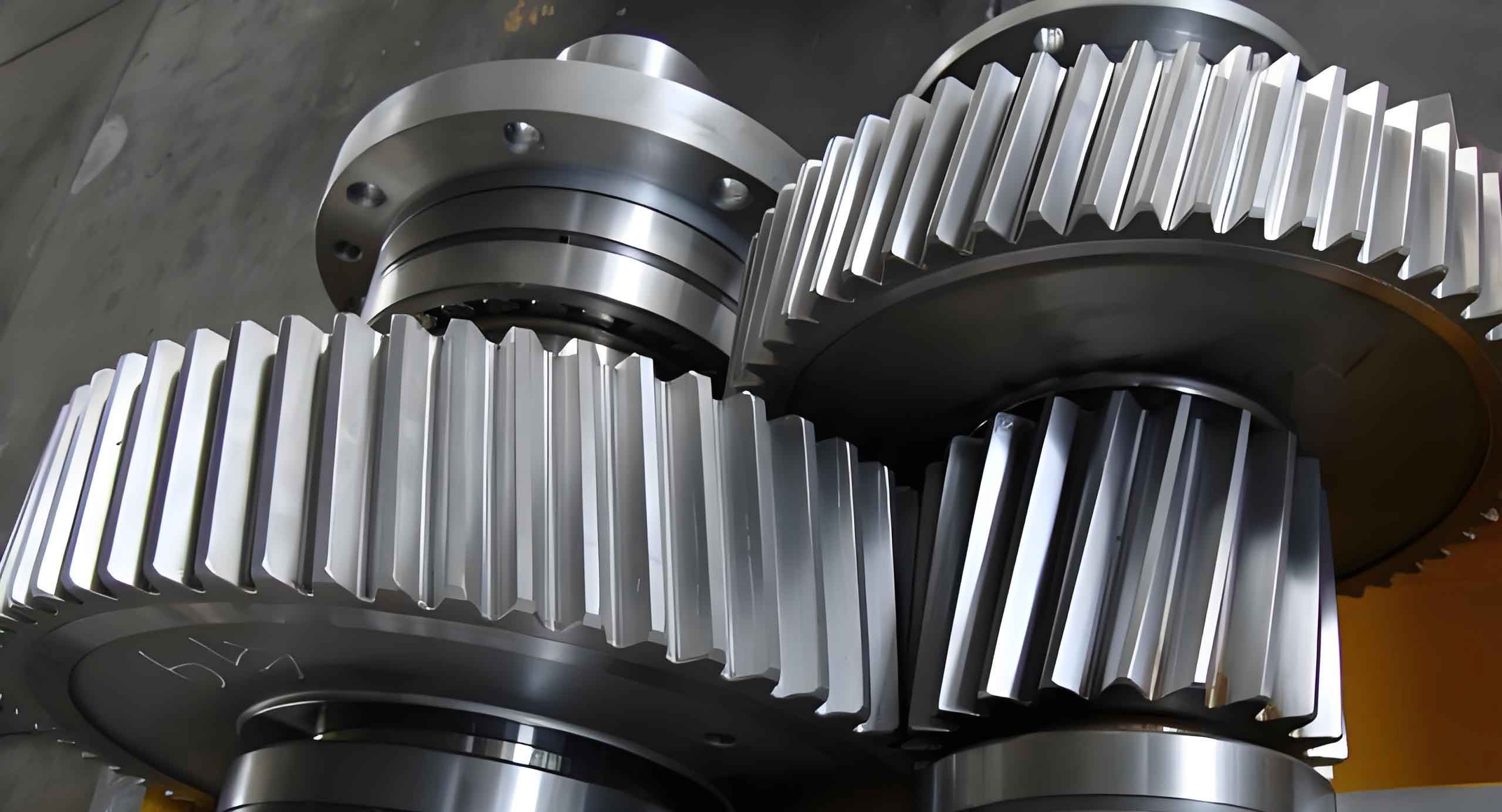
With the mathematical model established, I proceed to analyze the forming characteristics of helical gears. This involves numerical computation and simulation using specialized software. For this study, I consider a heavy-duty helical gear commonly used in mining machinery, with parameters as listed in Table 3. These parameters are typical for helical gears in industrial applications and provide a concrete basis for analysis.
| Parameter | Symbol | Value | Unit |
|---|---|---|---|
| Normal module | \( m_n \) | 2 | mm |
| Number of teeth | \( z \) | 50 | – |
| Pressure angle | \( \alpha \) | 20 | ° |
| Helix angle | \( \beta \) | 8 | ° |
| Face width | \( b \) | 40 | mm |
Using the derived equations, I implement the model in MATLAB, a powerful numerical computing software. The code computes the coordinates for the involute, transition curve, and helical path based on the parameters in Table 3. The output data is then imported into SolidWorks, a computer-aided design (CAD) software, to generate a three-dimensional model of the helical gear. This process involves creating the helical line first, then sweeping the transverse tooth profile along it to form the complete gear tooth. By leveraging these tools, I can visualize the forming process and assess the geometric accuracy of helical gears.
The computation in MATLAB involves solving the parametric equations over a range of values. For the involute, I define \( \theta \) from 0 to an appropriate limit to capture the active profile. For the transition curve, \( \alpha’ \) is varied to span the root region. The helical parameter \( t \) is sampled from 0 to 1 to cover the entire face width. The resulting point clouds are exported to SolidWorks, where they are used to create curves and surfaces. In SolidWorks, I generate the helical curve using the equation-driven curve feature, inputting the helical equations directly. Then, I create the tooth profile in a transverse sketch, incorporating the involute and transition curves. By sweeping this profile along the helical path, I obtain a single tooth of the helical gear. Finally, I use circular patterning to replicate the tooth around the gear body, resulting in a full helical gear model.
This approach allows for a detailed analysis of the forming characteristics. For instance, I can examine the smoothness of the tooth surface, the continuity between the involute and transition curve, and the alignment of the helical teeth. The model reveals that the mathematical equations accurately capture the geometry of helical gears, enabling precise manufacturing. Moreover, by adjusting parameters such as the helix angle or pressure angle, I can study their effects on the gear’s form and function. This flexibility is crucial for optimizing helical gears for specific applications, such as in mining machinery where durability and efficiency are paramount.
To further elucidate the forming process, I discuss the implications of each mathematical component. The involute profile ensures proper meshing with other gears, minimizing noise and wear. The transition curve reduces stress concentrations at the tooth root, enhancing fatigue resistance. The helix angle influences the contact ratio and axial forces; a larger helix angle increases smoothness but also raises axial thrust, which must be managed in bearing design. By integrating these aspects, the mathematical model provides a holistic view of helical gears’ forming behavior. Additionally, I can use the model to simulate manufacturing processes, such as hobbing or shaping, by incorporating tool kinematics into the equations.
In practice, the accuracy of helical gears is vital for transmission systems. Deviations in tooth profile can lead to vibration, noise, and premature failure. The mathematical model developed here serves as a reference for quality control and design validation. For example, by comparing the modeled profile with measured data from manufactured helical gears, I can identify discrepancies and refine the machining process. This iterative improvement is key to advancing helical gear technology. Furthermore, the model can be extended to include factors like thermal expansion or load deformation, making it applicable to dynamic analyses under operating conditions.
Another aspect worth exploring is the optimization of helical gears parameters. Using the mathematical model, I can perform sensitivity analyses to determine how changes in module, helix angle, or pressure angle affect performance metrics such as contact stress, bending stress, and efficiency. For instance, increasing the helix angle might improve load distribution but require stronger axial supports. By running simulations in MATLAB coupled with finite element analysis in SolidWorks, I can quantify these trade-offs. This optimization potential underscores the value of a robust mathematical foundation for helical gears.
To summarize the key equations and their roles in helical gears, I present Table 4, which consolidates the mathematical models discussed. This table serves as a quick reference for engineers and researchers working with helical gears.
| Component | Equations | Parameters | Purpose |
|---|---|---|---|
| Involute Profile | $$ x = r_b \cos \theta + r_b \theta \sin \theta $$ $$ y = r_b \sin \theta – r_b \theta \cos \theta $$ $$ z = 0 $$ | \( r_b, \theta \) | Define tooth flank geometry for smooth meshing |
| Transition Curve | $$ x = r_p \sin \phi – \left( \frac{e – x_t m_t}{\sin \alpha’} + r_\rho \right) \cos(\alpha’ – \phi) $$ $$ y = r_p \cos \phi – \left( \frac{e – x_t m_t}{\sin \alpha’} + r_\rho \right) \sin(\alpha’ – \phi) $$ $$ \phi = \frac{(e – x_t m_t) \cos \alpha’ + b}{r_p} $$ | \( e, r_\rho, b, r_p, x_t, m_t, \alpha’ \) | Connect involute to gear body, reduce stress concentration |
| Helical Path | $$ \gamma = \frac{b \tan \beta}{r} $$ $$ x = r \sin(\gamma t) $$ $$ y = r \cos(\gamma t) $$ $$ z = b t $$ | \( \beta, b, r, t \) | Extend tooth profile along axis for helical shape |
The integration of these models enables a comprehensive analysis of helical gears. In the forming simulation, I observe that the helical gear teeth exhibit a gradual engagement, which is beneficial for high-speed applications. The transition curve blends seamlessly with the involute, avoiding sharp corners that could initiate cracks. The helical path ensures uniform load distribution across the tooth face, contributing to the durability of helical gears. These characteristics are visually confirmed in the SolidWorks model, where I can rotate and section the gear to inspect internal features.
Beyond static modeling, I can explore dynamic behaviors of helical gears. For example, by incorporating the mathematical model into multi-body dynamics software, I can simulate the meshing process under load. This involves calculating the contact patterns and transmission errors, which are critical for noise and vibration analysis. The helix angle plays a significant role here, as it affects the overlap ratio and thus the smoothness of power transmission. Such simulations rely on the accurate geometric representation provided by the mathematical equations, highlighting their importance in advanced engineering analyses.
In terms of manufacturing, the mathematical model aids in tool design and process planning. For gear hobbing, the hob geometry must match the gear’s involute and helical parameters. By deriving the hob profile from the gear equations, I can ensure accurate tooth generation. Additionally, the model can be used to predict manufacturing errors, such as those due to machine tool deflections or thermal effects. This predictive capability is valuable for achieving high precision in helical gears production, especially in industries like automotive and aerospace where tolerances are tight.
To further expand on the forming characteristics, I consider the impact of material properties and heat treatment on helical gears. While the mathematical model focuses on geometry, material behavior influences forming processes such as forging or casting. By coupling geometric equations with material models, I can simulate forming stresses and predict defects. This holistic approach is essential for developing robust helical gears that withstand operational demands. For instance, in mining applications, helical gears must endure heavy loads and abrasive environments; thus, both geometric and material optimizations are necessary.
The use of software tools like MATLAB and SolidWorks demonstrates the practicality of the mathematical model. MATLAB handles the numerical computations efficiently, allowing for rapid parameter studies. SolidWorks provides a visual platform for design validation and prototyping. Together, they facilitate a digital twin of helical gears, enabling virtual testing before physical manufacturing. This reduces development time and cost, while improving product quality. The iterative process of model refinement and simulation aligns with modern engineering practices for helical gears.
In conclusion, the mathematical modeling of helical gears offers profound insights into their forming characteristics. By deriving equations for the involute profile, tooth root transition curve, and helical path, I establish a foundation for accurate design and analysis. The integration of these equations into computational software enables detailed simulations and optimizations. Helical gears, with their angled teeth, provide superior performance in transmission systems, and understanding their geometry is key to harnessing these benefits. This research underscores the importance of mathematical rigor in advancing helical gear technology, paving the way for innovations in machinery and manufacturing.
Looking ahead, future work could involve extending the model to include nonlinear effects, such as contact deformation under load, or exploring additive manufacturing techniques for helical gears. The principles discussed here remain applicable, emphasizing the enduring relevance of mathematical models in engineering. As helical gears continue to evolve, their forming characteristics will remain a central topic for research and development, driving improvements in efficiency, reliability, and sustainability across industries.