
Helical gear pairs are fundamental components in power transmission systems across industries such as manufacturing, automotive, and aerospace. Their dynamic performance, characterized by vibration and noise levels, is intrinsically linked to the system’s reliability and operational stability. A primary source of excitation within a gearbox is the fluctuation of the meshing stiffness as tooth pairs enter and exit the mesh. This fluctuation is inherently time-varying due to the changing number of tooth pairs in contact and the variation in the position of the contact lines along the tooth profile. Accurately predicting the meshing stiffness of helical gears is therefore paramount for dynamic modeling, noise-vibration-harshness (NVH) analysis, and design optimization.
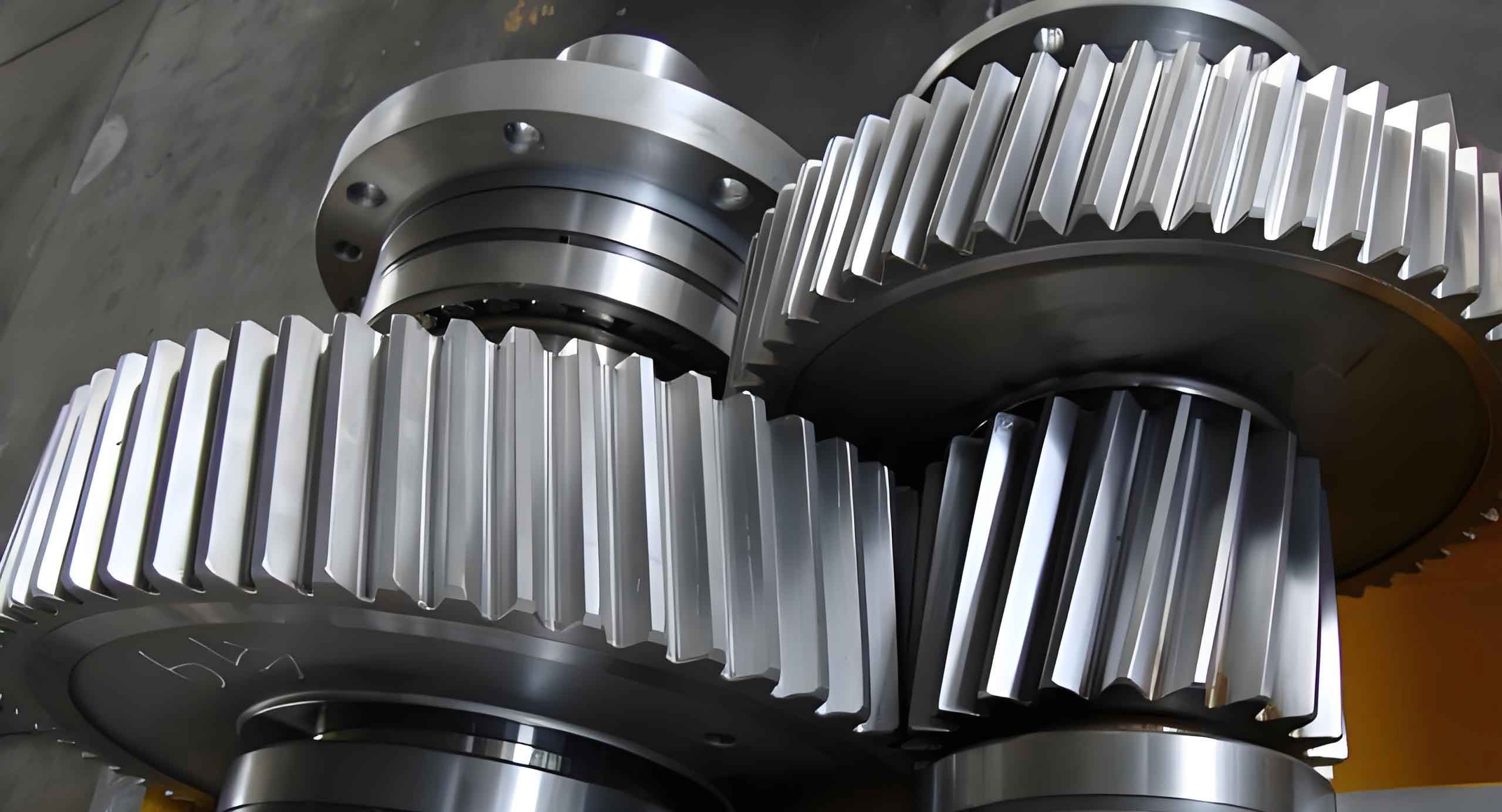
Under operational loads, teeth deform elastically. This deformation can cause a tooth pair to enter into contact slightly before or disengage slightly after the theoretical positions defined by the geometry of perfect, rigid teeth. This phenomenon, known as extended contact, causes the actual contact point to deviate from the theoretical line of action, potentially leading to meshing impacts at the entry and recess stages. To mitigate these impacts and improve load distribution, profile modifications, particularly tip relief, are commonly applied to the teeth of helical gears. However, this modification alters the tooth geometry, further complicating the accurate calculation of the true path of contact and the instantaneous meshing stiffness. Therefore, developing an efficient and accurate computational method that accounts for both tooth elastic deformation and profile modification is crucial for advanced gear design. This work presents an improved analytical model for calculating the time-varying meshing stiffness of modified helical gears, integrating the slice method with considerations for tooth bending deformation, extended contact, and Hertzian contact stiffness.
Fundamentals of Meshing Stiffness Calculation for Helical Gears
Slice Method and Meshing Mechanism
The core idea behind the slice method is to discretize a helical gear with face width $B$ into a series of $n_{slice}$ infinitesimally thin spur gear slices, each with a thickness of $\Delta B = B / n_{slice}$. Due to the helix angle, the contact lines on adjacent slices are staggered. The effective contact line length for the $i$-th slice gear, assuming no deformation, can be defined as a function of its dimensionless contact coordinate $\zeta_i$:
$$
l_i(\zeta_i) = \frac{\Delta B}{\cos \beta_b} \cdot
\begin{cases}
2, & \zeta_{in,i} < \zeta_i \le \zeta_{in,i} + d_{\varepsilon_\alpha} \\
1, & \zeta_{in,i} + d_{\varepsilon_\alpha} < \zeta_i \le \zeta_{in,i} + 1 \\
2, & \zeta_{in,i} + 1 < \zeta_i \le \zeta_{out,i}
\end{cases}
$$
where $\zeta_{in,i}$ and $\zeta_{out,i}$ are the dimensionless entry and exit points for the $i$-th slice, $\beta_b$ is the base circle helix angle, and $d_{\varepsilon_\alpha}$ is the fractional part of the transverse contact ratio $\varepsilon_\alpha$. The total contact line length $L(\zeta)$ for the helical gear pair is obtained by summing the contributions from all slices, accounting for their staggered positions: $L(\zeta) = \sum_{i=0}^{n_{slice}} l_i(\zeta_i)$.
Stiffness Contribution of a Slice
The meshing stiffness for a single tooth pair on the $i$-th slice, $k_{x,i}$, combines the tooth structural stiffness $k_{s,i}$ and the localized Hertzian contact stiffness $k_{h,i}$. The structural stiffness $k_{s,i}(\zeta_i)$ varies along the path of contact and can be modeled using a simplified, yet effective, formulation based on a maximum stiffness value $K_{max}$ and a cosine function that approximates its progression from the root to the tip. The Hertzian contact stiffness for the slice is influenced by the normal load $F^n_i$ and the slice geometry:
$$
k^n_{h,i}(\zeta_i) = E^{0.9}_e \left( \frac{\Delta B}{\cos \beta_b} \right)^{0.8} \left[ F^n_i(\zeta_i) \right]^{0.1} / 1.275
$$
where $E_e$ is the equivalent Young’s modulus. The combined mesh stiffness for the slice’s tooth pair is given by the series connection of these two stiffness components:
$$
k_{x,i}(\zeta_i) = \frac{\Delta B \cdot k_{s,i}(\zeta_i) \cdot k_{h,i}(\zeta_i)}{\Delta B \cdot k_{s,i}(\zeta_i) + k_{h,i}(\zeta_i) \cos \beta_b}
$$
Finally, the total mesh stiffness for the $i$-th slice gear, $K_{s,i}$, is determined by summing the stiffness of the tooth pairs that are simultaneously in contact within its mesh cycle, following the pattern defined by the contact ratio.
Influence of Tooth Bending Deformation
Under load, tooth bending causes deflection. This deflection can lead to a phenomenon where a tooth pair makes contact slightly before the theoretical start of the active profile (advanced entry) and loses contact slightly after the theoretical end of the active profile (delayed exit). This extends the actual zone of action. For a slice gear $i$, the effective meshing interval becomes $[\zeta_{min,i}, \zeta_{max,i}]$, where $\zeta_{min,i} = \zeta_{in,i} – (\Delta-\delta)_i$ and $\zeta_{max,i} = \zeta_{in,i} + \varepsilon_\alpha + \Delta’_i$. The extension terms $(\Delta-\delta)_i$ and $\Delta’_i$ are proportional to the tooth deflection under load $\delta_{F,i}$:
$$
(\Delta-\delta)_i(\zeta_i) = \frac{r_{b1} \delta_{F,i}(\zeta_i)}{C_p}, \quad \Delta’_i(\zeta_i) = \frac{r_{b1} \delta’_{F,i}(\zeta_i)}{C’_p}
$$
Here, $r_{b1}$ is the pinion base radius, and $C_p$, $C’_p$ are empirical coefficients. This extension effectively increases the contact ratio for the deformed slice gear to $\varepsilon_\alpha + (\Delta-\delta)_i + \Delta’_i$, altering the lengths of single and double contact regions.
Improved Algorithm Incorporating Tooth Deformation and Tip Relief
Tip relief is intentionally applied to the tooth profile, typically near the tip and root, to compensate for deflections and reduce meshing impacts. The presence of both elastic deformation and profile modification creates a complex interaction that determines the true contact condition. The key is to compare the deformation-induced extension with the amount of material removed by modification. At a given point $\zeta_i$ in the extended entry or exit zones, an equivalent deformation function $\delta_{D,i}$ is defined as the difference between the deflection extension and the modification depth $\delta_r(\zeta_i)$:
$$
\delta_{D,i}(\zeta_i) = (\Delta-\delta)_i(\zeta_i) – \delta_r(\zeta_i) \quad \text{(for entry zone)}
$$
$$
\delta’_{D,i}(\zeta_i) = \Delta’_i(\zeta_i) – \delta_r(\zeta_i) \quad \text{(for exit zone)}
$$
The modification depth $\delta_r(\zeta)$ is typically defined as a parabolic or linear function from the start of relief $\zeta_r$ to the tip $\zeta_{max}$, with a maximum relief amount $c_a$.
If $\delta_{D,i}(\zeta) < 0$ or $\delta’_{D,i}(\zeta) < 0$, it indicates that the modification depth exceeds the elastic deflection at that point, meaning the modified tooth profiles are not in contact (tooth separation). Otherwise, contact occurs. This logical condition, implemented using the Heaviside step function $H(\cdot)$, allows the improved model to dynamically determine the effective contact state. The effective contact line length and the slice mesh stiffness formulas are thus updated to account for four possible contact scenarios in the modified zones: double-contact, single-contact, or no-contact, depending on the sign of the equivalent deformation function.
The total meshing stiffness $K_T(\zeta)$ for the helical gear pair is the sum of the stiffness contributions from all slices using the improved algorithm. The load distribution coefficient $R$, which describes how the total load is shared among simultaneously engaged tooth pairs, can be derived from the stiffness ratio:
$$
R = \frac{F_D}{F_T} = \frac{K_D \delta}{K_T \delta} = \frac{K_D}{K_T} = \frac{\sum_{i=1}^{n_{slice}} k_{s,i}(\zeta_i)}{\sum_{i}^{n_{slice}} K_{s,i}(\zeta_i)}
$$
where $K_D$ is the stiffness of a representative single tooth pair across all slices.
Validation of the Improved Calculation Method
The accuracy of the proposed improved algorithm is validated against published results and commercial software. The following table lists the parameters for three different helical gear cases used for analysis and validation.
| Parameter | Case I | Case II | Case III |
|---|---|---|---|
| Normal Module $m_n$ (mm) | 4 | 4 | 2 |
| Pinion Teeth $z_1$ | 23 | 23 | 23 |
| Gear Teeth $z_2$ | 43 | 43 | 43 |
| Face Width $B$ (mm) | 20 | 40 | 40 |
| Helix Angle $\beta$ (°) | 8 | 14 | 18 |
| Transverse Contact Ratio $\varepsilon_\alpha$ | 1.6376 | 1.5926 | 1.5495 |
| Overlap Ratio $\varepsilon_\beta$ | 0.2215 | 0.7701 | 1.9673 |
| Total Contact Ratio $\varepsilon_\gamma$ | 1.8591 | 2.3627 | 3.5168 |
| Tip Relief Amount $c_{a1}, c_{a2}$ (μm) | 48 | 50 | 15 |
Comparisons show that the total mesh stiffness $K_T$, single pair stiffness $K_D$, and load distribution factor $R$ calculated by the improved method exhibit trends that are in excellent agreement with established literature data for all three cases. The proposed method successfully captures the smoothing effect of extended contact and the truncation effect of tip relief. Furthermore, comparisons with results from the finite element method (FEM) and commercial gear analysis software (e.g., KISSsoft) for Case II confirm the method’s accuracy, with only minor deviations observed near the points of minimum and maximum stiffness. This validates the improved algorithm as an efficient and reliable tool for calculating the meshing stiffness of modified helical gears.
Influence of Tip Relief Parameters on Meshing Stiffness
Using the validated model, a parametric study is conducted to investigate the influence of tip relief and operating load on the meshing characteristics of the three helical gear cases.
Effect of Relief Length $(l_n)$
Increasing the length of the relieved profile $l_n$ reduces the effective double-contact region. For gear sets with a total contact ratio $\varepsilon_\gamma > 2$ (Case II & III), the average and peak mesh stiffness $K_T$ decrease as $l_n$ increases. For Case I ($\varepsilon_\gamma < 2$), the peak $K_T$ remains relatively constant. The single pair stiffness $K_D$ is significantly affected by $l_n$ when the overlap ratio is high ($\varepsilon_\beta > \varepsilon_\alpha$, Case III), with its peak value decreasing. The load distribution factor $R$ is most sensitive to $l_n$ when its peak lies within the double-contact region.
Effect of Relief Amount $(c_a)$
Increasing the magnitude of tip relief $c_a$ also reduces the double-contact zone and the total contact ratio. Similar to relief length, $K_T$ decreases with increasing $c_a$ for high-contact-ratio gears. The impact on $K_D$ and $R$ follows patterns analogous to changing $l_n$, though the rates of change diminish once $c_a$ exceeds a certain threshold that effectively eliminates extended contact.
Effect of Relief Curve Exponent $(n_c)$
The exponent $n_c$ defines the shape of the relief curve (e.g., linear, parabolic). A smaller $n_c$ creates a more abrupt removal of material, resulting in lower mesh stiffness and a narrower double-contact zone. For $\varepsilon_\gamma > 2$, the maximum $K_T$ increases with $n_c$. The effect on $K_D$ is again more pronounced for high-overlap gears. The load distribution factor $R$ shows greater fluctuation with smaller $n_c$ values.
Effect of Transmitted Load $(T_n)$
Increasing the transmitted torque $T_n$ increases tooth deflection, which expands the extended contact zones. This leads to an increase in the effective total contact ratio and the overall mesh stiffness $K_T$. The single pair stiffness $K_D$ increases only slightly with load. Notably, a higher load reduces the peak value of the load distribution factor $R$, promoting slightly more uniform load sharing, and decreases the fluctuation of meshing stiffness, contributing to smoother operation.
Analysis of Meshing Stiffness Fluctuation
The dynamic excitation is strongly linked to the fluctuation of the meshing stiffness. The standard deviation of stiffness $K_{std}$ and the average mesh stiffness $K_m$ are key indicators. The analysis reveals that gear pairs with a higher total contact ratio $\varepsilon_\gamma$ exhibit significantly lower stiffness fluctuation, confirming the known benefit of high-contact-ratio helical gears for smooth operation.
The interplay between relief parameters and load is crucial for design optimization. While increasing relief length $l_n$ or amount $c_a$ generally reduces stiffness fluctuation ($K_{std}$), it also reduces the average stiffness ($K_m$), which may not be desirable for load capacity. Increasing the transmitted load $T_n$ reduces $K_{std}$ but increases $K_m$. The relief exponent $n_c$ offers a design trade-off: a higher $n_c$ (smoother relief) increases $K_m$ and can, depending on the gear geometry, help reduce $K_{std}$.
The following tables summarize the combined effects of different parameter pairs on stiffness fluctuation and average stiffness for Case II, illustrating the complex trade-offs involved in optimizing tip relief for helical gears.
| Parameter Increased | Effect on $K_{std}$ (Case I, $\varepsilon_\gamma<2$) | Effect on $K_{std}$ (Case II/III, $\varepsilon_\gamma>2$) | Primary Trade-off |
|---|---|---|---|
| Relief Length $(l_n)$ | Decreases | Decreases significantly | Reduces $K_m$ |
| Relief Amount $(c_a)$ | Decreases slightly | Decreases | Reduces $K_m$ |
| Relief Exponent $(n_c)$ | Decreases (if $\varepsilon_\beta<\varepsilon_\alpha$) | Varies with load | Affects contact shock |
| Transmitted Load $(T_n)$ | Decreases | Decreases | Increases stress |
| Parameter Increased | Effect on $K_m$ (Case I, $\varepsilon_\gamma<2$) | Effect on $K_m$ (Case II/III, $\varepsilon_\gamma>2$) | Note |
|---|---|---|---|
| Relief Length $(l_n)$ | Minor decrease | Decrease | Direct loss of contact. |
| Relief Amount $(c_a)$ | Minor decrease | Decrease | Especially for large $c_a$. |
| Relief Exponent $(n_c)$ | Minor increase | Increase | Smoother transition into mesh. |
| Transmitted Load $(T_n)$ | Increase | Increase | Due to extended contact. |
Conclusion
This work presents an improved analytical method for calculating the time-varying meshing stiffness of helical gears, explicitly accounting for the coupled effects of tooth bending deformation and tip profile modification. By integrating an extended contact model with a slice-based approach and a contact condition check based on the net deformation, the method provides an efficient and accurate alternative to complex finite element simulations for studying the loaded behavior of modified helical gears.
The key findings are: 1) The proposed algorithm reliably predicts mesh stiffness, load sharing, and contact line length, validated against established literature and software. 2) Tip relief parameters (length, amount, shape) significantly influence the meshing characteristics. Increasing relief generally reduces stiffness fluctuation but also lowers the average mesh stiffness. 3) The gear’s total and overlap contact ratios dictate how sensitive its stiffness is to relief parameters. 4) Increased load expands the contact zone, raises average stiffness, and can reduce stiffness fluctuation, promoting smoother operation. The method and insights provided are valuable for the design and dynamic analysis of advanced helical gear transmissions, enabling engineers to optimize profile modifications for specific performance goals such as reduced vibration and noise.