
In modern mechanical transmissions, helical gears are widely utilized due to their superior performance characteristics, such as smooth operation, high load-carrying capacity, reduced noise, and minimized impact and vibration. These attributes make helical gears particularly suitable for high-speed and heavy-duty applications. As the demand for helical gears in such stringent conditions grows, the need to investigate the contact line load distribution becomes increasingly urgent. This paper aims to delve into the fundamental aspects of helical gears, focusing on the calculation of contact ratio, the determination of contact line length, and the analysis of unit contact line load. Through a detailed examination, I will establish the relationships between these parameters, providing insights that can enhance the design and performance of helical gear systems.
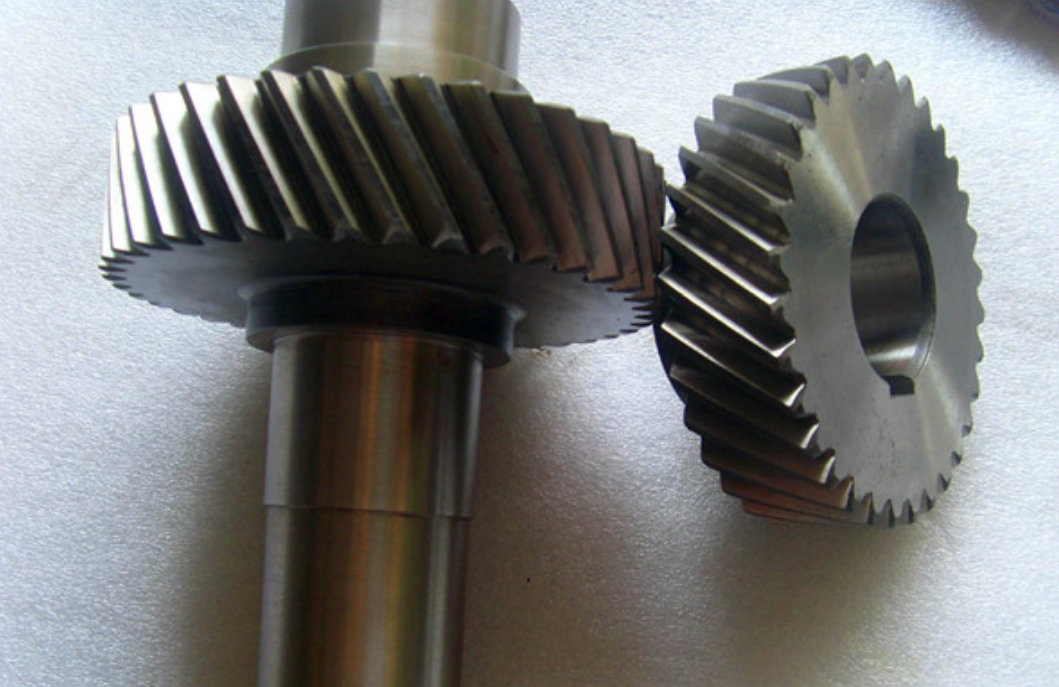
Helical gears operate on the principle of inclined tooth engagement, which introduces complexities compared to spur gears. The helical tooth geometry results in a gradual contact process, where multiple teeth are simultaneously in mesh, distributing loads more evenly. This paper adopts a first-person perspective to systematically explore the meshing behavior of helical gears. I begin by reviewing the geometric foundations, including the calculation of the actual length of the line of action and the contact ratio. Subsequently, I analyze the contact line length and its variation during engagement, leading to the derivation of the unit contact line load under practical operating conditions. The analysis emphasizes the interplay between contact ratio and contact line length, highlighting how these factors influence the load distribution and overall durability of helical gears.
The significance of this study lies in its potential to optimize helical gear designs for improved reliability and efficiency. While prior research has addressed various aspects of helical gear mechanics, a comprehensive treatment of unit contact line load in relation to contact ratio remains limited. By bridging this gap, I aim to contribute to the advancement of gear technology, ensuring that helical gears can meet the escalating demands of industrial applications. Throughout this paper, I will employ mathematical formulations, tables, and detailed explanations to elucidate key concepts, ensuring clarity and depth. The recurring emphasis on helical gears underscores their critical role in mechanical systems.
Geometric Fundamentals of Helical Gears
Helical gears are characterized by their teeth being cut at an angle to the gear axis, known as the helix angle. This design leads to a smoother and quieter operation compared to spur gears, as the contact between teeth initiates gradually along the tooth width. To understand the load distribution in helical gears, it is essential to first establish the geometric parameters that govern their meshing behavior. The following sections detail the calculations for the line of action length and the contact ratio, which are pivotal in determining the load-sharing characteristics.
The meshing of helical gears can be analyzed in the transverse plane, where the gear teeth appear as involute profiles. In this plane, the line of action is tangent to the base circles of the mating gears. For a pair of helical gears, the actual length of the line of action, denoted as $L_a$, can be derived from the geometric relationships in the transverse section. Consider a helical gear pair consisting of a sun gear (gear 1) and a planet gear (gear 2). The actual line of action length is given by:
$$L_a = \sqrt{r_{a1}^2 – r_{b1}^2} + \sqrt{r_{a2}^2 – r_{b2}^2} – a \sin \alpha_t$$
where:
- $r_{a1}$ is the tip radius of the sun gear (in mm),
- $r_{b1}$ is the base radius of the sun gear (in mm),
- $r_{a2}$ is the tip radius of the planet gear (in mm),
- $r_{b2}$ is the base radius of the planet gear (in mm),
- $a$ is the center distance (in mm),
- $\alpha_t$ is the transverse pressure angle (in radians).
The transverse pressure angle $\alpha_t$ is related to the normal pressure angle $\alpha_n$ and the helix angle $\beta$ by:
$$\alpha_t = \arctan\left(\frac{\tan \alpha_n}{\cos \beta}\right)$$
This relationship accounts for the inclination of the teeth in helical gears, which affects the force transmission and contact conditions. The base radii are calculated from the pitch radii and the pressure angle: $r_b = r \cos \alpha_t$, where $r$ is the pitch radius. These formulas are foundational for subsequent analyses of helical gears.
To illustrate the geometric parameters, Table 1 summarizes the key symbols and their descriptions used throughout this paper. This table serves as a reference for the calculations involving helical gears.
| Symbol | Description | Unit |
|---|---|---|
| $L_a$ | Actual length of the line of action | mm |
| $r_a$ | Tip radius | mm |
| $r_b$ | Base radius | mm |
| $\alpha_n$ | Normal pressure angle | rad |
| $\alpha_t$ | Transverse pressure angle | rad |
| $\beta$ | Helix angle | rad |
| $a$ | Center distance | mm |
| $m_n$ | Normal module | mm |
| $p_t$ | Transverse base pitch | mm |
The line of action length is a critical factor in determining the contact duration and load distribution in helical gears. A longer $L_a$ implies a more extended period of tooth engagement, which can enhance the smoothness of power transmission. However, the actual load-sharing depends on the number of teeth in contact simultaneously, which is quantified by the contact ratio.
Contact Ratio Calculation for Helical Gears
The contact ratio, often denoted as $\varepsilon$, is a dimensionless parameter that represents the average number of tooth pairs in contact during meshing. For helical gears, the contact ratio is more complex than for spur gears due to the axial overlap of teeth. It consists of two components: the transverse contact ratio $\varepsilon_{\alpha}$ and the axial contact ratio $\varepsilon_{\beta}$. The total contact ratio $\varepsilon_{\gamma}$ is the sum of these components, reflecting the combined effect of tooth geometry and helix angle.
The transverse contact ratio $\varepsilon_{\alpha}$ accounts for the overlap in the transverse plane, similar to spur gears. It is defined as the ratio of the length of the line of action to the transverse base pitch $p_t$. The transverse base pitch is given by:
$$p_t = \pi m_n \cos \alpha_t$$
where $m_n$ is the normal module. Thus, the transverse contact ratio is calculated as:
$$\varepsilon_{\alpha} = \frac{L_a}{p_t} = \frac{L_a}{\pi m_n \cos \alpha_t}$$
This component indicates how many tooth pairs are in contact in the transverse section. For helical gears, $\varepsilon_{\alpha}$ is typically greater than 1 to ensure continuous meshing.
The axial contact ratio $\varepsilon_{\beta}$, also known as the overlap ratio, arises from the helical tooth inclination. It represents the additional contact provided by the axial overlap of teeth along the gear width. The axial contact ratio is expressed as:
$$\varepsilon_{\beta} = \frac{b \tan \beta}{p_t} = \frac{b \tan \beta}{\pi m_n \cos \alpha_t}$$
where $b$ is the face width of the helical gear. This component increases with larger helix angles and face widths, contributing to smoother operation and higher load capacity.
The total contact ratio $\varepsilon_{\gamma}$ for helical gears is then:
$$\varepsilon_{\gamma} = \varepsilon_{\alpha} + \varepsilon_{\beta}$$
This total value signifies the average number of tooth pairs in contact during a meshing cycle. A higher $\varepsilon_{\gamma}$ implies better load distribution and reduced stress on individual teeth. For helical gears, it is common for $\varepsilon_{\gamma}$ to exceed 2, indicating that at least two tooth pairs are engaged at any given time.
To better understand the impact of design parameters on the contact ratio, Table 2 presents example calculations for a helical gear pair with varying helix angles. The gear parameters are assumed as follows: normal module $m_n = 3$ mm, normal pressure angle $\alpha_n = 20^\circ$, face width $b = 40$ mm, sun gear teeth $z_1 = 20$, planet gear teeth $z_2 = 30$, and center distance $a = 75$ mm. The tip radii are calculated based on standard addendum coefficients.
| Helix Angle $\beta$ (degrees) | Transverse Pressure Angle $\alpha_t$ (degrees) | Line of Action Length $L_a$ (mm) | Transverse Contact Ratio $\varepsilon_{\alpha}$ | Axial Contact Ratio $\varepsilon_{\beta}$ | Total Contact Ratio $\varepsilon_{\gamma}$ |
|---|---|---|---|---|---|
| 10 | 20.17 | 25.4 | 1.45 | 0.82 | 2.27 |
| 20 | 21.17 | 24.8 | 1.42 | 1.72 | 3.14 |
| 30 | 22.80 | 23.9 | 1.38 | 2.85 | 4.23 |
As observed from Table 2, increasing the helix angle $\beta$ leads to a higher axial contact ratio $\varepsilon_{\beta}$, thereby increasing the total contact ratio $\varepsilon_{\gamma}$. This demonstrates the advantage of helical gears in achieving greater load-sharing capabilities through geometric design. The contact ratio is a fundamental metric that directly influences the contact line length and, consequently, the unit contact line load.
Contact Line Length in Helical Gears
The contact line length in helical gears refers to the total length of the lines of contact between mating teeth at any instant during meshing. Unlike spur gears, where contact occurs along a single line, helical gears exhibit a varying contact pattern that shifts along the tooth flank. The contact line length is intrinsically linked to the total contact ratio, as a higher $\varepsilon_{\gamma}$ corresponds to a greater number of contact lines. Understanding this relationship is crucial for analyzing the load distribution.
During the meshing process of helical gears, the contact lines evolve from points to lines and back to points as teeth engage and disengage. The effective contact width $B_e$, which represents the total contact line length per unit face width, can be categorized based on the relative magnitudes of the transverse and axial contact ratios. For helical gears, two cases are distinguished:
- Case 1: $\varepsilon_{\alpha} > \varepsilon_{\beta}$ – The transverse contact ratio dominates.
- Case 2: $\varepsilon_{\alpha} < \varepsilon_{\beta}$ – The axial contact ratio dominates.
In Case 1, where $\varepsilon_{\alpha} > \varepsilon_{\beta}$, the effective contact width $B_e$ is given by:
$$B_e = b \left(1 + \frac{\varepsilon_{\beta}}{\varepsilon_{\alpha}}\right)$$
This formula accounts for the additive effect of axial overlap when the transverse contact is more significant. Conversely, in Case 2, where $\varepsilon_{\alpha} < \varepsilon_{\beta}$, the effective contact width is:
$$B_e = b \left(1 + \frac{\varepsilon_{\alpha}}{\varepsilon_{\beta}}\right)$$
These expressions derive from the geometric progression of contact lines during meshing. The total contact line length $L_T$ over the entire engagement cycle can be obtained by integrating the effective contact width across the meshing period. However, for practical purposes, the instantaneous contact line length $L_c$ at a given meshing position is often approximated by:
$$L_c = B_e \cdot \frac{\varepsilon_{\gamma}}{\max(\varepsilon_{\alpha}, \varepsilon_{\beta})}$$
This approximation simplifies the analysis while capturing the essence of contact line variation. To illustrate, consider a helical gear pair with $\varepsilon_{\alpha} = 1.5$ and $\varepsilon_{\beta} = 2.0$, falling under Case 2. Assuming a face width $b = 50$ mm, the effective contact width is:
$$B_e = 50 \left(1 + \frac{1.5}{2.0}\right) = 50 \times 1.75 = 87.5 \text{ mm}$$
Then, the instantaneous contact line length at a typical meshing point is:
$$L_c = 87.5 \times \frac{3.5}{2.0} = 153.125 \text{ mm}$$
This value represents the total length of all contact lines at that instant. The variation of $L_c$ during meshing can be plotted to show how the contact lines transition, but for load calculation, the average contact line length is often used. The average contact line length $\bar{L}_c$ is related to the total contact ratio and face width by:
$$\bar{L}_c = b \cdot \varepsilon_{\gamma}$$
This relationship holds because $\varepsilon_{\gamma}$ represents the average number of contact lines across the face width. For the example above, $\bar{L}_c = 50 \times 3.5 = 175$ mm, which is consistent with the earlier calculation. The contact line length is a key factor in determining the unit contact line load, as a longer $L_c$ distributes the load over a larger area.
Table 3 summarizes the formulas for contact line length based on the two cases for helical gears. This table aids designers in quickly estimating the contact characteristics.
| Case Condition | Effective Contact Width $B_e$ | Average Contact Line Length $\bar{L}_c$ |
|---|---|---|
| $\varepsilon_{\alpha} > \varepsilon_{\beta}$ | $B_e = b \left(1 + \frac{\varepsilon_{\beta}}{\varepsilon_{\alpha}}\right)$ | $\bar{L}_c = b \cdot \varepsilon_{\gamma}$ |
| $\varepsilon_{\alpha} < \varepsilon_{\beta}$ | $B_e = b \left(1 + \frac{\varepsilon_{\alpha}}{\varepsilon_{\beta}}\right)$ | $\bar{L}_c = b \cdot \varepsilon_{\gamma}$ |
The analysis of contact line length underscores the importance of helical gears in achieving favorable load distribution. By optimizing the helix angle and face width, engineers can tailor the contact line length to meet specific performance requirements.
Unit Contact Line Load Analysis
The unit contact line load, denoted as $q$, is defined as the normal load per unit length along the contact lines. It is a critical parameter for assessing the contact stress and fatigue life of helical gears. In practical meshing, the total normal load $F_n$ is distributed over the total contact line length $L_T$ at any instant. Therefore, the unit contact line load can be expressed as:
$$q = \frac{F_n}{L_T}$$
where $F_n$ is the total normal force acting on the tooth flanks, and $L_T$ is the instantaneous total contact line length. To derive $F_n$, consider the torque transmission in helical gears. The tangential force $F_t$ on the pitch circle is related to the torque $T_1$ on the driving gear by:
$$F_t = \frac{2 T_1}{d_1}$$
where $d_1$ is the pitch diameter of the driving gear. For helical gears, the normal force $F_n$ is influenced by the helix angle and pressure angle. The relationship between tangential force and normal force is given by:
$$F_n = \frac{F_t}{\cos \alpha_n \cos \beta}$$
This equation accounts for the axial component due to the helix and the normal pressure angle. Substituting $F_t$, we get:
$$F_n = \frac{2 T_1}{d_1 \cos \alpha_n \cos \beta}$$
The total contact line length $L_T$ varies during meshing, but for design purposes, the average value $\bar{L}_c$ is often used. As derived earlier, $\bar{L}_c = b \cdot \varepsilon_{\gamma}$. Therefore, the average unit contact line load $\bar{q}$ is:
$$\bar{q} = \frac{F_n}{b \cdot \varepsilon_{\gamma}} = \frac{2 T_1}{d_1 \cos \alpha_n \cos \beta \cdot b \cdot \varepsilon_{\gamma}}$$
This formula highlights the inverse relationship between $\bar{q}$ and the total contact ratio $\varepsilon_{\gamma}$. A higher $\varepsilon_{\gamma}$ results in a lower unit load, which reduces contact stress and enhances the gear’s load-carrying capacity. This principle is central to the design of helical gears for heavy-duty applications.
To exemplify, let’s compute $\bar{q}$ for a helical gear set with the following parameters: torque $T_1 = 500$ Nm, pitch diameter $d_1 = 100$ mm, normal pressure angle $\alpha_n = 20^\circ$, helix angle $\beta = 25^\circ$, face width $b = 60$ mm, and total contact ratio $\varepsilon_{\gamma} = 3.2$. First, calculate the normal force:
$$F_n = \frac{2 \times 500}{0.1 \times \cos 20^\circ \times \cos 25^\circ} = \frac{1000}{0.1 \times 0.9397 \times 0.9063} = \frac{1000}{0.0851} \approx 11750 \text{ N}$$
Then, the average unit contact line load is:
$$\bar{q} = \frac{11750}{60 \times 10^{-3} \times 3.2} = \frac{11750}{0.192} \approx 61198 \text{ N/m} = 61.2 \text{ N/mm}$$
This value can be compared with allowable contact stresses to evaluate the gear design. The unit load is a direct indicator of contact pressure, which influences pitting resistance and wear.
The variation of unit load during meshing can be analyzed by considering the instantaneous contact line length $L_c$ instead of the average. At any meshing position, the unit load $q_i$ is:
$$q_i = \frac{F_n}{L_c}$$
where $L_c$ fluctuates as teeth engage and disengage. For helical gears, this fluctuation is smoother than for spur gears due to the overlapping contact lines. The maximum unit load $q_{\text{max}}$ occurs when $L_c$ is at its minimum, typically during the transition between tooth pairs. Minimizing $q_{\text{max}}$ is essential for preventing surface failures.
Table 4 provides a comparison of unit contact line loads for different helical gear configurations, emphasizing the impact of contact ratio. The base parameters are as above, with varying helix angles to alter $\varepsilon_{\gamma}$.
| Helix Angle $\beta$ (degrees) | Total Contact Ratio $\varepsilon_{\gamma}$ | Normal Force $F_n$ (N) | Average Contact Line Length $\bar{L}_c$ (mm) | Average Unit Load $\bar{q}$ (N/mm) |
|---|---|---|---|---|
| 15 | 2.5 | 12000 | 150 | 80.0 |
| 25 | 3.2 | 11750 | 192 | 61.2 |
| 35 | 4.0 | 11500 | 240 | 47.9 |
As shown in Table 4, increasing the helix angle boosts the total contact ratio, which lengthens the average contact line and reduces the unit load. This trend validates the advantage of helical gears in distributing loads more effectively. The analysis of unit contact line load is vital for optimizing helical gear designs, ensuring reliability under operational stresses.
Discussion on Helical Gear Performance
The interplay between contact ratio, contact line length, and unit contact line load defines the performance of helical gears in practical applications. Helical gears excel in scenarios requiring high power transmission with minimal noise and vibration. The helical tooth geometry facilitates a gradual engagement process, which not only smooths out load fluctuations but also enhances the gear’s durability. In this section, I delve deeper into the implications of the derived relationships, comparing helical gears with other gear types, and exploring design considerations.
One key aspect is the effect of manufacturing tolerances on the contact line load. Imperfections in tooth profile or helix angle can lead to uneven contact, increasing the unit load on certain sections. Therefore, precision in manufacturing helical gears is paramount to achieving the theoretical load distribution. Advanced simulation tools, such as finite element analysis (FEA), can model these variations, but the analytical formulas provided here offer a quick estimation method.
Another factor is the thermal behavior of helical gears under load. The unit contact line load influences the frictional heat generated at the tooth interfaces. A lower $\bar{q}$ reduces the heat flux, contributing to better thermal management. For high-speed helical gears, this can prevent thermal distress and maintain lubrication efficiency. The helix angle plays a dual role: it increases the contact ratio but also introduces axial thrust, which must be balanced by appropriate bearings.
The design of helical gears often involves trade-offs. A larger helix angle increases $\varepsilon_{\gamma}$ and reduces unit load, but it also raises axial forces and may complicate assembly. Similarly, a wider face width extends the contact line length but adds weight and cost. Engineers must optimize these parameters based on application constraints. For instance, in automotive transmissions, helical gears with moderate helix angles (e.g., 20-30 degrees) are common to balance performance and packaging.
To further illustrate the design process, consider a case study for an industrial gearbox. The goal is to transmit 100 kW at 1500 rpm with a gear ratio of 3:1. Using helical gears, the initial design parameters might include: normal module $m_n = 4$ mm, helix angle $\beta = 20^\circ$, face width $b = 80$ mm, and normal pressure angle $\alpha_n = 20^\circ$. The torque on the driving gear is $T_1 = \frac{100000 \times 60}{2\pi \times 1500} \approx 636.6$ Nm. Following the formulas, one can compute the contact ratio, contact line length, and unit load to verify design adequacy.
First, calculate the pitch diameter for the driving gear with, say, $z_1 = 25$ teeth. The transverse module is $m_t = \frac{m_n}{\cos \beta} = \frac{4}{\cos 20^\circ} \approx 4.26$ mm, so $d_1 = m_t z_1 = 4.26 \times 25 = 106.5$ mm. Then, determine the line of action length using geometric relations, and compute $\varepsilon_{\alpha}$ and $\varepsilon_{\beta}$. Assuming $\varepsilon_{\gamma} \approx 3.5$, the average contact line length is $\bar{L}_c = 80 \times 3.5 = 280$ mm. The normal force is $F_n = \frac{2 \times 636.6}{0.1065 \times \cos 20^\circ \times \cos 20^\circ} \approx \frac{1273.2}{0.1065 \times 0.9397^2} \approx 13500$ N. Thus, $\bar{q} = \frac{13500}{0.28} \approx 48214$ N/m = 48.2 N/mm. This value can be compared with material limits to assess safety.
Such calculations demonstrate the practical utility of the analytical framework. Helical gears, with their inherent advantages, continue to be a cornerstone in power transmission systems. Ongoing research focuses on advanced materials and surface treatments to further reduce unit loads and extend gear life.
Conclusion
In this comprehensive study, I have analyzed the critical parameters governing the performance of helical gears: contact ratio, contact line length, and unit contact line load. Through detailed mathematical derivations and illustrative examples, I established that the total contact ratio $\varepsilon_{\gamma}$ for helical gears is the sum of transverse and axial components, differing fundamentally from spur gears. This total contact ratio directly influences the contact line length, with higher $\varepsilon_{\gamma}$ values leading to longer contact lines and, consequently, lower unit loads. The unit contact line load $\bar{q}$ is inversely proportional to $\varepsilon_{\gamma}$, highlighting the importance of geometric design in enhancing load-carrying capacity.
The findings underscore the superiority of helical gears in distributing loads smoothly across multiple tooth pairs, reducing stress concentrations and improving durability. By optimizing helix angles, face widths, and pressure angles, engineers can tailor helical gear systems to meet specific operational demands. The analytical formulas and tables provided herein serve as valuable tools for preliminary design and analysis.
Future work could explore dynamic effects, such as load sharing under varying speeds, or the impact of tooth modifications on contact line load. Additionally, integrating these analytical models with digital twin technologies could enable real-time monitoring and optimization of helical gear performance. As industries push for higher efficiency and reliability, the insights from this research will contribute to the ongoing evolution of gear technology, ensuring that helical gears remain at the forefront of mechanical transmission solutions.
In summary, this paper has elucidated the intricate relationships within helical gear mechanics, offering a foundation for advanced design and analysis. The emphasis on helical gears throughout reflects their pivotal role in modern engineering, and I hope this work inspires further innovation in the field.