
In the realm of mechanical power transmission, hypoid gears represent a critical component due to their unique ability to transmit motion between non-intersecting axes with high efficiency, smooth operation, and substantial load-bearing capacity. These gears are extensively employed in automotive differentials, aerospace systems, marine propulsion, and heavy machinery. The complexity of their geometry, characterized by hyperbolic pitch surfaces and offset axes, necessitates rigorous analysis to ensure optimal performance, durability, and noise reduction. This study delves into the quasi-static contact behavior of hypoid gears, combining theoretical modeling, finite element analysis, and experimental validation. Our focus is on developing precise mathematical models for tooth surfaces and fillets, evaluating contact patterns and transmission errors under load, and verifying the results through physical testing. The insights gained aim to enhance the design and application of hypoid gears in industrial settings.
The contact characteristics of hypoid gears under load are paramount for predicting fatigue life, vibration, and noise. Traditional design methods often rely on simplified assumptions, which may not capture the intricate stress distributions and deformations occurring during meshing. With advancements in computational mechanics, detailed simulations such as finite element analysis (FEA) have become indispensable. However, many existing studies overlook factors like complete gear geometry, support stiffness effects, and comprehensive experimental correlation. This work addresses these gaps by establishing a holistic framework that integrates accurate geometric modeling, quasi-static FEA considering system dynamics, and empirical validation. We emphasize the influence of loading conditions on contact ellipses, bending stresses, contact stresses, and transmission error fluctuations. By doing so, we provide a robust methodology for analyzing hypoid gears, which can inform optimization efforts and reliability assessments.
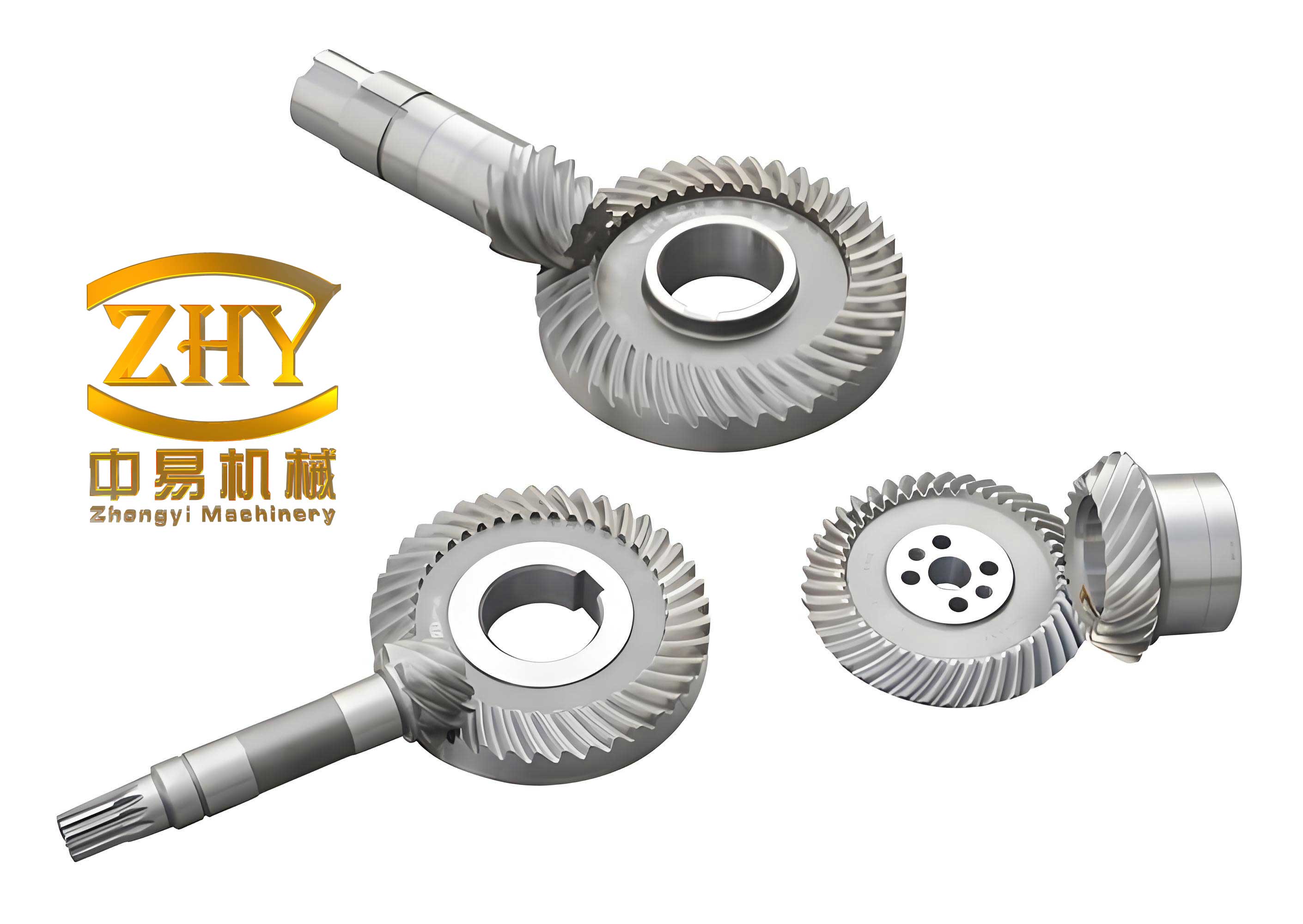
Our investigation begins with the mathematical formulation of hypoid gear surfaces. The geometry of hypoid gears is derived from the generation process involving imaginary crown gears or face-milling cutters. For the gear (larger wheel) and pinion (smaller wheel), we define coordinate systems attached to the machine tool and workpiece. The tooth surface comprises the active flank and the fillet region, which are generated by the cutting tool’s profile. For the gear, the convex side is typically the driving surface, while the pinion’s concave side engages with it. The mathematical model accounts for tool parameters such as cutter radius, pressure angle, blade geometry, and machine settings like radial distance, angular position, and offset.
Let us consider the gear first. In the machine coordinate system $\sigma_2$, the cutter axis is oriented along a unit vector $\mathbf{p}_2$. The cutter profile consists of a straight line for the flank and a circular arc for the fillet. For a point on the flank, defined by a parameter $s_2$ along the blade and an angle $\theta_2$ around the cutter axis, the position vector $\mathbf{r}_{c2}$ and normal vector $\mathbf{n}_{c2}$ in the cutter coordinate system $\sigma_{02}$ are given by:
$$ \mathbf{r}_{c2}(s_2, \theta_2) = \begin{bmatrix} (r_{02} – s_2 \sin \alpha_{02}) \cos \theta_2 \\ (r_{02} – s_2 \sin \alpha_{02}) \sin \theta_2 \\ – s_2 \cos \alpha_{02} \end{bmatrix} $$
$$ \mathbf{n}_{c2}(\theta_2) = \begin{bmatrix} \cos \alpha_{02} \cos \theta_2 \\ \cos \alpha_{02} \sin \theta_2 \\ – \sin \alpha_{02} \end{bmatrix} $$
where $r_{02}$ is the cutter point radius, $\alpha_{02}$ is the pressure angle, and $s_2$ ranges according to the depth of cut. For the fillet region, generated by a circular arc with radius $r_{e2}$, the position vector $\mathbf{r}_{e2}$ and normal vector $\mathbf{n}_{e2}$ for a point parameterized by angle $\theta_{02}$ are:
$$ \mathbf{r}_{e2}(\theta_{02}, \theta_2) = \begin{bmatrix} (r_{Oe2} \mp r_{e2} \sin \theta_{02}) \cos \theta_2 \\ (r_{Oe2} \mp r_{e2} \sin \theta_{02}) \sin \theta_2 \\ r_{e2} (\cos \theta_{02} – 1) \end{bmatrix} $$
$$ \mathbf{n}_{e2}(\theta_{02}, \theta_2) = \begin{bmatrix} \sin \theta_{02} \cos \theta_2 \\ \sin \theta_{02} \sin \theta_2 \\ \mp \cos \theta_{02} \end{bmatrix} $$
The transformation from the cutter coordinate system to the gear coordinate system involves a series of rotations and translations based on machine settings: radial distance $S_2$, angular position $q_2$, vertical offset $E_{02}$, axial offset $X_{02}$, bed distance $X_{B2}$, and machine root angle $\delta_{M2}$. As the cutter rotates by an incremental angle $\Delta q_2$, the gear rotates by $\psi_2 = i_{02} \Delta q_2$, where $i_{02}$ is the gear ratio of the generation process. The homogeneous transformation matrix $\mathbf{M}_{\sigma_{02}}^{\sigma_2}(\Delta q_2)$ combines these motions. The conjugate tooth surface is derived by applying the enveloping condition, which ensures that the relative velocity between the cutter and gear is perpendicular to the surface normal. This leads to the meshing equation:
$$ \mathbf{v}_g \cdot \mathbf{n}_2 = 0 $$
where $\mathbf{v}_g$ is the relative velocity vector. Solving this equation yields the gear tooth surface $\mathbf{r}_2(\theta_2, \Delta q_2)$ as a function of the parameters.
For the pinion, the modeling is more intricate due to the use of a tilted cutter head and single-sided cutting. The pinion cutter coordinate system $\sigma_{01}$ is defined with similar parameters: cutter radius $r_{01}$, pressure angle $\alpha_{01}$, and fillet radius $r_{e1}$. The position and normal vectors for the flank and fillet are analogous to those for the gear, but with additional transformations accounting for cutter tilt angle $i$ and swivel angle $j$. The machine settings include $S_1$, $q_1$, $E_{01}$, $X_{01}$, $X_{B1}$, and $\delta_{M1}$. The transformation chain from the cutter to the pinion coordinate system $\sigma_1$ involves rotations for tilt and swivel, followed by translations and rotations for machine motions. As the cutter rotates by $\Delta q_1$, the pinion rotates by $\psi_1 = i_{01} \Delta q_1$. The meshing equation is again applied to derive the pinion tooth surface $\mathbf{r}_1(\theta_1, \Delta q_1)$.
The mathematical models for both hypoid gears are summarized in Table 1, which lists the key parameters and equations. These models enable the generation of precise point clouds representing the tooth surfaces and fillets, which are then used for CAD model construction.
| Component | Parameters | Position Vector | Normal Vector |
|---|---|---|---|
| Gear Flank | $s_2, \theta_2, \alpha_{02}, r_{02}$ | $\mathbf{r}_{c2}(s_2, \theta_2)$ | $\mathbf{n}_{c2}(\theta_2)$ |
| Gear Fillet | $\theta_{02}, \theta_2, r_{e2}$ | $\mathbf{r}_{e2}(\theta_{02}, \theta_2)$ | $\mathbf{n}_{e2}(\theta_{02}, \theta_2)$ |
| Pinion Flank | $s_1, \theta_1, \alpha_{01}, r_{01}$ | $\mathbf{r}_{c1}(s_1, \theta_1)$ | $\mathbf{n}_{c1}(\theta_1)$ |
| Pinion Fillet | $\theta_{01}, \theta_1, r_{e1}$ | $\mathbf{r}_{e1}(\theta_{01}, \theta_1)$ | $\mathbf{n}_{e1}(\theta_{01}, \theta_1)$ |
With the mathematical models established, we proceed to assemble a hypoid gear pair for analysis. A specific hypoid gear set is chosen as a case study, with geometric parameters provided in Table 2. This set features a pinion with 9 teeth and a gear with 35 teeth, a shaft angle of 90°, an offset of 44.45 mm, and module of 4.899 mm. The pinion is left-handed, while the gear is right-handed. These hypoid gears are designed for automotive applications, where smooth torque transmission and low noise are essential.
| Parameter | Pinion | Gear |
|---|---|---|
| Number of Teeth, $z$ | 9 | 35 |
| Hand of Spiral | Left | Right |
| Module, $m$ (mm) | 4.899 | |
| Shaft Angle, $\Sigma$ (°) | 90 | |
| Offset, $E$ (mm) | 44.45 | |
| Pitch Diameter, $d$ (mm) | 64.913 | 171.45 |
| Face Width, $b$ (mm) | 38.41 | 26.92 |
| Spiral Angle, $\beta$ (°) | 50 | 15.63 |
The ideal contact pattern and transmission error for this hypoid gear pair are predetermined through tooth contact analysis (TCA). For the gear convex side and pinion concave side, which are the primary working surfaces, the desired contact ellipse has an average semi-major axis $l = 4$ mm, a contact path direction angle $\gamma = 60^\circ$, and the transmission error curve exhibits an intersection point at $\delta = -5 \times 10^{-5}$ rad. These indices serve as benchmarks for evaluating the loaded performance.
To perform quasi-static contact analysis, we develop a finite element model of the hypoid gear transmission system. The model includes the gear and pinion solids with accurate tooth geometries, as well as simplified shafts to represent support stiffness. The gear is modeled with two bearing supports, while the pinion is cantilevered, reflecting typical automotive differential arrangements. The material is steel with Young’s modulus $E = 2.1 \times 10^5$ MPa, Poisson’s ratio $\nu = 0.3$, and a friction coefficient of 0.1 at the tooth interface. The mesh employs eight-node linear hexahedral elements (C3D8 in ABAQUS), with refinement in the contact zones to capture stress gradients accurately. The finite element model comprises approximately 500,000 elements, ensuring a balance between computational efficiency and result accuracy.
The analysis follows a three-step quasi-static procedure. First, initial contact is established by eliminating backlash between the hypoid gears. Second, a torque load $T_2$ is applied to the gear shaft, simulating the resistance from the driven system. Third, a rotational motion $\omega_1$ is imposed on the pinion shaft, driving the meshing over several tooth engagements. The torque values range from 100 N·m to 600 N·m to investigate load effects. Outputs include contact pressure distribution, bending stresses at the tooth root, and transmission error calculated as the difference between the actual and theoretical gear rotation angles.
The results from the finite element analysis reveal significant insights into the behavior of hypoid gears under quasi-static loading. Starting with contact patterns, Figure 1 illustrates the evolution of the contact ellipse on the gear convex surface as torque increases. At low torque (e.g., 100 N·m), the contact ellipse aligns well with the design specifications, exhibiting the desired size, orientation, and location near the tooth center. As torque rises to 200 N·m, the ellipse enlarges, and its direction angle $\gamma$ decreases slightly, indicating a shift in the contact path towards the tooth flank. At higher torques (400 N·m and 600 N·m), the contact area expands further, extending towards the gear tooth toe (larger end), while the heel (smaller end) remains relatively untouched. This asymmetry is attributed to tooth bending and shear deformations, which cause the mesh to favor the stiffer regions of the hypoid gears. The contact trajectory lengthens, implying greater material engagement, which enhances load sharing but may increase sliding velocities and wear.
The contact stresses $\sigma_H$ on both hypoid gears are extracted from the FEA. Figure 2 shows the pressure distribution on the gear convex and pinion concave surfaces at 200 N·m and 400 N·m. The maximum contact stress occurs near the center of the contact ellipse and escalates with torque. For instance, at $T_2 = 200$ N·m, the peak $\sigma_H$ is approximately 450 MPa on the gear and 480 MPa on the pinion. At $T_2 = 400$ N·m, these values rise to 700 MPa and 720 MPa, respectively. The contact stress distribution is elliptical, conforming to Hertzian theory, but modified by the complex curvature of hypoid gear surfaces. A comparison between FEA results and empirical calculations based on the AGMA or ISO standards is presented in Table 3. The empirical values are derived from formula:
$$ \sigma_H = Z_E \sqrt{ \frac{F_t}{b d} \cdot \frac{u+1}{u} \cdot K_A K_V K_{H\beta} K_{H\alpha} } $$
where $Z_E$ is the elasticity factor, $F_t$ is the tangential force, $b$ is the face width, $d$ is the pitch diameter, $u$ is the gear ratio, and $K$ factors account for application, dynamics, load distribution, and transverse load. The FEA stresses are 10-20% lower than empirical estimates, likely because the empirical method uses conservative factors and does not consider load-induced changes in contact pattern and stress redistribution. Nevertheless, the trend is consistent, validating the FEA approach for hypoid gears.
| Torque $T_2$ (N·m) | FEA $\sigma_H$ (MPa) | Empirical $\sigma_H$ (MPa) | Deviation (%) |
|---|---|---|---|
| 100 | 294 | 390 | -24.6 |
| 200 | 451 | 555 | -18.7 |
| 400 | 706 | 786 | -10.2 |
| 600 | 890 | 980 | -9.2 |
Bending stresses $\sigma_F$ at the tooth root are critical for fatigue life prediction. The FEA results show that the maximum bending stress occurs at the fillet region, where the tooth blends into the gear body. Figure 3 displays the bending stress distribution on the gear and pinion at different torques. For the gear, the stress is higher on the convex side root, while for the pinion, the concave side root is more stressed. As torque increases from 100 N·m to 600 N·m, the peak bending stress grows non-linearly, from about 30 MPa to 150 MPa for the gear, and from 50 MPa to 250 MPa for the pinion. The pinion experiences higher stresses due to its smaller size and fewer teeth, resulting in greater tooth flexibility and stress concentration. Table 4 compares FEA bending stresses with empirical values calculated using the Lewis formula with correction factors:
$$ \sigma_F = \frac{F_t}{b m} Y_F Y_S Y_\beta Y_B K_A K_V K_{F\beta} K_{F\alpha} $$
where $Y_F$ is the form factor, $Y_S$ is the stress correction factor, $Y_\beta$ is the helix angle factor, and $Y_B$ is the rim thickness factor. At lower torques, the FEA and empirical results align closely, but at higher torques, the empirical values exceed FEA values by up to 30%. This discrepancy arises because the empirical method assumes uniform load distribution and does not account for load-sharing among multiple tooth pairs in hypoid gears, which improves under deformation.
| Torque $T_2$ (N·m) | Gear FEA $\sigma_F$ (MPa) | Gear Empirical $\sigma_F$ (MPa) | Pinion FEA $\sigma_F$ (MPa) | Pinion Empirical $\sigma_F$ (MPa) |
|---|---|---|---|---|
| 100 | 32 | 36 | 53 | 40 |
| 200 | 59 | 73 | 88 | 80 |
| 400 | 104 | 146 | 142 | 159 |
| 600 | 150 | 210 | 250 | 280 |
To delve deeper, we analyze the bending stress along the tooth root line (transition from fillet to active flank). Figure 4 plots the maximum bending stress at each point along this line for the gear and pinion at $T_2 = 400$ N·m. For the gear, the stress is relatively uniform across the face width, with a slight increase at the toe due to contact patch extension. For the pinion, the stress peaks near the midpoint, where the contact ellipse applies the highest moment. The stress variation with pinion rotation angle $\psi_1$ is shown in Figure 5. The bending stress fluctuates with a period corresponding to the tooth pitch angle $\psi_p = 2\pi / z$. The gear tooth experiences both tension and compression during meshing, leading to stress reversals that could accelerate fatigue. The pinion tooth shows more pronounced stress peaks, but shorter duration, due to its faster rotation and engagement pattern. The average bending stress over a mesh cycle, calculated as:
$$ \bar{\sigma}_F = \frac{1}{T} \int_0^T \left( \frac{1}{N} \sum_{k=1}^N \sigma_F^k(t) \right) dt $$
where $T$ is the cycle period and $N$ is the number of nodes along the root line, yields $\bar{\sigma}_F = 40.6$ MPa for the gear and $\bar{\sigma}_F = 19.7$ MPa for the pinion at $T_2 = 400$ N·m. This indicates that, on average, the gear root undergoes higher stress, albeit with lower peaks, highlighting the importance of considering mean stresses in fatigue calculations for hypoid gears.
Transmission error (TE) is a key indicator of hypoid gear vibration and noise. Under quasi-static conditions, TE is defined as the deviation between the actual position of the driven gear and its ideal position based on perfect kinematics. Figure 6 shows the TE curves for various torques. At low torque (100 N·m), the TE exhibits periodic fluctuations with amplitude of about $2 \times 10^{-5}$ rad, corresponding to transitions between single and double tooth contact. As torque increases to 200 N·m, the amplitude grows to $5 \times 10^{-5}$ rad, and the waveform becomes smoother due to enhanced load sharing. At 400 N·m, the TE amplitude reaches $8 \times 10^{-5}$ rad, but the curve shows less pronounced discontinuities, suggesting that multiple tooth pairs are engaged simultaneously, reducing mesh stiffness variations. The intersection point $\delta$ of the TE curve, which indicates the phase shift, shifts negatively with higher torque, aligning with design expectations. The instantaneous transmission ratio $i(t)$ is derived from TE as:
$$ i(t) = \frac{\Delta \psi_2(t)}{\Delta \psi_1(t)} = i_0 + \frac{d(\text{TE})}{d\psi_1} $$
where $i_0$ is the nominal gear ratio. Figure 7 plots $i(t)$ for different torques, showing oscillations around $i_0 = 35/9 \approx 3.889$. The amplitude of these oscillations increases with torque, from ±0.5% at 100 N·m to ±1.5% at 600 N·m, implying greater dynamic excitations in hypoid gears under heavy loads.
To validate the FEA findings, we conduct experimental tests on a dedicated hypoid gear test rig. The rig consists of a servo motor drive, a speed reducer, the hypoid gear set mounted in a differential-like housing, and a braking system to apply torque. The gear pair is identical to that modeled in FEA. For contact pattern observation, a thin layer of Prussian blue dye is applied to the gear teeth, and the gears are run under light load to imprint the contact areas. Figure 8 shows the contact patterns at torques of 100, 400, and 800 N·m. The experimental patterns closely match the FEA predictions: at low torque, the ellipse is small and centered; at medium torque, it enlarges and shifts toward the toe; at high torque, it extends further along the tooth flank. The direction angle $\gamma$ decreases from about 60° to 45° as torque increases, consistent with simulation. Minor discrepancies in ellipse shape are attributed to surface roughness and alignment tolerances in the test setup.
For bending stress measurement, strain gauges are mounted along the tooth root line on the gear convex side, as depicted in Figure 9. Five gauges are evenly spaced from heel to toe. The gauges are connected to a data acquisition system sampling at 10 kHz. The hypoid gears are run under constant torque conditions of 400, 800, and 1200 N·m, and the strain signals are converted to stress using Hooke’s law. Figure 10 compares the experimental stress distributions with FEA results at these torques. The trends agree well: stress increases with torque, and the peak stress location moves toward the toe. Quantitative comparison shows that experimental stresses are 10-15% higher than FEA values, likely due to factors not modeled in FEA, such as residual stresses from manufacturing, micro-geometry deviations, and dynamic effects from test rig vibrations. Nonetheless, the correlation confirms the validity of the FEA model for quasi-static analysis of hypoid gears.
The experimental and simulation results collectively underscore the sensitivity of hypoid gears to loading conditions. The contact pattern evolution indicates that design adjustments should ensure that under light load, the contact is biased toward the heel to prevent edge loading at high torque. The bending stress data suggest that the pinion is the critical component for bending fatigue, necessitating material enhancements or geometric optimizations like root fillet profiling. The transmission error measurements highlight the trade-off between load capacity and noise: higher torque reduces TE fluctuations but increases absolute error, which may excite resonances. These insights can guide the design of hypoid gears for specific applications, such as electric vehicle differentials where quiet operation and high torque density are paramount.
In conclusion, this study presents a comprehensive approach to analyzing hypoid gears under quasi-static conditions. We developed precise mathematical models for tooth surfaces and fillets, incorporating all relevant machine settings and tool geometries. Using these models, we created a detailed finite element model of a hypoid gear transmission system and performed quasi-static contact analyses across a range of torques. The results elucidate the behavior of contact patterns, contact stresses, bending stresses, and transmission errors in hypoid gears. Key findings include the expansion and shift of contact ellipses with load, the non-linear increase in stresses, and the load-dependence of transmission error characteristics. Experimental validation through contact pattern tests and strain measurements corroborates the simulation results, demonstrating the accuracy of our methodology. This work provides a foundation for further research into dynamic behavior, thermal effects, and lifetime prediction of hypoid gears. Future studies could explore the impact of misalignments, lubrication, and surface treatments on the performance of hypoid gears in real-world applications.