
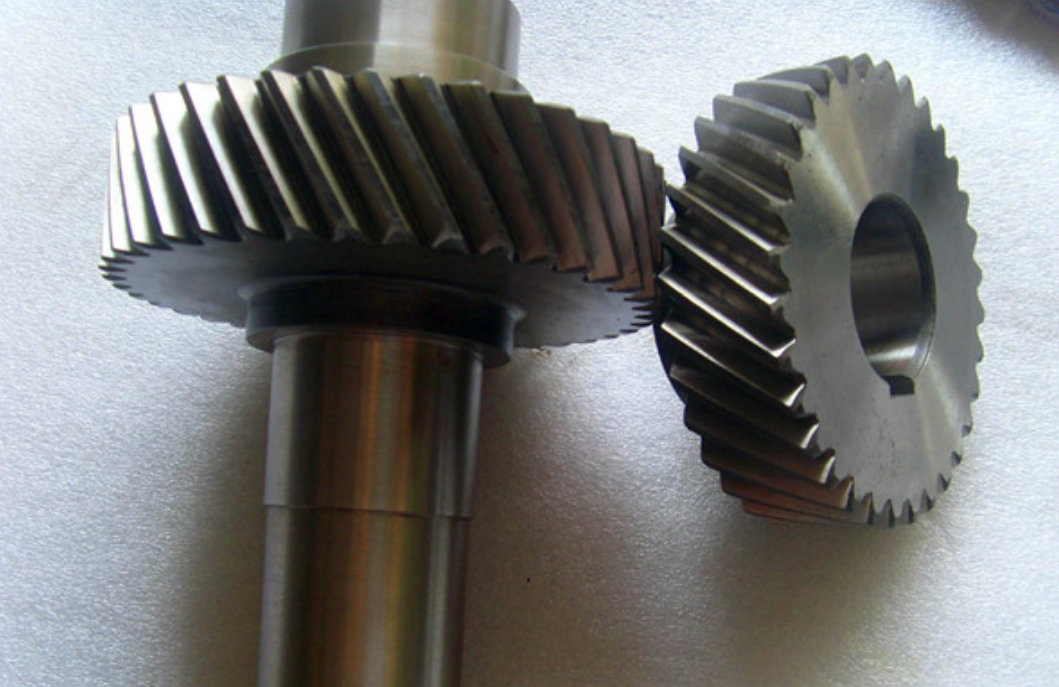
In modern mechanical transmission systems, helical gears are widely used due to their high load capacity, smooth operation, and reduced noise compared to spur gears. However, the dynamic behavior of helical gear systems is inherently nonlinear, primarily driven by factors such as time-varying mesh stiffness, gear transmission errors, and tooth backlash. These nonlinearities can lead to vibrations, noise, and reduced transmission accuracy, which are critical concerns in precision applications like automotive transmissions, wind turbines, and industrial machinery. In this study, I focus on analyzing the nonlinear vibration of helical gears by incorporating multi-harmonic components of static transmission error, which is often simplified to a single harmonic in prior research. By developing a comprehensive torsional dynamic model and employing numerical simulations, I aim to elucidate how higher-order harmonics influence system response and explore the effects of key parameters like damping ratio, load, and backlash on dynamic characteristics.
The importance of helical gears in power transmission cannot be overstated, as they enable efficient torque transfer with minimal slippage. Nonetheless, their performance is often compromised by dynamic excitations arising from manufacturing imperfections, assembly errors, and operational conditions. Traditional analyses typically approximate static transmission error as a first-order harmonic, but experimental evidence suggests that higher-order harmonics significantly contribute to vibration and noise spectra. Therefore, neglecting these components may lead to inaccurate predictions of system behavior. In this work, I utilize Romax software to model a helical gear transmission system and extract static transmission error through static analysis. This error is then expressed as a Fourier series to capture multiple harmonic components. A pure torsional dynamic model is established, accounting for nonlinearities such as stiffness excitation, tooth clearance, and static transmission error. By solving the state equations using numerical integration methods, I compare responses with first-order and multi-harmonic errors, demonstrating the substantial impact of higher-order terms. Furthermore, I investigate how damping ratio, load, and clearance alter the dynamic traits of helical gear systems, providing insights for design optimization and vibration suppression.
To begin, I establish a torsional dynamic model for a pair of helical gears, as this simplification is sufficient for engineering purposes while capturing essential nonlinearities. The system is represented using a lumped mass approach, where the gears are considered as rigid bodies connected by a spring-damper element along the line of action. The model includes the following parameters: θ₁ and θ₂ are the torsional displacements of the driving and driven gears, respectively; R₁ and R₂ denote the base circle radii; T₁ and T₂ represent external torque loads; I₁ and I₂ are moments of inertia; e(t) is the transmission error; K(t) is the time-varying mesh stiffness; and C is the damping coefficient. The equation of motion is derived from Newton’s second law, leading to a single-degree-of-freedom system after simplification.
The differential equation for the torsional vibration of helical gears can be expressed as:
$$ m\ddot{x} + C \cos \beta \dot{x} + K(t) \cos \beta f(x) = F_0 + m \ddot{e}(t) $$
Here, x(t) = R₁θ₁ – R₂θ₂ – e(t) is the transmission error relative to the static position, m = I₁I₂/(I₁R₂² + I₂R₁²) is the equivalent mass, β is the helix angle, F₀ = T₁/R₁ = T₂/R₂ is the mean load, and f(x) is the backlash function defined later. To facilitate numerical analysis, I non-dimensionalize the equation by introducing τ = ωₑt, y = x/b, and ω = ωₙ/ωₑ, where ωₑ = √(Kₘ/m) is the natural frequency, Kₘ is the average mesh stiffness, and b is half the backlash. The non-dimensional form becomes:
$$ \ddot{y} + 2\xi \cos \beta \dot{y} + \left[1 + \sum_{n=1}^{\infty} K_{mn} \cos(n\omega \tau + \varphi_n)\right] \cos \beta f(y) = F + \omega^2 \sum_{j=1}^{\infty} j^2 e_{mj} \cos(j\omega \tau + \varphi_j) $$
In this equation, ξ = C/(2mωₑ) is the damping ratio, Kₘₙ = Kₙ/Kₘ are normalized stiffness coefficients, F = F₀/(mωₑ²b) is the normalized load, and eₘⱼ = eⱼ/eₘ are normalized error coefficients. This formulation allows for systematic investigation of nonlinear dynamics.
Static transmission error is a key excitation source in helical gear systems, stemming from manufacturing inaccuracies, tooth deflection, and assembly misalignments. To accurately represent it, I employ Romax software to create a detailed model of a helical gear pair with supporting shafts and bearings. The gear parameters are as follows: module of 2.1 mm, pressure angle of 20°, helix angle of 25°, face width of 18 mm, 24 teeth on the driving gear, and 53 teeth on the driven gear. After applying an input torque of 80 N·m at 3000 rpm, static analysis confirms shaft integrity, with maximum bending stresses below the allowable limit for 45 steel (60 MPa). The static transmission error curve is extracted from the software and approximated using a Fourier series to include multiple harmonics, as higher-order terms are often neglected but crucial for vibration analysis.
The Fourier expansion of static transmission error e(t) is given by:
$$ e(t) = \frac{a_0}{2} + \sum_{j=1}^{5} \left[ A_j \cos(j\omega_n t) + B_j \sin(j\omega_n t) \right] $$
where ωₙ is the meshing frequency. The coefficients obtained from curve fitting are summarized in Table 1, highlighting the contributions of harmonics up to the fifth order. This multi-harmonic representation enables a more realistic simulation of excitation forces in helical gears.
| Harmonic Order j | Aⱼ (μm) | Bⱼ (μm) |
|---|---|---|
| 0 | 37.8 | – |
| 1 | -0.2406 | 1.8749 |
| 2 | 0.0276 | -0.1755 |
| 3 | -0.2869 | 0.0731 |
| 4 | -0.0879 | -0.0854 |
| 5 | -0.0160 | -0.0971 |
Time-varying mesh stiffness is another critical nonlinear factor in helical gear dynamics, arising from the changing number of tooth pairs in contact during rotation. For helical gears, the contact line length varies periodically, and stiffness can be modeled as proportional to this length. Assuming uniform load distribution along the contact line, the mesh stiffness for a single tooth pair is K(t) = Kₗ l(t), where Kₗ = Kₘ/L is a conversion factor, L is the average contact length, and l(t) is the instantaneous contact length. Since multiple teeth engage simultaneously, the total stiffness is the sum of contributions from all contacting pairs, leading to a periodic function that can be expanded into a Fourier series:
$$ K(t) = \frac{a_0}{2} + \sum_{n=1}^{5} \left[ A_n \cos(n\omega_n t) + B_n \sin(n\omega_n t) \right] $$
The Fourier coefficients for stiffness, derived from numerical simulations, are listed in Table 2. This representation captures the periodic variations essential for dynamic analysis of helical gears.
| Harmonic Order n | Aₙ | Bₙ |
|---|---|---|
| 0 | 13.475 | – |
| 1 | -0.2645 | 0.3138 |
| 2 | 0.0035 | 0.0202 |
| 3 | -0.0483 | -0.0283 |
| 4 | -0.0162 | 0.0057 |
| 5 | 0.0036 | 0.0096 |
Tooth backlash is an inherent clearance between mating teeth to prevent jamming, but it introduces strong nonlinearity into helical gear systems. The backlash function f(x) is defined as a piecewise linear function:
$$ f(x(t)) =
\begin{cases}
x(t) – b, & x(t) > b \\
0, & -b \leq x(t) \leq b \\
x(t) + b, & x(t) < -b
\end{cases} $$
where b is half the total backlash measured along the line of action. This nonlinearity can cause impacts and bifurcations, significantly affecting vibration responses in helical gears.
The dynamic model is solved numerically using the state-space approach. By defining state variables y₁ = y and y₂ = ẏ, the non-dimensional equation is converted into a system of first-order differential equations:
$$ \begin{aligned}
\dot{y}_1 &= y_2 \\
\dot{y}_2 &= F + \omega^2 \sum_{j=1}^{\infty} j^2 e_{mj} \cos(j\omega \tau + \varphi_j) – 2\xi \cos \beta y_2 \\
&\quad – \left[1 + \sum_{n=1}^{\infty} K_{mn} \cos(n\omega \tau + \varphi_n)\right] \cos \beta f(y_1)
\end{aligned} $$
I employ a variable-step Runge-Kutta method (e.g., ODE45 in MATLAB) to integrate these equations, ensuring accuracy despite the nonlinearities from backlash and multi-harmonic excitations. The initial conditions are set to zero, and simulations are run over sufficient cycles to achieve steady-state responses for helical gears.
To assess the impact of multi-harmonic static transmission error, I compare acceleration responses for two cases: one with only the first harmonic (j=1) and another with up to five harmonics (j=1 to 5). The parameters are fixed at ω=0.85, F=5.2113, b=4.5, and ξ=0.13. The results, plotted as acceleration versus time, reveal that the multi-harmonic case produces larger amplitude oscillations and more complex waveforms, including sharp peaks during transitions from single to multiple tooth contact. These peaks correspond to acceleration jumps that exacerbate noise and冲击 vibrations in helical gears. Thus, higher-order harmonics in static transmission error cannot be ignored for accurate dynamic predictions.
Next, I analyze the dynamic response of helical gears under multi-harmonic excitation. The time history of displacement shows periodic behavior, which is desirable for reducing vibration and wear in helical gear systems. The phase portrait forms a closed curve, confirming periodic motion, and the Fourier spectrum exhibits multiple frequency components due to nonlinear interactions. This underscores the richness of dynamic phenomena in helical gears when multi-harmonic errors are considered.
I then investigate the influence of damping ratio on the nonlinear dynamics of helical gears. By varying ξ from 0 to 0.5 while keeping other parameters constant, I generate bifurcation diagrams that depict the evolution of system response. For low damping ratios (ξ < 0.04), the helical gear system exhibits chaotic motion, characterized by irregular vibrations and high冲击 loads. As ξ increases to 0.04, the system transitions to multi-periodic orbits, reducing chaos. At ξ ≥ 0.09, the motion becomes periodic, indicating stabilization. Phase portraits for different damping ratios illustrate that higher damping weakens nonlinearities and suppresses response amplitudes, as seen in reduced Lyapunov exponents and spectrum magnitudes. This suggests that increasing damping, perhaps through viscoelastic materials or tuned dampers, can enhance the stability of helical gears.
The effect of load on helical gear dynamics is examined by varying the normalized load F. For F = 3, 5, and 9, time-domain plots show that larger loads increase the non-dimensional displacement and shift the mean upward. Frequency spectra indicate amplified vibration amplitudes with higher loads, implying that helical gears under heavy loads are more prone to excessive vibrations. This load sensitivity highlights the need for precise torque management in helical gear applications, such as in wind turbines or automotive transmissions, where fluctuating loads are common.
Backlash clearance is another critical parameter affecting helical gear behavior. By adjusting b to 10, 20, and 30, I observe that larger clearances lead to increased non-dimensional displacement and upward shifts in response. This is because greater backlash amplifies nonlinear impacts between teeth, promoting instability. Reducing clearance minimizes vibration, favoring smoother operation of helical gears, though it must be balanced against thermal expansion and lubrication requirements.
To quantify these effects, I summarize key trends in Table 3, which correlates parameter changes with dynamic characteristics of helical gears. This table aids in design decisions for optimizing helical gear systems.
| Parameter | Increase Effect | Recommendation for Helical Gears |
|---|---|---|
| Damping Ratio (ξ) | Reduces chaos, suppresses amplitude | Increase via damping materials |
| Load (F) | Increases displacement and vibration | Optimize load distribution |
| Backlash (b) | Amplifies nonlinear响应 and instability | Minimize within practical limits |
In conclusion, this study demonstrates the importance of considering multi-harmonic components in static transmission error for accurate nonlinear vibration analysis of helical gears. By developing a torsional dynamic model and solving it numerically, I show that higher-order harmonics significantly affect acceleration responses, leading to more complex vibrations. Furthermore, parametric studies reveal that increasing damping ratio stabilizes helical gear systems, while reducing load and backlash decreases vibration displacement, promoting operational smoothness. These insights can guide the design and maintenance of helical gears in various mechanical systems, enhancing reliability and performance. Future work could extend this analysis to include multi-mesh configurations, thermal effects, or experimental validation to further refine the understanding of helical gear dynamics.
The nonlinear nature of helical gears necessitates comprehensive modeling approaches that account for real-world excitations. As helical gears continue to be integral in advanced machinery, from robotics to aerospace, addressing their vibrational challenges through detailed dynamic analysis will remain a pivotal area of research. By incorporating multi-harmonic errors and exploring parameter sensitivities, this work contributes to the broader goal of optimizing helical gear systems for quieter, more efficient, and longer-lasting operations.