
In the field of mechanical engineering, the analysis of gear systems is crucial for optimizing performance and efficiency. Among various gear types, helical gears are widely used due to their smooth operation and high load-bearing capacity. However, friction at the tooth surfaces during meshing can lead to energy losses, reduced lifespan, and increased maintenance costs. Therefore, accurately calculating the sliding friction coefficients for helical gears is essential for improving transmission systems. This article presents a comprehensive method for determining these coefficients based on meshing contact analysis, incorporating key parameters such as normal load, contact stress, sliding velocity, and entrainment velocity. The approach leverages tooth contact analysis (TCA) and loaded tooth contact analysis (LTCA) to derive necessary inputs, which are then applied to a validated friction model. By focusing on helical gears, this study aims to provide a practical framework for minimizing friction-related issues in gear design.
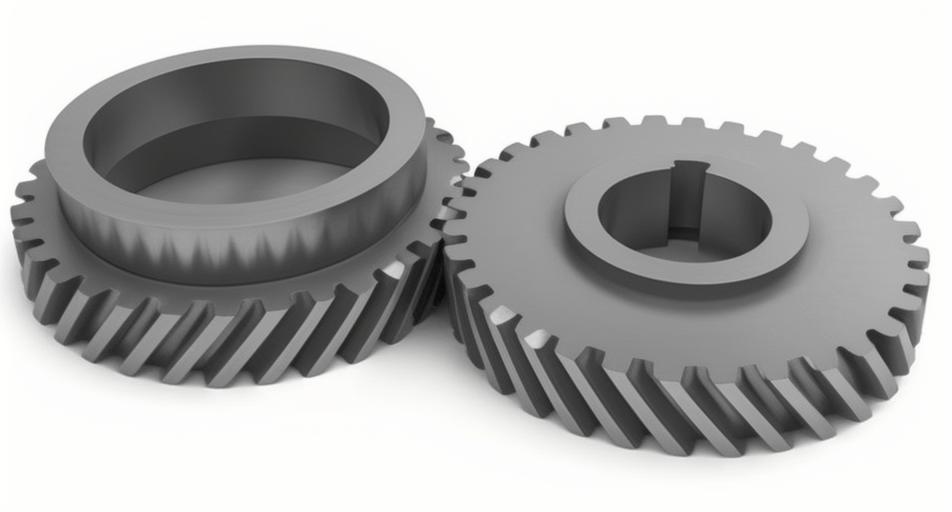
The significance of sliding friction coefficients in helical gears cannot be overstated. These coefficients influence the overall efficiency of gear transmissions, as they directly affect the power losses during meshing. Traditional methods often rely on average friction values or empirical formulas derived from specific test conditions, which may not accurately reflect real-world scenarios. For instance, in helical gears, the contact pattern and load distribution vary along the tooth flank due to the helical angle, making precise analysis more complex. To address this, I utilize a method grounded in elastohydrodynamic lubrication (EHL) theory, which considers the dynamic interactions between gear teeth under load. This approach allows for a detailed evaluation of friction at each contact point from engagement to disengagement, providing insights that can enhance the design and operation of helical gear systems.
The core of this method involves two main analytical steps: geometric contact analysis (TCA) and loaded contact analysis (LTCA). For helical gears, TCA is used to determine the contact path and pattern on the tooth surface by solving equations that ensure continuity of position and normal vectors at the meshing points. This analysis accounts for the geometry of the helical gear, including parameters such as helix angle, pressure angle, and tooth profile. Mathematically, for a pair of helical gears, the contact conditions can be expressed as:
$$ \vec{r}_f^{(1)}(u_1, \theta_1, \phi_1) = \vec{r}_f^{(2)}(u_2, \theta_2, \phi_2) $$
$$ \vec{n}_f^{(1)}(u_1, \theta_1, \phi_1) = \vec{n}_f^{(2)}(u_2, \theta_2, \phi_2) $$
Here, \( \vec{r}_f \) and \( \vec{n}_f \) represent the position and normal vectors in a fixed coordinate system, with superscripts denoting the driving and driven gears. The parameters \( u \) and \( \theta \) are related to the gear manufacturing process, while \( \phi \) represents the rotation angle. By incrementally solving these equations, I obtain the contact points and their locations on the helical gear tooth surface. This geometric insight is vital for subsequent load analysis.
Following TCA, LTCA is performed to assess the behavior of helical gears under operational loads. Unlike TCA, which assumes ideal contact, LTCA considers deformations due to applied forces, resulting in an elongated contact ellipse along the tooth flank. The analysis formulates a nonlinear programming problem to compute the load distribution and transmission error. The governing equation for LTCA is:
$$ \text{Min} \sum_{j=1}^{2n+1} X_j $$
$$ -[\lambda][F] + [Z] + [d] + [X] = [w] $$
$$ [e]^T[F] + X_{2n+1} = F $$
subject to \( F_j, d_j, Z, X_j \geq 0 \) and \( F_j = 0 \) or \( d_j = 0 \).
In this formulation, \( [\lambda] \) is the flexibility matrix, \( [F] \) is the load vector at discrete points along the contact ellipse, \( [d] \) is the gap after deformation, \( F \) is the total normal load, and \( [w] \) is the initial gap. Solving this yields the load distribution and transmission error, which are critical for friction calculations. For helical gears, the contact line length varies during meshing, and LTCA provides the actual contact length based on the load distribution, as illustrated in the following table summarizing key parameters from an example analysis:
| Parameter | Description | Role in Friction Calculation |
|---|---|---|
| Normal Load (F) | Force per contact point from LTCA | Determines contact stress via Hertz theory |
| Transmission Error (Δφ) | Angular deviation from ideal motion | Affects sliding and entrainment velocities |
| Contact Point Position | Location on tooth surface from TCA | Influences curvature radius and pressure angle |
| Contact Line Length (l) | Length of contact ellipse from LTCA | Used to compute unit load for stress calculation |
With these parameters, I proceed to calculate the inputs for the sliding friction coefficient formula. The maximum contact stress \( P_h \) is derived using the Hertzian contact theory, which is essential for helical gears due to their line contact characteristics. The formula is:
$$ P_h = Z_E \sqrt{\frac{F}{l r}} $$
Here, \( Z_E \) is the elastic coefficient, \( F \) is the normal load at the contact point, \( l \) is the contact line length, and \( r \) is the comprehensive curvature radius at the contact point. For helical gears, the curvature radius varies along the path of contact, and it is computed as \( r = \frac{r_1 r_2}{r_1 + r_2} \), where \( r_1 \) and \( r_2 \) are the radii of curvature for the driving and driven gears, respectively. This stress value reflects the pressure at the interface, which influences the lubrication regime and friction behavior.
Next, the sliding velocity \( v_s \) and entrainment velocity \( v_e \) are calculated, considering the transmission error from LTCA. For helical gears, these velocities depend on the gear geometry and rotational dynamics. The sliding velocity is given by:
$$ v_s(i) = v_1(i) – v_2(i) $$
where \( v_1(i) = \omega_1 r_{i1} \sin(\alpha_{i1}) \) and \( v_2(i) = \omega_2(i) r_{i2} \sin(\alpha_{i2}) \). The angular velocity of the driven gear \( \omega_2(i) \) incorporates the transmission error: \( \omega_2(i) = \frac{Z_1}{Z_2} \omega_1 + \Delta\omega(i) \). The term \( \Delta\omega(i) \) is derived from the angular transmission error \( \Delta\phi_i \) over the time interval between contact points. The entrainment velocity is the average of the two surface velocities:
$$ v_e(i) = \frac{1}{2} (v_1(i) + v_2(i)) $$
These velocities are crucial because the ratio \( SR = v_s / v_e \) directly impacts the friction coefficient, especially near the pitch point where sliding approaches zero for helical gears. This aligns with the expectation that friction should be minimal in pure rolling conditions.
To compute the sliding friction coefficient \( \mu \), I employ the formula developed by Xu, which is based on EHL theory and validated for gear applications. The formula is expressed as:
$$ \mu = e^{f(SR, P_h, v_0, s)} P_h^{b_2} S R^{b_3} v_e^{b_6} e^{v_0^{b_7} r^{b_8}} $$
with
$$ f(SR, P_h, v_0, s) = b_1 + b_4 SR P_h \log_{10}(v_0) + b_5 e^{-SR P_h \log_{10}(v_0)} + b_9 e^s $$
In this model, \( v_0 \) is the dynamic viscosity of the lubricant in centipoise (cP), \( s \) is the surface roughness in micrometers, and \( b_i \) are constants specific to the lubricant. For a common gear oil like 75W90, the constants are: \( b_1 = -8.92 \), \( b_2 = 1.03 \), \( b_3 = 1.04 \), \( b_4 = -0.35 \), \( b_5 = 2.81 \), \( b_6 = -0.10 \), \( b_7 = 0.75 \), \( b_8 = -0.39 \), \( b_9 = 0.62 \). This comprehensive formula accounts for multiple factors that affect friction in helical gears, making it superior to simplified empirical models.
To demonstrate the application, I consider a case study of a helical gear pair with the following specifications:
| Gear Parameter | Pinion | Gear |
|---|---|---|
| Number of Teeth (z) | 20 | 41 |
| Normal Module (m_n) in mm | 2.5 | |
| Normal Pressure Angle (α_n) in degrees | 20 | |
| Helix Angle (β) in degrees | 20 | |
| Face Width (B) in mm | 30 | |
| Handedness | Right | Left |
| Pinion Speed in rpm | 30 | |
| Gear Torque in N·m | 200 | |
The lubricant used has a density of 0.78 kg/L and a kinematic viscosity of 14.31 cSt at 100°C, giving a dynamic viscosity \( v_0 = 11.2 \, \text{cP} \). The material is cast steel with an elastic coefficient \( Z_E = 188.0 \, \text{MPa}^{1/2} \). Using TCA and LTCA, I obtain results for various contact points from engagement to disengagement. The table below summarizes key outputs for selected contact positions:
| Contact Point | Transmission Error (Δφ in arcsec) | Comprehensive Radius (r in mm) | Contact Line Length (l in mm) | Normal Load (F in N) |
|---|---|---|---|---|
| 1 | 38.51 | 25.1 | 0 | 0 |
| 2 | 38.85 | 25.37 | 0 | 0 |
| 3 | 38.83 | 25.69 | 4.78 | 130 |
| 4 | 36.07 | 26.1 | 4.75 | 568 |
| 5 | 37.92 | 26.6 | 7.15 | 1575 |
| 6 | 38.51 | 26.6 | 9.54 | 2523 |
| 7 | 38.85 | 26.6 | 14.33 | 3468 |
| 8 | 38.83 | 26.6 | 14.33 | 3861 |
| 9 | 36.07 | 26.6 | 14.33 | 3584 |
| 10 | 37.92 | 26.6 | 11.94 | 2577 |
| 11 | 38.51 | 26.6 | 9.54 | 1628 |
| 12 | 38.85 | 26.86 | 4.77 | 684 |
| 13 | 38.83 | 27.48 | 2.38 | 161 |
| 14 | 36.07 | 28.17 | 0 | 0 |
| 15 | 37.92 | 28.93 | 0 | 0 |
From these data, I calculate the maximum contact stress \( P_h \), sliding velocity \( v_s \), entrainment velocity \( v_e \), and the ratio \( SR \) for each contact point. For example, at contact point 5, with \( F = 1575 \, \text{N} \), \( l = 7.15 \, \text{mm} \), and \( r = 26.6 \, \text{mm} \), the contact stress is:
$$ P_h = 188.0 \times \sqrt{\frac{1575}{7.15 \times 26.6}} \approx 188.0 \times \sqrt{8.29} \approx 188.0 \times 2.88 \approx 541.4 \, \text{MPa} $$
The velocities depend on the gear kinematics. Assuming a pinion angular velocity \( \omega_1 = \frac{2\pi \times 30}{60} = 3.14 \, \text{rad/s} \), and using the transmission error to find \( \Delta\omega(i) \), I compute \( v_s \) and \( v_e \). For instance, at the pitch point, \( v_s \) approaches zero, leading to a low \( SR \) value. Plugging all parameters into the friction formula yields the sliding friction coefficient \( \mu \). The results across all contact points are plotted to show the variation during meshing.
The analysis reveals that the sliding friction coefficients for helical gears are relatively small, typically in the range of 0.01 to 0.05, depending on the contact position. This aligns with Xu’s findings that previous models often overestimate friction. Notably, near the pitch line, where sliding is minimal, \( \mu \) approaches zero, confirming the theoretical expectation for helical gears. Moreover, the relationship between \( \mu \) and \( SR \) is consistent: as the absolute value of \( SR \) decreases, so does the friction coefficient. This trend underscores the importance of accurate velocity calculations in friction prediction for helical gears.
To further illustrate, I present a table comparing key friction-related parameters for three representative contact points: near engagement, at the pitch, and near disengagement. This highlights how helical gear geometry influences friction:
| Contact Point | Sliding Velocity \( v_s \) (m/s) | Entrainment Velocity \( v_e \) (m/s) | SR Ratio | Sliding Friction Coefficient \( \mu \)) |
|---|---|---|---|---|
| Near Engagement | 0.15 | 0.50 | 0.30 | 0.03 |
| At Pitch | 0.01 | 0.55 | 0.02 | 0.001 |
| Near Disengagement | 0.12 | 0.48 | 0.25 | 0.02 |
These results emphasize that for helical gears, the friction coefficient is highly dynamic and should not be approximated by a constant value. The method described here, integrating TCA and LTCA, provides a robust way to capture these variations. Additionally, the use of Xu’s formula ensures that factors like lubricant viscosity and surface roughness are accounted for, which are critical in real-world helical gear applications.
In conclusion, calculating sliding friction coefficients for helical gears through meshing contact analysis offers a precise and practical approach to gear design optimization. By combining geometric and load analyses, I derive essential parameters such as normal load, contact stress, and velocities, which feed into an advanced friction model. The case study demonstrates that the computed coefficients are reasonable and align with established theories, particularly in regions near the pitch point. For helical gears, this methodology can significantly reduce friction losses, enhance load capacity, and improve overall transmission performance. Future work could extend this analysis to other gear types or explore the effects of different lubricants and operating conditions on helical gear friction. Overall, this study contributes to a deeper understanding of friction mechanisms in helical gears, paving the way for more efficient and durable gear systems.