
In my extensive experience designing molds for precision plastic components, few challenges are as technically demanding as creating injection molds for modified helical gears and worm gears. These components are critical in applications like electric vehicle window regulators, where space constraints and performance requirements often necessitate gears with a small number of teeth. To avoid undercutting and ensure sufficient strength, these gears are designed as modified or “deflection” gears. The core challenge transcends mere cavity machining; it lies in orchestrating a demolding process that respects the helical geometry of the part. A forced linear ejection would shear the delicate plastic teeth. Therefore, the demolding motion must be a precise helical trajectory, synchronized with the gear’s own spiral angle. This article delves into the comprehensive design philosophy, from parameter calculation to mold mechanism engineering, required to successfully manufacture these intricate plastic parts.
The journey begins with the component itself. A standard helical gear, when miniaturized with a low tooth count, would suffer from geometric interference during machining (undercut) and possess a weak root. The solution is profile shifting or modification. This involves adjusting the tool’s position relative to the gear blank during the theoretical generation process, effectively shifting the involute profile outward. This modification increases the root thickness and eliminates undercut, enhancing the gear’s load-bearing capacity and meshing performance. For a mold designer, this means the cavity’s tooth form is not a standard involute but a modified one. The foundational parameters for the mold cavity are not found in standard gear catalogs but must be derived through specific calculations that clone the exact geometry of the master sample part.
The critical parameters for a modified helical gear include the normal module (mn), number of teeth (z), helix angle (β), pressure angle (αn), and the all-important profile shift coefficient (x). The total profile shift is a key factor in preventing undercut for gears with low tooth counts. The minimum number of teeth to avoid undercut without modification is given by:
$$z_{min} = \frac{2}{\sin^2\alpha} $$
For a helical gear, this is modified by the helix angle:
$$z_{min, helical} = z_{min} \cdot \cos^3\beta $$
When the actual tooth count (z) is less than this minimum, a positive profile shift coefficient (x) is required. The required shift to avoid undercut can be approximated by:
$$x_{min} \approx \frac{z_{min} – z}{z_{min}} $$
These modified parameters directly define the cavity dimensions, such as the tip diameter (da) and root diameter (df):
$$d_a = d + 2 \cdot m_n \cdot (1 + x) $$
$$d_f = d – 2 \cdot m_n \cdot (1.25 – x) $$
where the reference diameter is:
$$d = \frac{m_n \cdot z}{\cos\beta} $$
The following table summarizes the key differences between standard and modified helical gear parameters relevant for mold cavity design:
| Parameter | Standard Helical Gear | Modified Helical Gear (For Mold Cavity) |
|---|---|---|
| Profile Shift Coefficient (x) | 0 | > 0 (Positive shift for small z) |
| Tip Diameter (da) | d + 2*mn | d + 2*mn*(1 + x) |
| Root Diameter (df) | d – 2.5*mn | d – 2*mn*(1.25 – x) |
| Tooth Thickness at Ref. Circle | π*mn / 2 | mn*(π/2 + 2*x*tanα) |
| Primary Design Goal | Standardized interchangeability | Avoid undercut, increase root strength for small z |
Once the cavity geometry is defined, the next layer of complexity is introduced by the material itself: plastic shrinkage. Unlike a simple block, a helical gear has a non-uniform cross-section. The tooth profile is thinner at the tip and thicker at the root. Applying a uniform, average shrinkage rate to this geometry would distort the involute shape, effectively reducing the root thickness we worked so hard to increase via modification. The tip would shrink less, and the root would shrink more, potentially leading to a weakened tooth. Therefore, the shrinkage calculation must be more sophisticated. One approach is to apply the shrinkage factor specifically to the generating rack profile of the gear before calculating the final gear dimensions. The effective space width on the gear must accommodate the shrunken tooth thickness of the mating part. A more practical method involves calculating the cavity dimensions (Cav) from the desired final part dimension (Pfinal) using the shrinkage rate (S):
$$C_{av} = \frac{P_{final}}{1 – S} $$
However, for critical tooth form dimensions, the shrinkage factor may need to be adjusted locally. The following formula can be used for the critical pitch diameter:
$$d_{cavity} = d_{part} \cdot (1 + S_{effective}) $$
Where Seffective may vary slightly from the nominal material shrinkage (e.g., 0.6% for glass-filled nylon 66) based on wall thickness and flow orientation. For a helical gear, this calculation must be performed in the normal plane.
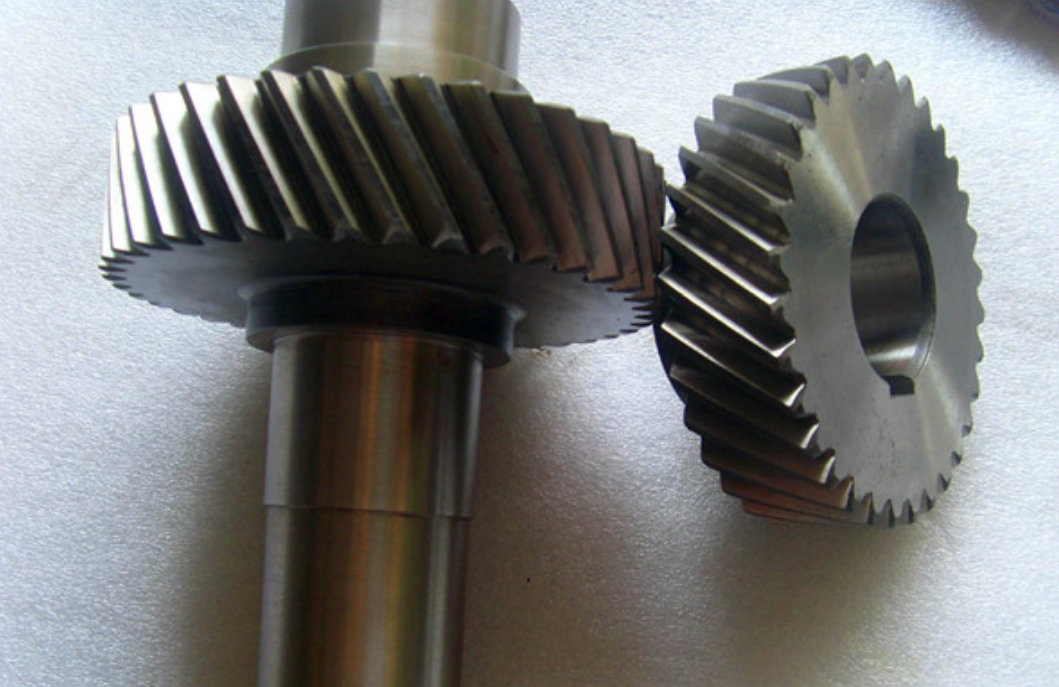
The heart of the challenge, and the focus of mold design ingenuity, is the demolding mechanism. Every single tooth on a helical gear or worm gear acts as an undercut, blocking a straight-line pull from the cavity. The only way to release the part without damaging it is to replicate its inherent helical motion during ejection. The part must simultaneously rotate and translate along its axis, tracing a spiral path that matches its own helix. Achieving this controlled spiral motion in an injection mold requires a mechanism that converts the mold’s linear opening stroke and/or the machine’s linear ejector stroke into a combined linear and rotary motion.
For a larger modified helical gear with an internal spline, a classic solution involves the clever use of bearings on the ejector sleeve (or push tube). The gear cavity is in the moving half. The ejector sleeve, which contacts the gear’s inner diameter, is mounted on two thrust ball bearings placed between the ejector plate and the support plate. When the injection machine’s ejector rod pushes the ejector plate forward, it exerts a linear force (P) on the gear. Normally, the friction (F1) between the gear teeth and the cavity wall would create a large resisting torque, preventing rotation. However, the thrust bearings drastically reduce the friction (Rx) between the rotating ejector sleeve and the stationary plates. This breaks the static equilibrium. The linear force P, acting at a distance (the gear’s pitch radius) from the axis, generates a significant torque:
$$T = P \cdot r_p $$
This torque causes the low-friction ejector sleeve to rotate. The sleeve’s motion is thus a synthesis of the machine-imposed linear translation and this induced rotation, resulting in the precise helical demolding path needed for the helical gear. The internal spline core must be designed to pull out linearly before this helical ejection begins to avoid interference.
For a compound part featuring a small helical gear on one end and a worm gear on the other, a two-stage demolding strategy is employed. The mold splits at a step on the part. The small helical gear is housed in an intermediate plate cavity, while the worm gear is in the moving half. A core pin forming the small gear’s bore is mounted in the intermediate plate via a self-aligning ball bearing. When the mold opens between the fixed and intermediate plates, the angled teeth of the small helical gear exert a force on the cavity wall. Because the core pin can rotate freely (due to the bearing), this force causes the pin and the part to undergo a helical unscrewing motion relative to the intermediate plate cavity, freeing the small helical gear. A spring-loaded detent pin locks the core pin’s position after rotation to ensure repeatable alignment. Subsequently, the worm gear section is ejected from the moving half using the same thrust-bearing-equipped ejector sleeve method described earlier, completing the spiral demolding process for the entire part.
The complexity of machining the helical cavity cannot be overstated. Methods like hobbing or broaching are often prohibitively expensive for mold cavities due to custom tooling costs. Electrical Discharge Machining (EDM) is a prevalent choice. This requires a precision electrode, which is itself a helical gear. However, this electrode is not a copy of the part; it must account for both the material shrinkage and the EDM spark gap. Its dimensions are intermediate between the cavity and the final part. If the final part dimension is P, the cavity dimension is C, the electrode dimension is E, the shrinkage is S, and the spark gap per side is G, the relationships are:
$$C = P \cdot (1 + S) $$
$$E = C – 2G = P \cdot (1 + S) – 2G $$
Machining this non-standard electrode helical gear requires specialized techniques, often involving a custom-ground single-point form tool. Furthermore, during EDM, the electrode must perform a helical feed motion into the workpiece, synchronized with its own helix angle, to accurately burn the cavity. This demands high-precision CNC path planning and control.
To summarize the demolding strategies for different scenarios, the following table provides a comparison:
| Component Type | Demolding Challenge | Proposed Mold Solution | Key Mechanism |
|---|---|---|---|
| Large Helical Gear with Internal Feature | Helical ejection without interference from internal core. | Thrust-bearing-mounted ejector sleeve in moving half. Core pulled out linearly before ejection. | Ejector sleeve rotates freely due to bearings, converting linear ejector force into helical motion. |
| Compound Part (Small Helical Gear + Worm Gear) | Two different helical features needing sequential spiral demolding. | Two-stage process: 1. Bearing-mounted core pin in intermediate plate for gear unscrewing. 2. Bearing-mounted ejector sleeve for worm gear ejection. | Self-aligning bearing allows rotation during first mold opening. Thrust bearings enable rotation during final ejection. |
| Simple Helical Gear (No internal undercut) | Basic helical ejection. | Ejector sleeve or plate mounted on thrust bearings. | Linear ejection force induces rotation via gear tooth angle against cavity. |
The calculation for the demolding force for a helical gear can be analyzed by considering a tooth as an inclined plane. The force P from the ejector must overcome the friction forces on both flanks of the tooth. The force equilibrium in the direction of ejection gives:
$$P = R_x + F_2 $$
where Rx is the horizontal component of the reaction force from the cavity (influenced by friction F1) and F2 is the friction force between the plastic gear and the ejector sleeve. The goal of using bearings is to minimize the contribution needed to overcome Rx, allowing more of the force P to be converted into the rotational moment. The normal force Q on the tooth flank can be related to the ejection force and the helix angle (β). A simplified analysis shows that the torque available for rotation is proportional to P and the pitch radius, and inversely related to the coefficient of friction. Reducing friction is therefore paramount.
Finally, managing the cooling and warpage of such a part is crucial. The non-uniform wall thickness of a helical gear tooth can lead to differential cooling and residual stresses. Conformal cooling channels that follow the contour of the gear cavity can help achieve a more uniform temperature distribution, reducing warpage and ensuring dimensional stability. The gate location is also critical; a pin-point gate at the center of the gear face (for a single cavity) or a balanced hot-runner system for multi-cavity molds ensures symmetrical filling and minimizes orientation-induced shrinkage differences.
In conclusion, the successful design of an injection mold for a modified plastic helical gear or worm gear is a multifaceted engineering endeavor. It begins with the precise calculation of the modified gear geometry to ensure mechanical performance. This geometry must then be accurately adjusted for material shrinkage, considering the non-uniform nature of the tooth profile. The cornerstone of the mold design is the demolding mechanism, which must ingeniously generate a helical ejection path to avoid damaging the part. This is typically achieved through the strategic incorporation of bearings—thrust ball bearings for ejector components and self-aligning bearings for rotating cores—to transform linear motion into the required spiral motion. Furthermore, advanced manufacturing techniques like EDM with helical electrode feed are necessary to realize the complex cavity geometry. Each of these aspects—parameter calculation, shrinkage compensation, mechanism design, and precision manufacturing—must be meticulously integrated to produce a high-strength, dimensionally accurate plastic helical gear capable of performing reliably in demanding applications. The design philosophy always centers on respecting and replicating the helical geometry throughout the entire process, from the digital model to the final ejected part.