
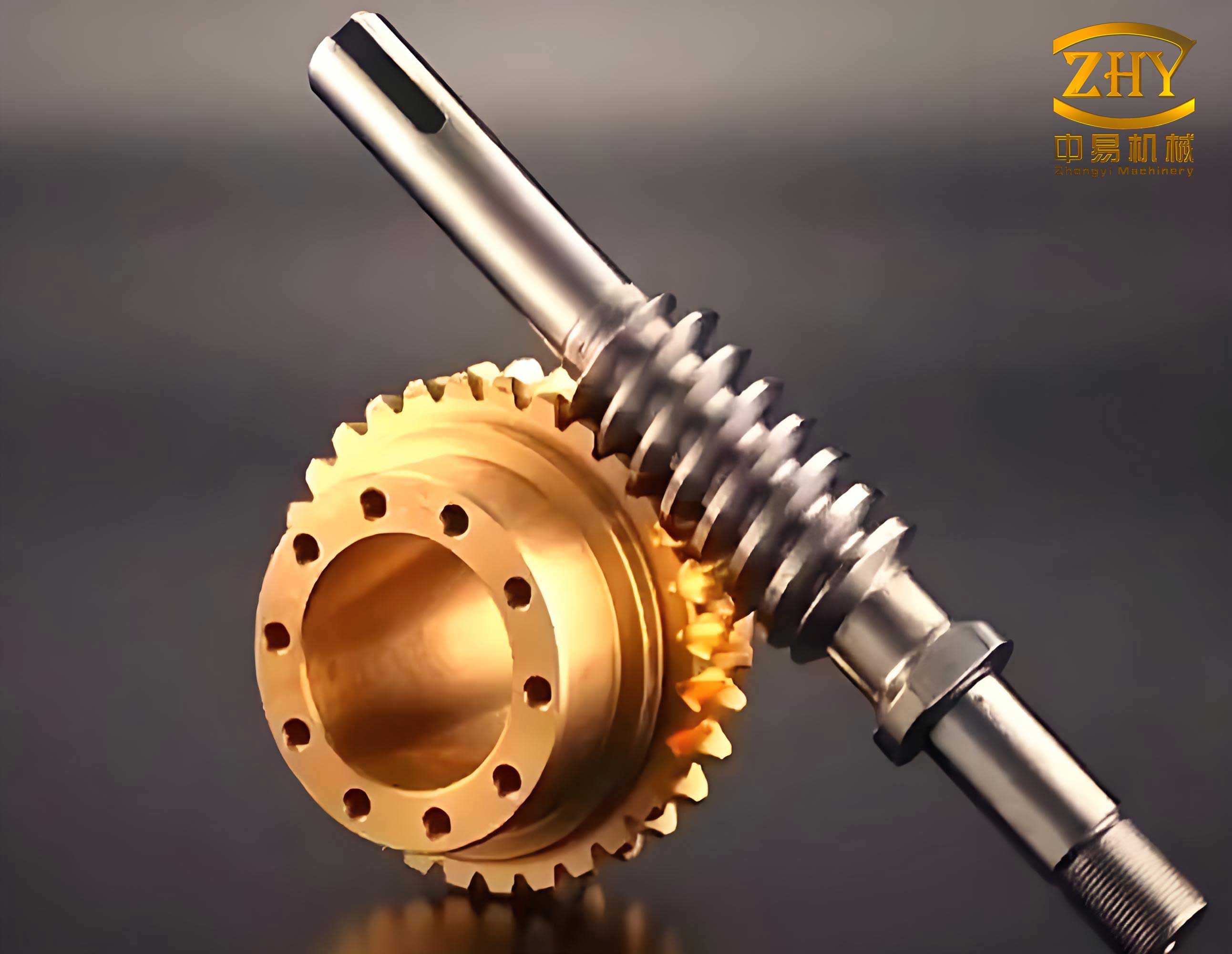
In the field of power transmission, screw gears, particularly worm drives, occupy a critical niche due to their unique ability to provide high reduction ratios in a single stage and their inherent self-locking capability. However, conventional screw gears, characterized by their sliding contact between the worm and worm wheel teeth, suffer from significant frictional losses and accelerated wear. My research focuses on an advanced variant aimed at mitigating these drawbacks: the roller enveloping hourglass worm drive. This drive replaces the traditional gear teeth on the worm wheel with cylindrical rollers. The worm thread surface is then generated as the envelope of this roller family during the relative meshing motion, transforming much of the sliding friction into rolling friction at the interface. This modification promises substantial gains in transmission efficiency and service life. While the theoretical meshing geometry under ideal conditions has been established, the performance in practical applications is invariably influenced by assembly misalignments. These errors, stemming from the real-world imperfections in manufacturing and assembly processes, can severely degrade contact patterns, leading to localized stress concentrations, increased noise, vibration, and in extreme cases, seizure. Therefore, mastering the influence law of assembly errors on the contact characteristics is paramount for the reliable design and application of these high-performance screw gears.
The core of this analysis lies in building a precise mathematical model for the meshing of these screw gears that incorporates potential assembly errors. I begin by establishing the coordinate systems for the ideal, error-free scenario. Let a fixed global coordinate system be defined. The roller worm wheel is associated with a moving coordinate system $ \sigma_1 (o_1 – x_1, y_1, z_1) $, rotating about its axis $ z_1 $ with an angular velocity $ \omega_1 $. The hourglass worm is associated with another moving system $ \sigma_2 (o_2 – x_2, y_2, z_2) $, rotating about its axis $ z_2 $ with an angular velocity $ \omega_2 $. The nominal center distance is $ a $, and the gear ratio is $ i_{12} = \omega_1 / \omega_2 = Z_2 / Z_1 $, where $ Z_1 $ and $ Z_2 $ are the number of worm threads and roller teeth, respectively. The coordinate transformation from $ \sigma_1 $ to $ \sigma_2 $ is governed by a series of rotation and translation matrices:
$$ \mathbf{r}_2 = \mathbf{M}_{n2} \mathbf{M}_{mn} \mathbf{M}_{1m} \mathbf{r}_1 $$
where $ \mathbf{r}_1 $ and $ \mathbf{r}_2 $ are position vectors in their respective frames, and the matrices account for the rotations $ \phi_1, \phi_2 $ and the nominal center offset.
The surface of a single cylindrical roller in its own coordinate system $ \sigma_1 $ can be simply described using parameters $ u $ (axial coordinate along the roller) and $ \theta $ (angular parameter around the roller):
$$ \mathbf{r}_1(u, \theta) = \begin{bmatrix} x_1 \\ y_1 \\ z_1 \end{bmatrix} = \begin{bmatrix} u \\ -r \sin\theta \\ r \cos\theta \end{bmatrix} $$
where $ r $ is the roller radius. The unit normal vector to this surface is:
$$ \mathbf{n}_1(\theta) = \begin{bmatrix} n_{x1} \\ n_{y1} \\ n_{z1} \end{bmatrix} = \begin{bmatrix} 0 \\ -\sin\theta \\ \cos\theta \end{bmatrix} $$
The fundamental condition for conjugate contact in screw gears is the meshing equation, which requires the relative velocity at a potential contact point to be orthogonal to the common surface normal. The relative velocity $ \mathbf{v}^{(12)} $ in $ \sigma_1 $ is derived from the kinematics of the two rotating bodies. The meshing function $ \Phi $ is then given by their scalar product:
$$ \Phi(u, \theta, \phi_1) = \mathbf{v}^{(12)} \cdot \mathbf{n}_1 = 0 $$
Substituting the expressions leads to the specific meshing function for this type of screw gear:
$$ \Phi(u, \theta, \phi_1) = a i_{12} \cos\theta – u \sin\theta – u i_{12} \cos\phi_1 \cos\theta = 0 $$
The instantaneous contact line on the roller surface is the set of points satisfying both the surface equation and the meshing equation: $ \mathbf{r}_1(u, \theta) $ subject to $ \Phi(u, \theta, \phi_1)=0 $. The corresponding generated hourglass worm thread surface is obtained by transforming these points into the worm’s coordinate system $ \sigma_2 $:
$$ \mathbf{r}_2(u, \theta, \phi_1) = \mathbf{M}_{n2} \mathbf{M}_{mn} \mathbf{M}_{1m} \mathbf{r}_1(u, \theta), \quad \text{with} \quad \Phi(u, \theta, \phi_1)=0 $$
Under ideal conditions, solving these equations reveals that the theoretical contact line for this roller-based screw gear is a spatial cylindrical helix, predominantly located near the central plane of the roller.
Mathematical Modeling with Incorporated Assembly Errors
The practical assembly of screw gears introduces deviations from the ideal theoretical setup. I model four primary, independent assembly errors, considering them as displacements of the worm relative to the worm wheel’s nominal position:
- Center Distance Error ($ \Delta a $): Deviation from the nominal distance $ a $.
- Worm Axial Error ($ \Delta L_2 $): Axial displacement of the worm along its own axis.
- Worm Wheel Axial Error ($ \Delta L_1 $): Axial displacement of the worm wheel along its axis (considered here as an equivalent error attributed to the worm’s position).
- Shaft Intersection Angle Error ($ \Delta \Sigma $): A slight deviation from the nominal perpendicular (90°) axis angle.
These errors are incorporated into the transformation matrix $ \mathbf{M}_{mn} $ linking the two fixed frames. The modified matrix becomes:
$$ \mathbf{M}_{mn} = \begin{bmatrix}
-1 & 0 & 0 & a + \Delta a \\
0 & \sin\Delta\Sigma & \cos\Delta\Sigma & -\Delta L_2 \\
0 & \cos\Delta\Sigma & -\sin\Delta\Sigma & \Delta L_1 \\
0 & 0 & 0 & 1
\end{bmatrix} $$
The roller surface remains unchanged in $ \sigma_1 $. However, the envelope worm surface equation must be recalculated using this error-inclusive transformation. The new worm surface $ \mathbf{r’}_2(u, \theta, \phi_1) $ is derived by applying the modified coordinate transformation to $ \mathbf{r}_1 $, still constrained by the same meshing condition $ \Phi(u, \theta, \phi_1)=0 $, as the kinematic relationship for generating the conjugate surface is assumed unchanged. The resulting equations are more complex, with terms containing $ \Delta a, \Delta L_1, \Delta L_2, $ and $ \Delta \Sigma $.
$$ x’_2 = y_1 (\sin\phi_2 \cos\phi_1 – \sin\phi_1 \cos\phi_2 \sin\Delta\Sigma) – x_1(\cos\phi_1 \cos\phi_2 + \sin\phi_1 \sin\phi_2 \sin \Delta\Sigma) + (a+\Delta a)\cos\phi_1 + \sin\phi_1 (\Delta L_1 \cos\Delta\Sigma – \Delta L_2 \sin\Delta\Sigma) – z_1 \cos\Delta\Sigma \sin\phi_1 $$
$$ y’_2 = y_1 (\sin\phi_1 \sin\phi_2 + \cos\phi_1 \cos\phi_2 \sin\Delta\Sigma) – x_1(\cos\phi_2 \sin\phi_1 – \cos\phi_1 \sin\phi_2 \sin\Delta\Sigma) + (a+\Delta a)\sin\phi_1 – \cos\phi_1 (\Delta L_1 \cos\Delta\Sigma – \Delta L_2 \sin\Delta\Sigma) + z_1 \cos\Delta\Sigma \cos\phi_1 $$
$$ z’_2 = \Delta L_2 \cos\Delta\Sigma + \Delta L_1 \sin\Delta\Sigma – z_1 \sin\Delta\Sigma + y_1 \cos\phi_2 \cos\Delta\Sigma + x_1 \cos\Delta\Sigma \sin\phi_2 $$
Quantitative Assessment of Contact Interference
The presence of assembly errors disrupts the ideal line contact, causing interference between the worm thread and the roller. To move beyond qualitative description and provide a tool for tolerance design, I establish a quantitative metric: the interference cross-sectional area on the roller. When interference occurs, the worm thread penetrates the theoretical cylindrical boundary of the roller. The intersection of this interference volume with a plane perpendicular to the roller’s axis (or the analysis of the extreme penetration points) defines a cross-section, which can be approximated as a polygon. Two common shapes are a triangle and a quadrilateral. The total interference area $ S_i $ for a given roller is calculated as follows:
For a triangular section with vertices $ \mathbf{T}_1, \mathbf{T}_2, \mathbf{T}_3 $:
$$ S_i = S_{\Delta 123} = \sqrt{P(P – a_T)(P – b_T)(P – c_T)} $$
where $ a_T = |\mathbf{T}_1 – \mathbf{T}_2| $, $ b_T = |\mathbf{T}_1 – \mathbf{T}_3| $, $ c_T = |\mathbf{T}_2 – \mathbf{T}_3| $, and $ P = (a_T + b_T + c_T)/2 $.
For a quadrilateral section with vertices $ \mathbf{Q}_1, \mathbf{Q}_2, \mathbf{Q}_3, \mathbf{Q}_4 $, it is treated as two triangles:
$$ S_i = S_{\Delta 123} + S_{\Delta 134} $$
with the areas of each triangle computed similarly using the respective side lengths.
The critical step is determining the coordinates of these vertices. A vertex is a point on the roller’s cylindrical surface that is precisely tangent to (or just contacted by) the erroneous worm surface. For a point $ \mathbf{j} $ on the roller’s axis and a corresponding point $ \mathbf{k} $ on the worm surface at the same axial height, the condition for contact (vertex condition) is that their Euclidean distance equals the roller radius $ r $:
$$ \sqrt{ (x_j – x_k)^2 + (y_j – y_k)^2 + (z_j – z_k)^2 } = r $$
This equation, combined with the roller surface equation and the erroneous worm surface equation, forms a system that can be solved numerically for the vertex coordinates across the engagement zone. I implement a numerical search algorithm in a computational environment to trace the contact boundaries and calculate the interference area for various error magnitudes.
Case Study and Influence Law Analysis
To validate the model and extract practical insights, I conduct a detailed case study on a specific roller enveloping hourglass worm drive with the parameters listed below. The analysis systematically varies one error component at a time while holding others at zero.
| Parameter | Symbol | Value |
|---|---|---|
| Center Distance | $ a $ | 80 mm |
| Transmission Ratio | $ i_{12} $ | 20 |
| Roller Radius | $ r $ | 7 mm |
| Roller Axial Parameter Range | $ u $ | [56, 68] mm |
| Worm Wheel Rotation Range | $ \phi_1 $ | [-40°, 40°] |
The results for each error type are quantified and summarized below:
1. Center Distance Error ($ \Delta a $)
The interference area shows a symmetric, non-linear increase with the absolute value of $ \Delta a $. Positive and negative errors of the same magnitude cause interference on opposite flanks of the rollers but result in similar area magnitudes. The outer rollers (edge teeth) experience greater interference than the central roller. The rate of increase in area gradually diminishes as the error grows larger.
| Error $\Delta a$ (mm) | Interference Trend | Relative Sensitivity |
|---|---|---|
| -0.10 to -0.01 | Area increases | Negative error affects left flank. | High for edge teeth, low for center. |
| 0 (Nominal) | Theoretical line contact (zero area). | – |
| +0.01 to +0.10 | Area increases | Positive error affects right flank. | High for edge teeth, low for center. |
The relationship can be approximated by a quadratic function for each flank: $ S_i \approx k \cdot (\Delta a)^2 $ for smaller errors, indicating a sensitive non-linear response.
2. Worm Axial Error ($ \Delta L_2 $)
This error has the most pronounced effect on the contact interference among the four types studied. The interference area increases monotonically with $ \Delta L_2 $. All rollers in mesh are affected almost uniformly. The sensitivity is highest initially, and the growth rate tapers off as the error increases, suggesting a non-linear relationship.
$$ \frac{\partial S_i}{\partial (\Delta L_2)} \text{ is maximum near } \Delta L_2 = 0 \text{ and decreases for larger } \Delta L_2 $$
3. Worm Wheel Axial Error ($ \Delta L_1 $)
In contrast, the axial displacement of the worm wheel (modeled as an equivalent worm error) has the smallest impact on the interference area for the same magnitude of displacement. The effect is also uniform across different rollers and exhibits a diminishing growth rate.
| Error Type | Symbol | Relative Impact on $S_i$ | Approx. Functional Dependence |
|---|---|---|---|
| Worm Axial | $ \Delta L_2 $ | Greatest | $ S_i \propto (\Delta L_2)^{n}, n<1 $ |
| Wheel Axial | $ \Delta L_1 $ | Least | $ S_i \propto (\Delta L_1)^{m}, m<1 $ |
Where the exponents $ n $ and $ m $ are less than 1, confirming the sub-linear growth, with $ n > m $ indicating the worm axial error’s greater influence.
4. Shaft Intersection Angle Error ($ \Delta \Sigma $)
This angular error also produces a symmetric effect about zero. However, its impact is highly non-linear and can be severe even for small angular deviations (e.g., within ±0.5°). The interference area increases rapidly with the absolute angle, and the edge teeth are significantly more sensitive than the central tooth.
$$ S_i(\Delta \Sigma) \approx \alpha \cdot |\Delta \Sigma|^\beta $$
where $ \beta > 1 $, indicating a super-linear or exponential-like sensitivity, especially for the edge rollers in these screw gears.
Discussion and Implications for Screw Gear Design
The developed model successfully transitions the analysis of assembly errors in roller enveloping hourglass screw gears from a qualitative observation of contact line shifts to a quantitative prediction of interference volume. The key findings have direct implications for the manufacturing, assembly, and tolerance specification of these drives.
First, the confirmation that the ideal contact is a spatial helix near the mid-plane provides a benchmark for evaluating contact patterns in experimental testing or loaded tooth contact analysis (LTCA).
Second, the quantified sensitivity ranking is crucial:
- Worm Axial Error ($ \Delta L_2 $) is the most critical. Precision in locating the worm along its axis during assembly is paramount. Strict tolerances or adjustable axial preload mechanisms should be employed.
- Center Distance Error ($ \Delta a $) is also highly influential. While its effect is symmetric, the non-linear growth means that small initial errors are particularly detrimental to achieving good contact. Accurate housing boring and bearing positioning are essential.
- Shaft Angle Error ($ \Delta \Sigma $) exhibits extreme sensitivity. Maintaining precise perpendicularity between the worm and worm wheel shafts is non-negotiable. An error limit within ±0.25° or less is strongly recommended based on the case study results to prevent severe edge loading.
- Worm Wheel Axial Error ($ \Delta L_1 $) has a relatively mild effect. This allows for slightly looser axial tolerances on the worm wheel assembly, potentially simplifying design and reducing cost.
The non-linear relationship between error magnitude and interference area $ S_i $ for all error types highlights a fundamental principle: the first few microns or micro-radians of misalignment cause the most significant degradation from the ideal contact. This underscores the importance of precision in the initial assembly stages of high-performance screw gears.
The methodology presented here—integrating error transforms into the meshing model and quantifying interference via a calculable cross-sectional area—provides a powerful analytical framework. It can be extended to study the combined effects of multiple simultaneous errors, which is the常态 in real-world assemblies. Furthermore, this model can serve as the foundation for performing sensitivity analysis, optimizing tolerance stacks, and informing the design of compensation mechanisms for ultra-precision roller enveloping worm drives and other advanced screw gear systems.