
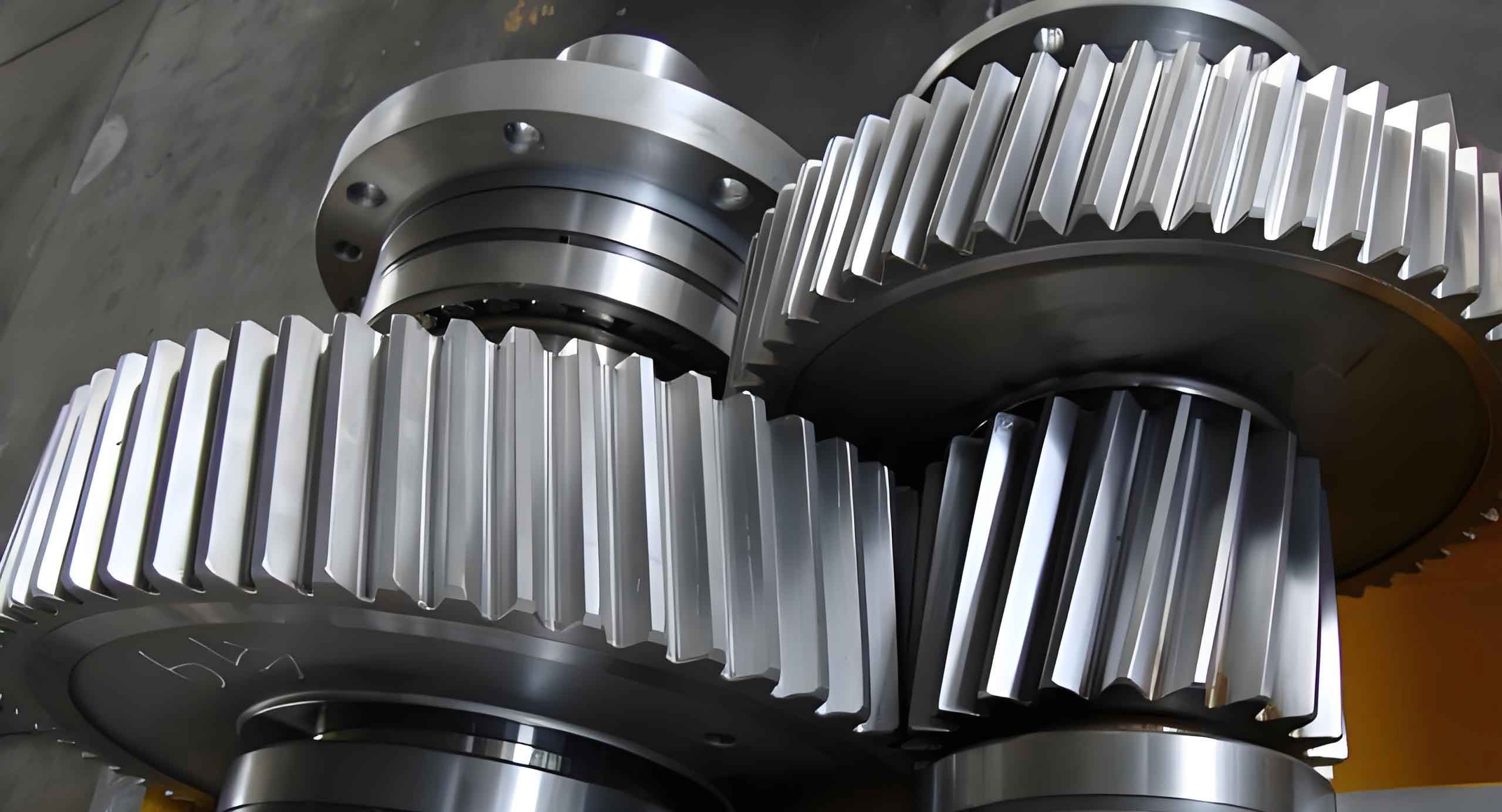
In the field of fluid power systems, external gear pumps are fundamental components widely utilized in vehicles, construction machinery, and various industrial applications due to their simplicity and reliability. Traditional spur gear pumps, however, suffer from inherent structural issues such as fluid trapping and pressure pulsation, which can lead to noise, vibration, and reduced efficiency. To overcome these limitations, helical gear pumps have gained significant attention in recent years. The helical gear design fundamentally mitigates trapping phenomena and improves pulsation characteristics, offering smoother operation and enhanced performance. Consequently, the demand for precise three-dimensional modeling of helical gear pairs specifically for pump applications has increased. These pump-specific helical gears often feature low tooth counts and allow for slight undercutting, necessitating precise modification requirements and accurate transition curve designs, rather than relying on simplified approximations like 0.38m fillets (where m is the module).
Current methodologies for modeling helical gears, as documented in various literature sources, typically involve generating an involute tooth profile curve using mathematical expressions, mirroring it to form a complete tooth or slot profile on the end face, and then sweeping this profile along a helical path to create a single tooth or slot. Subsequently, a circular pattern is applied to generate the entire helical gear model. However, these approaches frequently exhibit shortcomings: they often neglect modification requirements, commonly substitute transition curves with rough 0.38m fillets, lack true parametric capabilities, and involve overly complex processes due to software version dependencies. Therefore, in this article, I present a comprehensive, parameterized method for rapidly creating accurate models of helical gear pairs within the UGNX6.0 environment, addressing these deficiencies by employing entirely equation-driven curves and fully parametric assembly techniques.
The core of accurate helical gear modeling lies in the parametric definition of the tooth profile contour. For a helical gear, the basic parameters are defined in the normal plane. Let the normal module be denoted as $m_n$, the number of teeth as $Z$, the normal modification coefficient as $k_n$, and the helix angle at the reference cylinder as $\beta$. Other parameters, such as the normal pressure angle $\alpha_n$, normal addendum coefficient, and normal dedendum clearance coefficient, are typically assigned standard values. From these, the transverse plane parameters—transverse module $m_t$, transverse pressure angle $\alpha_t$, and transverse modification coefficient $k_t$—can be calculated using the following relations:
$$ m_t = \frac{m_n}{\cos \beta} $$
$$ \tan \alpha_t = \frac{\tan \alpha_n}{\cos \beta} $$
$$ k_t = k_n \cos \beta $$
A complete helical gear tooth profile consists of closed contour shapes on the front and rear end faces, connected by helical lines. The contour on the front end face includes several distinct segments: the tip arc, two symmetric involute curves, two symmetric transition curves, and the root arc. It is crucial to define these segments with precise mathematical equations to ensure accuracy and full parameterization. The coordinate system is established with the gear center as the origin, but the Y-axis is not aligned with the tooth symmetry line to facilitate the description of the transition curves.
The angles $\phi_1$, $\phi_2$, and $\phi_3$ are critical functions of $m_n$, $Z$, and $k_n$, defining the boundaries between different segments of the tooth profile. Specifically, $\phi_1 = \angle f_1 O b_1$, $\phi_2 = \angle f_1 O a_1$, and $\phi_3 = \angle f_1 O O’$, where points $f_1$, $b_1$, $a_1$, and $O’$ are defined in the profile diagram. The exact functional relationships for these angles are derived from gear geometry principles and can be referenced in detailed gear design literature.
The Cartesian coordinate equations for the transition curve segment $b_1f_1$ and the involute segment $a_1b_1$ in the front end plane ($k_b=0$) are given in matrix form. For the transition curve, the radial distance $r_{f_1b_1}(\phi_1 t)$ is a function of the parameter $t$ (which varies from 0 to 1) and the angle $\phi_1 t$. The coordinates are:
$$
\begin{bmatrix}
x_{f_1b_1} \\
y_{f_1b_1} \\
z_{f_1b_1}
\end{bmatrix}
=
\begin{bmatrix}
r_{f_1b_1}(\phi_1 t) \cdot \sin(\phi_1 t) \\
r_{f_1b_1}(\phi_1 t) \cdot \cos(\phi_1 t) \\
0
\end{bmatrix}
$$
For the involute segment, the radial distance $r_{j_1}((\phi_2 – \phi_1) t)$ is used, and the coordinates are:
$$
\begin{bmatrix}
x_{b_1a_1} \\
y_{b_1a_1} \\
z_{b_1a_1}
\end{bmatrix}
=
\begin{bmatrix}
r_{j_1}((\phi_2 – \phi_1) t) \cdot \sin(\phi_1 + (\phi_2 – \phi_1) t) \\
r_{j_1}((\phi_2 – \phi_1) t) \cdot \cos(\phi_1 + (\phi_2 – \phi_1) t) \\
0
\end{bmatrix}
$$
The symmetric segments on the other side of the tooth, namely transition curve $b_2f_2$ and involute $a_2b_2$, are obtained by mirroring the above curves about the line $OO’$. The mirror transformation matrix $M$ is defined as:
$$
M =
\begin{bmatrix}
-\cos 2\phi_3 & \sin 2\phi_3 & 0 \\
\sin 2\phi_3 & \cos 2\phi_3 & 0 \\
0 & 0 & 1
\end{bmatrix}
$$
Thus, the coordinates for the mirrored segments are:
$$
\begin{bmatrix}
x_{f_2b_2} \\
y_{f_2b_2} \\
z_{f_2b_2}
\end{bmatrix}
= M
\begin{bmatrix}
x_{f_1b_1} \\
y_{f_1b_1} \\
z_{f_1b_1}
\end{bmatrix},
\quad
\begin{bmatrix}
x_{b_2a_2} \\
y_{b_2a_2} \\
z_{b_2a_2}
\end{bmatrix}
= M
\begin{bmatrix}
x_{b_1a_1} \\
y_{b_1a_1} \\
z_{b_1a_1}
\end{bmatrix}
$$
The tip arc segment $a_1a_2$ and the root arc segment $f_1f_2$ are circular arcs. Their equations are:
$$
\begin{bmatrix}
x_{a_1a_2} \\
y_{a_1a_2} \\
z_{a_1a_2}
\end{bmatrix}
=
\begin{bmatrix}
r_{a} \cdot \sin(\phi_2 + (\phi_3 – \phi_2) t) \\
r_{a} \cdot \cos(\phi_2 + (\phi_3 – \phi_2) t) \\
0
\end{bmatrix}
$$
$$
\begin{bmatrix}
x_{f_1f_2} \\
y_{f_1f_2} \\
z_{f_1f_2}
\end{bmatrix}
=
\begin{bmatrix}
r_{f} \cdot \sin(2\phi_3 t) \\
r_{f} \cdot \cos(2\phi_3 t) \\
0
\end{bmatrix}
$$
where $r_a$ is the tip radius and $r_f$ is the root radius, both functions of $m_n$, $Z$, and $k_n$.
To extend the two-dimensional profile into a three-dimensional helical gear, the helical lines connecting corresponding points on the front and rear end faces must be defined. The helix angle $\beta$ at the reference cylinder governs this. For any axial position $b = B t$ (where $B$ is the face width), the profile at that cross-section is rotated by an angle $\beta’ = (B t \tan \beta) / r$, where $r$ is the reference circle radius. This ensures the consistency of the tooth shape along the axis. The helical line connecting point $f_1$ on the front face to $f_1’$ on the rear face is given by:
$$
\begin{bmatrix}
x_{f_1f_1′} \\
y_{f_1f_1′} \\
z_{f_1f_1′}
\end{bmatrix}
=
\begin{bmatrix}
r_{f} \cdot \sin\left(\frac{B t \tan \beta}{r}\right) \\
r_{f} \cdot \cos\left(\frac{B t \tan \beta}{r}\right) \\
B t
\end{bmatrix}
$$
Similarly, helical lines for other corresponding points can be derived. The rear end face profile is obtained by rotating the front end face profile by the total rotation angle $\beta’_T = (B \tan \beta) / r$ and translating it by distance $B$ along the axis. The combined rotation-translation matrix is:
$$
R =
\begin{bmatrix}
\cos\left(\frac{B \tan \beta}{r}\right) & \sin\left(\frac{B \tan \beta}{r}\right) & 0 \\
-\sin\left(\frac{B \tan \beta}{r}\right) & \cos\left(\frac{B \tan \beta}{r}\right) & 0 \\
0 & 0 & B
\end{bmatrix}
$$
All these equations are input into the UG software’s expression editor. Using the “Law Curve” tool with the “By Equation” option, every segment of the closed tooth profile contour and the connecting helical lines can be generated precisely. This approach ensures that the entire geometry is driven by parameters without any manual trimming, guaranteeing full parametric associativity.
With all necessary curves created, the next step is to generate the solid model of a single helical gear tooth. In UG, the “Sweep” feature is employed. This feature allows creating a solid body by sweeping one or more section curves along guide curves. For modeling the helical gear tooth, I define two sections: the closed profile curve on the front end face and the corresponding closed profile on the rear end face. Then, I specify three guide curves: typically, two helical lines from the transition curve endpoints and one from the involute tip point to ensure proper twisting control. The software sweeps the sections along these guides, resulting in a single, accurate tooth body. This tooth body is then united with a cylindrical body representing the gear’s root diameter to form a preliminary gear segment. The process is illustrated in the figure below, which shows the guide curves, sections, and resulting tooth solid.
To complete the full helical gear model, the single tooth body must be replicated around the gear axis. In UGNX6.0, the standard circular pattern feature may not work reliably with swept bodies for associative copying. Therefore, I use the “Instance Geometry” tool under the “Associative Copy” menu. Selecting the “Rotate” type, I define the tooth body as the geometry to instance, specify the gear axis as the rotation axis, set the number of instances to the tooth count $Z$, and define the angular spacing as $360^\circ / Z$. This creates a parameterized array of all teeth, which are then united with the root cylinder to produce a complete, solid helical gear component. Any change in the basic parameters like $Z$ or $\beta$ will automatically update the entire gear model.
For creating a helical gear pair assembly, I first prepare two separate part files: one for the driving helical gear and one for the driven helical gear. In each file, I create a reference plane that corresponds to a symmetry plane. For the driving helical gear, I create a plane that contains the gear axis and is symmetrically aligned with a tooth center (denoted as plane $Y_1O_1Z_1$). For the driven helical gear, I create a plane symmetrically aligned with a tooth space center (plane $Y_2O_2Z_2$). The Z-axes ($Z_1$, $Z_2$) are directed inward along the gear axes.
Next, I create a new assembly file. In this file, I define key parameters for the helical gear pair in the expression editor:
| Parameter Symbol | Description |
|---|---|
| $m_n$ | Normal module |
| $Z$ | Number of teeth (same for both gears in this case) |
| $k_{n1}$ | Normal modification coefficient for driving helical gear |
| $k_{n2}$ | Normal modification coefficient for driven helical gear |
| $\alpha_n$ | Normal pressure angle |
| $\beta$ | Helix angle at reference cylinder |
| $B$ | Face width |
| $\theta_1$ | Rotation angle of driving helical gear |
| $\theta_2$ | Rotation angle of driven helical gear (defined as $\theta_2 = -\theta_1$) |
| $A$ | Center distance, calculated as $A = \frac{m_n (Z_1 + Z_2)}{2 \cos \beta}$ for standard gears, adjusted for modification. |
These assembly-level expressions are linked to the corresponding parameters in the individual helical gear part files via UG’s inter-part expressions capability. It is essential to ensure that the two helical gears have opposite hand of helix: one left-handed and one right-handed. This is controlled by assigning positive $\beta$ to one helical gear and negative $\beta$ to the other in their respective part files.
In the assembly modeling space, I establish three base axes (X, Y, Z) and three base planes (YOZ, XOZ, XOY) at the assembly origin. The Z-axis points inward. Then, I insert the driving helical gear component. I apply the following constraints:
- The front face of the driving helical gear is aligned coincident with the base plane XOY.
- The axis $Z_1$ of the driving helical gear is constrained to be coincident with the assembly’s Z-axis.
- The reference plane $Y_1O_1Z_1$ of the driving helical gear is set at an angle $\theta_1$ relative to the base plane YOZ.
Next, I insert the driven helical gear component and apply constraints:
- The front face of the driven helical gear is aligned coincident with the base plane XOY.
- The axis $Z_2$ of the driven helical gear is constrained: its distance to the base plane YOZ is 0, and its distance to the base plane XOZ is the center distance $A$.
- The reference plane $Y_2O_2Z_2$ of the driven helical gear is set at an angle $\theta_2$ relative to the base plane YOZ.
This fully constrains the helical gear pair in a meshing position. By modifying the rotation angle $\theta_1$, the assembly can simulate the motion of the helical gears, useful for interference checking and kinematic analysis. Moreover, any change in the basic geometric parameters ($m_n$, $Z$, $\beta$, etc.) will propagate through the inter-part expressions, automatically updating both helical gear parts and their assembly positions. This ensures a completely parameterized and associative helical gear pair model.
The advantages of this modeling methodology are significant for the design and analysis of helical gear pumps. Firstly, the entire tooth profile is defined by precise mathematical equations, eliminating approximations for transition curves. This accuracy is critical for performing finite element analysis (FEA) to assess stress concentrations, contact patterns, and durability of the helical gears. Secondly, the fully parametric nature of the model allows for rapid design iterations. Engineers can explore different combinations of normal module, tooth count, modification coefficients, and helix angle to optimize pump performance metrics like flow ripple, efficiency, and noise. Thirdly, the use of UG’s associative modeling capabilities ensures that any modification at any level (part or assembly) updates the entire model consistently, reducing errors and saving time.
In practical application for helical gear pump design, this modeling approach facilitates several advanced engineering activities. Computational Fluid Dynamics (CFD) simulations of the pump’s internal flow require an exact geometric model of the pumping chambers formed by the meshing helical gears and the housing. The accurate transition curves and precise helical tooth surfaces generated by this method provide the necessary geometry for realistic CFD models, leading to better predictions of trapping phenomena, cavitation, and flow characteristics. Furthermore, the parameterized assembly model can be integrated into larger system models, enabling multidisciplinary simulations that couple structural dynamics with fluid dynamics.
To further illustrate the parametric relationships, the following table summarizes the key equations used in defining the helical gear geometry in the transverse plane, which is essential for understanding the conversion from normal plane parameters.
| Transverse Parameter | Calculation Formula |
|---|---|
| Transverse Module, $m_t$ | $m_t = \dfrac{m_n}{\cos \beta}$ |
| Transverse Pressure Angle, $\alpha_t$ | $\tan \alpha_t = \dfrac{\tan \alpha_n}{\cos \beta}$ |
| Reference Diameter, $d$ | $d = m_t \cdot Z = \dfrac{m_n \cdot Z}{\cos \beta}$ |
| Base Diameter, $d_b$ | $d_b = d \cdot \cos \alpha_t$ |
| Tip Diameter, $d_a$ | $d_a = d + 2 \cdot (h_{a}^* + k_n) \cdot m_n$ where $h_{a}^*$ is addendum coeff. |
| Root Diameter, $d_f$ | $d_f = d – 2 \cdot (h_{f}^* – k_n + c^*) \cdot m_n$ where $h_{f}^*$, $c^*$ are coeff. |
The mathematical description of the transition curve deserves special attention for helical gears in pump applications. Unlike standard gears, pump gears may use modified tooth shapes to optimize fluid displacement. The radial distance function $r_{f_1b_1}(\phi)$ for the transition curve is derived from the gear generation process (e.g., using a rack cutter or shaper). A common form based on a rack cutter with tip radius $\rho_a$ is:
$$ r_{f_1b_1}(\phi) = \sqrt{ \left( \frac{d}{2} \sin \phi – \rho_a \right)^2 + \left( \frac{d_b}{2} \right)^2 } $$
where $\phi$ varies from the start to the end of the transition region. This exact form, rather than a simple fillet, is implemented via the law curve equations.
The helix generation is governed by the fundamental relationship between axial travel and rotation. For a helical gear with face width $B$ and reference radius $r$, the total rotational angle from one end to the other is $\beta’_T = \frac{B \tan \beta}{r}$. This can be expressed in terms of the lead $L$ of the helix, where $L = \frac{2 \pi r}{\tan \beta}$. Therefore, $\beta’_T = \frac{2 \pi B}{L}$. This helical path ensures that the tooth maintains a constant lead angle across its face, which is vital for smooth meshing in a helical gear pump.
In conclusion, the method presented herein offers a robust framework for the accurate and efficient parametric modeling of helical gears specifically tailored for gear pump applications within the UG NX software environment. The cornerstone of this approach is the use of fully equation-driven law curves for every segment of the tooth profile, including the exact transition curves, and the helical paths. This eliminates geometric approximations and ensures high model fidelity. The subsequent use of associative sweep and instance geometry features creates a parameterized helical gear component that updates automatically with changes to its defining parameters. Finally, the assembly modeling technique with inter-part expressions and constraints yields a fully parameterized helical gear pair that can simulate meshing motion and adapt to design changes seamlessly. This integrated workflow significantly enhances the modeling efficiency, accuracy, and reliability for helical gear pump design, providing a solid foundation for subsequent analysis tasks such as structural simulation, fluid dynamics analysis, and manufacturability studies. The ability to quickly iterate helical gear designs based on performance requirements is a substantial benefit for engineers developing advanced fluid power systems.