
In modern internal combustion engines, the oil pump plays a critical role in ensuring proper lubrication and cooling of moving parts. The performance and longevity of the engine are heavily dependent on the efficiency and durability of the oil pump gear system. Over time, wear in gear pairs, such as helical gears, leads to increased clearances, reduced oil pressure, and ultimately, engine failure. Therefore, enhancing the wear resistance of these gears is paramount. Traditional materials like alloy steels, while strong, often fall short in addressing wear issues and can be costly. Powder metallurgy, particularly warm compaction technology, offers a promising alternative by enabling the production of high-performance helical gears with excellent wear characteristics and reduced manufacturing costs.
This article delves into the development and evaluation of high-performance powder metallurgy helical gears, focusing on their wear behavior under simulated engine conditions. I will explore the material composition, manufacturing processes, and extensive bench testing that demonstrate the superiority of these gears. Throughout this discussion, the term “helical gear” will be emphasized repeatedly, as it is central to the application in oil pumps. The helical gear design, with its angled teeth, provides smoother engagement and higher load capacity compared to spur gears, making it ideal for high-stress environments like engine oil pumps.
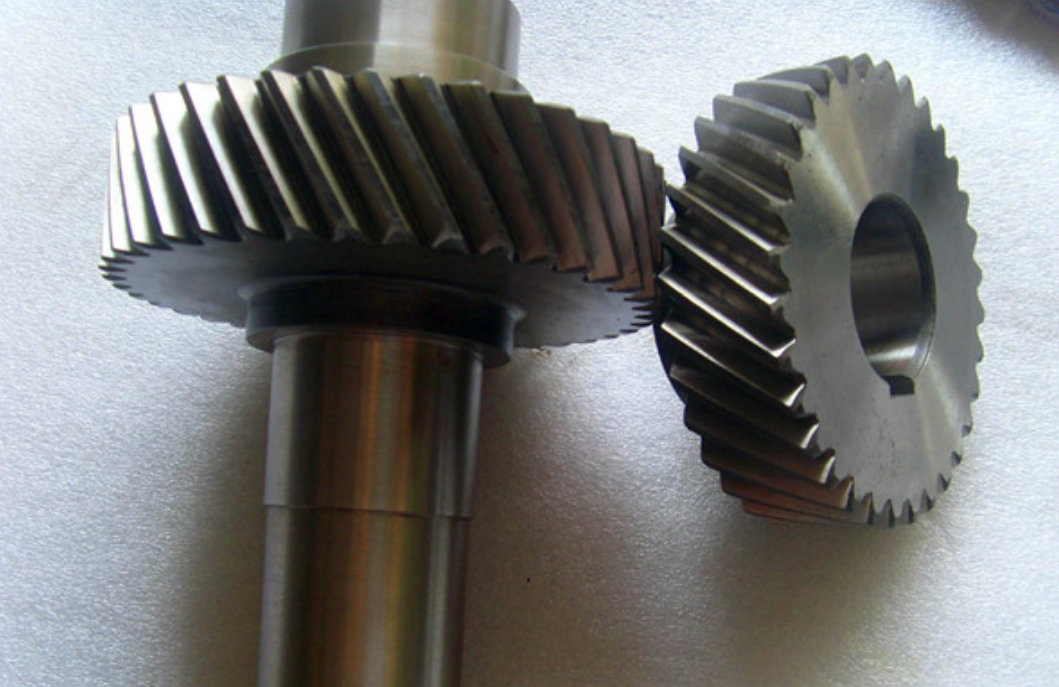
Powder metallurgy warm compaction is a advanced manufacturing technique that involves pressing metal powders at elevated temperatures, typically between 100°C and 150°C, to achieve higher densities and improved mechanical properties. This process is especially suited for complex shapes like helical gears, as it reduces the need for extensive machining, thereby lowering costs by 10% to 30%. For helical gears, the warm compaction process must accommodate the helical angle, requiring specialized tooling such as rotating dies to ensure proper powder flow and compaction. The helical gear geometry, characterized by its spiral teeth, introduces challenges in uniform density distribution, but warm compaction mitigates these issues through optimized lubrication and pressure control.
The material developed for these helical gears is a Fe-Ni-Cu-Mo-C alloy, with its chemical composition detailed in Table 1. This composition is designed to balance strength, toughness, and wear resistance after sintering and heat treatment.
| Element | Content (%) |
|---|---|
| Nickel (Ni) | 1.5 – 2.5 |
| Copper (Cu) | 1.5 – 2.5 |
| Molybdenum (Mo) | 0.8 – 1.2 |
| Carbon (C) | 0.6 – 1.0 |
| Iron (Fe) | Balance |
| Other | ≤ 0.6 |
The warm compaction process parameters include a temperature range of 100–150°C, a pressure of 700 MPa, and the use of die wall lubrication combined with internal lubricants in the powder mix. Sintering is conducted in two stages: a low-temperature phase at 800°C and a high-temperature phase at 1300°C, with a total sintering time of 80 minutes. Post-sintering heat treatment involves quenching from 870°C in water and tempering at 200°C for one hour. This results in a material with tensile strength exceeding 1200 MPa, impact toughness of at least 20 J/cm², and a surface hardness of HV 630 or higher. The mechanical properties are summarized in Table 2, showcasing the significant improvement achieved through warm compaction.
| Process | Tensile Strength (MPa) | Elongation (%) | Impact Toughness (J/cm³) | Hardness (HRC) |
|---|---|---|---|---|
| Conventional Warm Compaction | 1170 | 1.5 | 21 | 54 |
| Die Wall Lubrication Warm Compaction | 1220 | 1.5 | 23 | 56 |
The helical gear designed for this study has specific parameters that influence its performance in oil pump applications. The key geometric parameters include the normal module, number of teeth, pressure angle, helix angle, and face width. These parameters can be expressed using gear theory formulas. For instance, the normal module \(m_n\) is related to the transverse module \(m_t\) by the helix angle \(\beta\): $$m_n = m_t \cos \beta$$ where \(m_t\) is the transverse module. In this case, the helical gear has a normal module \(m_n = 5.5\), number of teeth \(z = 10\), normal pressure angle \(\alpha_n = 25^\circ\), helix angle \(\beta = 8.1^\circ\), and face width \(B = 37 \text{ mm}\). The helix angle is crucial for smooth operation and load distribution in helical gears, reducing noise and vibration compared to straight-cut gears.
Wear in helical gears is a complex phenomenon influenced by factors such as surface roughness, lubrication, load, and material properties. The wear rate can be modeled using Archard’s wear equation: $$W = K \frac{F_n L}{H}$$ where \(W\) is the wear volume, \(K\) is the wear coefficient, \(F_n\) is the normal load, \(L\) is the sliding distance, and \(H\) is the material hardness. For helical gears, the sliding distance varies along the tooth profile due to the helix angle, making wear analysis more intricate. In oil pumps, the primary wear modes include adhesive wear, abrasive wear, and surface fatigue. The powder metallurgy material, with its porous structure, can trap wear debris, reducing third-body abrasion and enhancing wear resistance.
To evaluate the wear characteristics of the powder metallurgy helical gear, an extensive bench test was conducted on an oil pump test rig. The test simulated real engine conditions over 350 hours, with periodic inspections at 100, 200, and 350 hours. The test rig circulates oil at controlled temperatures and pressures, mimicking the engine oil pump’s operation. The working fluid was 40CD+ oil maintained at \(90 \pm 5^\circ \text{C}\). Flow rates were measured using a precision turbine flow meter. The test protocol, outlined in Table 3, includes cycles at different speeds and pressures to represent various engine operating conditions.
| Oil Pump Speed (rpm) | Outlet Back Pressure (kPa) | Flow Rate (L/min) | Oil Temperature (°C) | Duration (h) |
|---|---|---|---|---|
| 3332 ± 10 | 700 ± 40 | 18000 ± 200 | 90 ± 5 | 1 |
| 2900 ± 10 | 640 ± 30 | 17200 ± 200 | 90 ± 5 | 7 |
| 2300 ± 10 | 520 ± 30 | 15400 ± 200 | 90 ± 5 | 2 |
Each cycle in the test represents a combination of high-speed and low-speed operations, totaling 35 cycles over 350 hours. The helical gears were inspected for wear on tooth faces, flanks, and end surfaces. Wear measurements were taken using a universal toolmaker’s microscope and a roughness profilometer. The results showed that the powder metallurgy helical gear exhibited minimal wear. For instance, the face width wear was only 0.003–0.005 mm, and the tooth thickness wear was less than 0.02 mm. In contrast, a reference helical gear made from 38CrMoAl alloy steel showed face width wear of 0.006–0.008 mm and tooth thickness wear of 0.03–0.05 mm. This demonstrates the superior wear resistance of the powder metallurgy helical gear.
The wear data is summarized in Table 4, highlighting the comparative performance. The reduced wear in the powder metallurgy helical gear leads to smaller clearances in the oil pump, minimizing oil leakage and maintaining flow efficiency. After 350 hours, the oil pump with powder metallurgy helical gears experienced only a 2.66% drop in flow rate, whereas the pump with alloy steel gears saw a drop exceeding 5%. This is critical for engine reliability, as consistent oil flow ensures proper lubrication under all conditions.
| Material | Face Width Wear (mm) | Tooth Thickness Wear at Pitch Circle (mm) | Tip Diameter Wear (mm) |
|---|---|---|---|
| 38CrMoAl Alloy Steel | 0.006 – 0.008 | 0.03 – 0.05 | 0.06 – 0.08 |
| Powder Metallurgy HGF1 | 0.003 – 0.005 | ≤ 0.02 | 0.02 – 0.04 |
Surface roughness analysis further supports the wear resistance of the powder metallurgy helical gear. Using a TR-200 roughness profilometer, measurements taken over a sampling length of 0.8 mm (with an evaluation length of 4 mm) showed that the surface roughness of the helical gear teeth changed minimally after testing. The porous nature of the powder metallurgy material allowed it to retain wear particles, reducing abrasive action. This can be expressed in terms of surface roughness parameters, such as the arithmetic mean roughness \(R_a\). For the helical gear, \(R_a\) remained low, indicating stable surface conditions. The relationship between wear and roughness can be approximated by: $$\Delta R_a = k \cdot t$$ where \(\Delta R_a\) is the change in roughness, \(k\) is a material-dependent constant, and \(t\) is the testing time. For the powder metallurgy helical gear, \(k\) was significantly lower than for alloy steel.
The success of the powder metallurgy helical gear in wear tests can be attributed to several factors. First, the warm compaction process achieves high density, which enhances mechanical properties. The density \(\rho\) can be calculated from the compaction pressure \(P\) and temperature \(T\) using empirical models: $$\rho = \rho_0 + A \cdot P + B \cdot T$$ where \(\rho_0\) is the initial powder density, and \(A\) and \(B\) are constants. For helical gears, achieving uniform density is challenging due to the complex shape, but warm compaction with rotating dies ensures consistency. Second, the material composition, with elements like nickel and molybdenum, forms hard phases during sintering that resist wear. The wear coefficient \(K\) in Archard’s equation is lower for this material due to its microstructure.
Helical gears in oil pumps operate under mixed lubrication regimes, where both hydrodynamic and boundary lubrication occur. The film thickness \(h\) between gear teeth can be estimated using the elastohydrodynamic lubrication (EHL) theory: $$h = 2.65 \frac{(U \eta)^{0.7} R^{0.43}}{\alpha^{0.54} E^{0.03} W^{0.13}}$$ where \(U\) is the rolling speed, \(\eta\) is the oil viscosity, \(R\) is the effective radius, \(\alpha\) is the pressure-viscosity coefficient, \(E\) is the effective elastic modulus, and \(W\) is the load per unit width. For helical gears, the helix angle affects the contact geometry, leading to elliptical contact patches. The powder metallurgy material’s ability to maintain surface integrity under these conditions reduces wear.
Beyond wear resistance, the powder metallurgy helical gear offers economic advantages. The near-net-shape manufacturing reduces material waste and machining steps. The cost savings can be quantified by comparing the total cost \(C\) for producing a helical gear via powder metallurgy versus traditional machining: $$C_{PM} = C_{material} + C_{pressing} + C_{sintering}$$ $$C_{machined} = C_{billet} + C_{machining} + C_{heat treatment}$$ where \(C_{PM}\) is typically 10–30% lower. This makes powder metallurgy helical gears attractive for mass production in automotive applications.
In conclusion, the development of high-performance powder metallurgy helical gears through warm compaction technology represents a significant advancement in engine oil pump design. These helical gears exhibit superior wear characteristics compared to alloy steel gears, as demonstrated by extensive bench testing. The reduced wear translates to better oil pump efficiency and longer engine life. The helical gear design, with its inherent benefits of smooth operation and high load capacity, is ideally suited for this application. Future work could focus on optimizing the helix angle for even better wear performance or exploring advanced coatings on powder metallurgy helical gears. The integration of powder metallurgy helical gears into engine systems promises enhanced reliability and cost-effectiveness, paving the way for broader adoption in the automotive industry.
To further illustrate the wear mechanisms, consider the wear volume \(V\) over time \(t\) for a helical gear under constant load. Using a simplified model: $$V = \int_0^t K \cdot F_n \cdot v_s \, dt$$ where \(v_s\) is the sliding velocity, which varies with the helix angle \(\beta\). For helical gears, \(v_s\) is lower than for spur gears due to the gradual engagement, reducing wear rates. The powder metallurgy material’s hardness \(H\) and toughness work synergistically to minimize \(K\), resulting in extended service life. This underscores the importance of material selection and geometry in helical gear design for wear-critical applications.
In summary, the powder metallurgy helical gear outperforms traditional materials in wear resistance, efficiency, and cost. The continuous emphasis on helical gear throughout this analysis highlights its pivotal role in advancing engine technology. As engines evolve toward higher performance and lower emissions, the demand for durable components like helical gears will only grow, making powder metallurgy an essential manufacturing solution.