
In the field of mechanical transmission, hyperboloid gears, also known as hypoid gears, play a pivotal role due to their superior performance characteristics. These gears are widely employed in automotive rear axle drives, offering advantages such as smooth operation, high power transmission capacity, and large reduction ratios. As someone deeply involved in gear design and manufacturing research, I have observed that while CAD/CAM systems for hyperboloid gear tooth geometry have advanced significantly, the design and manufacturing of gear blanks—the foundational components before tooth cutting—often remain overlooked. This gap motivated the development of an integrated CAD/CAM system specifically for hyperboloid gear blanks, aimed at streamlining the entire process from geometric design to数控加工. This article delves into the architecture, functionalities, and underlying principles of this system, which leverages modern software tools to enhance efficiency and precision in producing hyperboloid gear blanks.
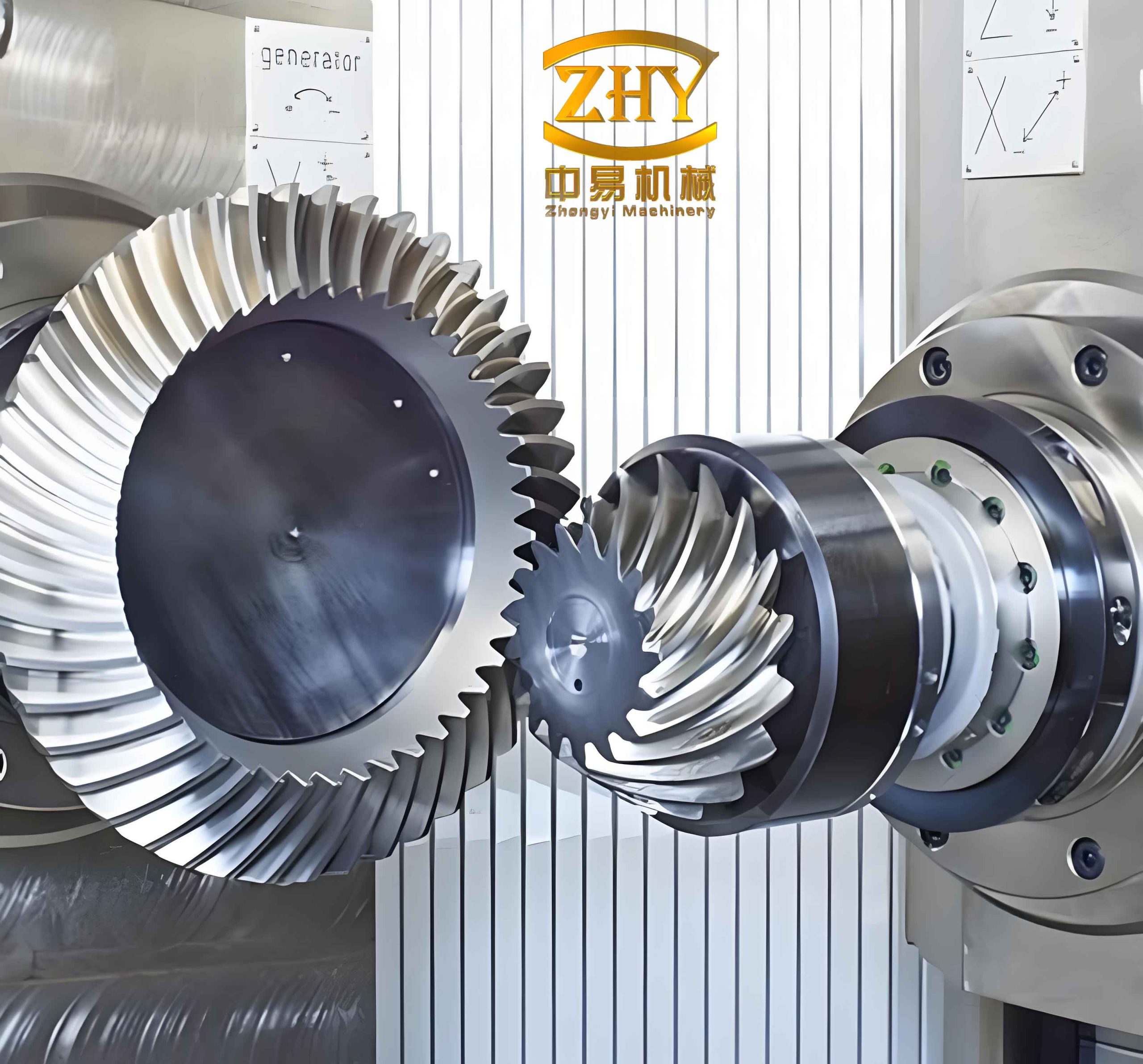
The importance of hyperboloid gears in industrial applications cannot be overstated. Their unique geometry, characterized by offset axes and curved tooth surfaces, allows for efficient power transfer in confined spaces. However, the complexity of hyperboloid gear design necessitates sophisticated tools to ensure accuracy and reliability. Traditional methods for gear blank design involve manual calculations and drafting, which are time-consuming and prone to errors. With the advent of CAD/CAM technologies, it has become possible to automate these processes, yet most existing systems focus primarily on tooth profile generation rather than the blank itself. Our integrated system addresses this by providing a comprehensive solution for hyperboloid gear blanks, integrating geometric design, strength verification, automated drawing generation, and数控代码 creation. This holistic approach reduces design cycles, minimizes human error, and facilitates seamless manufacturing, making it a practical asset for industries reliant on hyperboloid gears.
The core of our system is built upon a modular architecture, which ensures flexibility and maintainability. It consists of two primary modules: the CAD module and the CAM module. The CAD module handles the design aspects, including geometric parameter computation, strength validation, and parameterized drafting. The CAM module manages manufacturing-related tasks, such as NC source code generation and communication with数控 equipment. These modules are interconnected through parameterized interfaces, allowing data to flow seamlessly from design to production. The overall workflow begins with user input of initial design parameters for the hyperboloid gear pair. The system validates these inputs, performs geometric calculations, conducts strength checks, and, if all criteria are met, proceeds to generate detailed零件图 and数控代码. This integrated流程 ensures that hyperboloid gear blanks are designed and manufactured efficiently, meeting stringent quality standards.
To provide a clearer overview, Table 1 summarizes the key components and functions of the integrated CAD/CAM system for hyperboloid gear blanks.
| Module | Sub-module | Primary Function |
|---|---|---|
| CAD Module | Geometric Calculation | Computes blank dimensions based on input parameters |
| Strength Verification | Validates contact and bending strength using AGMA standards | |
| Parameterized Drawing | Generates 2D engineering drawings in AutoCAD | |
| CAM Module | NC Code Generation | Produces ISO-standard数控代码 for machining |
| Serial Communication | Establishes communication with数控机床 for code transfer |
The development environment for this system was carefully selected to ensure robustness and compatibility. We utilized Microsoft Visual C++ 6.0 as the primary programming language, owing to its powerful capabilities for system-level development and integration. AutoCAD 2002 served as the platform for drafting, with ObjectARX 2002 as the二次开发 tool. ObjectARX allows for direct access to AutoCAD’s internal database and functions, enabling efficient parameterized drawing generation. Additionally, mixed programming techniques were employed to combine the strengths of different tools, resulting in a cohesive system that can handle complex calculations and graphical outputs simultaneously. This environment supports the entire workflow for hyperboloid gear blanks, from initial design to final manufacturing instructions.
CAD Module: Design and Drafting for Hyperboloid Gear Blanks
The CAD module is the cornerstone of our integrated system, responsible for transforming user inputs into a validated design and detailed drawings. It operates in a sequential manner, starting with geometric calculations, followed by strength verification, and culminating in parameterized drafting. This ensures that hyperboloid gear blanks are not only dimensionally accurate but also structurally sound for their intended applications.
Geometric Calculation Sub-module
This sub-module initiates the design process by accepting user-provided parameters for the hyperboloid gear pair. These parameters include gear type, number of teeth, module, pressure angle,轴 offset, and other geometric constraints. The system first validates these inputs to prevent erroneous designs. For instance, it checks for compatibility between gear sizes and verifies that parameters fall within feasible ranges. If errors are detected, the user is prompted to re-enter values, with the system offering参考值 based on standard design practices for hyperboloid gears.
Upon validation, the geometric calculation proceeds using established formulas for hyperboloid gear blanks. The computation involves determining key dimensions such as pitch diameters, cone angles, blank thickness, and mounting surfaces. The mathematical basis for these calculations derives from gear theory, incorporating the unique geometry of hyperboloid gears. For example, the pitch diameter for the pinion (small gear) in a hyperboloid gear set can be expressed as:
$$ d_p = \frac{m \cdot z_p}{\cos \beta_p} $$
where \( m \) is the module, \( z_p \) is the number of teeth on the pinion, and \( \beta_p \) is the spiral angle. Similarly, for the gear (large gear), the pitch diameter is:
$$ d_g = \frac{m \cdot z_g}{\cos \beta_g} $$
These formulas are embedded within the system to automate dimensioning. Table 2 lists common input parameters and their typical ranges for hyperboloid gear blank design, which guide users during data entry.
| Parameter | Symbol | Typical Range | Description |
|---|---|---|---|
| Number of Teeth (Pinion) | \( z_p \) | 5-20 | Defines pinion size |
| Number of Teeth (Gear) | \( z_g \) | 20-50 | Defines gear size |
| Module | \( m \) | 2-10 mm | Tooth size metric |
| Pressure Angle | \( \alpha \) | 20°-25° | Tooth profile angle |
| 轴 Offset | \( E \) | 10-100 mm | Distance between axes |
| Spiral Angle (Pinion) | \( \beta_p \) | 30°-50° | Tooth orientation on pinion |
| Spiral Angle (Gear) | \( \beta_g \) | 20°-40° | Tooth orientation on gear |
Once calculations are complete, the system stores the geometric data in a structured database, which is then accessed by subsequent sub-modules. This ensures consistency throughout the design process for hyperboloid gear blanks.
Strength Verification Sub-module
After geometric dimensions are established, the strength verification sub-module assesses the structural integrity of the hyperboloid gear blanks under specified operating conditions. This is critical because hyperboloid gears often endure high loads in applications like vehicle drivetrains. The module employs the American Gear Manufacturers Association (AGMA) standards, which provide widely accepted formulas for contact stress and bending stress evaluation.
For contact strength, the AGMA equation for hyperboloid gears is used:
$$ \sigma_H = Z_E \sqrt{ \frac{F_t}{b \cdot d_p} \cdot \frac{K_A \cdot K_V \cdot K_{H\beta} \cdot K_{H\alpha}}{Z_I} } $$
where \( \sigma_H \) is the contact stress, \( Z_E \) is the elasticity coefficient, \( F_t \) is the tangential load, \( b \) is the face width, \( d_p \) is the pinion pitch diameter, and \( K_A \), \( K_V \), \( K_{H\beta} \), \( K_{H\alpha} \) are application, dynamic, load distribution, and transverse load factors, respectively. \( Z_I \) is the geometry factor for pitting resistance. Similarly, bending strength is evaluated using:
$$ \sigma_F = \frac{F_t}{b \cdot m} \cdot K_A \cdot K_V \cdot K_{F\beta} \cdot K_{F\alpha} \cdot Y_J $$
where \( \sigma_F \) is the bending stress, \( K_{F\beta} \) and \( K_{F\alpha} \) are bending load distribution and transverse load factors, and \( Y_J \) is the geometry factor for bending strength. The system compares these calculated stresses with allowable material stresses, which are retrieved from a material database. If the stresses exceed limits, the design is flagged as inadequate, and the user is guided to modify parameters—such as increasing face width or selecting a stronger material—until the hyperboloid gear blanks meet strength requirements.
To illustrate, Table 3 presents sample strength calculation results for a hyperboloid gear pair, demonstrating how the system validates designs.
| Parameter | Value | Allowable Limit | Status |
|---|---|---|---|
| Contact Stress (\( \sigma_H \)) | 1200 MPa | 1500 MPa | Pass |
| Bending Stress (\( \sigma_F \)) | 300 MPa | 400 MPa | Pass |
| Safety Factor (Contact) | 1.25 | >1.0 | Pass |
| Safety Factor (Bending) | 1.33 | >1.0 | Pass |
This rigorous verification ensures that hyperboloid gear blanks can withstand operational demands, reducing the risk of failure in the field.
Parameterized Drawing Sub-module
The parameterized drawing sub-module is where the CAD capabilities shine, automating the generation of detailed engineering drawings for hyperboloid gear blanks. By leveraging ObjectARX, this sub-module interacts directly with AutoCAD to create 2D drawings that adhere to national drafting standards. The process begins with drawing environment initialization, where settings such as scale, units, layers, line types, and colors are configured. This standardization simplifies subsequent绘图 operations and enhances drawing clarity.
A key step is selecting a coordinate base point, typically the apex of the face cone on the gear blank, which is set to (0,0,0). Using the geometric parameters computed earlier, the system calculates the coordinates of all other points relative to this base. For example, points defining the back cone, mounting surfaces, and keyways are determined through trigonometric relations specific to hyperboloid gears. The drawing then proceeds by invoking AutoCAD functions to create entities like lines, arcs, and hatch patterns. Below is a generalized code snippet illustrating how a line (representing a锥面) is drawn programmatically, though actual implementation uses ObjectARX classes:
// Pseudo-code for drawing a line in AutoCAD via ObjectARX
AcDbObjectId createLine(AcGePoint3d startPt, AcGePoint3d endPt) {
    AcDbLine *pLine = new AcDbLine(startPt, endPt);
    AcDbBlockTableRecord *pBlockTableRec;
    // Open block table for model space
    acdbHostApplicationServices()->workingDatabase()
        ->getSymbolTable(pBlockTable, AcDb::kForRead);
    pBlockTable->getAt(ACDB_MODEL_SPACE, pBlockTableRec, AcDb::kForWrite);
    AcDbObjectId lineId;
    pBlockTableRec->appendAcDbEntity(lineId, pLine);
    pBlockTable->close();
    pBlockTableRec->close();
    pLine->close();
    return lineId;
}
This approach ensures that drawings are generated dynamically based on design parameters. If parameters change, the drawings update automatically, embodying true parameterization. After the main geometry is drawn, the system adds annotations, dimensions, and tolerances. Title blocks and property tables are inserted as attribute blocks, populated with data like part numbers, materials, and designer information. Since hyperboloid gear blanks are designed in pairs (pinion and gear), the module produces two drawings simultaneously, saving time and ensuring consistency. The resulting drawings are ready for review or modification in AutoCAD, allowing users to make custom adjustments if needed.
CAM Module: Manufacturing and Communication for Hyperboloid Gear Blanks
Once the CAD module completes the design phase, the CAM module takes over to prepare for physical manufacturing. This module translates the geometric data of hyperboloid gear blanks into actionable instructions for数控机床, encompassing NC code generation and serial communication with machining equipment.
NC Code Generation Sub-module
The NC code generation sub-module extracts contour data from the CAD drawings of hyperboloid gear blanks and converts it into数控代码 compliant with ISO standards. The process involves several steps: data extraction, toolpath planning, and code synthesis. First, the system retrieves the coordinates of key points defining the blank’s profile, such as outer diameters, cone surfaces, and grooves. This data is stored in a structured format, often as a list of (x, y, z) points relative to the workpiece coordinate system.
Next, through a dialog interface, the user inputs practical machining parameters, including workpiece mounting位置, tool dimensions, and material properties. The system then queries a工艺 database to determine optimal cutting conditions, such as spindle speed, feed rate, depth of cut, and number of roughing and finishing passes. For hyperboloid gear blanks, which often require turning operations on lathes, the toolpath is planned to minimize machining time while maintaining accuracy. A common approach is to use contour parallel paths, where the tool follows the blank’s profile in successive passes. The cutting sequence is optimized to reduce tool wear and avoid collisions.
Based on these inputs, the system generates数控代码 in ISO format. For example, a simple turning operation for a hyperboloid gear blank might produce code snippets like:
N10 G00 X100 Z50  ; Rapid positioning
N20 G01 X90 Z0 F0.2  ; Linear feed to start point
N30 G01 X80 Z-20  ; Turning contour
N40 G02 X70 Z-30 I5 K0  ; Circular interpolation for curved section
To enhance efficiency, the system supports different types of数控机床, such as CNC lathes or milling machines, by adapting the code syntax accordingly. Table 4 outlines key parameters considered during NC code generation for hyperboloid gear blanks.
| Parameter | Symbol | Typical Value | Role in Machining |
|---|---|---|---|
| Spindle Speed | \( N \) | 500-2000 rpm | Rotational speed of workpiece |
| Feed Rate | \( F \) | 0.1-0.5 mm/rev | Tool movement speed |
| Depth of Cut | \( a_p \) | 1-5 mm | Material removal per pass |
| Tool Radius | \( r \) | 0.4-1.2 mm | Influences surface finish |
| Number of Passes | \( n \) | 3-10 | Roughing and finishing cycles |
The generated code is validated through simulation within the system to detect potential errors, such as tool interference or excessive cuts, ensuring that hyperboloid gear blanks are machined accurately on the first attempt.
Serial Communication Sub-module
To bridge the gap between software and hardware, the serial communication sub-module establishes a connection between the computer and the数控机床. This allows for direct transfer of NC代码 to the machine, automating the manufacturing process for hyperboloid gear blanks. The module is implemented in Visual C++ using third-party communication controls, specifically the MSComm control, and employs multi-threading techniques to handle data transmission efficiently.
The communication workflow involves two primary threads: a file发送 thread and a file接受 thread. The发送 thread reads the generated NC code from a file and sends it to the机床 via a serial port (e.g., COM1 or COM2). The接受 thread monitors the port for responses from the机床, such as status reports or error messages, ensuring two-way communication. This dual-thread approach prevents blocking and allows for real-time monitoring during machining. The流程 can be summarized as follows:
- Initialize serial port parameters (baud rate, parity, data bits, stop bits).
- Open the port and establish connection with the数控机床.
- 启动发送 thread to transmit NC code in blocks, with checks for acknowledgment.
- 启动接受 thread to log incoming data and detect completion or faults.
- Close the port after machining is confirmed.
Error handling mechanisms are embedded to manage scenarios like transmission failures or machine errors, prompting retries or user alerts. This robust communication setup ensures that hyperboloid gear blanks are manufactured precisely as designed, with minimal manual intervention.
System Integration and Practical Application
The integration of CAD and CAM modules within a single system creates a seamless workflow for hyperboloid gear blank production. From a user perspective, the system operates as a cohesive unit: after inputting design parameters, one can sequentially execute geometric calculations, strength checks, drawing generation, and NC code creation without switching between disparate software. This integration is facilitated by a shared database that stores all parameters and results, ensuring data consistency across modules.
In practical terms, the system has been tested in scenarios involving automotive rear axle gears. For instance, when designing hyperboloid gear blanks for a vehicle differential, users reported a reduction in design time by over 50% compared to manual methods. The parameterized drawings generated by the system adhere to ISO standards, reducing drafting errors and improving documentation quality. Moreover, the automated NC code generation eliminated the need for手工编程, which is often tedious and error-prone for complex shapes like hyperboloid gears. The serial communication feature further streamlined the manufacturing process, allowing for direct machine control and faster turnaround times.
To quantify benefits, Table 5 compares traditional methods versus the integrated CAD/CAM system for hyperboloid gear blanks.
| Aspect | Traditional Method | Integrated CAD/CAM System |
|---|---|---|
| Design Time | Weeks (manual calculations and drafting) | Days (automated processes) |
| Error Rate | High (human errors in calculations and drawings) | Low (automated validation and parameterization) |
| Drawing Quality | Variable (depends on drafter skill) | Consistent (standardized templates and automation) |
| NC Programming | Manual, time-consuming | Automatic, based on CAD data |
| Manufacturing Integration | Disconnected (separate design and production steps) | Seamless (direct code transfer to machines) |
These advantages underscore the system’s practicality for industries that rely on hyperboloid gears, such as automotive, aerospace, and heavy machinery. By reducing lead times and improving accuracy, it contributes to more efficient supply chains and higher product quality.
Mathematical Foundations and Algorithmic Details
To provide deeper insight, let’s explore some mathematical foundations underpinning the system’s algorithms for hyperboloid gear blanks. The geometry of hyperboloid gears is based on the theory of crossed-axis gears, where the pinion and gear axes are offset and non-parallel. The blank dimensions derive from fundamental gear equations, which are implemented in the geometric calculation sub-module.
For example, the cone angles for the pinion and gear are critical for blank design. The pinion cone angle \( \delta_p \) can be computed using:
$$ \delta_p = \arctan\left( \frac{\sin \Sigma}{i + \cos \Sigma} \right) $$
where \( \Sigma \) is the shaft angle (usually 90° for hyperboloid gears) and \( i \) is the gear ratio \( z_g / z_p \). Similarly, the gear cone angle \( \delta_g \) is:
$$ \delta_g = \Sigma – \delta_p $$
These angles determine the taper of the hyperboloid gear blanks, influencing mounting and assembly. The system also calculates blank diameters at different sections, such as the outer diameter \( D_o \) and inner diameter \( D_i \), using formulas like:
$$ D_o = d + 2 \cdot m \cdot \cos \delta $$
where \( d \) is the pitch diameter and \( \delta \) is the cone angle. Such equations are encoded in C++ within the geometric calculation sub-module, ensuring rapid and accurate computations.
In strength verification, the AGMA formulas involve several factors that depend on gear geometry and operating conditions. The geometry factor \( Z_I \) for contact strength, specific to hyperboloid gears, is derived from tooth contact analysis and can be approximated as:
$$ Z_I = \frac{\cos \beta_b \cdot \sin \alpha_t}{2 \cdot m_N \cdot (1/\rho_1 + 1/\rho_2)} $$
where \( \beta_b \) is the base helix angle, \( \alpha_t \) is the transverse pressure angle, \( m_N \) is the normal module, and \( \rho_1, \rho_2 \) are the radii of curvature at the contact point. These parameters are calculated internally based on input data, allowing the system to evaluate stresses accurately for hyperboloid gears.
The parameterized drawing algorithm uses transformation matrices to convert 3D gear blank coordinates into 2D drawing views. For instance, to project a point \( P(x, y, z) \) onto a front view, the system applies:
$$ P_{front} = \begin{bmatrix} 1 & 0 & 0 \\ 0 & 0 & -1 \end{bmatrix} \begin{bmatrix} x \\ y \\ z \end{bmatrix} $$
This linear algebra approach ensures that drawings are geometrically consistent. The NC code generation employs interpolation algorithms, such as linear (G01) and circular (G02/G03) interpolation, to define toolpaths. For curved sections on hyperboloid gear blanks, circular interpolation parameters are computed using the center coordinates and radius derived from contour data.
Future Enhancements and Conclusions
Looking ahead, the integrated CAD/CAM system for hyperboloid gear blanks can be extended in several directions. One potential enhancement is the incorporation of 3D modeling capabilities, allowing for direct generation of solid models in software like SolidWorks or CATIA. This would facilitate finite element analysis (FEA) for more detailed strength评估 and thermal analysis. Additionally, integrating machine learning algorithms could optimize design parameters automatically, suggesting improvements based on historical data and performance metrics for hyperboloid gears.
Another area for development is cloud-based collaboration, enabling multiple users to work on hyperboloid gear blank designs simultaneously from different locations. This would support distributed manufacturing environments and accelerate product development cycles. Furthermore, expanding the system to support additive manufacturing (3D printing) for prototyping hyperboloid gear blanks could reduce material waste and lead times for custom designs.
In conclusion, this integrated CAD/CAM system represents a significant advancement in the design and manufacturing of hyperboloid gear blanks. By combining geometric computation, strength verification, parameterized drafting, and automated数控编程 into a unified platform, it addresses a critical gap in gear production technology. The system’s modular architecture ensures flexibility and scalability, while its implementation using industry-standard tools like Visual C++ and AutoCAD makes it accessible and practical. For engineers and manufacturers working with hyperboloid gears, this system offers a reliable means to produce high-quality gear blanks efficiently, ultimately contributing to better-performing transmissions and drivetrains. As hyperboloid gears continue to be essential in various机械 systems, such integrated solutions will play a vital role in advancing manufacturing technology and meeting evolving industry demands.