
In modern engineering applications, helical gears are fundamental components in power transmission systems, widely employed in sectors such as maritime propulsion, aerospace, automotive, and wind energy. Their ability to transmit high loads with smooth operation and reduced noise makes them preferable over spur gears. However, as demands for higher speeds and heavier loads increase, helical gears experience significant thermal and elastic deformations, leading to non-conjugate meshing, vibration, and noise. These issues compromise transmission accuracy and system stability, particularly in critical applications like naval vessels where stealth and reliability are paramount. To address this, gear modification techniques are essential, but traditional methods often overlook thermal effects. This study focuses on developing a three-dimensional modification strategy for helical gears that incorporates both thermal and elastic deformations, using finite element analysis, optimization algorithms, and experimental validation to enhance performance.
The core challenge lies in accurately predicting and compensating for deformations under operational conditions. Helical gears, due to their angled teeth, exhibit complex contact patterns and stress distributions, which are further influenced by temperature rises from friction and lubrication. Ignoring thermal deformation can lead to suboptimal modification, resulting in persistent vibration and noise. Therefore, I propose an integrated approach that models the temperature field, extracts thermal deformation, combines it with elastic deformation, and optimizes modification parameters. This method aims to minimize transmission error and vibration, ultimately improving the stability and efficiency of gear systems. The following sections detail the theoretical framework, numerical simulations, parameter optimization, and experimental results, emphasizing the importance of thermal considerations in helical gear design.
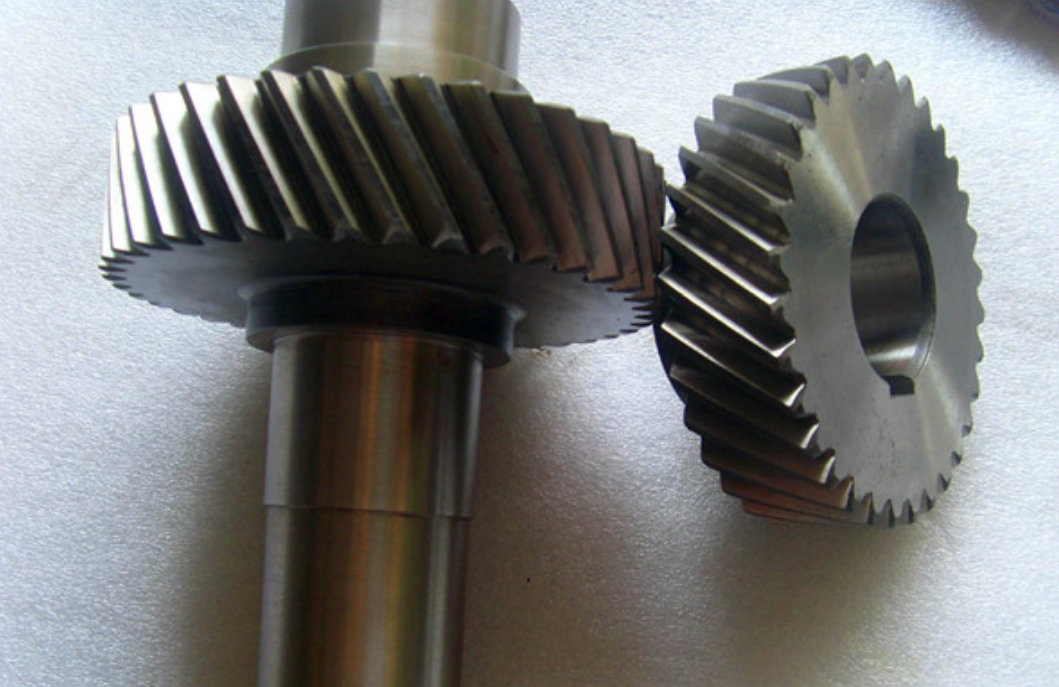
To begin, understanding the thermal behavior of helical gears is crucial. When helical gears operate under high-speed and heavy-load conditions, frictional heat generation at the tooth contacts raises the gear body temperature. This temperature increase causes thermal expansion, altering the tooth geometry and affecting meshing characteristics. The temperature distribution is non-uniform, depending on factors like gear geometry, material properties, lubrication, and operating conditions. I developed a finite element model to simulate the steady-state temperature field of helical gears. The model uses a three-dimensional mesh with refined elements at the tooth surfaces to capture gradients accurately. The gear parameters are listed in Table 1, which includes key dimensions and operational data.
| Parameter | Symbol | Value | Unit |
|---|---|---|---|
| Module | m | 6 | mm |
| Face Width | b | 75 | mm |
| Pressure Angle | α | 20 | ° |
| Helix Angle | β | 9.9116 | ° |
| Number of Teeth (Pinion/Gear) | z1/z2 | 19/47 | – |
| Power Transmitted | P | 86.77 | kW |
| Pinion Speed | n1 | 2500 | rpm |
| Load Torque | T | 800 | Nm |
The lubrication oil used is L-TSA32 turbine oil, with properties at 40°C provided in Table 2. These properties influence heat transfer and temperature distribution within the helical gears.
| Property | Symbol | Value | Unit |
|---|---|---|---|
| Density | ρ | 0.8825 | g/cm³ |
| Kinematic Viscosity | ν | 32.34 | mm²/s |
| Thermal Conductivity | k | 0.1277 | W/(m·K) |
| Specific Heat Capacity | cp | 1920.2 | J/(kg·K) |
The finite element analysis involves solving the heat conduction equation with boundary conditions accounting for heat generation at the contact interfaces and convection to the lubricant. The governing equation is:
$$ \nabla \cdot (k \nabla T) + \dot{q} = 0 $$
where \( T \) is the temperature, \( k \) is the thermal conductivity, and \( \dot{q} \) is the heat generation rate per unit volume. For helical gears, the heat generation due to friction can be estimated as:
$$ \dot{q} = \frac{\mu F v}{A} $$
with \( \mu \) as the coefficient of friction, \( F \) as the normal load, \( v \) as the sliding velocity, and \( A \) as the contact area. The simulation results reveal the temperature distribution on the tooth surfaces. For helical gears, the temperature peaks not necessarily at the pitch circle but often near the tooth tip or root, and along the face width, it reaches a maximum around the mid-width region. This pattern is attributed to the varying contact conditions and heat dissipation rates across the tooth profile and width.
After obtaining the temperature field, I proceed to compute the thermal deformation. The structural analysis module of the finite element software is used, with the temperature field applied as a body load. The material is assumed isotropic with a linear thermal expansion coefficient \( \alpha_t \). The thermal strain \( \epsilon_{th} \) is given by:
$$ \epsilon_{th} = \alpha_t \Delta T $$
where \( \Delta T \) is the temperature change relative to a reference state. The total deformation includes displacements in the x, y, and z directions. For modification purposes, the critical component is the deformation along the line of action, which directly affects meshing. I extract the deformation at key points: on the tooth profile at the mid-width and along the pitch line across the face width. These deformations are then converted into modification amounts for the tooth profile and lead directions, respectively.
The next step involves determining the modification parameters for helical gears. Traditional modification considers only elastic deformation under load, but here I integrate thermal deformation. Modification typically includes profile modification (along the tooth height) and lead modification (along the tooth width), combined to form three-dimensional modification. The modification curve is often a fourth-order parabola to ensure smooth transitions. Let the profile modification parameters be: \( y_1 \) and \( y_2 \) as the maximum modification amounts at the root and tip, respectively, and \( y_3 \) and \( y_4 \) as the corresponding modification lengths. Similarly, for lead modification: \( y_5 \) and \( y_6 \) as the maximum modification amounts at the entry and exit sides, and \( y_7 \) as the unmodified length in the center. The total modification \( M(x,z) \) at any point on the tooth surface can be expressed as:
$$ M(x,z) = f_p(x) + f_l(z) $$
where \( f_p(x) \) is the profile modification function and \( f_l(z) \) is the lead modification function. For a fourth-order parabola, these are defined as:
$$ f_p(x) = y_1 \left( \frac{x – x_1}{x_2 – x_1} \right)^4 \text{ for root region, and } y_2 \left( \frac{x – x_3}{x_4 – x_3} \right)^4 \text{ for tip region} $$
$$ f_l(z) = y_5 \left( \frac{z – z_1}{z_2 – z_1} \right)^4 \text{ for entry side, and } y_6 \left( \frac{z – z_3}{z_4 – z_3} \right)^4 \text{ for exit side} $$
with \( x \) and \( z \) being coordinates along the profile and lead directions, respectively.
Initially, I consider only elastic deformation. Using loaded tooth contact analysis (LTCA) and optimization techniques like genetic algorithms, the modification parameters are optimized to minimize transmission error. Transmission error is a key indicator of vibration and noise in helical gears, defined as the difference between the actual and theoretical positions of the output gear. The objective function for optimization is to reduce the amplitude of transmission error. The optimized parameters for elastic modification are shown in Table 3.
| Parameter | Description | Value (m) |
|---|---|---|
| y1 | Root max modification | 1.04 × 10⁻⁵ |
| y2 | Tip max modification | 1.26 × 10⁻⁶ |
| y3 | Root modification length | 1.6 × 10⁻³ |
| y4 | Tip modification length | 3.2 × 10⁻³ |
| y5 | Entry max modification | 8.5 × 10⁻⁶ |
| y6 | Exit max modification | 8.3 × 10⁻⁶ |
| y7 | Unmodified length | 3.5 × 10⁻² |
Now, incorporating thermal deformation, I extract the thermal modification amounts from the finite element results. The deformation along the line of action \( \Delta s \) at specific points is calculated using vector projections. For a point on the tooth surface with displacements \( u_x \) and \( u_y \) in the coordinate system, the deformation along the line of action is:
$$ \Delta s = u_y \cos \theta_2 – u_x \cos \theta_1 = u_y \sin \theta_1 – u_x \cos \theta_1 $$
where \( \theta_1 \) and \( \theta_2 \) are angles related to the gear geometry. From the analysis, I obtain thermal modification amounts for the profile and lead directions, as summarized in Table 4.
| Parameter | Description | Value (m) |
|---|---|---|
| y1,th | Thermal root modification | 1.65 × 10⁻⁶ |
| y2,th | Thermal tip modification | 1.35 × 10⁻⁶ |
| y5,th | Thermal entry modification | 1.48 × 10⁻⁶ |
| y6,th | Thermal exit modification | 1.66 × 10⁻⁶ |
Combining elastic and thermal modifications, the total modification parameters are derived by superposition. This results in a new set of parameters for helical gears that account for both effects, as shown in Table 5. This integrated approach ensures that the gear teeth are shaped to compensate for deformations under actual operating conditions, leading to improved meshing performance.
| Parameter | Description | Value (m) |
|---|---|---|
| y1,total | Total root max modification | 1.20 × 10⁻⁵ |
| y2,total | Total tip max modification | 1.00 × 10⁻⁵ |
| y3,total | Root modification length | 1.6 × 10⁻³ |
| y4,total | Tip modification length | 3.2 × 10⁻³ |
| y5,total | Total entry max modification | 1.00 × 10⁻⁵ |
| y6,total | Total exit max modification | 1.00 × 10⁻⁵ |
| y7,total | Unmodified length | 3.5 × 10⁻² |
To validate the effectiveness of this thermal-elastic modification method for helical gears, I conducted performance tests on a mechanical closed-loop power circulating gear test rig. The test setup includes a drive motor, torque sensor, load applicator, test gearbox with the modified helical gears, a companion gearbox, optical encoders for measuring rotation, and data acquisition systems. The helical gears tested have the parameters listed in Table 1, modified according to Table 5. The test rig simulates real operating conditions, allowing for the measurement of transmission error and vibration.
Transmission error is measured using high-resolution optical encoders mounted on the input and output shafts. The vibration acceleration along the line of action is captured by accelerometers placed near the gear mesh. The data is processed to obtain time-domain signals and frequency spectra. Comparing the results before and after modification demonstrates significant improvements. For the modified helical gears, the amplitude of transmission error decreased from 8.3464 micrometers to 4.4168 micrometers, a reduction of 47.08%. Similarly, the root mean square (RMS) of the meshing line acceleration decreased from 122.2663 m/s² to 36.2526 m/s², a reduction of 70.35%. These reductions indicate lower vibration and noise levels, confirming that the thermal-elastic modification approach enhances the dynamic performance of helical gears.
The theoretical simulations align well with experimental data, as shown in comparative plots. The transmission error waveform becomes smoother and more periodic after modification, and the vibration acceleration peaks are substantially reduced. This consistency validates the finite element models and optimization process. Furthermore, the modification not only improves dynamic behavior but also contributes to longer gear life by promoting even load distribution and reducing stress concentrations. In helical gears, proper modification minimizes edge loading and mitigates the effects of misalignments and deformations.
In conclusion, this study presents a comprehensive method for three-dimensional modification of helical gears that incorporates both thermal and elastic deformations. By developing a finite element model to analyze temperature fields and thermal deformations, and combining these with elastic deformation data through optimization, I derived an improved modification scheme. Experimental tests on helical gears confirmed that this approach significantly reduces transmission error and vibration, with amplitude reductions of 47.08% and 70.35%, respectively. The success of this method underscores the importance of considering thermal effects in high-speed, heavy-duty gear applications. For helical gears, which are prone to complex deformation patterns, integrating thermal analysis into the design process is crucial for achieving optimal performance, reliability, and noise reduction. Future work could explore transient thermal analyses, advanced lubrication models, and multi-objective optimization to further refine modification strategies for helical gears in diverse industrial settings.
The implications of this research extend beyond naval propulsion to any field where helical gears are used under demanding conditions. By adopting a thermal-elastic modification approach, engineers can design gear systems that operate more quietly, efficiently, and durably. This methodology provides a practical framework for enhancing the stability of helical gear transmissions, contributing to advancements in mechanical power transmission technology. As industries continue to push the limits of speed and load, such integrated design techniques will become increasingly vital for meeting performance and environmental standards.