
As a researcher in fluid power systems, I have always been fascinated by the dynamics of positive displacement pumps, particularly helical gear pumps. These pumps are widely used in industrial applications due to their robust design, high power density, and superior self-priming capabilities compared to spur gear pumps. However, one persistent challenge is flow pulsation, which stems from the inherent structural characteristics of gear pumps. In this article, I will delve into the analysis of instantaneous flow rate and flow pulsation in helical gear pumps, employing a superposition-based approach to overcome the complexities of direct integration methods. The goal is to provide insights that can guide the optimization of helical gear pump design for reduced flow pulsation and improved system stability.
Gear pumps operate by varying the volume of their working chambers to draw in and discharge fluid. This volumetric change leads to periodic fluctuations in flow rate, known as flow pulsation. In hydraulic systems, flow pulsation induces pressure pulsation, transforming the pump into a source of fluid-borne vibration and noise. This can compromise the reliability and performance of the entire system. While spur gear pumps exhibit significant flow pulsation, helical gear pumps offer smoother operation because the helical teeth engage gradually along the tooth width. This gradual engagement reduces flow pulsation, making helical gear pumps suitable for high-pressure and heavy-duty applications. The flow characteristics of helical gear pumps can be understood by considering them as a superposition of infinitely thin spur gear pumps staggered along the tooth width due to the helix angle. This perspective forms the basis of my analysis.
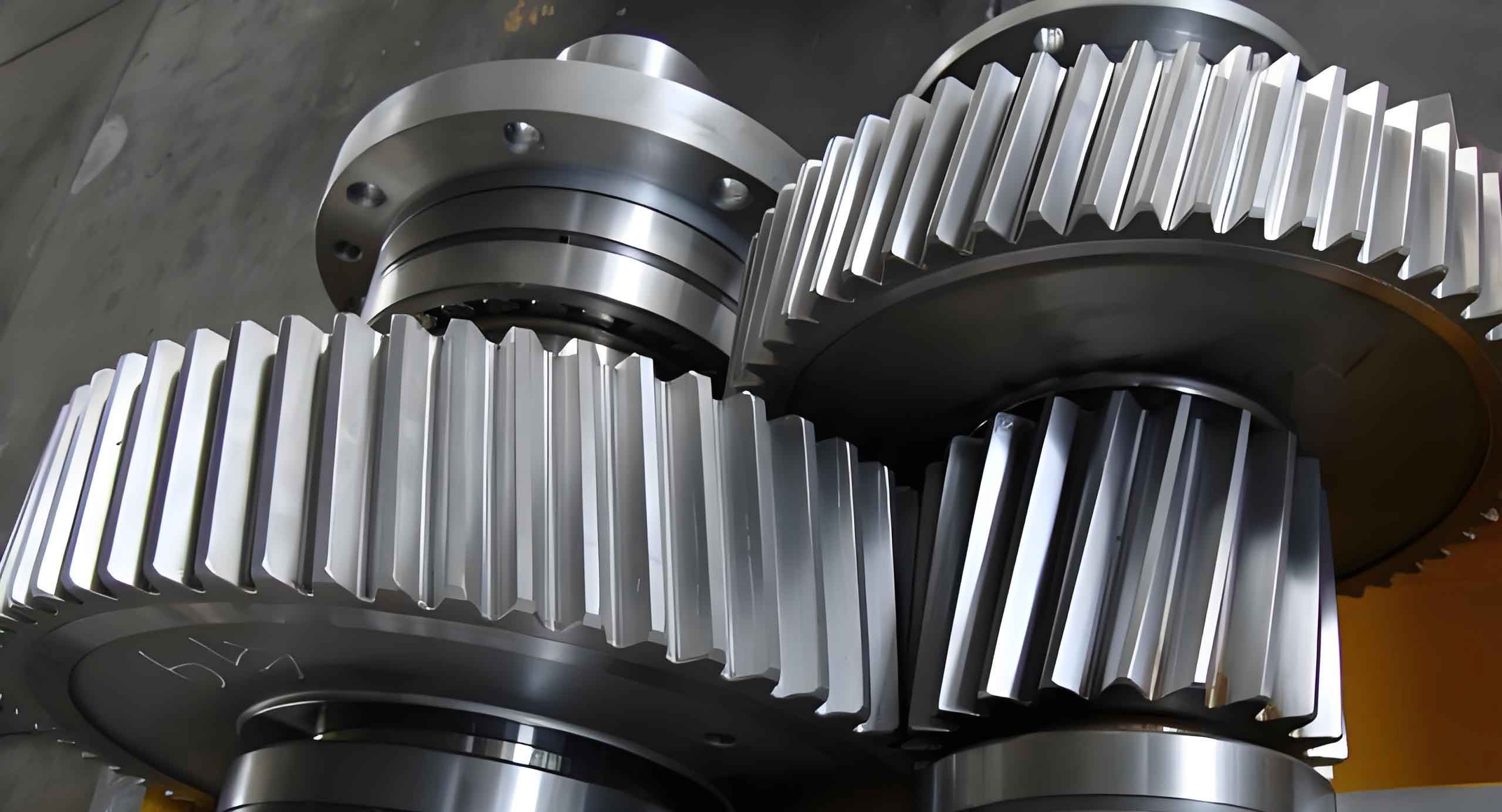
Traditionally, the instantaneous flow rate of a helical gear pump is derived using direct integration methods. For a spur gear pump, the instantaneous flow rate is given by:
$$q_{V,sh} = b \omega (R_a^2 – R_w^2 – R_b^2 \phi^2)$$
where \(b\) is the tooth width, \(\omega\) is the angular velocity, \(R_a\), \(R_w\), and \(R_b\) are the tip, pitch, and base circle radii, respectively, and \(\phi\) is the gear rotation angle. This equation shows that the flow rate varies parabolically over a single engagement cycle. For a helical gear pump, with a helix angle \(\beta\), an infinitesimally thin spur gear pump at a distance \(x\) from a reference end face has an instantaneous flow rate expressed as:
$$q_{V,x\theta} = \omega \left( R_a^2 – R_w^2 – R_b^2 \left( \theta – \frac{x \tan \beta}{R} \right)^2 \right) dx$$
where \(\theta\) is the rotation angle at the reference face, and \(R\) is the pitch circle radius. The sign in the term \(\theta – \frac{x \tan \beta}{R}\) depends on the coordinate system, but it does not affect the final result. Integrating this expression over the tooth width \(b\) yields the total instantaneous flow rate. However, due to the helix angle, the integration must be split into intervals corresponding to full and partial tooth width engagement, making the process cumbersome. Specifically, within the non-full engagement interval, the integral involves two different periodic functions, requiring a transformation of the reference angle and piecewise integration. This complexity has led to various interpretations in the literature, with some studies suggesting parabolic flow patterns, while others, including computational fluid dynamics (CFD) simulations, indicate a quasi-sinusoidal variation.
To address these discrepancies, I propose using the principle of superposition combined with graphical methods via MATLAB. This approach is more intuitive and avoids the mathematical intricacies of direct integration. The core idea is to discretize the helical gear pump into \(n\) thin spur gear pump slices along the tooth width. Each slice is offset by a small angle due to the helix angle. The total instantaneous flow rate is then the sum of the flow rates from all slices. Mathematically, for the \(i\)-th slice, the flow rate is:
$$q_{V,i} = \omega \left( R_a^2 – R_w^2 – R_b^2 \left( \theta – \frac{i b \tan \beta}{n R} \right)^2 \right) \frac{b}{n}$$
where \(i\) ranges from 0 to \(n-1\). The total flow rate is:
$$q_{V,sh} = \sum_{i=0}^{n-1} q_{V,i}$$
As \(n\) approaches infinity, this summation converges to the integral result. This method allows for easy computation and visualization of flow characteristics under various parameters. For instance, using gear parameters from prior studies (e.g., tip diameter \(D_a = 4.8224\) cm, pitch diameter \(D = 4.3151\) cm, base diameter \(D_b = 3.9641\) cm, tooth width \(b = 2.7\) cm, speed \(2000\) rpm), I analyzed the flow behavior. The critical helix angle \(\beta_c\) to avoid fluid trapping is given by \(\frac{2\pi}{Z} \geq \frac{b \tan \beta}{R}\), where \(Z\) is the number of teeth. For these parameters, \(\beta_c \approx 15.5857^\circ\).
To illustrate the superposition effect, consider a helical gear pump with a helix angle of \(6^\circ\). When discretized into \(n=10\) slices, the instantaneous flow rate over half a rotation shows each slice’s parabolic curve offset by \(\frac{b \tan \beta}{R(n-1)}\). The total flow curve, obtained by summing these, exhibits a smoothed pattern compared to a single spur gear pump. This demonstrates how the helical geometry mitigates flow pulsation. The following table summarizes the key parameters used in the analysis:
| Parameter | Symbol | Value | Unit |
|---|---|---|---|
| Tip Circle Radius | \(R_a\) | 2.4112 | cm |
| Pitch Circle Radius | \(R\) | 2.15755 | cm |
| Base Circle Radius | \(R_b\) | 1.98205 | cm |
| Tooth Width | \(b\) | 2.7 | cm |
| Angular Velocity | \(\omega\) | 209.44 | rad/s |
| Number of Teeth | \(Z\) | 12 | – |
| Critical Helix Angle | \(\beta_c\) | 15.5857 | ° |
Using MATLAB, I computed the instantaneous flow rate for various helix angles and tooth widths. For a fixed tooth width of 27 mm, the flow curves at different helix angles reveal distinct patterns. At \(0^\circ\) (spur gear pump), the flow varies parabolically. As the helix angle increases, the transition between engagement cycles becomes smoother, altering the flow shape. At the critical helix angle, the flow curve nearly approximates a straight line, indicating minimal pulsation. Similarly, for a fixed helix angle of \(15.5857^\circ\), varying the tooth width shows that flow pulsation decreases with increasing width, reaching a minimum at the critical tooth width. The following table compares the flow pulsation characteristics for different configurations:
| Helix Angle (°) | Tooth Width (cm) | Flow Pattern | Pulsation Level |
|---|---|---|---|
| 0 | 2.7 | Parabolic | High |
| 6 | 2.7 | Transitional | Moderate |
| 10 | 2.7 | Smoothed | Low |
| 15.5857 | 2.7 | Near-Constant | Very Low |
| 15.5857 | 2.0 | Transitional | Moderate |
| 15.5857 | 3.0 | Smoothed | Low |
To quantify flow pulsation, I use the flow non-uniformity coefficient \(\delta_q\), defined as:
$$\delta_q = \frac{q_{V,\text{max}} – q_{V,\text{min}}}{q_{V,\text{mean}}}$$
where \(q_{V,\text{max}}\), \(q_{V,\text{min}}\), and \(q_{V,\text{mean}}\) are the maximum, minimum, and mean instantaneous flow rates, respectively. The mean flow rate is equivalent to the theoretical flow rate, which for helical gear pumps remains constant under varying helix angles, consistent with the prismatic concept. However, it scales linearly with tooth width. Through MATLAB simulations, I derived \(\delta_q\) for different helix angles and tooth widths. The results show that, under conditions preventing fluid trapping, \(\delta_q\) decreases linearly with increasing helix angle for a fixed tooth width. Similarly, for a fixed helix angle, \(\delta_q\) decreases linearly with increasing tooth width. At the critical helix angle or critical tooth width, \(\delta_q\) approaches zero, indicating nearly pulsation-free operation. This linear relationship can be expressed as:
$$\delta_q = C_1 – C_2 \beta \quad \text{(for fixed } b\text{)}$$
$$\delta_q = C_3 – C_4 b \quad \text{(for fixed } \beta\text{)}$$
where \(C_1, C_2, C_3, C_4\) are constants dependent on gear geometry. For example, with the given parameters, the coefficients can be approximated from simulation data. The table below summarizes the flow non-uniformity coefficients for selected cases:
| Case | Helix Angle (°) | Tooth Width (cm) | \(\delta_q\) (%) | Mean Flow Rate (L/min) |
|---|---|---|---|---|
| Spur Gear | 0 | 2.7 | 24.5 | 52.3 |
| Helical Gear 1 | 6 | 2.7 | 18.2 | 52.3 |
| Helical Gear 2 | 10 | 2.7 | 12.7 | 52.3 |
| Helical Gear 3 | 15.5857 | 2.7 | 0.5 | 52.3 |
| Helical Gear 4 | 15.5857 | 2.0 | 8.9 | 38.7 |
| Helical Gear 5 | 15.5857 | 3.0 | 0.2 | 58.1 |
The superiority of helical gear pumps in reducing flow pulsation is evident from these results. The helical gears’ gradual engagement mechanism distributes the flow variations over time, leading to a more stable output. This is particularly beneficial in high-pressure applications where pulsation can cause excessive noise and component wear. Moreover, the superposition method confirms that the instantaneous flow rate of helical gear pumps can exhibit diverse patterns depending on the helix angle and tooth width, but always trends toward smoother flow as these parameters approach critical values. It is worth noting that the critical conditions are determined by the no-fluid-trapping criterion, which ensures that the pump operates efficiently without internal leakage or cavitation.
In practical design, optimizing helical gear pumps involves balancing multiple factors. Increasing the helix angle reduces flow pulsation but may raise manufacturing complexity and axial thrust. Similarly, increasing tooth width reduces pulsation but increases pump size and weight. Therefore, the choice of parameters should be tailored to specific application requirements. For instance, in noise-sensitive environments, selecting a helix angle close to the critical value can significantly mitigate pulsation. The superposition-based graphical approach provides a rapid assessment tool for designers to visualize flow characteristics without resorting to complex integrals. Additionally, modern simulation tools like CFD can complement this analysis by capturing transient effects and fluid-structure interactions.
Beyond flow pulsation, helical gear pumps offer other advantages, such as higher volumetric efficiency and better load distribution across teeth. However, they are also prone to axial forces due to the helix angle, which must be managed through thrust bearings or dual-helix designs. Future research could explore the impact of profile modifications, such as tip relief or lead crowning, on the flow characteristics of helical gear pumps. Furthermore, integrating real-time monitoring systems based on flow sensors could enable adaptive control strategies to minimize pulsation in variable-speed applications.
In conclusion, my analysis using the superposition principle and graphical methods reveals that helical gear pumps exhibit variable instantaneous flow patterns influenced by helix angle and tooth width. The flow non-uniformity coefficient decreases linearly with both parameters under normal operating conditions, reaching a minimum at critical values. This underscores the importance of parametric optimization in designing helical gear pumps for low-pulsation performance. By leveraging computational tools, engineers can efficiently explore the design space and develop pumps that meet the evolving demands of hydraulic systems. The inherent benefits of helical gears, combined with strategic design choices, pave the way for quieter, more reliable fluid power solutions across industries.