
In modern mechanical power transmission systems, the relentless pursuit of higher power density, reduced weight, and increased operational efficiency has led to significant innovations in gear design. Among these, helical gears are pivotal components, prized for their smoother and quieter operation compared to their spur gear counterparts due to the gradual engagement of their angled teeth. I will delve into advanced aspects of their dynamic behavior and profile design, focusing particularly on specialized configurations that push the boundaries of conventional gearing. This article will explore the dynamic modeling of gear systems, the implications of asymmetric tooth profiles, the critical issue of undercutting in low-tooth-count designs, and the impact of profile modifications on dynamic performance. The goal is to provide a comprehensive understanding of how to optimize helical gears for demanding applications.
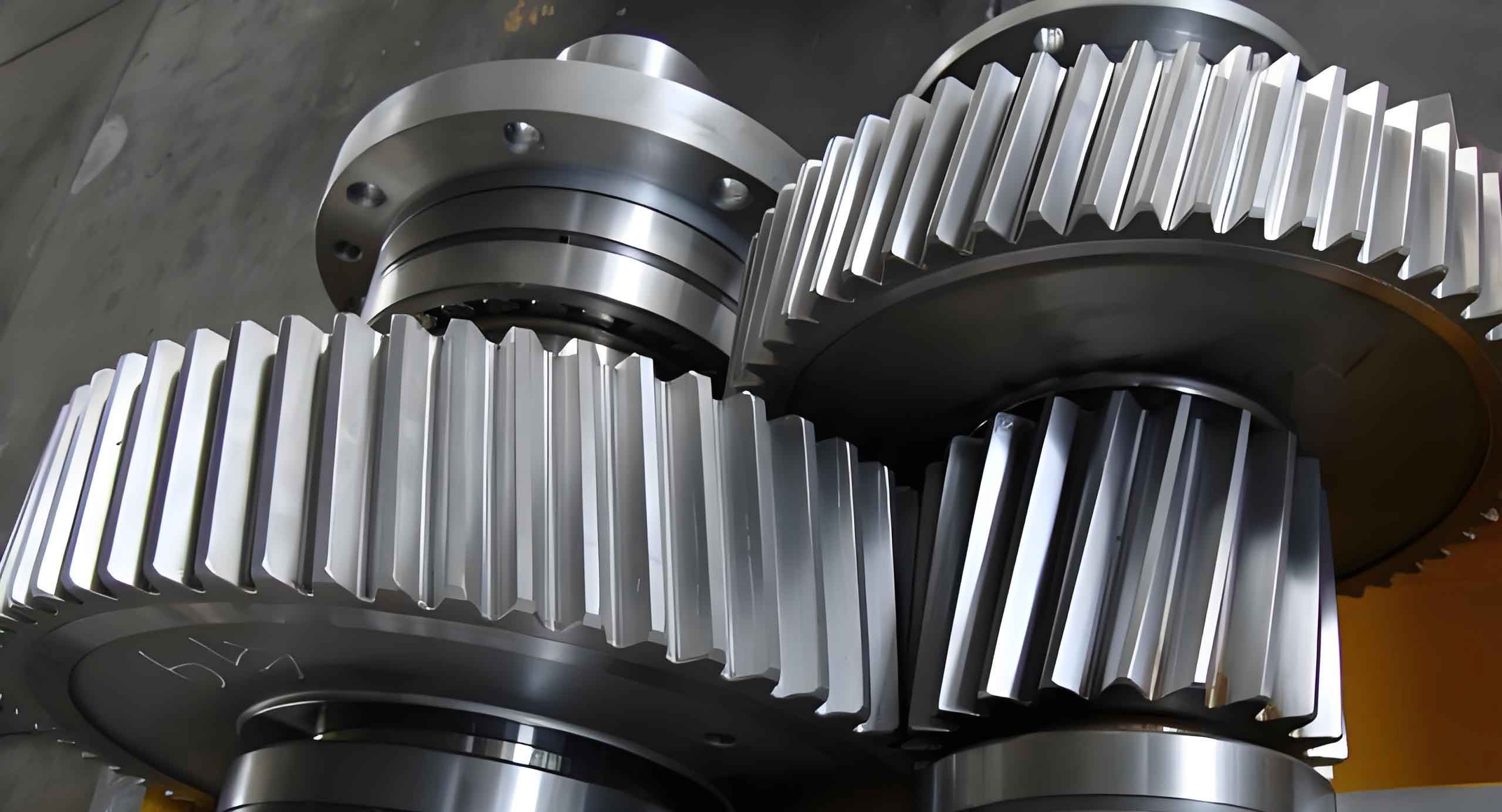
Fundamentals and Contact Analysis of Helical Gears
The superior performance of helical gears stems directly from their fundamental geometry. A key characteristic is the helix angle, denoted by $\beta$. This angle dictates the orientation of the teeth relative to the gear axis. The meshing action in helical gears is not instantaneous across the full face width; instead, contact begins at a point on one end of a tooth and progressively sweeps across its face as the gears rotate. This results in multiple teeth being in contact at any given time, a condition known as high contact ratio. The line of contact is diagonal across the face of the tooth, which contributes to a more gradual transfer of load and significantly reduces vibration and noise excitation.
The basic geometric relationships for standard helical gears in the transverse plane (perpendicular to the axis) are derived from their virtual spur gear equivalents. The transverse module $m_t$ is related to the normal module $m_n$ (a standard design parameter) by:
$$ m_t = \frac{m_n}{\cos \beta} $$
Similarly, the transverse pressure angle $\alpha_t$ is related to the normal pressure angle $\alpha_n$ by:
$$ \tan \alpha_t = \frac{\tan \alpha_n}{\cos \beta} $$
The dynamic behavior of a pair of meshing helical gears is governed by the time-varying mesh stiffness $k_m(t)$. This stiffness fluctuates periodically due to changes in the number of tooth pairs in contact and the position of the contact line along the active profile. For a healthy gear pair with perfect geometry, the mesh stiffness is a periodic function that can be expanded into a Fourier series:
$$ k_m(t) = k_{m0} + \sum_{q=1}^{\infty} A_q \cos(q \omega_m t + \phi_q) $$
where $k_{m0}$ is the mean mesh stiffness, $A_q$ is the amplitude of the $q$-th harmonic, $\omega_m$ is the mesh frequency ($\omega_m = Z \cdot \omega$, with $Z$ as the number of teeth and $\omega$ as the rotational speed), and $\phi_q$ is the phase angle. This parametric excitation is a primary source of vibration in gear systems.
Dynamic Modeling of Helical Gear Systems
To accurately predict the dynamic response, a lumped-parameter model is commonly employed. A comprehensive model for a single-stage gearbox with helical gears must account for six degrees of freedom per gear: three translational ($x$, $y$, $z$) and three rotational ($\theta_x$, $\theta_y$, $\theta_z$). However, for many analyses focused on torsional and transverse vibrations, a simplified model coupling torsional and lateral motions suffices.
The equations of motion for a two-gear system can be derived using Lagrange’s equations or Newton’s second law. Considering the gears as rigid disks connected by a spring-damper element representing the gear mesh, the governing equations in the direction along the line of action are:
$$ I_p \ddot{\theta}_p + R_{bp} c_m (R_{bp} \dot{\theta}_p – R_{bg} \dot{\theta}_g + \dot{e}(t)) + R_{bp} k_m(t) (R_{bp} \theta_p – R_{bg} \theta_g + e(t)) = T_p $$
$$ I_g \ddot{\theta}_g – R_{bg} c_m (R_{bp} \dot{\theta}_p – R_{bg} \dot{\theta}_g + \dot{e}(t)) – R_{bg} k_m(t) (R_{bp} \theta_p – R_{bg} \theta_g + e(t)) = -T_g $$
where:
- $I_p$, $I_g$ are the mass moments of inertia of the pinion and gear.
- $R_{bp}$, $R_{bg}$ are the base circle radii.
- $c_m$ is the mesh damping coefficient (often proportional to $k_m$).
- $e(t)$ is the static transmission error (STE), a major source of excitation.
- $T_p$, $T_g$ are the input torque and load torque.
The static transmission error $e(t)$ is defined as the deviation of the actual position of the driven gear from its theoretical position relative to the driver gear, assuming perfectly rigid teeth. It arises from manufacturing errors, intentional profile modifications, and tooth deflections under load. For helical gears, it can be modeled as:
$$ e(t) = e_a \cos(\omega_m t + \phi_e) $$
The primary sources of dynamic excitation in helical gear systems are summarized below:
| Excitation Type | Source | Frequency Domain | Effect on Dynamics |
|---|---|---|---|
| Parametric Excitation | Time-varying mesh stiffness $k_m(t)$ | Mesh frequency $\omega_m$ and its harmonics | Causes parametric resonances, major contributor to vibration. |
| Forced Excitation | Static Transmission Error $e(t)$ | Mesh frequency $\omega_m$ and its harmonics | Acts as an external force, exciting the system at mesh frequency. |
| External Excitation | Fluctuating input torque $T_p(t)$ or load $T_g(t)$ | Low frequency (e.g., 1X or 2X rotational speed) | Can modulate the mesh vibration, causing sidebands. |
| Impact Excitation | Meshing impact at start of contact | Broadband frequency content | Generates high-frequency noise and transient stress. |
Asymmetric Tooth Profiles for Performance Enhancement
Traditional involute gear teeth are symmetric about the centerline of the tooth space. An asymmetric tooth profile breaks this symmetry by assigning different pressure angles to the drive side (active flank) and the coast side (inactive flank) of the tooth. This design philosophy allows for performance optimization tailored to the primary direction of power transmission. Typically, a larger pressure angle is used on the drive side. This offers several key advantages for helical gears:
- Increased Bending Strength: A larger drive-side pressure angle results in a thicker tooth root, dramatically reducing the bending stress at the fillet. This allows for higher load capacity or more compact gear design.
- Improved Surface Durability: The increased pressure angle reduces the radius of curvature at the contact point, which can favorably alter the contact stress (Hertzian stress) distribution, potentially improving pitting resistance.
- Reduced Sliding Velocity: A higher pressure angle can decrease the specific sliding velocities on the active flank, which is beneficial for reducing wear and friction losses.
The design of an asymmetric rack-cutter is the foundation for generating such gears. In the normal plane, the rack profile is defined with distinct parameters for each side. The key geometric parameters for the drive side and coast side are denoted with subscripts *d* and *c* respectively (e.g., $\alpha_{nd}$, $\alpha_{nc}$, $h_{ad}^*$, $h_{ac}^*$, $\rho_{fd}^*$, $\rho_{fc}^*$).
Undercutting Analysis in Low-Number Helical Gears
When designing helical gears with a low number of teeth (e.g., $Z < 17$ in standard designs) to achieve higher reduction ratios in compact spaces, undercutting becomes a critical concern. Undercutting is an over-cutting phenomenon during the gear generation process (e.g., hobbing) where the cutting tool removes material from the involute profile near the tooth root. This weakens the tooth and shortens the effective contact length. Asymmetric profiles complicate this analysis because the critical undercutting condition is different for each flank.
The mathematical modeling of undercutting involves analyzing the generating process. The coordinate system of the asymmetric rack-cutter is transformed through a series of homogeneous coordinate transformations to model its motion relative to the workpiece (the generating gear). The condition for a point on the cutter to be a contact point (i.e., part of the generated envelope) is given by the equation of meshing:
$$ \mathbf{n}^{(c)} \cdot \mathbf{v}^{(cg)} = 0 $$
where $\mathbf{n}^{(c)}$ is the unit normal vector to the cutter surface and $\mathbf{v}^{(cg)}$ is the relative velocity between the cutter and the generating gear.
Undercutting occurs when the generated gear tooth profile develops a singular point—a point where the tangent vector is zero. At this point, the relative velocity of the cutter with respect to the gear along the contact normal becomes zero in the generation motion. By solving the system of equations derived from the condition that the Jacobian matrix of the transformation becomes singular, the limiting condition for undercutting can be found. For a standard symmetric spur gear, the well-known minimum tooth number to avoid undercutting is $Z_{min} = \frac{2 h_a^*}{\sin^2 \alpha}$. For an asymmetric helical gear, the analysis is more complex due to the different pressure angles and the helix angle.
A practical design strategy for low-tooth-count asymmetric helical gears is to allow controlled undercutting on the non-driving (coast) side while preventing it on the critical drive side. This is achieved by applying profile shift (or addendum modification). The necessary positive profile shift coefficient $x_n$ to avoid undercutting on the drive side can be approximated by:
$$ x_{n, min} \geq \frac{h_{ad}^* – \frac{Z \sin^2 \alpha_{nt}}{2 \cos \beta}}{ \cos \alpha_{nd} } $$
where $\alpha_{nt}$ is the transverse pressure angle on the drive side. This ensures the drive-side root is strong, while the undercut coast side, which carries little to no load, is acceptable. Key parameters influencing undercutting are listed below:
| Parameter | Symbol | Effect on Undercutting Tendency |
|---|---|---|
| Number of Teeth | $Z$ | Lower $Z$ drastically increases undercutting risk. |
| Drive-Side Normal Pressure Angle | $\alpha_{nd}$ | Higher $\alpha_{nd}$ reduces undercutting risk. |
| Coast-Side Normal Pressure Angle | $\alpha_{nc}$ | Lower $\alpha_{nc}$ increases coast-side undercutting, which may be allowed. |
| Helix Angle | $\beta$ | Higher $\beta$ slightly reduces undercutting risk in the transverse plane. |
| Addendum Coefficient | $h_a^*$ | Higher $h_a^*$ increases undercutting risk. |
| Profile Shift Coefficient | $x_n$ | Positive shift ($x_n > 0$) is the primary tool to prevent undercutting. |
Finite Element Simulation of Meshing Dynamics
Transient finite element analysis (FEA) is a powerful tool for investigating the dynamic response and stress state of helical gears under realistic operating conditions. A three-dimensional finite element model accurately captures the complex geometry, including the lead crowning, tip relief, and root fillets. The simulation involves several key steps:
- Model Generation: Creating precise solid models of the pinion and gear, often using parametric equations or dedicated gear modeling software.
- Meshing: Applying a fine mesh, particularly in the contact region and at the tooth roots, using hexahedral or high-quality tetrahedral elements.
- Contact Definition: Defining surface-to-surface contact pairs between all potential contacting flanks, with a suitable friction coefficient (often Coulomb friction).
- Boundary Conditions and Loading: Constraining the bore of each gear appropriately (e.g., coupling to a reference node), applying a rotational speed to the driver, and a resisting torque to the driven gear.
- Transient Dynamics Solution: Solving the equations of motion over a sufficient number of mesh cycles using an explicit or implicit time integration scheme.
From such an analysis, one can extract detailed time-history data for:
- Root Bending Stress: The von Mises stress at critical nodes in the tooth root fillet over a full engagement cycle shows a dynamic amplification over the static stress.
- Contact Stress: The Hertzian pressure distribution along the contact line, which moves across the tooth face.
- Dynamic Transmission Error (DTE): The dynamic component of the STE, calculated from the relative angular displacement of the gears.
- Nodal Accelerations: The acceleration of specific nodes (e.g., on the gear body or shaft) in the x, y, and z directions, which are direct indicators of vibration levels.
The dynamic root stress $\sigma_{dyn}(t)$ can be significantly higher than the static value $\sigma_{stat}$ calculated by standard methods (e.g., ISO 6336). The dynamic factor $K_v$ can be inferred from the FEA results:
$$ K_v \approx \frac{\max(\sigma_{dyn}(t))}{\sigma_{stat}} $$
For high-speed helical gears, this factor can be substantial, especially at system resonances.
Analysis of Dynamic Response and Mesh Impact
The dynamic response of helical gears is characterized by vibrations in all three translational directions. A node at the tooth root will experience oscillatory accelerations in the axial (z), radial (y), and tangential (x) directions. The amplitudes in all three directions are often of comparable magnitude, indicating that the vibration of a helical gear pair is truly three-dimensional and not confined to the plane of rotation. This is due to the axial force component generated by the helix angle.
A critical event in each mesh cycle is the meshing impact that occurs when a new tooth pair enters the engagement zone. Due to elastic deflections of the teeth already in contact and manufacturing deviations, the incoming tooth is not perfectly positioned on the theoretical path of contact. This results in a collision, generating a sharp impulse. The peak dynamic root stress often coincides with this initial impact. The magnitude of this impact stress $\sigma_{imp}$ is influenced by several operational factors:
- Rotational Speed ($\omega$): A higher speed linearly increases the relative impact velocity of the mating tooth flanks, leading to a near-linear increase in impact stress. Speed is typically the most dominant factor affecting dynamic overload.
- Applied Torque ($T$): A higher torque increases the static deflection of the loaded teeth, altering the kinematic error and the effective backlash. This also increases the impact severity, but its effect is generally less pronounced than that of speed for a given gear design.
This relationship can be conceptually summarized as:
$$ \sigma_{imp} \propto f(V_{impact}, \delta_{deflection}) $$
where $V_{impact} \propto \omega$ and $\delta_{deflection} \propto T$.
Tip Relief Modification to Mitigate Mesh Impact
To mitigate the detrimental effects of meshing impact and to reduce vibrations and noise, profile modifications are universally applied to high-performance helical gears. Tip relief is one of the most common modifications, where a small amount of material is removed from the tip region of the tooth, deviating from the perfect involute profile.
The purpose of tip relief is to compensate for the elastic deflection of the loaded tooth and the mating tooth. By removing material, the incoming tooth makes contact more smoothly, reducing the velocity discontinuity and thus the impact force. The optimal amount of relief $C_{rel}$ is typically on the order of the static deflection of the tooth pair under load. It is a critical design parameter with a non-linear effect on dynamic performance.
The effect of tip relief amount on the peak dynamic root stress can be described conceptually:
- Insufficient Relief ($C_{rel}$ too small): The compensation is inadequate. The meshing impact remains high, leading to elevated dynamic stress and vibration.
- Optimal Relief ($C_{rel} \approx \delta_{deflection}$): The tooth engagement becomes smooth, nearly eliminating the initial impact. The dynamic stress is minimized, and transmission error is reduced. There is a slight temporal delay in the load pickup, observable in the stress history.
- Excessive Relief ($C_{rel}$ too large): An effective loss-of-contact or “back-side impact” scenario can occur. After the relieved tip region passes, the contact jumps to a point further down the flank, creating a secondary, potentially severe impact. This can cause dynamic stresses to rise dramatically, even exceeding the unmodified case.
Therefore, precise calculation and manufacturing of tip relief, often combined with lead crowning, are essential for optimizing the dynamic behavior of modern helical gear drives.
Conclusion
The advancement of mechanical systems necessitates a deep and nuanced understanding of gear dynamics. Helical gears, with their inherent advantages, serve as a cornerstone for efficient power transmission. By embracing advanced design concepts like asymmetric tooth profiles, engineers can significantly enhance the load capacity and durability of these components, especially in space-constrained applications requiring low tooth counts. A rigorous analysis of undercutting is paramount in such designs to ensure structural integrity on the primary drive flank.
Dynamic performance, governed by parametric and forced excitations, dictates noise, vibration, and fatigue life. Transient finite element analysis provides invaluable insights into the complex stress states and vibratory response throughout the mesh cycle. It clearly shows that the dynamic behavior of helical gears is three-dimensional, with significant accelerations occurring in axial, radial, and tangential directions. Furthermore, operational parameters have distinct influences; rotational speed typically exerts a more dominant effect on meshing impact severity than applied torque.
Finally, intentional profile modifications, particularly optimized tip relief, are not merely finishing touches but essential design features. They act as a powerful tool to tame meshing impacts, smooth out transmission error, and minimize dynamic stresses. The quest for optimal gear performance is a balance of innovative geometry, precise analysis, and controlled modification, all converging to push the capabilities of helical gear technology forward.