
As an engineer deeply involved in gear theory, I find the analysis of hypoid gear meshing to be a cornerstone for developing advanced manufacturing methods. The principles governing their contact are complex, revolving around the concept of “second-order generation” of tooth surfaces. In this article, I will systematically analyze the fundamental issues in hypoid gear transmission, focusing on the induced normal curvature and the direction of the contact line. Furthermore, I will demonstrate the application of these principles in determining the parameters for the generating gear in the Semi-Finish method with Cutter Tilt, a pivotal process in modern hypoid gear manufacturing.
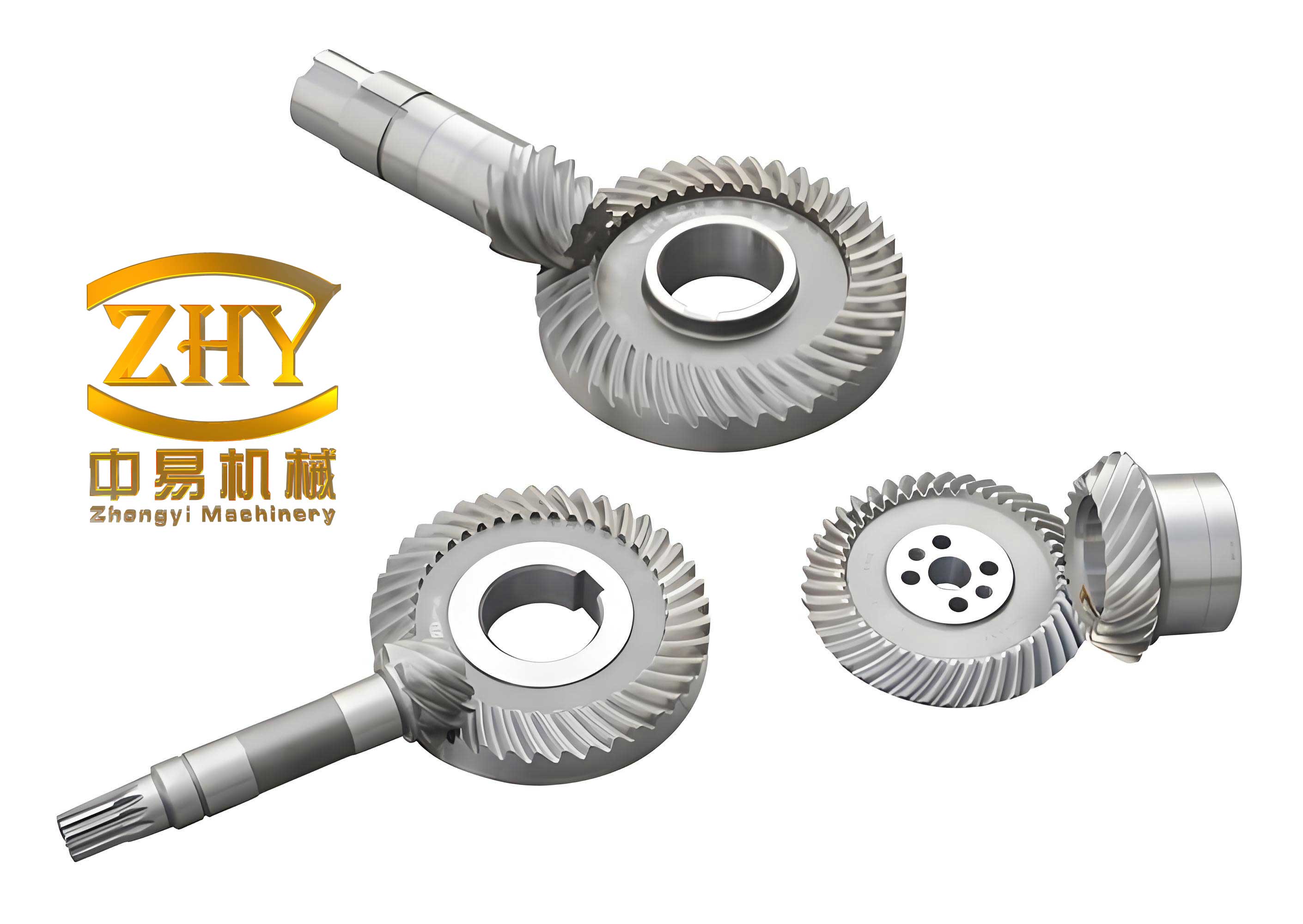
The geometry of a hypoid gear pair is defined by an axis crossing angle $\Sigma$, an offset distance $E$, and the pitch cone angles $\delta_1$ and $\delta_2$ for the pinion and gear, respectively. The pitch cones are tangent at a point $P$, which lies on a common pitch plane. The tooth surfaces contact along a line at any instant, and at point $P$, we establish a critical coordinate system. The $z$-axis is the common tooth surface normal at $P$, directed from the pinion tooth body outward. The $x$-axis is aligned with the tangent to the tooth trace (the line of intersection between the tooth surface and the pitch plane) at $P$. The $y$-axis completes the right-handed system ($y = z \times x$). The spiral angle $\beta$ and pressure angle $\alpha$ at $P$ are defined relative to this local frame.
Let $\vec{\omega}^{(1)}$ and $\vec{\omega}^{(2)}$ be the angular velocity vectors of the pinion and gear, with a constant speed ratio $i_{12} = \omega_1 / \omega_2$. For simplicity in derivation, we can set $\omega_1 = 1$, making $\omega_2 = 1/i_{12}$. The relative angular velocity $\vec{\omega}^{(12)} = \vec{\omega}^{(1)} – \vec{\omega}^{(2)}$ and the relative sliding velocity $\vec{v}^{(12)}$ at $P$ are foundational for analyzing meshing conditions. Their projections onto the $(x, y, z)$ frame yield the kinematic basis for all subsequent curvature analysis.
Induced Normal Curvature and Contact Line Direction
The core of hypoid gear tooth contact analysis lies in understanding the second-order properties of the mating surfaces. The induced normal curvature in a given direction on the common tangent plane measures the difference in normal curvatures of the two surfaces in that direction. The direction where this induced curvature is zero defines the instantaneous contact line. For a hypoid gear pair at point $P$, the direction angle $\theta$ of the contact line relative to the $x$-axis, and the induced normal curvature $\kappa_\nu^{(12)}$ in an arbitrary direction $\nu$, are derived from the fundamental equations of gearing.
The formula for the contact line direction angle $\theta$ is:
$$\tan\theta = -\frac{(\vec{\omega}^{(12)} \cdot \vec{y})}{(\vec{\omega}^{(12)} \cdot \vec{x}) + \frac{v_x^{(12)}}{\rho}}$$
where $\rho$ is related to the pitch cone geometry. For a hypoid gear, substituting the expressions for $\vec{\omega}^{(12)}$ and $\vec{v}^{(12)}$ leads to a specific form. The induced normal curvature in the $x$-direction, $\kappa_x^{(12)}$, is particularly important and is given by:
$$\kappa_x^{(12)} = \frac{(\vec{\omega}^{(12)} \cdot \vec{y})^2 – (\vec{\omega}^{(12)} \cdot \vec{x})(\vec{\omega}^{(12)} \cdot \vec{x} + \frac{2v_x^{(12)}}{\rho})}{v_x^{(12)} (\vec{\omega}^{(12)} \cdot \vec{x} + \frac{v_x^{(12)}}{\rho})}$$
After extensive algebraic manipulation using the hypoid gear geometry, this can be expressed in terms of fundamental design parameters: spiral angles $\beta_1, \beta_2$, pressure angle $\alpha$, pitch angles, and offset.
A crucial case arises when the $x$-direction is a principal direction for the gear tooth surface (often true for generated or form-cut gears). If $\tau_x^{(2)} = 0$ (the geodesic torsion is zero), the formulas simplify significantly. Let $\Delta\beta = \beta_1 – \beta_2$ and introduce the so-called “limit pressure angle” $\alpha_0$ which satisfies $\tan\alpha_0 = \sin\Sigma / (i_{12} + \cos\Sigma)$. Then the expressions become more manageable:
$$\tan\theta = \frac{\sin\Delta\beta}{\cos\Delta\beta – \frac{\sin\beta_1 \sin\beta_2}{\sin\alpha \sin\alpha_0}}$$
$$\kappa_x^{(12)} = \frac{1}{\rho} \left[ \frac{\tan(\alpha – \alpha_0)}{\tan\alpha} \cdot \frac{\sin^2\beta_2}{\sin\Delta\beta} – \frac{\tan(\alpha + \alpha_0)}{\tan\alpha} \cdot \frac{\sin^2\beta_1}{\sin\Delta\beta} \right]$$
These equations are fundamental for predicting the contact pattern behavior of a hypoid gear set.
Tooth Surface Modification and the Principle of Localization
In practice, perfect line contact in hypoid gears is neither achievable nor desirable due to alignment errors and deflection. The goal is to produce a controlled point contact with a favorable elliptical contact pattern (heel-toe and profile orientation). This is accomplished by modifying the pinion tooth surface during cutting so that it deviates slightly from the theoretically conjugate surface, matching only up to second-order terms (curvatures) at the design point $P$. This process is called “localization.”
The condition for second-order approximation (localization) is that the difference between the pinion surface curvatures and the conjugate-to-the-gear surface curvatures must be precisely controlled. If we ensure the modified pinion surface has the same normal curvature and geodesic torsion as the theoretical conjugate surface in two independent directions (e.g., the $x’$ and $y’$ directions of the pinion’s root plane) at $P$, then the mismatch will be of third- or higher-order, creating a localized bearing contact.
Determining the Generating Gear in the Semi-Finish with Cutter Tilt Method
The Semi-Finish method with Cutter Tilt is a sophisticated process for finishing hypoid pinions. The gear is cut non-generated with a cutter whose axis is perpendicular to the gear’s root plane. The pinion is cut in a generated process, where its teeth are enveloped by a virtual generating gear (or crown gear) represented by the cutter blade swing. The key is to determine the parameters of this virtual generating gear to achieve the desired localized contact with the physically cut gear.
The Original Generating Gear
We first conceive an original generating gear that meshes with the pinion in a non-offset hypoid relationship (i.e., their axes intersect). Its geometry is determined by enforcing the second-order contact condition at point $P$. Let the pinion root plane parameters be known: root angle $\delta_{f1}$, root spiral angle $\beta_{f1}$, root pressure angle $\alpha_{f1}$, and pitch point distance $r_{1P}$. Let the generating gear’s corresponding parameters be denoted with superscript $(g)$: $\delta^{(g)}$, $\beta^{(g)}$, $\alpha^{(g)}$, $r_{P}^{(g)}$.
The condition for the pinion surface generated by this gear to have the target curvatures $\kappa_{x’}^{(1)}$ and $\tau_{x’}^{(1)}$ (which are derived from the gear tooth curvatures and the desired meshing conditions) leads to a system of equations. The unknowns are the generating gear’s spiral angle $\beta^{(g)}$, its pitch angle complement $\xi^{(g)}$ (where $\xi^{(g)} = 90^\circ – \delta^{(g)}$), and the equivalent cutter radius $R_{c1}^{(g)}$ at point $P$.
Solving this system yields unique values:
$$\tan\xi^{(g)} = \frac{\sin\beta_{f1}}{\tan\theta’}$$
$$\tan\beta^{(g)} = \frac{\cos\beta_{f1}}{\tan(\alpha_{f1} – \alpha_0′)}$$
$$R_{c1}^{(g)} = \frac{r_{1P} \sin\alpha_{f1}}{\cos\beta_{f1} \cos(\alpha_{f1} – \alpha_0′)}$$
Here, $\theta’$ and $\alpha_0’$ are the contact direction angle and limit pressure angle calculated for the pinion-root-plane coordinate system $(x’, y’, z’)$.
This original generating gear provides the correct second-order matching but may not yield an optimal contact pattern shape (e.g., it might cause diagonal or “kinked” contact).
The Practical Generating Gear
To optimize the contact pattern, a crucial modification is introduced: the pitch cone distance (or “length”) of the generating gear is altered. We choose a practical value $r_{Pp}^{(g)}$ different from the original $r_{P}^{(g)}$. The modification $\Delta r_P$ is:
$$\Delta r_P = \frac{1}{r_{Pp}^{(g)}} – \frac{1}{r_{P}^{(g)}}$$
To maintain the same second-order contact conditions at $P$ (i.e., the same pinion surface curvatures), we must now allow an offset between the pinion and the practical generating gear. This transforms their mesh into a true hypoid gear pair with non-intersecting axes. The goal is to find the new parameters of this practical generating gear—its spiral angle $\beta_p^{(g)}$ and pitch angle $\delta_p^{(g)}$ (and consequently its offset relative to the pinion)—while keeping the equivalent cutter radius $R_{c1}^{(g)}$ and the target pinion curvatures constant.
By equating the curvature generation conditions for the original and practical generating gears, we can solve for the new parameters. The defining equations become:
$$\tan\beta_p^{(g)} = \frac{\cos\beta_{f1}}{\tan(\alpha_{f1} – \alpha_0′)} \cdot \frac{1}{1 + r_{1P} \cdot \Delta r_P \cdot F}$$
and
$$\sin\delta_p^{(g)} = \sin\delta_{f1} \cdot \frac{\tan\beta_{f1}}{\tan\beta_p^{(g)}}$$
where $F$ is a function of the basic geometric parameters. The offset $E_g$ of the practical generating gear axis from the pinion axis can then be calculated from the solved geometry.
By strategically choosing $\Delta r_P$ (often termed “length correction” or “ratio of roll”), the engineer can control the orientation and size of the contact ellipse on the pinion tooth, moving it toe-ward or heel-ward to optimize load distribution and reduce sensitivity to misalignment. This flexibility makes the Semi-Finish with Cutter Tilt method extremely powerful for manufacturing high-performance hypoid gear sets.
| Parameter | Original Generating Gear | Practical Generating Gear |
|---|---|---|
| Relationship to Pinion | Non-offset, intersecting axes | Offset, non-intersecting axes (true hypoid mesh) |
| Pitch Cone Distance $r_P^{(g)}$ | Uniquely determined by curvature matching | Chosen freely as a design variable ($r_{Pp}^{(g)}$) |
| Spiral Angle $\beta^{(g)}$ | Fixed by theory | Adjusted ($\beta_p^{(g)}$) to maintain curvatures with the new $r_{Pp}^{(g)}$ |
| Primary Purpose | Establishes baseline second-order contact | Optimizes contact pattern location and shape via $\Delta r_P$ |
Extension to Other Manufacturing Methods
The principles outlined here are not limited to the Semi-Finish method. They form the theoretical backbone for the design and analysis of all modern hypoid gear generating processes. For instance:
- In the Formate method, the gear is non-generated, and the pinion is generated against a virtual generating gear whose geometry is directly derived from the gear cutter head. The curvature analysis ensures the pinion is correctly modified to localize contact with the formate-cut gear.
- In the Helixform method, both members are generated. The complex machine settings for both the gear and pinion cutting processes are calculated to produce a pair whose tooth surfaces have predetermined relative curvatures at the design point, ensuring optimal meshing from the start.
In all cases, the fundamental task is to solve the “inverse problem” of gear generation: Given the desired meshing condition (contact path, bearing pattern) between the final hypoid gear pair, determine the machine settings (cutter geometry, tilt, rotational ratios, offsets) that will produce the required tooth surface modifications on the work gear. The equations for induced curvature and contact line direction are the essential tools for this task.
Conclusion
The meshing of hypoid gears is governed by precise geometric and kinematic relationships. A deep understanding of the induced normal curvature and the direction of the instantaneous contact line is paramount. These concepts, rooted in the theory of second-order surface generation, provide the analytical framework needed to design and manufacture high-quality hypoid gear pairs. By applying these principles, specifically through the calculation of original and practical generating gear parameters, manufacturing methods like the Semi-Finish with Cutter Tilt can be optimized. This process translates theoretical conjugate action into a robust, localized bearing contact that accommodates real-world imperfections, ensuring the smooth, quiet, and efficient operation that modern hypoid gear drives are known for. The ability to control curvature through machine setting calculations remains the definitive link between hypoid gear design theory and its successful practical application in automotive and industrial drivetrains.
| Quantity | General Symbol | Key Formula / Dependency |
|---|---|---|
| Relative Angular Velocity | $\vec{\omega}^{(12)}$ | $\vec{\omega}^{(1)} – \vec{\omega}^{(2)}$; function of $\Sigma$, $i_{12}$, $\beta_1$, $\beta_2$. |
| Sliding Velocity at $P$ | $\vec{v}^{(12)}$ | $\vec{\omega}^{(1)} \times \vec{r}_1 – \vec{\omega}^{(2)} \times \vec{r}_2$; lies in pitch plane. |
| Contact Line Direction Angle | $\theta$ | $\tan\theta = \frac{\sin\Delta\beta}{\cos\Delta\beta – \frac{\sin\beta_1 \sin\beta_2}{\sin\alpha \sin\alpha_0}}$ (simplified case). |
| Induced Normal Curvature ($x$-dir) | $\kappa_x^{(12)}$ | Complex function of $\rho$, $\alpha$, $\alpha_0$, $\beta_1$, $\beta_2$, $\Delta\beta$. Governs contact ellipse size. |
| Limit Pressure Angle | $\alpha_0$ | $\tan\alpha_0 = \frac{\sin\Sigma}{i_{12} + \cos\Sigma}$. A fundamental design parameter. |
| Pinion Surface Target Curvature | $\kappa_{x’}^{(1)}$ | $\kappa_{x’}^{(1)} = \kappa_{x’}^{(2)} + \kappa_{x’}^{(12)}$, where $\kappa_{x’}^{(2)}$ is gear tooth curvature. |