
In modern engineering, helical gears are fundamental components in power transmission systems due to their smooth operation and high load-carrying capacity. Achieving high precision in helical gears is critical, and grinding is often the final machining process to ensure accuracy. Among various grinding methods, worm wheel grinding stands out for its efficiency and precision. In this article, I will delve into the shaping principles and error characteristics of helical gears when ground using a worm wheel grinding machine. My discussion is based on the characteristic line groups of involute helical surfaces, which provide a robust framework for understanding gear geometry and machining errors. Throughout this exploration, I will emphasize the role of helical gears in manufacturing and how their unique features influence grinding outcomes. I aim to present a comprehensive analysis that incorporates mathematical models, tables, and formulas to summarize key concepts, making this accessible for engineers and researchers alike.
To begin, let me introduce the involute helical surface, which is the tooth flank of helical gears. This surface can be described mathematically using a coordinate system. Consider a reference frame rotating around the Z-axis, denoted as \( O, \{\mathbf{e}(\phi), \mathbf{e}_1(\phi), \mathbf{k}\} \), where \(\mathbf{e}(\phi)\) and \(\mathbf{e}_1(\phi)\) are unit vectors in the radial and tangential directions, respectively, and \(\mathbf{k}\) is the axial unit vector. The equation of the involute helical surface is given by:
$$\mathbf{r} = R_b \mathbf{e}(\lambda + \theta) – R_b \lambda \mathbf{e}_1(\lambda + \theta) + z \mathbf{k},$$
where \(R_b\) is the base circle radius, \(\lambda\) is the unfolding angle, \(\theta\) is the involute rotation angle, and \(z\) is the displacement parameter. For helical gears, the relationship between \(\theta\) and \(z\) is defined by the base helix angle \(\beta_b\):
$$z = \frac{R_b}{\tan \beta_b} \theta.$$
Substituting this into the general equation yields the specific form for involute helical surfaces:
$$\mathbf{r} = R_b \mathbf{e}(\lambda + \theta) – R_b \lambda \mathbf{e}_1(\lambda + \theta) + \frac{R_b \theta}{\tan \beta_b} \mathbf{k}.$$
This representation highlights four characteristic line groups on the surface: the involute, helix, straight generatrix, and contact trace. Each group plays a pivotal role in shaping helical gears during grinding. The involute lines represent the cross-sectional profile, the helix lines correspond to the tooth direction, the straight generatrices are instantaneous contact lines in mesh, and the contact traces are paths of points where the gear engages with the grinding wheel. Understanding these lines is essential for analyzing the shaping principles of worm wheel grinding machines.
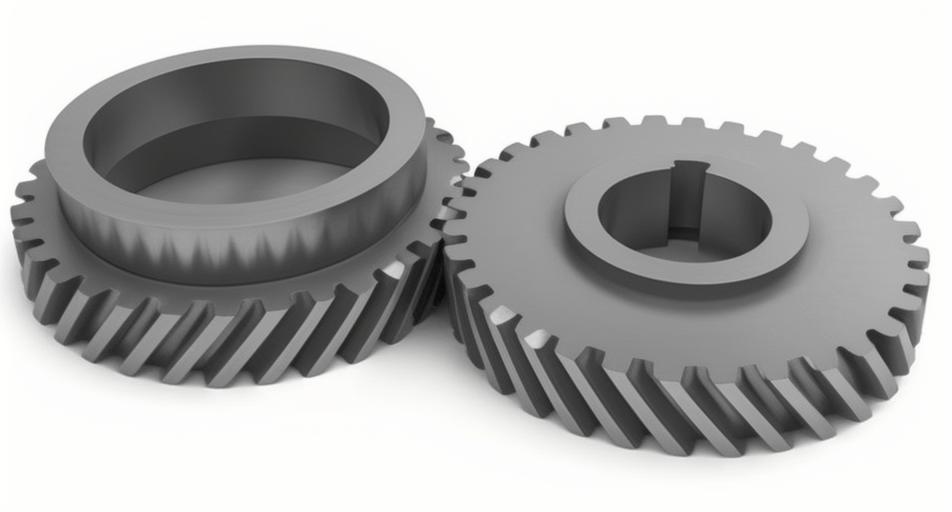
The worm wheel grinding machine operates on the continuous generating principle, where a worm-shaped grinding wheel engages with the helical gear workpiece. The wheel rotates, and for each revolution, the workpiece turns by one tooth pitch, while axial feed and differential motions are applied to grind the entire tooth flank. This process is highly efficient, making it suitable for mass production of small to medium-sized helical gears. From my perspective, the shaping principle can be derived from the characteristic line groups. Specifically, the machine constructs the gear surface by generating a network of contact traces and helix lines. When the wheel and workpiece rotate without axial feed, a single contact trace is ground. Then, with axial feed and differential motion, a helix line—referred to as the starting line—is formed. By combining these movements, multiple contact traces are generated along the helix, ultimately creating the complete involute helical surface. This approach ensures that the gear geometry adheres to the theoretical design, but errors can arise due to machine inaccuracies.
To formalize the shaping principle, let me define key parameters. The worm wheel grinding machine, such as the NZA type, involves a fixed transmission ratio between the wheel and workpiece, maintained by the indexing chain. The axial feed \(f_a\) and differential motion \(\Delta \omega\) are controlled to achieve the desired helix angle. The contact trace on the helical gear surface satisfies the engagement condition with the grinding wheel. For a given point on the surface, the contact trace can be expressed as a function of \(\lambda\) and \(\theta\). In practice, the machine sequentially grinds contact traces at starting points \(Q_1, Q_2, Q_3, \ldots\) along the helix, as shown in the figure above. This process constructs the surface from two families of lines: contact traces and helices. The table below summarizes the role of each characteristic line group in shaping helical gears.
| Characteristic Line Group | Mathematical Description | Role in Shaping Helical Gears |
|---|---|---|
| Involute | \(\theta = \text{constant}\) in the surface equation | Defines the cross-sectional profile; used for profile error assessment. |
| Helix | \(\lambda = \text{constant}\) leads to \(x^2 + y^2 = R_b^2(1+\lambda^2)\) and \(z = \frac{R_b \theta}{\tan \beta_b}\) | Represents the tooth direction; basis for helix error analysis. |
| Straight Generatrix | \(\lambda + \theta = \text{constant}\) gives a straight line tangent to the base cylinder | Serves as instantaneous contact line; influences contact precision. |
| Contact Trace | Points satisfying meshing conditions with the grinding wheel | Directly ground by the machine; affects overall surface accuracy. |
Moving to error characteristics, the grinding process introduces deviations that impact the quality of helical gears. Based on the shaping principle, errors can be categorized into surface errors, helix errors, profile errors, and straight generatrix errors. Each type stems from specific machine inaccuracies and interacts with the characteristic line groups. For instance, surface errors result from a combination of contact trace errors and helix errors. Since the worm wheel grinding machine generates contact traces periodically, any radial or tangential error in the wheel rotation—often with a period equal to the wheel revolution—propagates to the gear surface. This causes contact trace errors that are consistent along the helix lines, meaning that at starting points, all contact traces exhibit similar error magnitudes. I can represent this mathematically by considering an error function \(E_c(\lambda, \theta)\) for contact traces, which depends on machine kinematics.
Helix errors, on the other hand, primarily arise from inaccuracies in the differential chain or incorrect setup of the crossing angle between the wheel and workpiece. The differential chain controls the relative motion that forms the helix, so its periodic errors lead to cyclical variations in the helix line. If there is a constant error, such as an incorrect helix angle, it is usually due to misadjustment of the crossing angle. The helix error \(E_h(z)\) can be modeled as:
$$E_h(z) = A \sin\left(\frac{2\pi z}{P_s} + \phi\right) + B,$$
where \(A\) is the amplitude, \(P_s\) is the helix pitch, \(\phi\) is the phase, and \(B\) is a constant offset. This error directly affects the tooth direction of helical gears, impacting their meshing smoothness.
Profile errors are a synthesis of contact trace errors and helix errors. In worm wheel grinding, the profile is not directly ground as an involute; instead, it is constructed from contact traces. Therefore, the profile error \(E_p(\lambda)\) at a given cross-section is influenced by both \(E_c\) and \(E_h\). If helix errors are negligible, the profile error remains consistent across different sections along the tooth width, as shown in the table below. This consistency is a key advantage of worm wheel grinding, but it can be compromised by significant contact trace errors.
| Error Type | Primary Source | Effect on Helical Gears | Mathematical Expression |
|---|---|---|---|
| Surface Error | Wheel rotation errors and contact trace inaccuracies | Overall deviation of the tooth flank; impacts load distribution. | \(E_s = E_c + E_h\) |
| Helix Error | Differential chain inaccuracies or crossing angle misadjustment | Tooth direction deviations; causes noise and vibration. | \(E_h(z) = f(\text{differential error})\) |
| Profile Error | Combination of contact trace and helix errors | Cross-sectional shape inaccuracies; affects gear meshing quality. | \(E_p(\lambda) = g(E_c, E_h)\) |
| Straight Generatrix Error | Derived from profile and helix errors | Instantaneous contact line deviations; reduces contact precision. | \(E_g = E_p + E_h\) |
To deepen the analysis, let me discuss the straight generatrix error, which is crucial for the contact performance of helical gears. The straight generatrices are lines on the tooth surface that represent instantaneous contact during meshing. Errors in these lines directly affect the contact pattern and stress distribution. Since straight generatrices are composed of points from involute and helix lines, their error \(E_g\) is a composite of profile error \(E_p\) and helix error \(E_h\). In worm wheel grinding, if contact trace errors are significant, they propagate to the straight generatrices, leading to poor contact conditions. This highlights the importance of minimizing contact trace errors to enhance the accuracy of helical gears.
From a practical standpoint, I recommend focusing on machine calibration to reduce errors. For example, regular maintenance of the indexing and differential chains can mitigate periodic errors. Additionally, precise adjustment of the crossing angle ensures correct helix angles. The table below provides guidelines for error control in worm wheel grinding of helical gears, based on my experience.
| Machine Component | Potential Error | Impact on Helical Gears | Control Measure |
|---|---|---|---|
| Indexing Chain | Periodic radial or tangential errors | Contact trace errors; surface inaccuracies. | Use high-precision encoders; regular lubrication. |
| Differential Chain | Cyclical or constant errors | Helix errors; incorrect tooth direction. | Calibrate with laser interferometry; optimize gear ratios. |
| Wheel Alignment | Crossing angle misalignment | Constant helix error; profile deviations. | Employ digital alignment tools; verify with test cuts. |
| Axial Feed System | Backlash or nonlinearity | Uneven material removal; surface roughness issues. | Implement closed-loop control; use linear guides. |
In terms of mathematical modeling, the error characteristics can be further analyzed using differential geometry. The involute helical surface has curvature properties that influence error propagation. The normal curvature \(\kappa_n\) along a direction on the surface can be expressed as:
$$\kappa_n = \frac{L du^2 + 2M du dv + N dv^2}{E du^2 + 2F du dv + G dv^2},$$
where \(E, F, G\) are the first fundamental form coefficients, and \(L, M, N\) are the second fundamental form coefficients, derived from the surface equation. Errors in grinding alter these coefficients, leading to deviations in curvature and, consequently, in gear performance. For helical gears, minimizing curvature errors is vital for ensuring smooth transmission and longevity.
To conclude, worm wheel grinding is an effective method for producing high-precision helical gears, but its accuracy depends on a thorough understanding of shaping principles and error characteristics. By leveraging the characteristic line groups—involute, helix, straight generatrix, and contact trace—I have shown how the gear surface is constructed and where errors originate. My analysis indicates that contact trace errors are often the limiting factor in achieving superior accuracy, so future research should focus on optimizing wheel design and machine dynamics. Additionally, advanced monitoring techniques, such as in-process measurement, can help real-time error correction. As helical gears continue to be integral in industries like automotive and aerospace, refining grinding processes will remain a key engineering challenge. Through this discussion, I hope to contribute to the ongoing efforts to enhance the manufacturing of helical gears, ensuring they meet the stringent demands of modern applications.
Finally, I emphasize that the principles outlined here are not only theoretical but also practical. Engineers can apply these insights to troubleshoot grinding issues and improve gear quality. By integrating mathematical models with empirical data, we can push the boundaries of precision manufacturing for helical gears. I encourage further exploration into adaptive control systems and digital twins for worm wheel grinding machines, as these technologies hold promise for reducing errors and increasing efficiency. In summary, the journey toward perfect helical gears is ongoing, and with continued innovation, we can achieve even higher standards of excellence.