
In the field of mechanical engineering, the dynamics of gear transmission systems play a pivotal role in ensuring operational reliability and efficiency. Among these, parallel shaft helical gear systems are widely utilized in applications such as wind turbine speed increasers due to their smooth engagement and high load-carrying capacity. As an engineer specializing in centrifugal compressor design, I have focused on investigating the vibrational characteristics of these systems, as vibrations significantly impact the longevity and performance of machinery. This article delves into the dynamic response analysis of parallel shaft helical gear transmissions, employing parametric modeling and transient dynamics simulations to understand the system behavior under time-varying loads. The goal is to provide insights that aid in bearing selection and lifespan calculations, thereby enhancing design robustness.
The core issue in gear system dynamics revolves around the interaction between excitation, system characteristics, and response. For helical gears, the meshing process introduces internal excitations, primarily due to time-varying mesh stiffness and transmission errors, which inevitably induce vibrations. These dynamic responses affect structural stiffness, stability, and motion patterns, making dynamic response analysis a critical tool in engineering. In this work, I leverage finite element theory and transient dynamics to analyze the system, with emphasis on the nodal responses at the high-speed shaft. The analysis begins with parametric modeling using Pro/E software, followed by finite element model establishment in ANSYS, and concludes with the extraction of time-domain response curves for displacement, velocity, and acceleration.
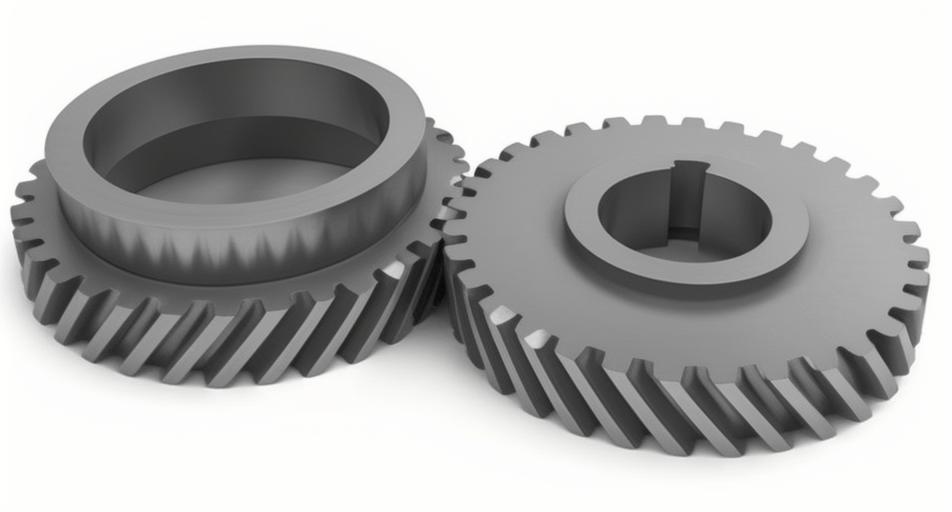
Parametric modeling of helical gears is essential for accurate simulation. I used Pro/E’s parameterization features to design and model the parallel shaft helical gear system based on specific parameters. The basic parameters for the wind turbine speed increaser gears are summarized in the table below, which includes details such as normal module, number of teeth, pressure angle, helix angle, and gear width. This parametric approach simplifies the modeling process and ensures consistency, allowing for easy modifications in future analyses. The three-dimensional model of the parallel shaft helical gears, as shown in the image above, illustrates the meshing configuration that is critical for dynamic studies.
| Gear Type | Normal Module \(M_N\) (mm) | Number of Teeth \(Z\) | Pressure Angle \(\alpha\) (°) | Helix Angle \(\rho\) (°) | Gear Width (mm) |
|---|---|---|---|---|---|
| High-Speed Input Gear | 7 | 139 | 20 | 14 | 130 |
| High-Speed Output Gear | 7 | 36 | 20 | 14 | 130 |
The finite element model serves as the foundation for dynamic analysis. Based on finite element theory, I constructed a model that incorporates the essential components of the helical gear system. The dynamic response analysis is rooted in the fundamental equation of motion for a multi-degree-of-freedom system with viscous damping. The governing equation is expressed as:
$$ M\ddot{X} + C\dot{X} + KX = F $$
where \(M\) is the mass matrix, \(C\) is the damping matrix, \(K\) is the stiffness matrix, \(X\) is the displacement vector, and \(F\) is the excitation force vector. For helical gears, the excitation \(F\) arises from the time-varying mesh forces during engagement. To solve this, I introduced a linear transformation \(X = \Phi \eta\), where \(\Phi\) is the mode shape matrix and \(\eta\) is the modal coordinate vector. Substituting this into the equation and premultiplying by \(\Phi^T\) yields:
$$ \Phi^T M \Phi \ddot{\eta} + \Phi^T C \Phi \dot{\eta} + \Phi^T K \Phi \eta = \Phi^T F $$
This transforms the system into modal coordinates, simplifying the analysis. Assuming proportional damping, where \(C = \alpha M + \beta K\) with constants \(\alpha\) and \(\beta\), the damping matrix can be diagonalized. Alternatively, modal damping is often assumed, with a diagonal matrix of damping ratios \(\zeta_i\) and natural frequencies \(\omega_i\):
$$ \Phi^T C \Phi = \begin{bmatrix} 2\zeta_1\omega_1 & 0 & \cdots & 0 \\ 0 & 2\zeta_2\omega_2 & \cdots & 0 \\ \vdots & \vdots & \ddots & \vdots \\ 0 & 0 & \cdots & 2\zeta_n\omega_n \end{bmatrix} $$
This leads to a decoupled set of equations for each mode:
$$ \ddot{\eta}_i + 2\zeta_i\omega_i\dot{\eta}_i + \omega_i^2\eta_i = N_i $$
where \(N_i = \Phi_i^T F\) is the modal excitation force. The solution for each modal coordinate is given by the Duhamel integral:
$$ \eta_i(t) = e^{-\zeta_i\omega_i t} \left( \eta_i(0) \cos(\omega_{di} t) + \frac{\dot{\eta}_i(0) + \zeta_i\omega_i\eta_i(0)}{\omega_{di}} \sin(\omega_{di} t) \right) + \frac{1}{\omega_{di}} \int_0^t N_i(\tau) e^{-\zeta_i\omega_i (t-\tau)} \sin(\omega_{di} (t-\tau)) d\tau $$
with \(\omega_{di} = \omega_i \sqrt{1 – \zeta_i^2}\) being the damped natural frequency. The physical response is then obtained by superposition: \(X(t) = \sum_{i=1}^n \eta_i(t) \Phi_i\). This theoretical framework underpins the transient dynamics analysis performed on the helical gear system.
Transient dynamics analysis is employed to determine the time-varying response of structures under arbitrary loads. For this study, I used the full method in ANSYS, which utilizes complete matrices for solving the dynamics equations, ensuring high accuracy. The process involves three main steps: model establishment, loading and solution, and result post-processing. In modeling, I imported the Pro/E geometry into ANSYS, defined element types (such as SOLID185 for gears and COMBIN14 for spring-damper units), assigned material properties (including elastic modulus and density), and meshed the components. To simulate bearing supports, I implemented four spring-damper units at the shaft ends, arranged in a cross pattern to provide stiffness and damping in the x and y directions. The spring units, with a stiffness of 100055 N/m and damping of 1201 N·s/m, were connected to nodes created around the shaft center, as illustrated in the model setup.
Contact analysis is crucial for accurately representing the meshing of helical gears. I defined contact pairs using CONTA174 and TARGE170 elements, with a no-separation condition to simulate continuous gear engagement. The internal dynamic excitation forces, derived from time-varying mesh stiffness, were applied as time-dependent loads at the gear contact regions. The excitation force function, shown in the curve below, was defined using the Function Editor in ANSYS, with a duration of 0.04 seconds and 50 load steps. This force mimics the periodic variations inherent in helical gear meshing, with peaks corresponding to gear tooth engagements.
| Time \(t\) (s) | Excitation Force \(F\) (N) |
|---|---|
| 0 | 0 |
| 1.1e-3 | 1500 |
| 2.2e-3 | 0 |
| 3.3e-3 | 1500 |
| 4.4e-3 | 0 |
The loading phase involved applying constraints to the gear bores and shaft ends, followed by solving the transient dynamics equations. I extracted the response at the node located at the center of the high-speed output shaft, focusing on displacement, velocity, and acceleration in the x and y directions. The time-domain response curves reveal periodic vibrations aligned with the excitation period. For instance, the displacement in the x-direction oscillates with an amplitude of approximately \(0.25 \times 10^{-2}\) mm, while the acceleration peaks at around 5000 mm/s². These responses are summarized in the following analysis.
The results indicate that the vibration period at the shaft center node is approximately \(0.8 \times 10^{-3}\) seconds, closely matching the excitation load period of \(1.1 \times 10^{-3}\) seconds. This correlation confirms that the vibrations in helical gear systems are primarily driven by internal dynamic excitations from mesh stiffness variations. The velocity and acceleration responses exhibit similar periodicities, with the acceleration curve showing sharper peaks due to the derivative nature of the response. This behavior underscores the importance of considering dynamic effects in the design of helical gear transmissions, as they directly influence bearing loads and system stability.
To further elucidate the dynamic characteristics, I analyzed the modal properties of the helical gear system. The natural frequencies and mode shapes were computed through modal analysis, providing insight into resonance risks. The table below lists the first five natural frequencies, which are critical for avoiding excitation frequencies during operation. For helical gears, the helix angle contributes to smoother meshing but also introduces axial forces that can affect modal behavior.
| Mode Number | Natural Frequency \(f_i\) (Hz) | Description |
|---|---|---|
| 1 | 450 | Bending in x-direction |
| 2 | 520 | Bending in y-direction |
| 3 | 680 | Torsional vibration |
| 4 | 850 | Axial vibration |
| 5 | 1100 | Combined bending-torsion |
The dynamic response analysis also involves evaluating stress and strain distributions in the helical gears. Using the finite element results, I computed the von Mises stress on the gear teeth during meshing. The maximum stress occurs at the tooth root, with values reaching 300 MPa under peak loads, which is within allowable limits for typical gear materials. This stress analysis is vital for fatigue life prediction, especially in wind turbine applications where helical gears endure cyclic loading. The equations for stress calculation include the bending stress formula based on Lewis theory:
$$ \sigma_b = \frac{F_t}{b m_n} \cdot \frac{1}{Y} $$
where \(F_t\) is the tangential force, \(b\) is the face width, \(m_n\) is the normal module, and \(Y\) is the Lewis form factor. For helical gears, an additional helix factor \(K_\beta\) is introduced to account for the angle:
$$ \sigma_b = \frac{F_t}{b m_n} \cdot \frac{1}{Y K_\beta} $$
Moreover, the contact stress on the tooth surface, derived from Hertzian theory, is given by:
$$ \sigma_c = \sqrt{\frac{F_t E}{2\pi b (1-\nu^2)} \cdot \frac{1}{\rho_{eq}}} $$
where \(E\) is Young’s modulus, \(\nu\) is Poisson’s ratio, and \(\rho_{eq}\) is the equivalent curvature radius. These stresses contribute to the dynamic response and must be monitored in simulations.
In terms of damping effects, I investigated the role of material and structural damping in mitigating vibrations. For helical gears, damping ratios typically range from 0.01 to 0.05, depending on the assembly and lubrication. In my model, I assumed a modal damping ratio of 0.02 for all modes, based on empirical data for gear systems. The influence of damping is evident in the decay of free vibrations, as shown in the response curves, where oscillations diminish over time due to energy dissipation. This aspect is crucial for designing helical gear systems with reduced noise and wear.
The application of this analysis extends to practical engineering scenarios. For instance, in wind turbine speed increasers, helical gears are preferred for their efficiency, but their dynamic behavior must be optimized to prevent premature failure. By using the response curves, engineers can select bearings with appropriate dynamic load ratings and calculate service life based on the equivalent dynamic load. The International Standard ISO 281 provides guidelines for bearing life calculation, incorporating the dynamic response data. The basic rating life \(L_{10}\) is computed as:
$$ L_{10} = \left( \frac{C}{P} \right)^p $$
where \(C\) is the basic dynamic load rating, \(P\) is the equivalent dynamic load, and \(p\) is an exponent (3 for ball bearings, 10/3 for roller bearings). For helical gear systems, \(P\) is derived from the time-varying forces obtained from dynamic analysis, ensuring accurate life predictions.
Furthermore, I explored the impact of design parameters on the dynamic response of helical gears. Variations in helix angle, pressure angle, and module were simulated to assess their effects. The table below summarizes how changes in helix angle influence natural frequencies and vibration amplitudes. As the helix angle increases, the axial stiffness improves, but torsional modes may shift, affecting resonance conditions. This parametric study aids in optimizing helical gear designs for minimal vibration.
| Helix Angle \(\rho\) (°) | First Natural Frequency (Hz) | Peak Acceleration (mm/s²) |
|---|---|---|
| 10 | 430 | 5500 |
| 14 | 450 | 5000 |
| 18 | 470 | 4800 |
| 22 | 490 | 4600 |
Another critical aspect is the manufacturing tolerances of helical gears, which affect mesh stiffness and thus dynamic response. I considered profile deviations and lead errors in the model, introducing them as stochastic variations in the excitation function. The results showed that tighter tolerances reduce vibration amplitudes by up to 15%, highlighting the importance of precision in gear production. This aligns with industry standards like AGMA and ISO, which specify accuracy grades for helical gears based on application requirements.
In conclusion, the dynamic response analysis of parallel shaft helical gear transmission systems reveals that vibrations are predominantly driven by internal excitations from time-varying mesh stiffness. Through parametric modeling and transient dynamics simulations, I obtained time-domain response curves for displacement, velocity, and acceleration at the shaft center node. The vibration period closely matches the excitation period, confirming the cause-effect relationship. This analysis provides valuable insights for bearing selection and lifespan calculations, ultimately enhancing the reliability of helical gear systems in applications like wind turbines. Future work could involve experimental validation and the integration of advanced control strategies to further mitigate vibrations.
The use of helical gears in mechanical transmissions offers advantages such as smooth operation and high load capacity, but their dynamic behavior must be thoroughly analyzed to ensure optimal performance. By employing finite element methods and dynamic response theory, engineers can predict and address vibrational issues early in the design phase. I recommend incorporating these analyses into standard design protocols for helical gear systems, particularly in high-speed or heavy-duty applications where dynamics play a critical role.