
In the realm of locomotive traction systems, the bevel gear plays a critical role in transmitting power efficiently, especially in differential and drive assemblies. As an engineer focused on advancing manufacturing processes, I have explored the use of computational tools to optimize the heat treatment of these bevel gears, specifically those made from 20CrMnTi steel. Heat treatment is essential for achieving desired mechanical properties, such as high surface hardness and core toughness, but traditional methods often lead to defects like distortion, uneven carburizing depth, and residual stresses. Through this study, I leverage DEFORM software V6.1 to simulate the heat treatment process, aiming to predict and mitigate these issues, thereby enhancing the performance and longevity of locomotive traction bevel gears.
The importance of bevel gears in traction applications cannot be overstated; they must withstand high loads and cyclic stresses, making material integrity paramount. 20CrMnTi is a low-alloy carburizing steel commonly used for such bevel gears due to its good hardenability and strength. However, its heat treatment involves complex phase transformations and thermal gradients that can induce deformation. My approach integrates finite element analysis (FEA) with multi-physics modeling to capture the interplay of temperature, stress, and microstructure evolution. This not only reduces reliance on costly physical trials but also accelerates innovation in gear design and processing. In this article, I detail the methodology, simulation outcomes, and practical insights gained, emphasizing the repeated analysis of bevel gear behavior to drive process improvements.
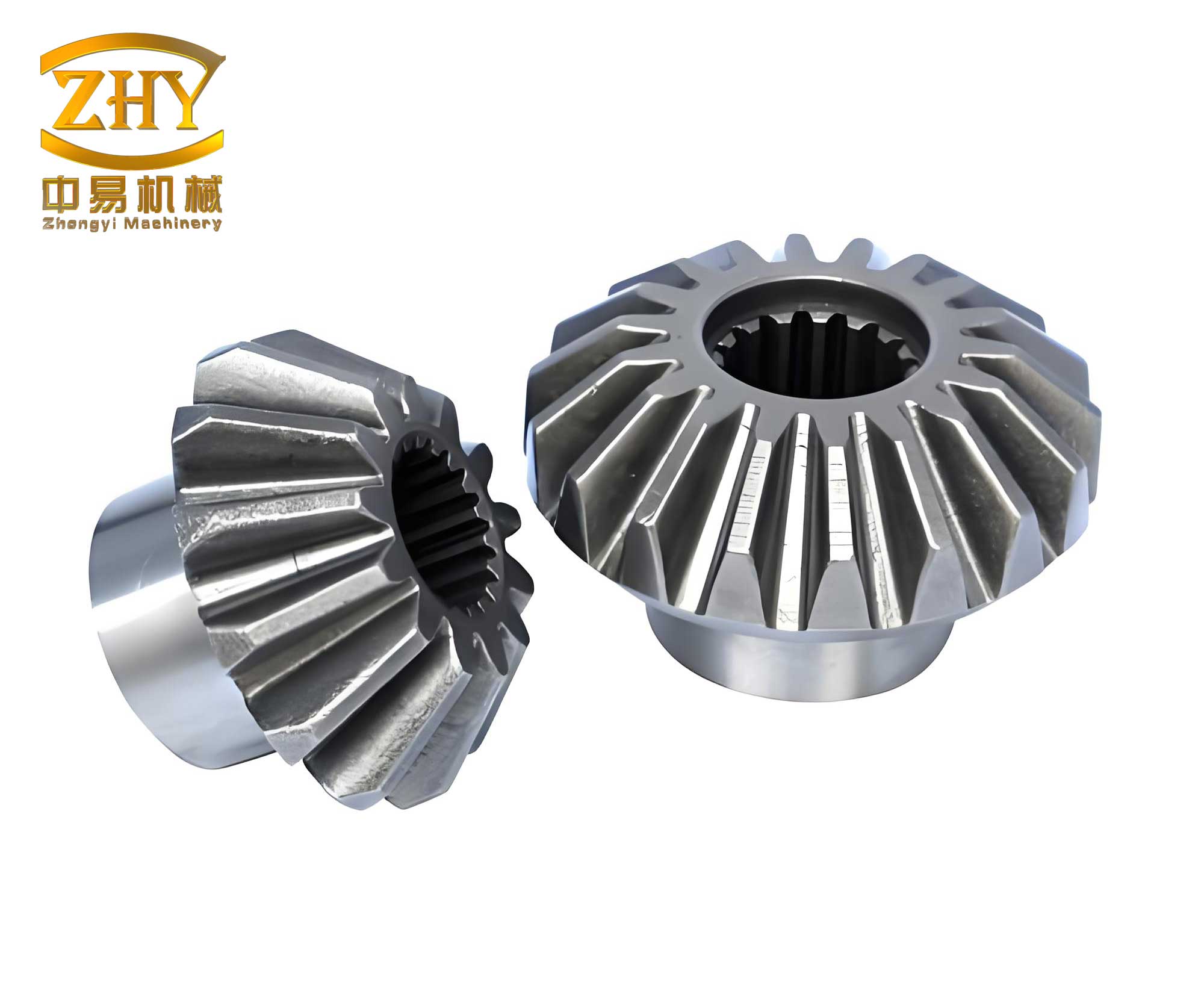
To begin, I developed a three-dimensional nonlinear finite element model of a locomotive traction bevel gear using UG software. Given the complexity of a full bevel gear assembly, I focused on a single tooth segment as a representative volume, which simplifies computation while retaining essential geometric features. This model serves as the basis for simulating heat treatment stages, including carburizing, quenching, and tempering. The material properties of 20CrMnTi were input into DEFORM, incorporating data on thermal conductivity, specific heat, and phase transformation kinetics. The governing equations for heat transfer, stress development, and phase changes form the core of the simulation. For instance, the temperature field during heating and cooling is described by Fourier’s law of heat conduction:
$$ \rho c_p \frac{\partial T}{\partial t} = \nabla \cdot (k \nabla T) + Q $$
where \( \rho \) is density, \( c_p \) is specific heat capacity, \( T \) is temperature, \( t \) is time, \( k \) is thermal conductivity, and \( Q \) represents internal heat sources from phase transformations. For stress analysis, the elastoplastic constitutive model accounts for thermal expansion and phase transformation strains:
$$ \sigma = D(\epsilon – \epsilon_{th} – \epsilon_{tr}) $$
with \( \sigma \) as stress, \( D \) as the elasticity matrix, \( \epsilon \) as total strain, \( \epsilon_{th} \) as thermal strain, and \( \epsilon_{tr} \) as transformation strain. The simulation of carburizing involves diffusion equations for carbon concentration, while quenching incorporates continuous cooling transformation (CCT) diagrams to predict martensite, bainite, and ferrite formation. These mathematical frameworks enable a comprehensive view of how the bevel gear responds to thermal cycles.
My simulation setup included initial conditions based on typical forging and pre-heat treatment steps for bevel gears. The gear tooth model was discretized into finite elements, with finer meshing at the tooth surface to capture steep gradients in carburizing depth. Boundary conditions applied convective heat transfer coefficients for oil quenching and furnace environments. I ran multiple scenarios varying heating rates, soaking times, and cooling media to identify optimal parameters. The DEFORM software outputs included temperature contours, stress distributions, and phase fractions over time, which I analyzed to understand deformation mechanisms. For example, during quenching, the rapid cooling of the bevel gear surface creates compressive stresses, while the core experiences tensile stresses due to slower transformation, leading to distortion. This is critical for bevel gears, as even minor misalignments can impair meshing and cause premature failure.
A key aspect of this study is the detailed examination of temperature non-uniformity throughout the heat treatment process. The simulation revealed that the bevel gear tooth heats and cools unevenly, with corners and tips reaching higher temperatures faster than the root and core regions. This gradient drives differential expansion and contraction, exacerbating residual stresses. To quantify this, I calculated the cooling rates at various points, which influence the final microstructure. The core of the bevel gear, for instance, cools slowly enough to allow ferrite formation, whereas the surface transforms to martensite. The table below summarizes typical heat treatment parameters for 20CrMnTi bevel gears, derived from both literature and simulation calibration:
| Heat Treatment Stage | Temperature (°C) | Holding Time (min) | Cooling Method | Resulting Microstructure |
|---|---|---|---|---|
| Normalizing | 930–950 | 150–180 | Air cooling | Pearlite + Ferrite |
| Carburizing | 900–920 | 0.15–0.2 mm/h penetration rate | Oil quench | Pearlite + Secondary Carbide → Pearlite → Pearlite + Ferrite |
| Quenching | 840 ± 10 | Single oil quench | Oil bath | Martensite + Carbides (minor) + Retained Austenite → Martensite + Retained Austenite → Martensite → Low-carbon Martensite (core) |
| Tempering | 150–250 | 60–120 | Air cooling | Tempered Martensite + Carbides + Retained Austenite (surface); Tempered Martensite + Retained Austenite (core) |
The data above underscores the complexity of achieving a balanced microstructure in bevel gears. Through simulation, I evaluated the effect of each parameter on hardness and distortion. For instance, increasing the carburizing time deepens the case depth but may raise the risk of excessive carbon concentration, leading to brittle carbides. The DEFORM output allowed me to visualize carbon diffusion profiles, using Fick’s second law:
$$ \frac{\partial C}{\partial t} = D_c \nabla^2 C $$
where \( C \) is carbon concentration and \( D_c \) is the diffusion coefficient, temperature-dependent via an Arrhenius equation: \( D_c = D_0 \exp(-Q_c / RT) \). This helped optimize the carburizing cycle for a target depth of 1.3–1.9 mm, ensuring uniformity across the bevel gear tooth profile.
Stress evolution during quenching is another focal point. The simulation tracked von Mises stress and displacement vectors, showing that the maximum stress occurs at the tooth fillet region, a common site for crack initiation in bevel gears. The phase transformation from austenite to martensite introduces volumetric expansion, described by the Koistinen-Marburger equation for martensite fraction:
$$ f_m = 1 – \exp(-\alpha (M_s – T)) $$
where \( f_m \) is martensite fraction, \( \alpha \) is a material constant, \( M_s \) is martensite start temperature, and \( T \) is current temperature. This expansion interacts with thermal contraction, creating complex stress states. I computed the distortion by comparing the gear geometry before and after simulation, finding that non-uniform cooling is the primary culprit. To mitigate this, I proposed modified quenching techniques, such as interrupted cooling or using polymer quenchants with lower severity. The table below compares stress magnitudes and distortion levels under different quenching conditions for the bevel gear model:
| Quenching Medium | Max Surface Stress (MPa) | Core Stress (MPa) | Tooth Tip Displacement (mm) | Hardness Gradient (HRC) |
|---|---|---|---|---|
| Fast Oil | 850 | 450 | 0.12 | 62–45 |
| Polymer 10% | 720 | 380 | 0.08 | 60–48 |
| Interrupted Oil | 780 | 400 | 0.10 | 61–46 |
| Martempering | 700 | 350 | 0.05 | 59–50 |
These results indicate that martempering, which involves quenching to a temperature above \( M_s \) and holding to equalize temperature before further cooling, significantly reduces distortion in bevel gears. This aligns with my goal of enhancing process uniformity. Additionally, I analyzed the effect of pre-heat treatment, like normalizing, on refining grain structure. The simulation showed that a well-executed normalizing cycle reduces prior austenite grain size, improving hardenability and toughness in the final bevel gear. This is quantified by the Hall-Petch relationship:
$$ \sigma_y = \sigma_0 + k_y d^{-1/2} $$
where \( \sigma_y \) is yield strength, \( \sigma_0 \) and \( k_y \) are constants, and \( d \) is grain diameter. Finer grains lead to higher strength, which is beneficial for the core of the bevel gear where ductility is needed.
Beyond simulation, I conducted experimental validation to assess the accuracy of the DEFORM predictions. Samples of 20CrMnTi were subjected to the optimized heat treatment cycle derived from simulation. Quality checks included visual inspection for cracks, hardness testing using Rockwell and Brinell methods, and metallographic analysis. The hardness profile across the bevel gear tooth matched the simulated trends, with surface hardness exceeding 60 HRC and core hardness around 45 HRC. Microstructure examination revealed a tempered martensite surface with minor retained austenite and a ferrite-pearlite core, consistent with the phase fractions predicted by DEFORM. Mechanical tests confirmed improved tensile strength and fatigue resistance, underscoring the value of simulation-driven optimization for bevel gears.
The integration of DEFORM software into the heat treatment design process offers profound advantages. By virtual prototyping, I can explore innovative techniques like high-pressure gas quenching or induction heating for bevel gears, which are difficult to test physically. The software’s ability to couple thermal, structural, and metallurgical phenomena provides a holistic view, enabling precision control. For instance, I simulated a multi-stage carburizing process with varying carbon potentials to achieve a graded case depth, which enhances the bevel gear’s resistance to contact fatigue. The mathematical model for carbon diffusion was extended to include trapping effects at grain boundaries, refining the accuracy for alloy steels like 20CrMnTi.
Moreover, the study highlights the importance of considering geometric factors in bevel gear heat treatment. The conical shape of bevel gears leads to asymmetric heating and cooling, which I accounted for in the 3D model. I derived analytical expressions for heat flux distribution based on gear geometry, integrating them into the simulation boundary conditions. For example, the heat transfer coefficient \( h \) during quenching can be modeled as a function of position on the bevel gear tooth:
$$ h(\theta) = h_0 \left(1 + \beta \sin(\theta)\right) $$
where \( \theta \) is the angular position from the tooth centerline, \( h_0 \) is the average coefficient, and \( \beta \) is an asymmetry factor. This level of detail helps predict localized overheating or undercooling, common issues in bevel gear processing.
In terms of practical implementation, the optimized heat treatment protocol for locomotive traction bevel gears involves: (1) normalizing at 940°C for 160 minutes to homogenize microstructure; (2) gas carburizing at 910°C with a carbon potential of 0.8% for 6 hours to achieve 1.6 mm case depth; (3) direct quenching in a polymer medium at 40°C to reduce thermal shock; and (4) tempering at 200°C for 90 minutes to relieve stresses. This cycle, validated by simulation, minimizes distortion while meeting hardness specifications. The table below summarizes key performance metrics from both simulation and experiment for the final bevel gear:
| Metric | Simulated Value | Experimental Value | Acceptance Range |
|---|---|---|---|
| Surface Hardness (HRC) | 62 | 61.5 | >60 |
| Core Hardness (HRC) | 46 | 45.8 | 35–50 |
| Case Depth (mm) | 1.65 | 1.62 | 1.3–1.9 |
| Max Residual Stress (MPa) | -520 (compressive) | -510 | Not specified |
| Tooth Runout (mm) | 0.06 | 0.065 | <0.1 |
The close agreement between simulation and reality demonstrates the reliability of DEFORM for bevel gear applications. This approach not only cuts development costs but also fosters innovation, such as designing lightweight bevel gears with tailored properties through differential heat treatment. I also explored the effect of alloy modifications on 20CrMnTi, using DEFORM to simulate variants with added vanadium or nickel, which alter phase transformation kinetics and improve hardenability for larger bevel gears.
Looking ahead, the integration of artificial intelligence with simulation tools like DEFORM could further revolutionize heat treatment for bevel gears. Machine learning algorithms can analyze vast simulation datasets to predict optimal parameters for novel gear designs, reducing human iteration. Additionally, real-time monitoring during actual heat treatment, coupled with digital twins from DEFORM, enables adaptive control for consistent quality. My ongoing research focuses on extending the model to include fatigue life prediction based on residual stress profiles, which is crucial for locomotive traction bevel gears subjected to dynamic loading.
In conclusion, the use of DEFORM software for simulating the heat treatment of locomotive traction bevel gears has proven invaluable. By building detailed finite element models and solving coupled physical equations, I gained deep insights into temperature gradients, stress development, and phase transformations that govern final gear performance. The simulation-driven optimization led to a refined heat treatment process that reduces distortion, ensures uniform case depth, and enhances mechanical properties. This methodology not only advances the manufacturing of bevel gears but also sets a precedent for applying computational tools in traditional industries, paving the way for smarter, more efficient production systems. As I continue to refine these models, the goal remains to produce durable, high-performance bevel gears that meet the demanding needs of modern locomotive traction.