
The precision of power transmission is a paramount concern in the design of high-performance robotic joints. Among various reducers, the rotary vector reducer stands out due to its remarkable attributes, including a high reduction ratio, exceptional torsional stiffness, compact structure, and high power density. These features make it the preferred solution for precision motion control in industrial robot joints. The transmission accuracy, fundamentally characterized by the transmission error, is a critical performance metric for the rotary vector reducer. This error represents the deviation between the theoretical and the actual output position for a given input, directly influencing the positioning accuracy and motion smoothness of the robotic system.
While significant research has focused on the influence of gear manufacturing inaccuracies, assembly errors, and the flexibility of primary transmission components like the cycloid disk, the role of the main bearing system is often oversimplified. The main bearings in a rotary vector reducer, typically a pair of back-to-back mounted thin-walled angular contact ball bearings, serve as the crucial interface between the rotating output stage (planetary carrier) and the static housing. They simultaneously support radial loads, axial loads, and overturning moments. Due to their thin-walled nature, the inner and outer rings of these bearings are prone to significant elastic deformation under operational loads. This compliance alters the kinematic relationships within the bearing and, by extension, affects the positional relationship of the connected components in the reducer. Furthermore, the elastohydrodynamic lubrication (EHL) film generated between the rolling elements and raceways introduces a nonlinear stiffness and damping effect. Therefore, a comprehensive analysis of transmission error must account for the coupled effects of main bearing structural flexibility and lubrication characteristics. This study aims to develop a multi-physics dynamic model of a rotary vector reducer that integrates these factors to quantify their impact on transmission error, providing insights for the precision design of both the reducer and its supporting bearings.
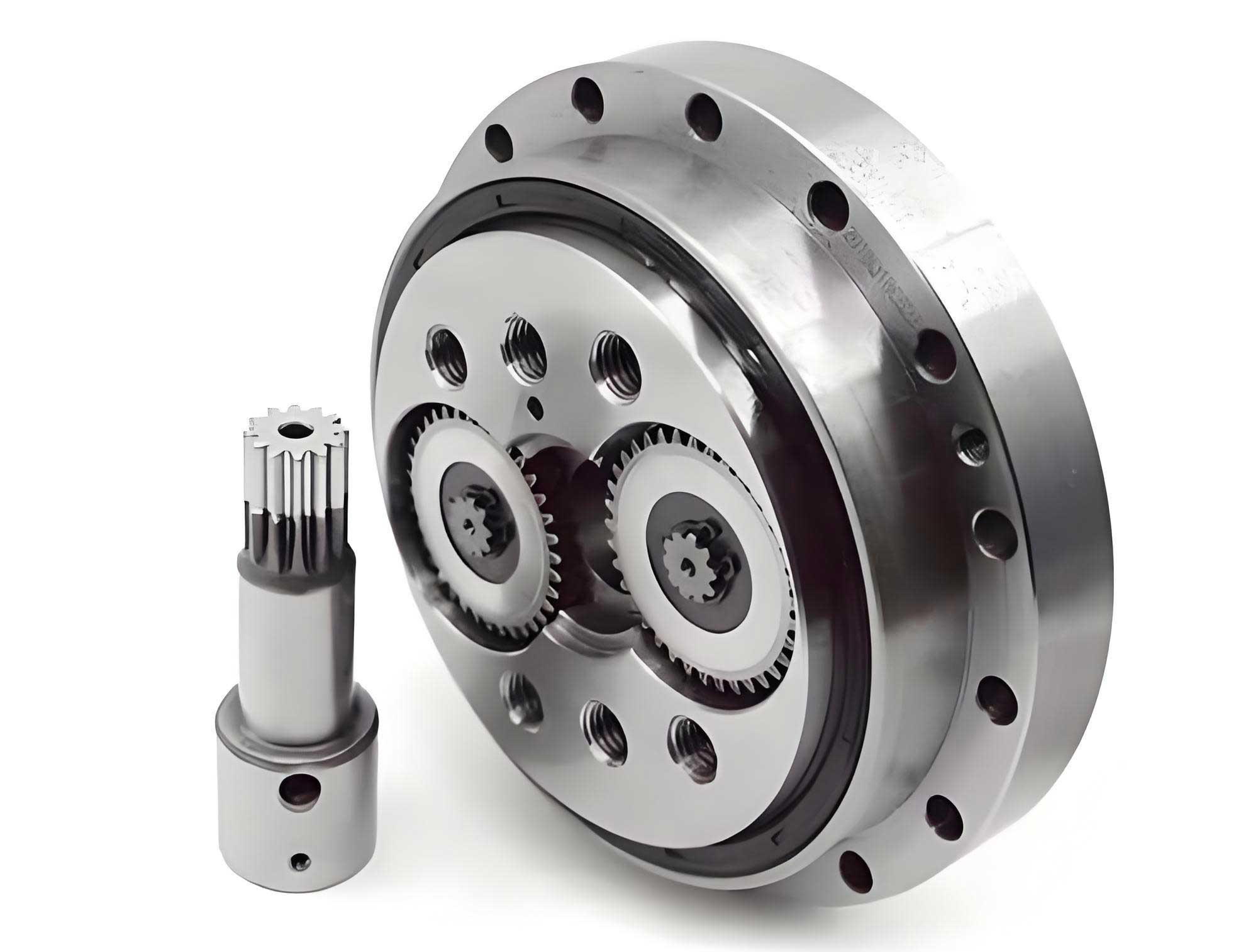
1. System Modeling and Parameterization
To investigate the dynamic behavior, we first establish parametric three-dimensional models of the key subsystems: the main bearing and the rotary vector reducer itself.
1.1. Main Bearing Model
The main bearing is a customized thin-section angular contact ball bearing. Its primary dimensions are summarized in Table 1. A parameterized 3D CAD model was created based on these specifications to ensure consistency and facilitate subsequent modifications for parametric studies.
| Parameter | Symbol | Value | Unit |
|---|---|---|---|
| Inner Raceway Diameter | $d_i$ | 260 | mm |
| Outer Raceway Diameter | $d_o$ | 360 | mm |
| Ball Diameter | $D_b$ | 30 | mm |
| Pitch Circle Diameter | $D_m$ | 310 | mm |
| Number of Balls | $Z$ | 26 | – |
| Initial Contact Angle | $\alpha_0$ | 40 | ° |
1.2. Rotary Vector Reducer Model
The rotary vector reducer is a two-stage speed reduction device. The first stage is a standard involute planetary gear train, and the second stage is a cycloid-pin wheel (planetary) mechanism. The basic technical parameters of the studied rotary vector reducer are listed in Table 2.
| Stage | Parameter | Symbol | Value | Unit |
|---|---|---|---|---|
| First Stage (Planetary) | Sun Gear Teeth | $z_s$ | 12 | – |
| Planet Gear Teeth | $z_p$ | 44 | – | |
| Module | $m_n$ | 3 | mm | |
| Pressure Angle | $\alpha_n$ | 20 | ° | |
| Second Stage (Cycloid) | Cycloid Disk Teeth | $z_c$ | 59 | – |
| Number of Pins | $z_{rp}$ | 60 | – | |
| Eccentricity | $a$ | 2.4 | mm | |
| Pin Diameter | $d_{rp}$ | 10 | mm | |
| Pin Circle Radius | $R_p$ | 82.5 | mm |
1.3. Mesh Stiffness Calculation
The time-varying mesh stiffness is a primary source of excitation in gear systems. Accurate calculation is essential for dynamic analysis.
First Stage (Involute Gears): The single tooth pair mesh stiffness $c’$ per unit face width is calculated based on ISO 6336 standards. For a gear pair with given tooth numbers $z_1$, $z_2$ and profile shift coefficients $x_1$, $x_2$, the unit compliance $q$ can be approximated. The single tooth stiffness considering contact ratio $\epsilon_{\alpha}$ is:
$$c_{\gamma} = (0.75 \epsilon_{\alpha} + 0.25) c’$$
The total mesh stiffness $k_{12}$ for the sun-planet pair is then:
$$k_{12} = c_{\gamma} \cdot b \cdot 10^6 \quad \text{[N/m]}$$
where $b$ is the face width.
Second Stage (Cycloid-Pin Mesh): The contact between the cycloid disk and each pin is modeled as contact between two cylinders. The stiffness for the $i$-th pin-cycloid contact $k_{ni}$ is derived from Hertzian contact theory:
$$k_{ni} = \frac{\pi b E \rho_r \rho_c}{4(1-\mu^2)(\rho_r + \rho_c) \rho_i}$$
where $E$ is the elastic modulus, $\mu$ is Poisson’s ratio, $b$ is the cycloid disk width, $\rho_r$ and $\rho_c$ are the radii of curvature of the cycloid profile and the pin at the contact point, respectively, and $\rho_i$ is the equivalent radius:
$$\rho_i = \frac{\rho_r \rho_c}{\rho_r + \rho_c}$$
The effective torsional stiffness $k_{34}$ of the cycloid stage about the center is the sum of the contributions from all simultaneously engaged pins, projected by their moment arms $l_i$:
$$k_{34} = \sum_{i=1}^{N_{eng}} k_{ni} l_i^2$$
where $l_i = r’_c \frac{\sin \phi_i}{\sqrt{1 + k^2 – 2k \cos \phi_i}}$, with $r’_c$ as the rolling circle radius of the cycloid, $k$ the shortening coefficient, and $\phi_i$ the position angle of the $i$-th pin.
2. Development of the Integrated Dynamic Model
2.1. Rigid-Flexible Coupled Multi-body Model of the Main Bearing
To accurately capture the deformation of the thin-walled rings, a rigid-flexible coupled multi-body dynamics approach is employed. The inner and outer rings of the main bearing are treated as flexible bodies. Their finite element models are created, and component mode synthesis is used to generate Modal Neutral Files (.mnf) containing their mass, stiffness, and mode shape information. These flexible rings are then integrated into a multi-body dynamics environment, where the rolling elements and cage are modeled as rigid bodies. The contact forces between these components are modeled using a non-linear spring-damper formulation based on the Hertzian contact theory. The Impact function used is:
$$F_{impact} = \begin{cases}
k (q_0 – q)^e – c_{max} \cdot \dot{q} \cdot step(q, q_0-d, 1, q_0, 0), & q \le q_0 \\
0, & q > q_0
\end{cases}$$
where $q$ is the instantaneous contact deformation, $q_0$ is the clearance/initial gap, $k$ is the contact stiffness, $e$ is the force exponent (typically 1.5 for Hertzian contact), $c_{max}$ is the maximum damping coefficient, and $step$ is a smoothing function.
2.2. Elastohydrodynamic Lubrication (EHL) Model Considering Ring Deflection
The lubrication film between the rolling elements and raceways affects load distribution and introduces damping. We couple a simplified EHL model with the bearing dynamics.
Ring Deflection: Under combined radial and axial loads, the thin rings deform. The radial deflection $u(\theta)$ at an angular position $\theta$ on the outer ring can be approximated using ring theory and superposition of discrete ball loads $Q_j$:
$$u(\theta) = \sum_j u^{Q_j}_{\theta} + u^{q}_{\theta}$$
where $u^{Q_j}_{\theta}$ is the deflection due to a concentrated load $Q_j$ at angle $\psi_j$, and $u^{q}_{\theta}$ is the deflection from distributed loads (e.g., housing fit). The contact elastic deformation $\delta$ at the ball-raceway interface is given by:
$$\delta = K Q^{2/3}$$
where $K$ is a constant depending on the contact geometry and material.
Lubrication Equations: The governing equation for the lubricant pressure $p$ in the contact conjunction is the Reynolds equation:
$$\frac{\partial}{\partial x}\left( \frac{\rho h^3}{\eta} \frac{\partial p}{\partial x} \right) + \frac{\partial}{\partial y}\left( \frac{\rho h^3}{\eta} \frac{\partial p}{\partial y} \right) = 12 u_s \frac{\partial (\rho h)}{\partial x}$$
where $h$ is the film thickness, $\eta$ is the lubricant viscosity, $\rho$ is the lubricant density, and $u_s$ is the entrainment velocity. The film thickness equation accounts for both the geometry and the elastic deformation of the surfaces:
$$h(x,y) = h_0 + \frac{x^2}{2R_x} + \frac{y^2}{2R_y} + v(x,y)$$
where $h_0$ is the central film thickness, $R_x$, $R_y$ are the effective radii of curvature, and $v(x,y)$ is the elastic deformation calculated from the pressure field using the Boussinesq integral. The lubricant properties are pressure-dependent. Density is modeled as:
$$\rho(p) = \rho_0 \left(1 + \frac{0.6p}{1+1.7p}\right)$$
and viscosity is modeled using the Roelands equation:
$$\eta(p) = \eta_0 \exp\left\{ (\ln(\eta_0) + 9.67) \left[ (1 + \frac{p}{p_0})^{z} – 1 \right] \right\}$$
A user-defined subroutine was developed to solve this coupled EHL problem, taking instantaneous loads and kinematics from the multi-body model and returning updated contact forces incorporating the oil film effect.
2.3. Integrated Rotary Vector Reducer Dynamic Model
The complete rotary vector reducer model is assembled in a multi-body dynamics software. It includes:
- Components: All gears, shafts, cycloid disks, pins, housing, and the main bearings (with flexible rings).
- Joints and Constraints: Revolute joints, fixed joints, and planar joints to define kinematic relationships.
- Force Elements:
- Gear mesh forces using time-varying stiffness $k_{12}(t)$ and $k_{34}(t)$ with calculated damping.
- Bearing contact forces from the rigid-flexible-EHL bearing model.
- Contacts between cycloid disk and pins, and between pins and their housings.
- Inputs/Outputs: A rotational velocity is applied to the input shaft (sun gear). A load torque is applied to the output carrier, modeled using a step function to simulate run-up and steady-state conditions: $T_{load} = T_{max} \cdot step(time, t_1, 0, t_2, 1)$.
The material properties for key components are listed in Table 3.
| Component | Material | Elastic Modulus (GPa) | Poisson’s Ratio | Density (kg/m³) |
|---|---|---|---|---|
| Gears, Shafts, Cycloid Disk | 20CrMnMo | 207 | 0.254 | 7870 |
| Housing | QT500-7 | 168 | 0.240 | 7250 |
| Planet Carrier | ZG65Mn | 198 | 0.230 | 7850 |
| Pins | GCr15 | 208 | 0.300 | 7800 |
3. Simulation Results and Model Validation
3.1. Kinematic Validation
The overall transmission ratio $i_{total}$ of the rotary vector reducer is given by:
$$i_{total} = 1 + \frac{z_p \cdot z_{rp}}{z_s (z_{rp} – z_c)}$$
Substituting values from Table 2: $i_{total} = 1 + \frac{44 \times 60}{12 \times (60-59)} = 1 + 220 = 221$.
With an input speed of $9000^\circ/s$ (150 RPM), the theoretical output speed is $9000 / 221 \approx 40.724^\circ/s$. The simulation results from the dynamic model under steady-state conditions yielded an average output speed of $40.72^\circ/s$, confirming the kinematic accuracy of the model. A comparison is shown in Table 4.
| Parameter | Theoretical Value | Simulation Value | Unit |
|---|---|---|---|
| Input Speed | 9000.0 | 9000.0 | °/s |
| Output Speed | ~40.724 | ~40.72 | °/s |
| Total Ratio | 221.00 | ~221.02 | – |
3.2. Dynamic Response of Key Components
The dynamic response of the system components was analyzed. The crank shaft, driven by the planet gear, exhibits a compound motion of rotation and revolution. Its center of mass traces a circular path, resulting in sinusoidal displacement waveforms in the X and Y directions, with an amplitude equal to the distance from the crank center to the planetary carrier center. Similarly, the cycloid disk, following the crank pin, exhibits a complex orbital motion. Its center of mass displacement also shows a sinusoidal pattern, with an amplitude related to the mechanism’s eccentricity. These predicted motions align perfectly with the theoretical kinematics of the rotary vector reducer mechanism.
3.3. Main Bearing Contact Characteristics
Start-up Phase: The contact forces between rolling elements and the inner race during the start-up transient (0-0.2s) were analyzed. The forces on seven adjacent balls remain relatively smooth and below 200 N, without sharp impacts. This indicates stable load sharing and smooth acceleration, which is beneficial for bearing life and reducer performance.
Steady-State Phase: Under steady operation with combined loading, the contact force on a single ball varies periodically. The force waveform is a superposition of contributions from the varying radial and axial load components experienced by the main bearing as the rotary vector reducer transmits torque. The period of this variation corresponds to the cycle time of the force transmission path through the reducer’s epicyclic stages.
4. Analysis of Transmission Error
The dynamic transmission error $\Delta E(t)$ is calculated as the difference between the actual output rotation and the ideal output rotation based on the input and the nominal gear ratio:
$$\Delta E(t) = \theta_{out}(t) – \frac{\theta_{in}(t)}{i_{total}}$$
where $\theta_{in}(t)$ and $\theta_{out}(t)$ are the instantaneous input and output angular positions, obtained by integrating the simulated angular velocities.
4.1. Effect of Main Bearing Flexibility
We compared the transmission error from two models: a fully rigid model (where all bearing components are rigid) and the proposed compliant model (with flexible bearing rings and EHL). The results are striking:
- Fully Rigid Model: The transmission error fluctuated within a range of approximately $-25.2$ arcseconds to $+21.6$ arcseconds, with a clear periodic pattern linked to the gear meshing frequency.
- Compliant Bearing Model: When bearing flexibility and lubrication were introduced, the amplitude of the transmission error increased significantly, ranging from about $-43.2$ to $+45.0$ arcseconds. Furthermore, the waveform and periodicity of the error changed, indicating that the bearing’s dynamic compliance modulates the gear-induced vibrations.
This comparison unequivocally demonstrates that the flexibility of the main bearing in a rotary vector reducer is a significant contributor to the overall transmission error and cannot be neglected in high-precision design.
4.2. Influence of Raceway Deformation Magnitude
The deformation of the bearing rings is load-dependent. To isolate this effect, we simulated the rotary vector reducer under different external load conditions, leading to varying levels of outer ring elastic deformation $\delta_{o}$ at the most heavily loaded contact point. The relationship between this deformation and the resulting peak-to-peak transmission error ($TE_{pp}$) is presented in Table 5 and shows a clear trend. As the operational load increases, causing greater ring deflection ($\delta_{o}$ from ~0.35 µm to ~0.65 µm), the transmission error of the system monotonically increases. This is because the ring deformation alters the precise relative positioning between the output carrier and the fixed housing, directly introducing kinematic error into the output. This finding underscores the importance of maximizing the support stiffness of the main bearing housing and selecting bearings with adequate ring cross-section stiffness to minimize this source of error in the rotary vector reducer.
3.3. Influence of Lubrication Film Characteristics
The properties of the EHL film also play a non-linear role. We investigated the effect of varying the central oil film thickness $h_c$ and the maximum Hertzian contact pressure $p_{max}$ within realistic operational ranges.
Oil Film Thickness: The simulation results indicated a non-monotonic relationship. As the film thickness increased from a very thin state, the transmission error initially decreased. This can be attributed to the damping effect of the fluid film, which attenuates vibration. However, beyond an optimal thickness, further increase led to a rise in transmission error. An excessively thick film may introduce excessive compliance (a “softening” effect) in the bearing contact, reducing its effective stiffness and allowing for greater relative motion under load, which manifests as increased error.
Contact Pressure/Oil Film Pressure: A similar trend was observed for the effect of the maximum contact pressure (influenced by load and film shape). An initial increase in pressure (associated with a more robust load-carrying film) reduced the transmission error, likely by improving the load distribution and damping. However, at very high pressures, the transmission error began to increase again, possibly due to heightened non-linear stiffness effects and increased shear in the lubricant.
| Influencing Factor | Trend | Probable Mechanism | Design Implication for Rotary Vector Reducer |
|---|---|---|---|
| Bearing Ring Flexibility (Deformation $\delta_{o}$) | $\uparrow \delta_{o} \Rightarrow \uparrow TE$ | Kinematic error introduced via misalignment of output axis. | Maximize support stiffness; use stiffer ring sections. |
| Oil Film Thickness ($h_c$) | $\uparrow h_c \Rightarrow TE \downarrow \text{ then } \uparrow$ | Optimal damping vs. excessive contact compliance. | Control viscosity, surface finish, and preload to maintain optimal film. |
| Contact Pressure ($p_{max}$) | $\uparrow p_{max} \Rightarrow TE \downarrow \text{ then } \uparrow$ | Improved load sharing vs. heightened nonlinearities. | Optimize bearing preload and internal geometry. |
5. Conclusion
This study presented a comprehensive multi-physics dynamic modeling approach for a rotary vector reducer, with a specific focus on integrating the compliance and lubrication characteristics of its thin-walled main bearings. The key conclusions are as follows:
- A coupled dynamic model was successfully developed, incorporating rigid-flexible multi-body dynamics for the bearing structures and a simplified elastohydrodynamic lubrication model. This integrated model provides a more realistic simulation platform for analyzing the rotary vector reducer’s performance compared to traditional fully rigid models.
- Simulation results validated the model’s kinematic accuracy and revealed the dynamic contact behavior within the main bearing during start-up and steady-state operation.
- The flexibility of the main bearing’s thin-walled rings was identified as a major source of transmission error in the rotary vector reducer. Neglecting this flexibility led to an underestimation of the transmission error amplitude by a significant margin (e.g., error range increased from ~±24″ to ~±44″ in the studied case).
- A parametric analysis demonstrated that increasing ring deformation, caused by higher loads, directly increases transmission error. Furthermore, the characteristics of the lubrication film exhibit a non-linear, optimizing influence; both film thickness and contact pressure have an optimal range that minimizes transmission error.
These findings have direct implications for the precision design of rotary vector reducers. To minimize transmission error, designers should:
- Prioritize increasing the structural support stiffness for the main bearings to limit ring deformation.
- Carefully select bearing internal geometry, preload, lubricant type, and operating conditions to achieve the optimal elastohydrodynamic lubrication state that provides sufficient damping without introducing excessive contact compliance.
The methodology and insights from this study contribute to a deeper understanding of the complex interactions within a rotary vector reducer and provide a valuable tool for its optimization towards higher positioning accuracy and dynamic performance.