
The precise and reliable transmission of motion and force is paramount in advanced robotic systems. Among the core components enabling this, the rotary vector reducer stands out for its compactness, high reduction ratio, torsional rigidity, and excellent positioning accuracy. The performance of a rotary vector reducer is critically dependent on its internal cycloidal-pin gear drive mechanism. Within this mechanism, the cycloidal gear is the precision heart, whose operational characteristics dictate the reducer’s overall transmission precision, efficiency, fatigue life, and reliability.
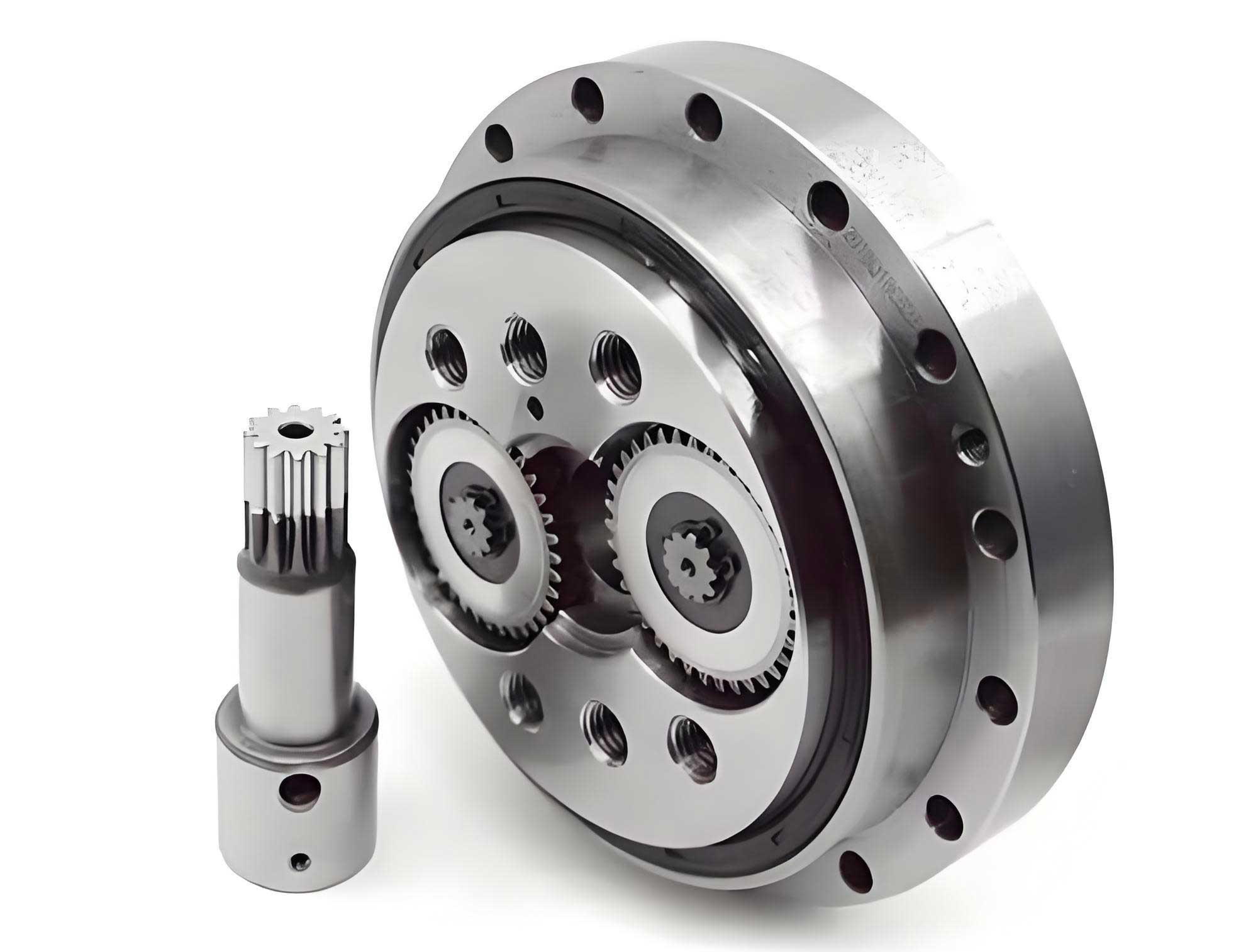
The theoretical profile of a cycloidal gear, generated by a pin rolling inside a hypotrochoid, results in line contact with the pin gear under ideal conditions. However, manufacturing tolerances, assembly errors, and the need for lubrication necessitate the introduction of controlled clearance, known as tooth profile modification. The primary challenge lies in determining the optimal modification parameters. An ideal modification scheme should ensure multi-tooth engagement for high load capacity, uniform load distribution among the engaged teeth, minimal transmission error (or backlash), and ease of assembly. Among various methods, the combination of positive equidistant modification (increasing the pin radius) and negative radial moving modification (decreasing the pin center circle radius) has proven to be highly effective in approximating the conjugate profile derived from a theoretical rotation modification.
While several mathematical models exist for implementing this positive equidistant plus negative radial-moving strategy, a clear comparative analysis of their performance outcomes is absent. This study aims to fill that gap. We will analyze and compare three prominent optimization models for cycloidal gear tooth profile modification. Using numerical methods and performance simulations, we will evaluate key metrics such as load distribution, number of simultaneously engaged tooth pairs, proximity to the ideal conjugate profile, and the resulting geometric transmission error. This comparative study seeks to identify the model that offers the best balance of performance characteristics for practical application in high-precision rotary vector reducer systems.
1. Theoretical Foundation and Modification Models
The meshing principle of the cycloidal-pin gear pair is based on planetary motion. The fundamental coordinate equations for the cycloidal gear tooth profile, encompassing various modification types, provide the starting point for our analysis. For a cycloidal gear with tooth count $z_c$ mating with a pin gear of $z_p$ pins, the general form of the modified tooth profile coordinates $(x_c, y_c)$ can be expressed as a function of the generating angle $\phi$.
Let $r_p$ be the radius of the pin center circle, $r_{rp}$ the nominal pin radius, $a$ the eccentricity, and $K_1 = a z_p / r_p$ the shortening coefficient. Introducing modification parameters: $\Delta r_{rp}$ for equidistant modification (positive for increase), $\Delta r_p$ for radial moving modification (negative for decrease), and $\Delta \delta$ for rotation modification, the unified parametric equations are:
$$ x_c = \left[ r_p + \Delta r_p – (r_{rp} + \Delta r_{rp}) S^{-1} \right] \cdot \sin\left[(1 – i_H) \phi – \Delta \delta\right] – \frac{a}{r_p + \Delta r_p} \left[ r_p + \Delta r_p – z_p (r_{rp} + \Delta r_{rp}) S^{-1} \right] \cdot \sin\left(i_H \phi + \Delta \delta\right) $$
$$ y_c = \left[ r_p + \Delta r_p – (r_{rp} + \Delta r_{rp}) S^{-1} \right] \cdot \cos\left[(1 – i_H) \phi – \Delta \delta\right] + \frac{a}{r_p + \Delta r_p} \left[ r_p + \Delta r_p – z_p (r_{rp} + \Delta r_{rp}) S^{-1} \right] \cdot \cos\left(i_H \phi + \Delta \delta\right) $$
where $i_H = -z_p / z_c$ is the transmission ratio between the cycloidal gear and the pin gear (considering the fixed pin gear), and $S = \sqrt{1 + K_1^2 – 2K_1 \cos\phi}$.
For the comparison, we focus on models that combine positive $\Delta r_{rp}$ and negative $\Delta r_p$, typically with the constraint $\Delta r_{rp} + \Delta r_p \geq 0$ to ensure non-negative radial clearance at the tooth tip and root.
1.1 Model A: Normal Clearance Optimization Model
This model aims to make the modified cycloidal tooth profile as close as possible to the conjugate profile of the rotation-modified gear across the entire meshing zone. The “closeness” is measured by the normal clearance between the two profiles. The optimization objective is to minimize the sum of squares of these normal clearances at discrete points along the profile. The normal clearance $\Delta(\phi_i)$ at a point corresponding to angle $\phi_i$ is given by:
$$ \Delta(\phi_i) = \Delta r_{rp} \left(1 – \frac{\sin\phi_i}{S_i}\right) – \frac{\Delta r_p \left(1 – K_1 \cos\phi_i – \sqrt{1 – K_1^2} \sin\phi_i \right)}{S_i} – \frac{\Delta \delta a z_c \sin\phi_i}{S_i} $$
where $S_i = \sqrt{1 + K_1^2 – 2K_1 \cos\phi_i}$. The design variables are $X = [\Delta r_{rp}, \Delta r_p]^T$. The objective function $F_A(X)$ is formulated as:
$$ F_A(X) = \sum_{i=1}^{n} \left[ \Delta(\phi_i) \right]^2 $$
subject to $\Delta r_{rp} \geq 0$, $\Delta r_p \leq 0$, and $\Delta r_{rp} + \Delta r_p \geq 0$.
1.2 Model B: Normal Deviation Optimization Model
Similar in spirit to Model A, this model seeks to minimize the deviation between the modified profile and the conjugate rotation-modified profile, but defined slightly differently. The objective function $F_B(X)$ is directly based on the terms contributing to the profile shift:
$$ F_B(X) = \sum_{i=1}^{n} \left[ \Delta r_{rp} + \left( \Delta r_p (1 – K_1 \cos\phi_i) – \Delta \delta a z_c \sin\phi_i \right) S_i \right]^2 $$
This model operates under the same constraints as Model A. The goal is to make this deviation as uniform and close to zero as possible over the meshing range.
1.3 Model C: Prescribed Radial Clearance Model
This model takes a more direct approach. First, a total radial clearance $\Delta = \Delta r_{rp} + \Delta r_p$ is prescribed based on considerations of lubrication, manufacturing, and assembly tolerances. Then, the individual modification amounts are calculated analytically to distribute this clearance optimally along the tooth profile, aiming to keep the working flanks as close to the theoretical profile as possible. The optimal values are derived as:
$$ \Delta r_{rp}^* = \frac{\Delta}{1 + \sqrt{1 – K_1^2}} $$
$$ \Delta r_{p}^* = -\frac{\Delta \sqrt{1 – K_1^2}}{1 + \sqrt{1 – K_1^2}} $$
This model is simpler as it reduces the optimization problem to choosing an appropriate total radial clearance $\Delta$.
2. Performance Analysis Methodology
To compare these models fairly, we establish a consistent framework for analyzing the meshing performance of the cycloidal gear in a rotary vector reducer.
2.1 Load Distribution Analysis
A critical performance indicator is how the input torque is distributed among the simultaneously engaged pin-cycloid tooth pairs. The analysis follows a compatibility condition based on elastic deformation. The fundamental equation relates the load on the $i$-th tooth pair $F_i$ to the total deformation $\delta_i$ and the initial clearance $\Delta(\phi_i)$ from the modification:
$$ F_i = \frac{\delta_i – \Delta(\phi_i)}{\delta_{max}} F_{max} $$
Here, $\delta_{max}$ and $F_{max}$ are the deformation and load on the most heavily loaded tooth pair. The deformation $\delta_i$ is proportional to the distance $l_i$ from the contact normal to the cycloidal gear’s center:
$$ \delta_i = l_i \beta = \frac{\sin\phi_i}{S_i} \delta_{max} $$
where $\beta$ is the angular deflection of the cycloidal gear under load. The distance $l_i$ is $l_i = r_c’ (\sin\phi_i / S_i)$, with $r_c’$ related to the pitch radius. The maximum load $F_{max}$ can be found from equilibrium and the compatibility condition, requiring an iterative solution because $\delta_{max}$ itself depends on $F_{max}$ via Hertzian contact deformation. For a cylindrical pin and cycloidal tooth, the maximum contact deformation $W_{max}$ under load $F_{max}$ is:
$$ W_{max} = \frac{2(1-\nu^2)}{\pi E} \frac{F_{max}}{b_c} \left( \frac{2}{3} + \ln{\frac{16 r_{rp} \rho}{c^2}} \right) $$
where $c$ is the half-width of the contact area, $b_c$ is the face width of the cycloidal gear, $\nu$ and $E$ are Poisson’s ratio and Young’s modulus, and $\rho$ is the radius of curvature of the cycloidal tooth at the contact point. An iterative computational loop is established to solve for the consistent load distribution, number of engaged teeth (where $\delta_i > \Delta(\phi_i)$), and individual tooth loads.
2.2 Geometric Transmission Error (Backlash)
Backlash, or lost motion, is a key precision metric for a rotary vector reducer. The geometric angular backlash $\gamma_0$, resulting solely from tooth profile modifications (excluding other elastic deflections), can be estimated from the modification parameters. For the combined equidistant and radial-moving modification, the expression is:
$$ \gamma_0 \approx \frac{2}{a z_c \sin\phi_i} \left[ \Delta r_p (1 – K_1 \cos\phi_i) + \Delta r_{rp} S_i \right] $$
This value varies with the engagement position $\phi_i$. A smaller and more uniform $\gamma_0$ across the meshing zone indicates higher potential transmission accuracy.
3. Case Study and Comparative Results
We apply the three models to a common rotary vector reducer cycloidal gear set with the following parameters:
| Parameter | Symbol | Value | Unit |
|---|---|---|---|
| Number of Cycloidal Gear Teeth | $z_c$ | 39 | – |
| Number of Pin Gear Teeth | $z_p$ | 40 | – |
| Pin Center Circle Radius | $r_p$ | 64.0 | mm |
| Pin Radius | $r_{rp}$ | 3.0 | mm |
| Eccentricity | $a$ | 1.25 | mm |
| Shortening Coefficient | $K_1$ | 0.78125 | – |
| Face Width | $b_c$ | 8.8 | mm |
| Torque on Cycloidal Gear | $T_c$ | 208 | Nm |
| Rotation Modification | $\Delta \delta$ | 0.0005 | rad |
For Models A and B, a nonlinear constrained optimization solver (like MATLAB’s fmincon) is used with 400 sample points across $\phi \in [0, \pi]$. For Model C, we calculate its parameters based on the total radial clearance $\Delta$ obtained from the optimized results of Models A and B, creating two instances: Model C1 (using $\Delta_A$) and Model C2 (using $\Delta_B$).
3.1 Optimized Modification Parameters
The optimization yields the following modification parameters for each model:
| Model | $\Delta r_{rp}$ (mm) | $\Delta r_{p}$ (mm) | Total Radial Clearance $\Delta$ (mm) |
|---|---|---|---|
| Model A | +0.00489 | -0.00489 | 0.00978 |
| Model B | +0.00713 | -0.00315 | 0.00998 |
| Model C1 ($\Delta_A$) | +0.00603 | -0.00377 | 0.00978 |
| Model C2 ($\Delta_B$) | +0.00634 | -0.00396 | 0.00998 |
A key observation is that Model A yields equal magnitude for equidistant and radial-moving modifications ($|\Delta r_{rp}| = |\Delta r_p|$). The other models show a larger positive equidistant amount and a smaller negative radial-moving amount. The parameters for the two prescribed-clearance models (C1, C2) lie between those of Models A and B.
3.2 Load Distribution and Initial Clearance
Applying the load distribution analysis with the parameters from Table 2 yields the following performance summary:
| Model | Maximum Tooth Load $F_{max}$ (N) | Number of Simultaneously Engaged Teeth |
|---|---|---|
| Model A | 671.4 | 10 |
| Model B | 668.1 | |
| Model C1 | 665.4 | |
| Model C2 | 672.9 |
All models result in the same number of tooth pairs sharing the load (10 out of a possible 20 per half-rotation), which is excellent for the rotary vector reducer‘s load capacity and smoothness. The maximum load values are very close, with variations less than 1.2%. The load distribution curves and the initial clearance $\Delta(\phi)$ curves for all four models are nearly superimposed. The tooth pair near $\phi \approx 36^\circ$ consistently carries the highest load and has the smallest initial clearance. Models A and C1 produce virtually identical load and clearance patterns, as do Models B and C2. Overall, the differences in meshing stiffness and load-sharing uniformity among the models are negligible from a practical engineering standpoint.
3.3 Geometric Transmission Error (Backlash) Comparison
The calculated geometric angular backlash $\gamma_0$ reveals a more significant distinction between the models. The following table shows the approximate range of $\gamma_0$ over the primary meshing zone:
| Model | Approximate Geometric Backlash $\gamma_0$ (micro-radians) | Relative Magnitude |
|---|---|---|
| Model A | 40 – 60 | Lowest |
| Model B | 75 – 110 | ~1.8x Model A |
| Model C1 / C2 | 55 – 85 | ~1.4x Model A |
Model A generates the smallest geometric backlash, approximately 40-45% lower than that of Model B. The prescribed clearance models (C1, C2) produce backlash values midway between Models A and B. Since minimizing lost motion is crucial for precision applications like robotic joints using a rotary vector reducer, this gives Model A a distinct advantage.
4. Discussion and Conclusion
This comparative study of three prominent tooth profile modification models for cycloidal gears in rotary vector reducer applications leads to several important conclusions.
First, while all models based on the positive equidistant and negative radial-moving principle produce modification parameters that are numerically different, their core performance in terms of multi-tooth engagement and basic load distribution is remarkably similar. All optimized profiles successfully create the necessary clearance from the theoretical profile while remaining very close to the ideal conjugate profile derived from rotation modification. This validates the effectiveness of the combined modification approach.
Second, the key differentiating factor among the models is their impact on the geometric transmission error or backlash. The Normal Clearance Optimization Model (Model A) consistently yields the smallest magnitude of angular backlash. This is a critical advantage for high-precision systems where positional accuracy and stiffness are paramount. The Prescribed Radial Clearance Model (Model C) offers a good compromise and simplicity, as the designer directly controls the total radial clearance, but at the cost of higher backlash compared to Model A. The Normal Deviation Model (Model B), while effective, results in the largest backlash among the three.
Third, from a holistic design perspective for a rotary vector reducer, the Normal Clearance Optimization Model (Model A) is recommended as the most suitable for engineering applications demanding the highest precision. It ensures the essential benefits of multi-tooth contact and uniform load distribution while simultaneously minimizing the inherent geometric lost motion. This leads to a rotary vector reducer with superior positioning accuracy, repeatability, and torsional rigidity. For applications where absolute peak precision is slightly less critical, or where manufacturing considerations favor a specific total radial clearance, the Prescribed Radial Clearance Model (Model C) provides a very practical and effective alternative.
In summary, the choice of modification model directly influences the precision-performance trade-off in a rotary vector reducer. This analysis provides a clear guideline for designers to select the optimal tooth profile modification strategy based on the specific performance requirements of their application.