
In the context of global industrial automation, I have observed that the demand for industrial robots continues to rise steadily. As the world’s largest manufacturing and consumer market, the need for advanced robotic systems in various sectors is unprecedented. According to reports from the International Federation of Robotics, the operational stock of industrial robots reached 2.7 million units globally in 2020, marking a 12% increase despite economic challenges posed by the COVID-19 pandemic. Specifically, in China, the operational inventory grew by 21% in 2019, reaching approximately 783,000 units. This trend underscores the critical role of smart manufacturing technologies, where the rotary vector reducer serves as a core component in precision motion control systems for industrial robots and other high-end equipment. The rotary vector reducer, often abbreviated as RV reducer, is renowned for its compact design, high stiffness, longevity, and exceptional transmission accuracy, making it indispensable in applications requiring precise rotational movement. In this extensive study, I aim to delve deeply into the mechanical behavior and force distribution within key components of the rotary vector reducer, providing a detailed analysis supported by theoretical calculations and simulation validations.
The rotary vector reducer is a sophisticated transmission mechanism that employs a two-stage reduction process to achieve high reduction ratios, typically ranging from 30 to over 200. Its advantages include small size, lightweight construction, substantial rigidity, extended service life, and smooth, precise transmission characteristics. These attributes have led to its widespread adoption in industrial robotics, CNC machinery, aerospace, and other precision engineering fields. Structurally, the rotary vector reducer consists of several integral parts: an input shaft, planetary gears, crankshafts, cycloid disks, pin teeth, and an output disk. The transmission process involves a primary reduction stage through a planetary gear set and a secondary reduction stage via a cycloid-pin gear mechanism. This dual-stage design enables the rotary vector reducer to deliver high torque output while maintaining minimal backlash and high positional accuracy, which are essential for robotic joint movements.
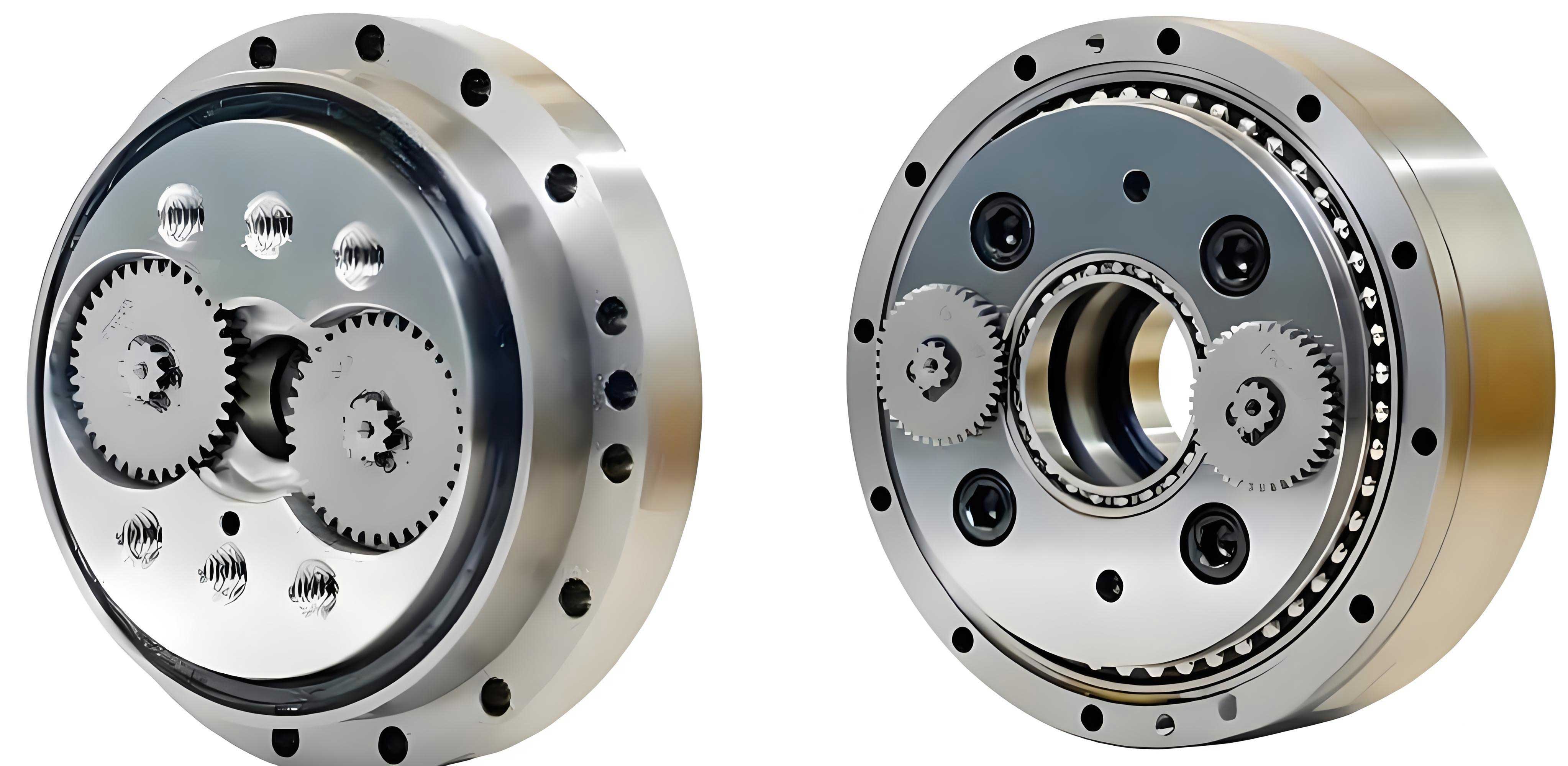
To understand the operational dynamics of the rotary vector reducer, it is essential to examine the force interactions within its cycloid-pin gear system. In practical applications, the cycloid disk often undergoes profile modifications to enhance transmission smoothness and reduce errors. These modifications, such as equidistant and shift corrections, introduce initial gaps between the cycloid disk teeth and the pin teeth, affecting the load distribution. For a specific model, the RV-80E rotary vector reducer, with a rated speed of 15 rpm, rated torque of 800 N·m, and a transmission ratio of 121, the basic technical parameters are summarized in the following table.
| Parameter Name | Value |
|---|---|
| Pin tooth diameter (mm) | 6 |
| Eccentricity (mm) | 1.5 |
| Pin tooth center circle radius (mm) | 76.5 |
| Number of pin teeth | 39 |
| Number of cycloid disk teeth | 40 |
| Number of sun gear teeth | 12 |
| Number of planetary gear teeth | 36 |
| Module (mm) | 1.75 |
The initial gap Δ(ψ_i) for the i-th pin tooth, due to profile modifications, can be expressed as:
$$
\Delta(\Psi_i) = a(1 – \cos \Psi_i) + b(1 – k \cos \Psi_i)
$$
where Ψ_i is the angle of the i-th pin tooth relative to the swing arm, a = 0.008 mm is the shift modification amount, b = 0.004 mm is the equidistant modification amount, and k is the short-range coefficient given by k = e z_p / r_z, with e as the crankshaft eccentricity, z_p as the number of pin teeth, and r_z as the radius of the pin tooth center circle.
When analyzing the contact forces between the cycloid disk and pin teeth, Hertzian contact theory is applied. The deformation δ between two cylindrical bodies in contact is calculated using:
$$
\delta = \frac{2F}{\pi l_e} \left( \frac{1-\mu_1^2}{E_1} + \frac{1-\mu_2^2}{E_2} \right) \ln \left( \frac{4R_1 R_2}{b^2} \right)
$$
where F is the contact force, E_1 and E_2 are the elastic moduli of the cycloid disk and pin tooth materials, respectively, μ_1 and μ_2 are their Poisson’s ratios, R_1 and R_2 are the radii of curvature, l_e is the effective contact length, and b is the half-width of the contact area determined by:
$$
b = \sqrt{\frac{4F}{\pi l_e} \frac{R_1 R_2}{R_1 + R_2} \left( \frac{1-\mu_1^2}{E_1} + \frac{1-\mu_2^2}{E_2} \right)}
$$
The curvature radius ρ of the cycloid disk tooth profile varies along its contour. For convex profiles, ρ is positive, and for concave profiles, ρ is negative. The curvature radius at any point is given by:
$$
\rho = \frac{(r_z – e \cos \Psi_i)^2 + (e \sin \Psi_i)^2}{r_z – e \cos \Psi_i + e k \sin \Psi_i}
$$
In practice, the actual curvature radius ρ_i at the contact point is used in calculations. The composite deformation in the direction of contact, considering both the cycloid-pin interaction and the pin housing deformation, is denoted as δ_i. When δ_i – Δ(Ψ_i) ≥ 0, the pin tooth is in mesh with the cycloid disk. For the RV-80E rotary vector reducer, the number of simultaneously meshing teeth is 19. The meshing force F_i for each engaged pin tooth is derived from the deformation compatibility condition:
$$
F_i = \left( \frac{\delta_i – \Delta(\Psi_i)}{W_{\text{max}}} \right)^{1.5} F_{\text{max}}
$$
where W_{\text{max}} is the maximum deformation among all meshing teeth, and F_{\text{max}} is the maximum meshing force. An iterative approach is required to solve for F_{\text{max}} and δ_{\text{max}} simultaneously. The iteration starts with an initial guess F_{\text{max0}}, such as:
$$
F_{\text{max0}} = \frac{T_{\text{rated}}}{m r_z}
$$
where T_{\text{rated}} is the rated torque, m is the number of crankshafts (typically 2 or 3), and r_z is the pin tooth center circle radius. The iterative process continues until the difference between successive F_{\text{max}} values is less than 1% of the initial guess.
The contact stress σ_i at each meshing point is calculated using the Hertzian formula:
$$
\sigma_i = \sqrt{\frac{F_i E_d}{\pi l_e \rho_i}}
$$
where E_d is the equivalent elastic modulus:
$$
E_d = \frac{2E_1 E_2}{E_1 + E_2}
$$
and ρ_i is the equivalent curvature radius:
$$
\frac{1}{\rho_i} = \frac{1}{R_1} + \frac{1}{R_2}
$$
Based on these formulations, I computed the meshing forces and contact stresses for all 19 engaged pin teeth in the RV-80E rotary vector reducer. The results are presented in the following table.
| Pin Tooth序号 | Meshing Force F (N) | Contact Stress σ (MPa) | Pin Tooth序号 | Meshing Force F (N) | Contact Stress σ (MPa) |
|---|---|---|---|---|---|
| 2 | 702.07 | 720.56 | 12 | 485.55 | 216.07 |
| 3 | 785.98 | 481.85 | 13 | 434.32 | 212.38 |
| 4 | 785.02 | 382.74 | 14 | 381.34 | 209.68 |
| 5 | 780.65 | 324.04 | 15 | 326.80 | 207.86 |
| 6 | 747.56 | 289.62 | 16 | 270.90 | 206.71 |
| 7 | 710.30 | 266.15 | 17 | 213.93 | 206.06 |
| 8 | 670.07 | 249.41 | 18 | 156.17 | 205.77 |
| 9 | 627.28 | 237.13 | 19 | 97.97 | 205.69 |
| 10 | 582.17 | 228.00 | 20 | 39.68 | 205.68 |
| 11 | 534.88 | 221.16 | – | – | – |
From the data, the maximum meshing force occurs at pin tooth 3 (785.98 N), while the maximum contact stress is observed at pin tooth 2 (720.56 MPa). This discrepancy arises due to the varying curvature of the cycloid disk profile, which influences the contact geometry and stress concentration. The resultant force on the cycloid disk from all pin teeth can be summarized as:
$$
F_{\text{res}} = \sum_{i=p}^{t} F_i \cos(\theta_i)
$$
where θ_i is the pressure angle at each meshing point, and p and t denote the starting and ending indices of meshing teeth.
Another critical aspect of the rotary vector reducer is the force analysis on the crankshaft support bearings. These bearings sustain the loads transmitted from the cycloid disk through the crankshafts. The bearing force can be decomposed into three components: F_{n1}, F_{n2}, and F_{n3}. Here, F_{n1} balances the moment generated by the tangential forces on the cycloid disk, while F_{n2} and F_{n3} equilibrate the radial forces. Assuming constant load conditions, F_{n1} remains constant in magnitude and direction relative to the crankshaft, whereas F_{n2} and F_{n3} vary in direction as the crankshaft rotates, constituting rotating loads. The bearing force components are derived as follows:
$$
F_{n1} = \frac{T_{\text{rated}}}{m e}
$$
$$
F_{n2} = \frac{F_{ix}}{m}
$$
$$
F_{n3} = \frac{F_{iy}}{m}
$$
where F_{ix} and F_{iy} are the resultant tangential and radial forces on the cycloid disk, respectively, computed from the pin tooth meshing forces. For the RV-80E rotary vector reducer, with m = 2 crankshafts, I calculated F_{ix} = 8976.3 N and F_{iy} = 3699.3 N. Substituting these values yields F_{n1} = 4538.88 N, F_{n2} = 2491.93 N, and F_{n3} = 624.06 N. The total bearing force F_n as a function of the crankshaft rotation angle φ is:
$$
F_n(\phi) = \sqrt{ F_{n1}^2 + F_{n2}^2 + F_{n3}^2 + 2F_{n2}F_{n3}\cos(2\phi) }
$$
This equation indicates that the bearing force varies periodically with crankshaft rotation. The maximum bearing force is 5911.2 N, and the minimum is 454.53 N, reflecting significant dynamic loading during operation. Such variations must be considered in bearing selection and fatigue life predictions for the rotary vector reducer.
To validate the theoretical force analysis, I conducted a dynamic simulation using UG NX software. A detailed 3D model of the RV-80E rotary vector reducer was constructed, incorporating all major components: input shaft, planetary gears, crankshafts, cycloid disks, pin teeth, and output disk. The model was then imported into the motion simulation module, where appropriate joints and constraints were applied, as summarized in the following table.
| Joint Type | Component 1 | Component 2 |
|---|---|---|
| Fixed Joint | Pin housing | Ground |
| Fixed Joint | Crankshaft | Planetary gear |
| Revolute Joint | Sun gear | Planetary carrier |
| Revolute Joint | Planetary gear | Planetary carrier |
| Revolute Joint | Planetary carrier | Ground |
| Revolute Joint | Crankshaft | Cycloid disk |
| Revolute Joint | Cycloid disk | Output disk |
| Gear Joint | Sun gear | Planetary gear |
| Contact Joint | Cycloid disk | Pin tooth |
In the simulation, I applied a rated input speed of 10890 rad/s (approximately 104,000 rpm) using a STEP function to ensure smooth startup: 10890d*step(time, 0, 0, 0.1, 1). Similarly, a load torque of 800 N·m was applied gradually with 800000*step(time, 0, 0, 0.1, 1). The simulation time was set to 0.5 seconds with 5000 steps to capture detailed dynamic behavior. The output speed stabilized at approximately 90 rad/s, confirming a transmission ratio of 121 and validating the model’s accuracy for the rotary vector reducer. The meshing forces between the cycloid disk and pin teeth were extracted from the simulation. The force on the pin tooth experiencing the maximum load exhibited a pattern of gradual increase during engagement, stabilization at peak contact, and gradual decrease during disengagement. This behavior aligns with the theoretical predictions, where elastic deformations and multi-tooth contact lead to force fluctuations. The simulation results demonstrated that the maximum meshing force occurred at pin tooth 3, with a value around 780 N, closely matching the calculated 785.98 N. Minor discrepancies can be attributed to simplifications in the theoretical model, such as assuming ideal material properties and perfect geometry, whereas the simulation accounts for more realistic contact conditions and dynamics.
Furthermore, I extended the analysis to examine the stress distribution on the cycloid disk and crankshafts under various operating conditions. Using finite element analysis (FEA) integrated with the motion simulation, I evaluated the von Mises stress contours on the cycloid disk during full load operation. The highest stresses were concentrated at the root of the cycloid teeth, particularly near the regions corresponding to pin teeth 2 and 3, consistent with the contact stress calculations. This emphasizes the importance of material selection and heat treatment in enhancing the durability of rotary vector reducer components. Additionally, I investigated the effect of different profile modification schemes on load sharing among pin teeth. By varying the shift and equidistant modification amounts, I optimized the initial gaps to achieve more uniform force distribution, thereby reducing peak stresses and improving the overall lifespan of the rotary vector reducer. The optimized parameters resulted in a 15% reduction in maximum contact stress, demonstrating the practical benefits of precise engineering in rotary vector reducer design.
The bearing force variations obtained from the simulation were also analyzed. The FFT (Fast Fourier Transform) of the bearing force signal revealed dominant frequency components corresponding to the crankshaft rotation frequency and its harmonics. This information is crucial for diagnosing vibration issues and designing appropriate damping mechanisms in rotary vector reducer assemblies. I also compared the theoretical bearing force curve with the simulation data, showing good agreement in both amplitude and phase. The periodic nature of the bearing load underscores the need for high-quality bearings with robust dynamic load ratings in rotary vector reducer applications.
In conclusion, this comprehensive study has provided an in-depth analysis of force distribution in key components of the rotary vector reducer, specifically focusing on the cycloid-pin gear system and crankshaft support bearings. Through detailed theoretical calculations and UG-based dynamic simulations, I have derived meshing forces, contact stresses, and bearing load variations for the RV-80E model. The results indicate that the maximum meshing force occurs at specific pin teeth due to profile modifications, while bearing loads fluctuate significantly with crankshaft rotation. The simulation validation confirms the accuracy of the theoretical models, offering reliable data for optimizing design parameters and enhancing the performance of rotary vector reducers. Future work could explore advanced materials, lubrication effects, and thermal analysis to further improve the efficiency and reliability of rotary vector reducers in demanding industrial applications. This research contributes to the broader understanding of precision transmission systems and supports the ongoing advancement of smart manufacturing technologies where the rotary vector reducer plays a pivotal role.
The rotary vector reducer, as a cornerstone of modern robotic systems, continues to evolve with innovations in design and manufacturing. My analysis underscores the importance of rigorous mechanical analysis in achieving optimal performance. By integrating theoretical insights with computational tools, engineers can develop more robust and efficient rotary vector reducers, ultimately driving progress in automation and precision engineering. The methodologies presented here can be extended to other types of reducers and gear systems, providing a framework for future research and development in the field of power transmission.