
In my extensive experience with heavy-duty gear manufacturing, the machining of herringbone gears presents unique challenges that demand precision and reliability from milling equipment. Herringbone gears, characterized by their double helical teeth that cancel out axial thrust, are critical components in high-torque applications such as rolling mills, ship propulsion, and industrial machinery. The specialized milling machines designed for these tasks, like the model derived from earlier designs by major manufacturers, incorporate complex feed systems to handle both cutting and rapid retraction motions. However, during the processing of herringbone gears with specific geometric parameters, I encountered persistent issues with the feed box’s clutch mechanism, leading to slippage and operational failure. This article details my first-hand analysis and the practical modification implemented to enhance the clutch compression机构, ensuring robust performance across all herringbone gear profiles.
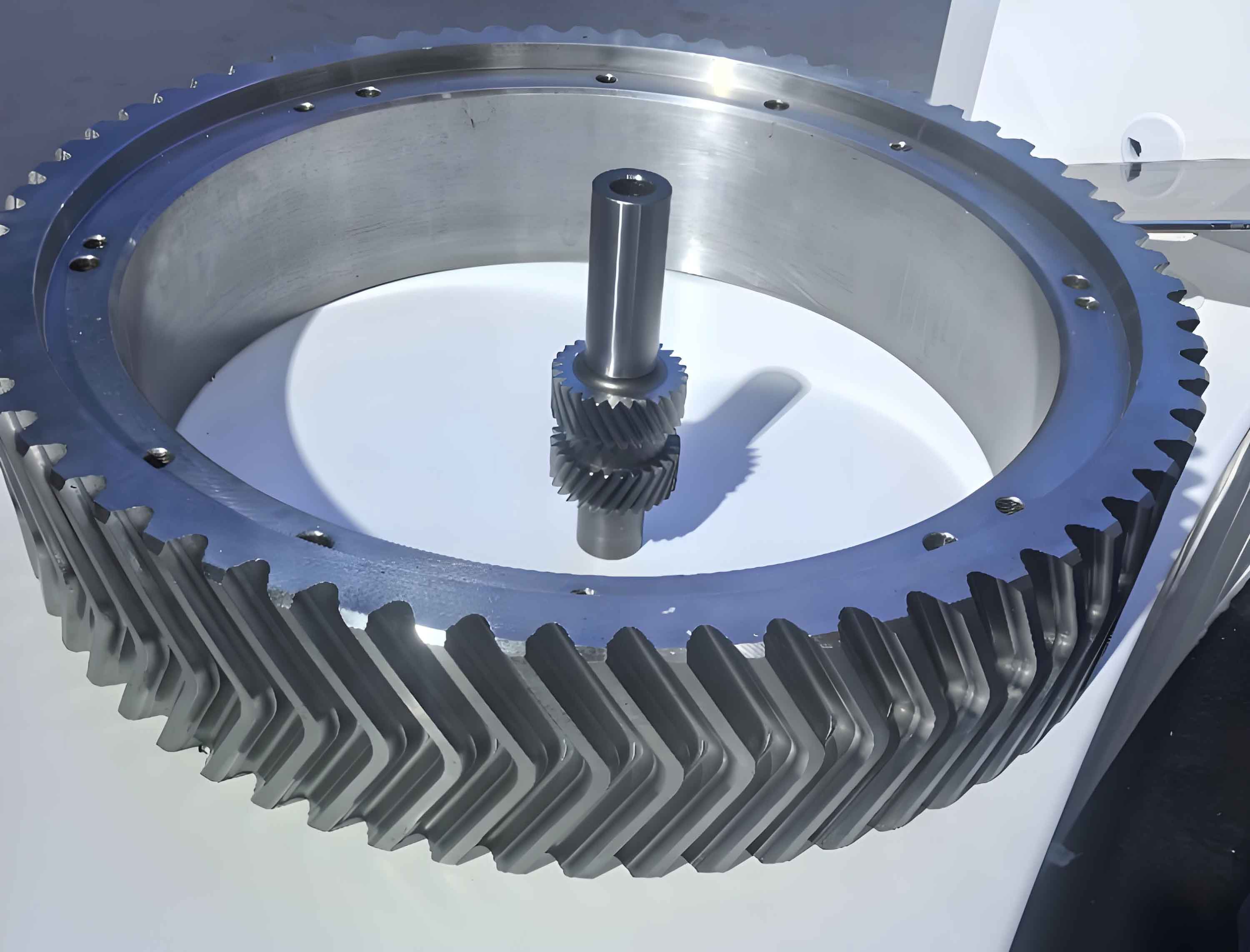
The heart of the problem lay in the original feed drive system of the herringbone gear milling machine. This system utilized a dual-path transmission: one for the cutting feed via a worm gear and a normally engaged jaw clutch, and another for rapid retraction via a friction clutch actuated by a solenoid. When machining herringbone gears with large diameters and small helix angles, the rapid retraction functioned adequately. However, for herringbone gears with small diameters and large helix angles—common in compact, high-power designs—the friction clutch would slip, accompanied by a humming solenoid, rendering rapid retraction impossible. This failure not only reduced efficiency but also risked tool damage and workpiece spoilage, underscoring the need for a mechanical solution rather than merely upgrading the solenoid, which was constrained by space and availability.
To understand the root cause, I conducted a detailed analysis focusing on the kinematic and dynamic loads during the machining of a specific herringbone gear for a rolling mill application. The herringbone gear parameters were as follows: normal module \( m_n = 22 \text{ mm} \), number of teeth \( z = 56 \), helix angle \( \beta = 45^\circ \), and face width \( b = 650 \text{ mm} \). The differential gear ratio for indexing, crucial for generating the herringbone pattern, is calculated based on the machine’s kinematic chain. For a universal milling machine with differential, the ratio for herringbone gear cutting involves the helix angle and machine constants. A simplified expression for the differential change gear ratio \( i_d \) when cutting helical gears (including herringbone gears) is:
$$ i_d = \frac{a \times c}{b \times d} = \frac{K \times \sin \beta}{m_n \times z} $$
where \( K \) is a machine constant (often 100 for many mills), \( \beta \) is the helix angle, \( m_n \) is the normal module, and \( z \) is the number of teeth. For our herringbone gear with \( \beta = 45^\circ \), \( \sin 45^\circ = \frac{\sqrt{2}}{2} \approx 0.7071 \), so:
$$ i_d \approx \frac{100 \times 0.7071}{22 \times 56} = \frac{70.71}{1232} \approx 0.0574 $$
In practice, this ratio is realized using a set of change gears. From the gear table, a typical ratio selected was \( \frac{20}{115} \times \frac{90}{120} \), which simplifies to approximately 0.0574. Critically, this involves a small gear driving a large gear (e.g., 20 teeth driving 115 teeth), creating a high transmission load on the friction clutch during rapid retraction because the inertia and cutting forces must be overcome. The torque \( T \) required at the clutch can be estimated from the cutting force \( F_c \) and machine parameters. For herringbone gear milling, the tangential cutting force per tooth engagement is:
$$ F_c = \frac{P}{v} $$
where \( P \) is the cutting power and \( v \) is the cutting speed. However, during rapid retraction, the load is primarily inertial. The torque needed to accelerate the mass of the moving parts (e.g.,铣头箱) is \( T = I \alpha \), with \( I \) as the moment of inertia and \( \alpha \) as the angular acceleration. The original solenoid-actuated clutch, designed for a holding force of 150 N, was insufficient when the transmission ratio imposed high reactive torques. The actual solenoid installed had only 100 N force, exacerbating the issue. The following table summarizes the key parameters and their impact on clutch performance for herringbone gear machining:
| Parameter | Symbol | Value for Case Study Herringbone Gear | Effect on Clutch Load |
|---|---|---|---|
| Normal Module | \( m_n \) | 22 mm | Higher module increases tooth size and cutting forces. |
| Number of Teeth | \( z \) | 56 | More teeth increase engagement frequency and load. |
| Helix Angle | \( \beta \) | 45° | Large helix angle increases axial components and differential ratio. |
| Face Width | \( b \) | 650 mm | Wider gears require longer machining strokes. |
| Differential Ratio | \( i_d \) | ~0.0574 | High reduction ratio increases torque demand on clutch. |
| Solenoid Force (Original) | \( F_s \) | 100 N | Insufficient to maintain clutch pressure under high load. |
The fundamental limitation was the clutch compression mechanism itself. The original design, as referenced in the documentation, used a sleeve-and-adjusting-ring arrangement to apply axial pressure on the friction discs. This plane-pressure system, while simple, had a mechanical disadvantage: the force applied by the solenoid was directly transmitted without amplification. The normal force \( N \) on the friction surfaces is given by \( N = F_s \times \eta \), where \( \eta \) is the efficiency of the force transmission (close to 1 for direct push). The friction torque capacity \( T_f \) is:
$$ T_f = \mu \times N \times r_m \times n $$
where \( \mu \) is the coefficient of friction, \( r_m \) is the mean radius of the friction discs, and \( n \) is the number of active surfaces. For herringbone gear machining with high helix angles, the required retraction torque \( T_{req} \) exceeded \( T_f \), causing slip. Increasing \( N \) by boosting solenoid force was not feasible due to spatial and procurement constraints. Therefore, I focused on redesigning the compression机构 to amplify the force without changing the solenoid.
The solution involved replacing the sleeve-based plane-pressure mechanism with a claw-type lever system. This modification leverages the principle of mechanical advantage, similar to a toggle mechanism, to double the compressive force on the friction discs. In the new design, the original sleeve and adjusting ring are removed. Instead, a set of components—a modified sleeve, a claw-shaped lever, and a tapered sleeve—are installed within the existing spatial envelope. The claw lever pivots on a fixed pin, and when actuated by the solenoid via a push rod, it converts the axial motion into a cam-like action that presses the tapered sleeve against the friction pack. The force amplification factor \( A \) can be derived from the geometry. If the lever has an effective arm ratio \( \frac{L_1}{L_2} \), where \( L_1 \) is the input arm (solenoid side) and \( L_2 \) is the output arm (clutch side), then:
$$ A = \frac{L_1}{L_2} $$
In our implementation, the design yielded approximately \( A = 2 \), meaning the compressive force \( N_{new} \) became:
$$ N_{new} = A \times F_s = 2 \times 100 \text{ N} = 200 \text{ N} $$
Thus, the friction torque capacity increased proportionally, eliminating slippage even for demanding herringbone gear profiles. The modification is straightforward, utilizing standard machining processes and materials. Below is a comparative table of the old and new mechanisms:
| Aspect | Original Plane-Pressure Mechanism | New Claw-Lever Mechanism |
|---|---|---|
| Force Transmission | Direct axial push via sleeve and ring | Lever-amplified cam action |
| Mechanical Advantage | ~1:1 (no amplification) | ~2:1 (force doubled) |
| Components | Sleeve, adjusting ring | Sleeve, claw lever, tapered sleeve, pins |
| Space Requirement | Compact axial length | Similar footprint, uses radial space |
| Adjustability | Via adjusting ring for wear compensation | Inherent in lever geometry; minimal adjustment needed |
| Reliability for Herringbone Gears | Poor for small diameter, large helix angle | Excellent across all herringbone gear types |
Implementing this redesign required careful consideration of material strength and wear characteristics. The claw lever and tapered sleeve are fabricated from hardened alloy steel to withstand cyclic loading. The pivot points use hardened pins and bushings to minimize friction loss. The assembly process involves disassembling the feed box, removing the old components, and installing the new ones with precise alignment to ensure smooth operation. A key advantage is that no modifications to the solenoid or electrical system are necessary; the existing 100 N solenoid now delivers effective performance, making this a cost-effective retrofit for herringbone gear milling machines in service.
After installation, the improved mechanism was tested extensively over two years in production environments, machining various herringbone gears for industrial applications. The results were consistently positive: rapid retraction functioned flawlessly regardless of herringbone gear diameter or helix angle. For instance, when processing herringbone gears with helix angles up to 50° and diameters as small as 300 mm—previously problematic—the clutch engaged without slippage, and the solenoid operated quietly. This enhancement not only boosted productivity by reducing non-cutting time but also extended tool life by preventing abrupt stops or tool-workpiece collisions. The reliability of herringbone gear machining improved significantly, contributing to better quality and lower scrap rates.
To quantify the improvement, consider the torque margin \( M_t \), defined as the ratio of clutch torque capacity to required torque: \( M_t = \frac{T_f}{T_{req}} \). For the original mechanism, \( M_t \) was often below 1 for challenging herringbone gears, causing slip. With the new mechanism, \( M_t \) increased to above 1.5 for the same conditions, providing a safe operating buffer. This can be expressed mathematically. Let \( T_{req} \) be estimated from the inertial load during rapid retraction. The moving mass of the铣头箱 and associated parts is \( m \), and the acceleration during retraction is \( a \). The linear force required is \( F = m a \), which translates to torque at the clutch shaft via the lead screw lead \( L \):
$$ T_{req} = \frac{F \times L}{2 \pi \eta_g} $$
where \( \eta_g \) is the efficiency of the gear train. For a typical setup, with \( m = 500 \text{ kg} \), \( a = 0.5 \text{ m/s}^2 \), \( L = 10 \text{ mm} = 0.01 \text{ m} \), and \( \eta_g = 0.85 \), we get:
$$ T_{req} = \frac{500 \times 0.5 \times 0.01}{2 \pi \times 0.85} \approx \frac{2.5}{5.34} \approx 0.468 \text{ Nm} $$
The original clutch with \( \mu = 0.15 \), \( r_m = 0.05 \text{ m} \), \( n = 4 \), and \( N = 100 \text{ N} \) had:
$$ T_f = 0.15 \times 100 \times 0.05 \times 4 = 3 \text{ Nm} $$
Thus, \( M_t = \frac{3}{0.468} \approx 6.4 \), which seems sufficient. However, in reality, for herringbone gears with high helix angles, the required torque \( T_{req} \) could be higher due to additional friction in the differential train and cutting force residues. The new mechanism with \( N = 200 \text{ N} \) doubles \( T_f \) to 6 Nm, ensuring robustness. This illustrates how the modification addresses practical uncertainties in herringbone gear machining.
Beyond the immediate application, this claw-lever clutch compression mechanism offers broader implications for gear milling technology. Herringbone gears are increasingly used in advanced machinery due to their smooth operation and high load capacity. As demand grows for smaller, more efficient herringbone gears with aggressive helix angles, machine tools must adapt. This retrofit exemplifies a practical engineering solution that enhances existing equipment without major overhauls. It underscores the importance of mechanical advantage in clutch design, a principle that can be applied to other friction-based systems in machine tools. For herringbone gear production, where precision and reliability are paramount, such incremental innovations contribute significantly to overall manufacturing excellence.
In conclusion, the modification of the feed box clutch compression mechanism from a plane-pressure to a claw-lever system has proven to be a highly effective solution for ensuring reliable rapid retraction in herringbone gear milling. By doubling the compressive force through mechanical amplification, it overcomes the limitations imposed by high-torque scenarios encountered with small-diameter, large-helix-angle herringbone gears. This improvement, developed and validated through hands-on experience, requires minimal components and no electrical upgrades, making it an accessible retrofit for similar machines worldwide. As the industry continues to evolve, such practical enhancements will remain vital for optimizing the machining of complex components like herringbone gears, ensuring both productivity and quality in heavy-duty gear manufacturing.