
The rotary vector reducer, commonly known as the RV reducer, stands as a critical high-precision power transmission component extensively employed in industrial robotics. Its defining characteristics are exceptional load-bearing capacity, high torsional stiffness, compact structure, and most importantly, superior transmission accuracy. For reliable and precise robotic motion, the allowable transmission angle error of a rotary vector reducer is typically required to be within 1 arc-minute (approximately 0.0167°). This stringent requirement means that even minute errors introduced during the manufacturing and assembly processes of its components can significantly degrade the overall system performance. Among its two-stage reduction mechanism, the secondary cycloidal-pin gear reduction stage contributes the majority of the total reduction ratio and is identified as the primary source of transmission inaccuracy. Within this stage, the geometric and positional errors of the crankshafts, the cycloidal gear’s crankpin holes, and the output mechanism’s crankshaft bores are paramount, as they directly link the input rotation from the primary stage to the final output. This analysis focuses on modeling the interaction of these three key elements as a four-bar linkage mechanism. By establishing the direct relationship between input and output angles through this model, the impact laws of individual and combined errors on transmission accuracy are derived, leading to practical design standards and control measures for manufacturing and assembly.
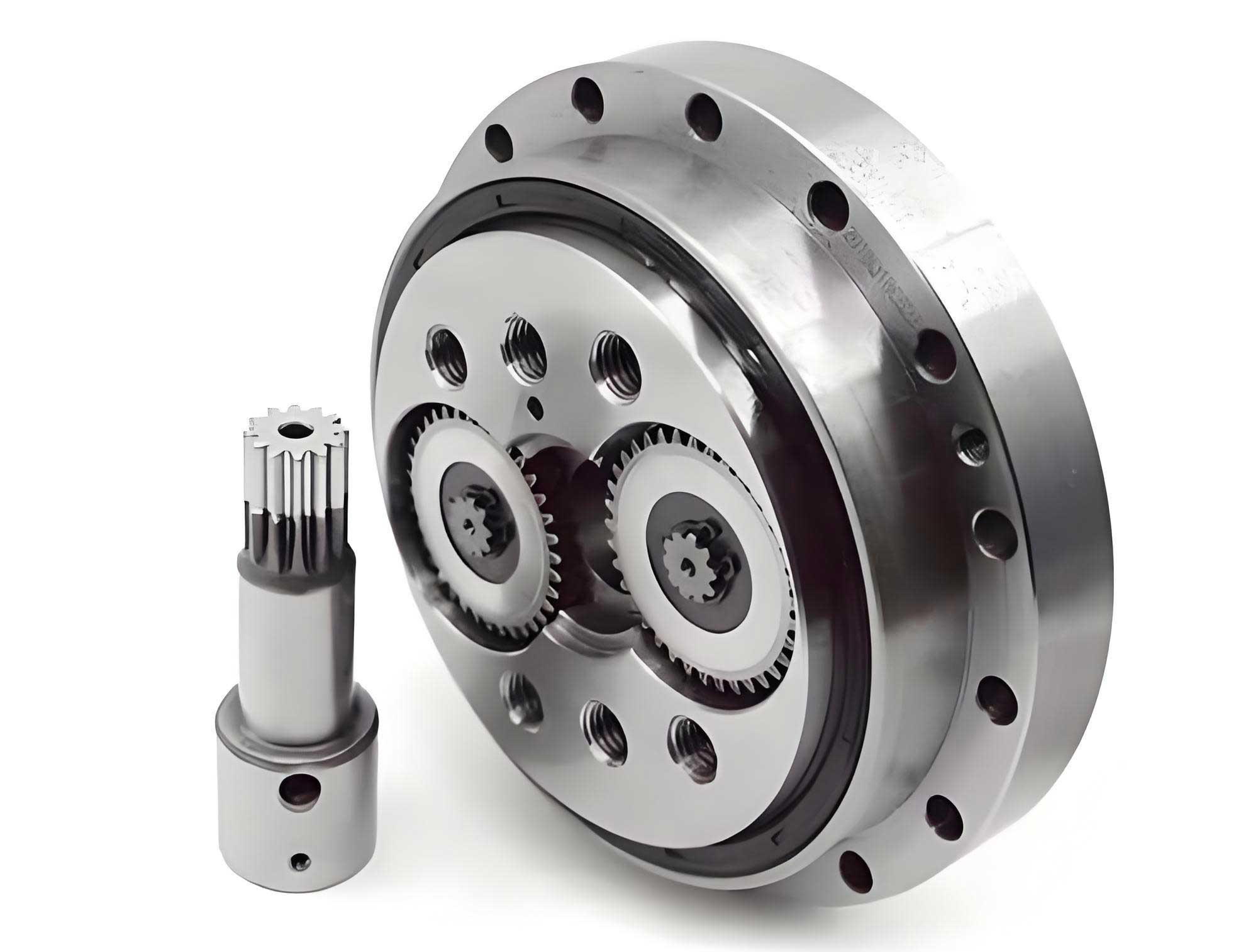
Fundamentals of RV Reducer and the Four-Bar Model
The rotary vector reducer operates on a two-stage principle. The primary stage is a standard involute planetary gear train, which provides an initial speed reduction. The secondary stage, which is the focus of this error analysis, is a precise cycloidal drive. In this stage, the rotation from the planetary carrier is transferred to two or more parallel eccentric crankshafts. These crankshafts engage with a pair of cycloidal gears via bearings. The cycloidal gears mesh with a fixed ring of pin gears, causing them to undergo a compound epicyclic motion. This motion is then converted back into concentric rotation by an output mechanism (often a pin-and-hole type) connected to the cycloidal gears, delivering high torque at low speed.
The kinematic chain from a crankshaft’s eccentric section to the output mechanism can be abstracted into a planar four-bar linkage. For a twin-crankshaft rotary vector reducer configuration, this model is particularly effective. One crankshaft’s eccentricity forms the first crank link, the distance between the bearing centers on the cycloidal gear forms the coupler link, the second crankshaft’s eccentricity forms the second crank link, and the distance between the crankshaft centers on the output mechanism forms the fixed frame link. In an ideal, error-free state, this forms a perfect parallelogram, ensuring synchronized and accurate motion transfer.
The fundamental geometric and operational parameters for a typical RV-40E reducer, which serves as the basis for this analysis, are summarized in the table below.
| Parameter Name | Symbol | Value |
|---|---|---|
| Pin Gear Center Circle Diameter | $d_p$ | 128 mm |
| Pin Diameter | $D_{rp}$ | 6 mm |
| Number of Cycloidal Gear Teeth | $z_c$ | 39 |
| Number of Sun Gear Teeth | $z_1$ | 10 |
| Number of Planetary Gear Teeth | $z_2$ | 26 |
| Number of Pin Gear Teeth | $z_p$ | 40 |
| Crankshaft Eccentricity | $e$ | 1.3 mm |
| Motor Input Speed | $n$ | 525 rpm |
Four-Bar Linkage Model with Error Incorporation
In the presence of manufacturing and assembly deviations, the ideal parallelogram is distorted. Let the nominal lengths of the four links be $l_1$, $l_2$, $l_3$, and $l_4$, corresponding to the first crankshaft eccentricity, the cycloidal gear’s internal center distance, the second crankshaft eccentricity, and the output mechanism’s center distance, respectively. Their nominal orientations are given by angles $\beta_i$. Actual manufactured dimensions and positions introduce deviations: length errors $\Delta l_i$ and angular errors $\Delta \beta_i$. Furthermore, radial clearance in the bearing joints leads to a relative displacement vector $\Delta \mathbf{p}$ between the theoretical and actual connection points.
The vector loop equation for the closed four-bar chain with errors becomes:
$$ \mathbf{l’}_1 + \mathbf{l’}_2 – \mathbf{l’}_3 = \mathbf{l’}_4 $$
where $\mathbf{l’}_i = (l_i + \Delta l_i) \angle (\beta_i + \Delta \beta_i)$.
Projecting this equation onto the x and y axes, and assuming small angular errors for the coupler link ($\sin \beta’_2 \approx \beta’_2$, $\cos \beta’_2 \approx 1 – (\beta’_2)^2/2$), yields a quadratic equation for the output-related angle $\beta’_2$:
$$ a(\beta’_2)^2 + b\beta’_2 + c = 0 $$
where the coefficients $a$, $b$, and $c$ are functions of the erroneous link parameters and the input angle $\beta’_1$:
$$
\begin{aligned}
a &= l’_2 l’_4 – l’_1 l’_2 \cos \beta’_1 \\
b &= 2 l’_1 l’_2 \sin \beta’_1 \\
c &= (l’_1)^2 + (l’_2)^2 + (l’_4)^2 – (l’_3)^2 – 2l’_1 l’_4 \cos \beta’_1 + 2l’_1 l’_2 \cos \beta’_1 – 2l’_2 l’_4
\end{aligned}
$$
with $l’_i = l_i + \Delta l_i$. Solving this equation for $\beta’_2$ and comparing it to the ideal output provides the kinematic transmission error. It is critical to analyze both rigid error (error due purely to geometric deviations under no load) and elastic error (the combined error considering elastic deformations at joints and links under operational load). The elastic analysis requires superimposing the elastic displacement vectors $\mathbf{l}_{11}$ and $\mathbf{l}_{33}$ at the crankshaft-cycloid gear bearings onto the rigid error model, effectively modifying $l’_1$ and $l’_3$ to $l”_1$ and $l”_3$.
$$ l”_1 = \sqrt{ (l’_1)^2 + l_{11}^2 – 2 l’_1 l_{11} \cos \theta_1 } $$
$$ l”_3 = \sqrt{ (l’_3)^2 + l_{33}^2 – 2 l’_3 l_{33} \cos \theta_3 } $$
Here, $\theta_1$ and $\theta_3$ are the angles between the rigid-error eccentricity vectors and the elastic displacement vectors, determined by the force equilibrium within the rotary vector reducer.
Analysis of Individual Error Sources
Crankshaft Eccentricity Error ($\Delta e$ or $\Delta l_1, \Delta l_3$)
This error directly changes the lengths of links $l_1$ and $l_3$. Under rigid conditions, bearing clearance causes a shift in the connection points. Analysis shows that the maximum rigid error occurs when the input angle $\beta’_1 = 90^\circ$. The tangential and radial forces on the crankshafts, derived from the cycloidal gear meshing load, are used to calculate the elastic displacement direction ($\theta_1, \theta_3$). For the analyzed rotary vector reducer, with $\Delta e$ varying within $[-0.1, 0.1]$ mm, the rigid output angle error ranges from $0.0333^\circ$ to $0.0389^\circ$, while the elastic error is slightly larger, from $0.0335^\circ$ to $0.0390^\circ$. Crucially, the trend indicates that a negative deviation (smaller eccentricity) in both crankshafts leads to higher transmission accuracy, while a positive deviation reduces it.
| Eccentricity Error $\Delta e$ (mm) | Rigid Angle Error (deg) | Elastic Angle Error (deg) |
|---|---|---|
| -0.10 | 0.0333 | 0.0335 |
| -0.05 | 0.0350 | 0.0352 |
| 0.00 | 0.0367 | 0.0369 |
| +0.05 | 0.0383 | 0.0385 |
| +0.10 | 0.0389 | 0.0390 |
Cycloidal Gear Crankpin Hole Position Error ($\Delta l_2$)
This error alters the length and orientation of the coupler link $l_2$. In the rigid model, it changes the effective position of the crankshaft centers relative to the cycloidal gear. Interestingly, analysis reveals that a deviation in either the positive or negative direction can improve transmission accuracy compared to the nominal condition. This is because the hole position error can partially compensate for other inherent errors in the system, such as the crankshaft eccentricity error. For $\Delta l_2$ in $[-0.1, 0.1]$ mm, the rigid error varies between $0.036058^\circ$ and $0.036111^\circ$, and the elastic error between $0.03618^\circ$ and $0.03624^\circ$. This suggests a permissible tolerance zone for this parameter in the design of a rotary vector reducer.
Output Mechanism Crankshaft Bore Position Error ($\Delta l_4$)
This error modifies the length of the fixed frame link $l_4$. The analysis shows a distinct asymmetric behavior. When the error trends negative (smaller center distance), accuracy first decreases then slightly recovers. When it trends positive (larger center distance), accuracy improves significantly. For $\Delta l_4$ in $[-0.1, 0.1]$ mm, the rigid error range is $[0.036008^\circ, 0.036123^\circ]$, while the elastic error is markedly higher at $[0.038588^\circ, 0.038706^\circ]$, underscoring the substantial impact of load-induced deformations when this parameter is off-nominal.
| Error Source | Ideal Deviation for Higher Accuracy | Key Observation |
|---|---|---|
| Crankshaft Eccentricity ($\Delta e$) | Towards Lower Limit (Negative) | Elastic error > Rigid error. Negative bias beneficial. |
| Cycloid Gear Hole Pos. ($\Delta l_2$) | Within Tolerance Zone (Slightly Negative Preferred) | Can compensate other errors. Has a forgiving zone. |
| Output Mech. Bore Pos. ($\Delta l_4$) | Towards Upper Limit (Positive) | Elastic error significantly larger. Positive bias strongly beneficial. |
Analysis of Combined Error Effects
In a real rotary vector reducer, these errors coexist and interact. The combined effect is not simply additive but involves complex interactions through the four-bar linkage geometry. The following analyses consider pairs of errors varying simultaneously within the $[-0.1, 0.1]$ mm range.
Combination: Crankshaft Error & Cycloid Gear Hole Error
The combined error surface shows a convex, stepped distribution. The lowest error (highest accuracy) is achieved when the crankshaft error is at its maximum negative value and the cycloid gear hole error is near the center of its tolerance zone. The rigid error range for this combination is $[0.0347^\circ, 0.0375^\circ]$, and the elastic error range is $[0.0355^\circ, 0.0383^\circ]$, confirming that the elastic model consistently predicts worse performance.
Combination: Crankshaft Error & Output Mechanism Bore Error
This combination also yields a convex surface. Maximum accuracy is observed when the crankshaft error is maximally negative and the output bore error is maximally positive. The rigid and elastic error ranges for this case are $[0.0346^\circ, 0.0375^\circ]$ and $[0.0354^\circ, 0.0383^\circ]$, respectively.
Combination: Cycloid Gear Hole Error & Output Mechanism Bore Error
This interaction produces a saddle-shaped surface. The highest accuracy occurs under two distinct conditions: 1) maximum positive cycloid hole error with maximum negative output bore error, and 2) maximum negative cycloid hole error with maximum positive output bore error. Since the output bore error should be biased positive for overall best performance (from individual and other combined analyses), the practical choice is to pair it with a slightly negative bias on the cycloid gear hole error. The error ranges for this combination are $[0.0358^\circ, 0.0362^\circ]$ (rigid) and $[0.0384^\circ, 0.0387^\circ]$ (elastic).
The general governing equation for the output angle $\beta’_2$ under combined errors, considering the first-order approximation, can be expressed as a function of the input and the deviations:
$$ \Delta \beta_2 \approx \sum_{i=1}^{4} \left( \frac{\partial \beta_2}{\partial l_i} \Delta l_i + \frac{\partial \beta_2}{\partial \beta_i} \Delta \beta_i \right) + \sum_{k} \left( \frac{\partial \beta_2}{\partial \Delta p_k} \Delta p_k \right) $$
Where the partial derivatives are the sensitivity coefficients, determined from the four-bar model, and $\Delta p_k$ represents joint clearances. The non-linear interaction is evident in the cross-terms that arise when solving the full quadratic equation.
Design Guidelines and Error Control Strategies
Based on the comprehensive analysis of the rotary vector reducer’s secondary stage via the four-bar linkage model, the following guidelines and strategies are formulated to enhance transmission accuracy:
- Selective Tolerance Biasing: Manufacturing tolerances should not be simply symmetric. For the crankshaft eccentricity, the nominal dimension should be biased toward the lower limit of the tolerance zone. For the output mechanism’s crankshaft bore center distance, the bias should be toward the upper limit. The cycloidal gear’s crankpin hole position has a more flexible permissible zone but is best kept toward the lower limit when considered with other errors.
- Control of Bearing Clearance: The radial clearance in the crankshaft-cycloid gear bearings and the output pin-hole joints is a critical amplifier of other geometric errors. Minimizing this clearance is essential, as it directly features in the displacement vector $\Delta \mathbf{p}$ and influences the elastic deformation path. Preloaded or selectively fitted bearings should be considered.
- Elastic Error Dominance: The analysis consistently shows that the predicted transmission error under load (elastic error) is greater than the kinematic (rigid) error. Therefore, design validation and tolerance allocation for a high-performance rotary vector reducer must account for the deformed state under operational loads, not just the as-manufactured geometry.
- Compensation through Assembly: The interaction between different error sources, particularly between the cycloid gear and output mechanism holes, suggests that selective assembly could be a powerful technique. By measuring individual component errors and mating parts whose error patterns are complementary (e.g., positive bore error with negative hole error), the overall system error can be minimized.
- Systematic Sensitivity Analysis: During the design phase, the four-bar model should be used to perform a full sensitivity analysis, calculating the coefficients $\frac{\partial \beta_2}{\partial l_i}$ for all parameters. This identifies which tolerances have the greatest impact on the final output error of the rotary vector reducer, allowing for cost-effective tightening of critical dimensions.
In conclusion, the transmission accuracy of a rotary vector reducer is highly sensitive to the interdependent errors in the crankshafts, cycloidal gear, and output mechanism of its secondary reduction stage. Modeling this subsystem as a four-bar linkage provides a direct and effective analytical framework to quantify these effects. The findings demonstrate that intelligent, non-symmetric tolerance design—specifically, biasing crankshaft dimensions low, output mechanism dimensions high, and carefully controlling cycloid gear dimensions—coupled with stringent control of joint clearances, is paramount to achieving the sub-arc-minute precision required for advanced robotic applications. This methodology offers a theoretical foundation for guiding the precision manufacturing and assembly processes of the critical rotary vector reducer.