
The pursuit of high precision, compactness, and reliability in modern robotics and precision machinery has placed significant demands on power transmission components. Among these, the rotary vector reducer stands out due to its exceptional combination of high reduction ratio, torsional stiffness, compact size, and load-bearing capacity. The transmission accuracy and operational smoothness of a rotary vector reducer are profoundly influenced by the dynamic behavior of its core components. The cycloidal wheel, serving as the primary force-transmitting element in the secondary reduction stage, is particularly critical. Its vibrational characteristics under operational loads directly impact noise generation, transmission error, and overall system longevity. Therefore, a deep understanding and analysis of the cycloidal wheel’s dynamic properties through advanced simulation techniques are essential for the optimal design and performance enhancement of rotary vector reducers.
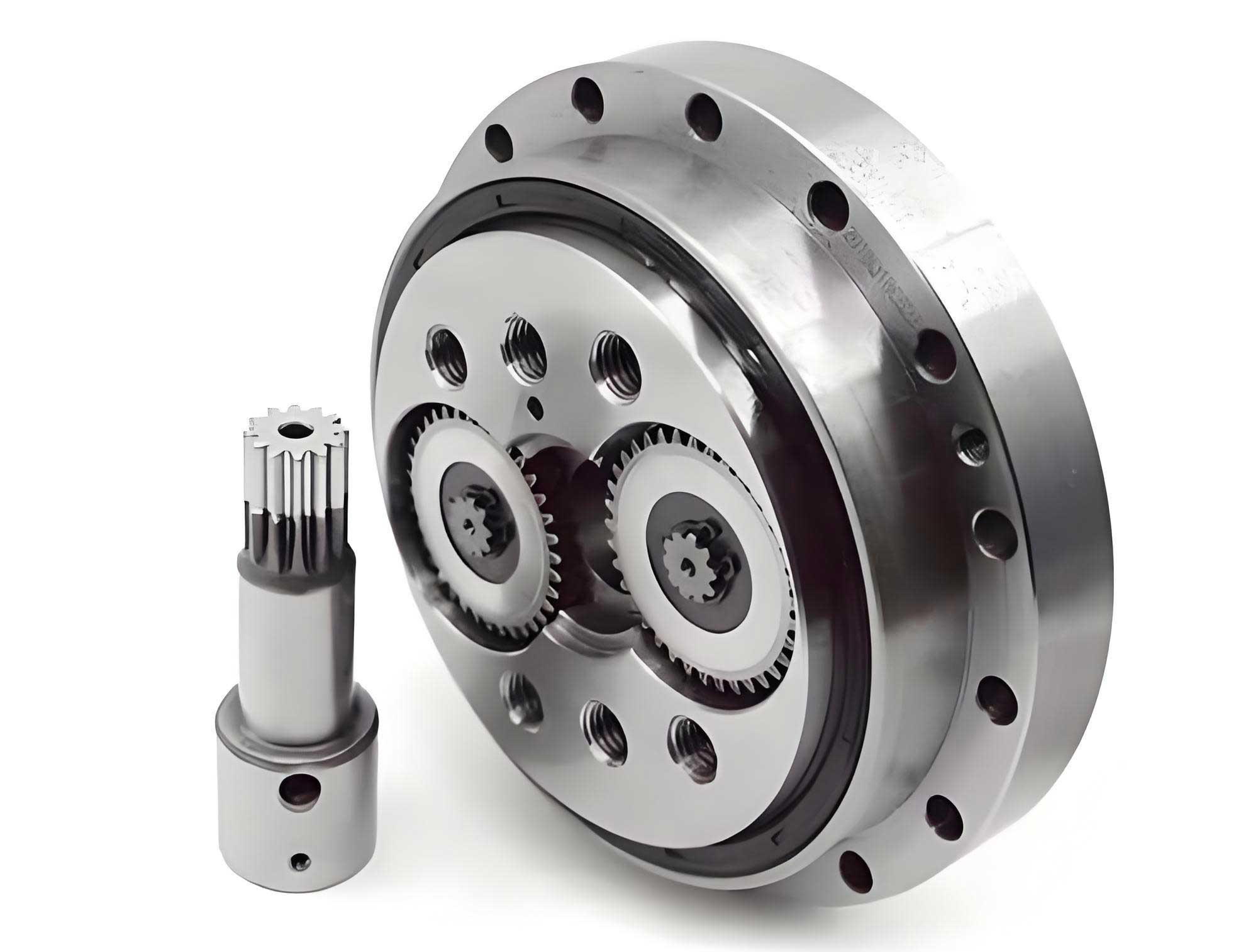
The operational principle of a typical rotary vector reducer involves a two-stage speed reduction mechanism. The first stage consists of a conventional involute gear planetary transmission, where an input sun gear meshes with multiple planetary gears. The second, and most distinctive, stage is a cycloidal-pin gear planetary transmission. The planetary gears from the first stage are connected to eccentric crankshafts. These crankshafts drive the cycloidal wheels, which mesh with a stationary ring of pin gears housed in the reducer’s casing. The cycloidal wheels undergo a compound motion: a revolution around the central axis driven by the crankshafts and a counter-rotation about their own centers due to the meshing action with the pins. This counter-rotation is output through a set of pins or rollers placed in holes on the cycloidal wheel, connected to the output flange. The unique geometry of the cycloidal tooth profile, derived from a trochoidal curve, allows for multi-tooth contact, enabling the rotary vector reducer to achieve high load capacity and shock resistance within a minimal space.
The dynamic performance of the entire rotary vector reducer system is a complex interplay of various factors, including time-varying mesh stiffness, manufacturing errors, assembly clearance, and the inherent vibrational modes of components like the cycloidal wheel. Excitation forces arising from gear meshing, especially at the cycloid-pin interface, can induce vibrations. If the frequency of these excitations coincides with the natural frequencies of critical components, resonance can occur, leading to amplified noise, increased wear, and potential failure. Thus, modal analysis—the study of the inherent vibration characteristics (natural frequencies and mode shapes) of a structure—becomes a fundamental step in the design process. Identifying these characteristics allows engineers to steer the design away from potential resonant conditions during normal operation.
Parametric Modeling and Mathematical Foundation of the Cycloidal Wheel
Accurate geometric modeling is the cornerstone of any reliable finite element analysis. For complex profiles like the cycloidal tooth, a parametric modeling approach is indispensable. This method links the geometric model directly to its defining mathematical equations and key design parameters. Any modification to a parameter automatically updates the entire three-dimensional model, streamlining the design iteration and optimization process for the rotary vector reducer component.
The tooth profile of a standard cycloidal wheel is a shortened epicycloid. It can be generated by tracing the path of a point fixed on a rolling circle (generating circle) as it rolls without slipping along the inside of a fixed base circle (pin gear center circle). For a rotary vector reducer, modifications such as equidistant and shifting profile modifications are typically applied to optimize tooth contact and ensure proper backlash. The parametric equations for the modified cycloidal profile in the Cartesian coordinate system (with the wheel center as the origin) are given by:
$$
\begin{aligned}
x &= [R_z \sin(\varphi) – K_1 a_z \sin(\frac{Z_c}{Z_b}\varphi)] + r_z \frac{K_1 \sin(\frac{Z_c}{Z_b}\varphi) – \sin(\varphi)}{\sqrt{1 + K_1^2 – 2K_1 \cos(\frac{Z_c}{Z_b}\varphi)}} \\
y &= [R_z \cos(\varphi) – K_1 a_z \cos(\frac{Z_c}{Z_b}\varphi)] – r_z \frac{K_1 \cos(\frac{Z_c}{Z_b}\varphi) – \cos(\varphi)}{\sqrt{1 + K_1^2 – 2K_1 \cos(\frac{Z_c}{Z_b}\varphi)}}
\end{aligned}
$$
Where:
- $Z_c$ is the number of teeth on the cycloidal wheel.
- $Z_b$ is the number of pins on the stationary ring ($Z_b = Z_c + 1$ for standard designs).
- $R_z$ is the radius of the pin gear center circle.
- $a_z$ is the eccentricity of the crankshaft (center distance between the rolling circle and base circle).
- $K_1$ is the shortening coefficient ($K_1 = a_z Z_b / R_z$), defining the shape of the curtate cycloid.
- $r_z$ is the radius of the pins (or needles).
- $\varphi$ is the rolling angle parameter, typically ranging from $0$ to $2\pi$.
The terms involving $r_z$ represent the equidistant modification (creating a parallel curve offset by the pin radius), while adjustments to $a_z$ or $R_z$ can incorporate profile shifting modifications. Using modern CAD software like SolidWorks, these equations can be implemented via “Equation Driven Curves” to sketch the precise tooth profile. By extruding this profile and adding features like bearing holes (for the crankshaft bearings) and output pin holes, a fully parametric three-dimensional solid model of the cycloidal wheel for a specific rotary vector reducer is created.
For this analysis, an RV-80E type rotary vector reducer is used as a reference. The key parameters for its cycloidal wheel are summarized in the table below:
| Parameter | Symbol | Value | Unit |
|---|---|---|---|
| Cycloidal Wheel Material | – | 42CrMo (initially) | – |
| Number of Cycloid Teeth | $Z_c$ | 39 | – |
| Number of Pins | $Z_b$ | 40 | – |
| Eccentricity | $a_z$ | 1.5 | mm |
| Pin Center Circle Radius | $R_z$ | 66.0 | mm |
| Pin Radius | $r_z$ | 3.0 | mm |
| Profile Shift Modification | – | 0.01 | mm |
| Tooth Width | – | 8.83 | mm |
Finite Element Modal Analysis: Methodology and Setup
Modal analysis via the Finite Element Method (FEM) is a powerful numerical technique to determine the natural frequencies and corresponding mode shapes of a structure. The governing equation for undamped free vibration is derived from the dynamic equilibrium of the system:
$$ [M]\{\ddot{u}\} + [K]\{u\} = \{0\} $$
where $[M]$ is the global mass matrix, $[K]$ is the global stiffness matrix, $\{u\}$ is the nodal displacement vector, and $\{\ddot{u}\}$ is the nodal acceleration vector. Assuming harmonic motion $\{u\} = \{\phi\} e^{i \omega t}$, the equation reduces to the generalized eigenvalue problem:
$$ ([K] – \omega^2 [M]) \{\phi\} = \{0\} $$
The solutions to this equation are the eigenvalues $\omega_i^2$, where $\omega_i$ is the i-th natural frequency (in rad/s), and the eigenvectors $\{\phi_i\}$, which describe the i-th mode shape.
The process begins by importing the parametric 3D CAD model of the cycloidal wheel into ANSYS or a similar FEA suite. The material properties are defined. For the initial model, alloy steel 42CrMo is assigned with the following properties:
| Property | Value | Unit |
|---|---|---|
| Density ($\rho$) | 7850 | kg/m³ |
| Young’s Modulus (E) | 206 | GPa |
| Poisson’s Ratio ($\nu$) | 0.277 | – |
The geometry is then discretized into a finite number of small elements. A tetrahedral or hex-dominant mesh is typically used for such complex geometries. Mesh convergence studies are performed to ensure the results are independent of element size. For the cycloidal wheel model under consideration, a high-quality mesh with approximately 85,000 nodes and 42,500 solid elements is generated to ensure accuracy.
Two distinct boundary condition scenarios are analyzed to provide a comprehensive understanding of the cycloidal wheel’s dynamic characteristics within the rotary vector reducer assembly:
- Free-Free Boundary Condition: The cycloidal wheel is completely unconstrained. This analysis reveals the intrinsic dynamic properties of the component itself, independent of its mounting. The first six modes (rigid body modes: three translations and three rotations) will have natural frequencies near zero and are typically ignored. The subsequent modes are the flexible-body modes of the wheel.
- Constrained Boundary Condition: This scenario mimics the actual working state of the cycloidal wheel inside the rotary vector reducer. Constraints are applied to the cylindrical surfaces of the bearing holes (where the crankshaft bearings are press-fitted) to simulate the radial and axial support provided by the bearings. This condition stiffens the structure, and its natural frequencies are expected to be higher than those in the free-free state.
Simulation Results: Natural Frequencies and Mode Shapes
The results from the finite element modal analysis for both boundary conditions are presented below. The focus is on the first ten flexible modes (excluding rigid body modes for the free condition).
Free-Free Boundary Condition Results
| Mode Order | Natural Frequency (Hz) | Description of Mode Shape |
|---|---|---|
| 1 (Flex) | 769.6 | Torsional deformation about the X-axis. |
| 2 | 1165.7 | Breathing mode (radial expansion/contraction) primarily in the Y-direction. |
| 3 | 1735.8 | Combined bending and twisting in the X-Y plane. |
| 4 | 2852.4 | Warping/twisting deformation in the Y-Z plane. |
| 5 | 3264.6 | Higher-order radial stretching in the X-Y plane. |
| 6 | 4769.5 | Complex warping and stretching in the Y-Z plane. |
| 7 | 5368.7 | Bending of the entire wheel along the X-axis. |
| 8 | 6079.6 | Bending of the entire wheel along the Y-axis. |
| 9 | 6452.1 | Coupled mode featuring X-axis torsion and Y-axis bending. |
Analysis of the mode shapes, particularly for modes 4 (1735.8 Hz) and 7 (4769.5 Hz), reveals a critical insight: the maximum deformation consistently occurs at specific locations. These are the regions on the cycloidal tooth profile that are directly adjacent to the outer edges of the large, lightening (penetration) holes. These holes are necessary for weight reduction in the rotary vector reducer but create local areas of reduced stiffness. This identifies the tooth-holes interface as a potential structural weak point prone to higher dynamic stress during vibration.
Constrained Boundary Condition Results
| Mode Order | Natural Frequency (Hz) | Description of Mode Shape |
|---|---|---|
| 1 | 1543.8 | Torsional deformation about the constrained axis (similar to X-axis). |
| 2 | 2715.9 | Predominantly torsional deformation about the Y-axis. |
| 3 | 3213.7 | In-plane (X-Y) twisting deformation. |
| 4 | 4178.9 | Out-of-plane (Y-Z) bending/warping. |
| 5 | 5269.5 | Complex in-plane deformation involving multiple hole sectors. |
| 6 | 5774.6 | Axial (Z-direction) stretching and warping near the teeth. |
| 7 | 7284.6 | Overall bending deformation. |
| 8 | 7871.4 | Higher-order axial (thickness-direction) vibration. |
| 9 | 8965.3 | Coupled high-frequency bending and torsional mode. |
As anticipated, the application of constraints at the bearing holes significantly increases the stiffness of the cycloidal wheel structure, leading to a substantial rise in all natural frequencies compared to the free-free condition. For instance, the first flexible mode frequency increases from 769.6 Hz to 1543.8 Hz. This constrained condition more accurately represents the wheel’s behavior within the assembled rotary vector reducer. Notably, modes 7 (5774.6 Hz) and 9 (7871.4 Hz) under constraint now occupy frequency ranges that are critical for evaluation against potential system excitations.
Resonance Risk Assessment and Dynamic Interaction within the Rotary Vector Reducer
The isolated analysis of the cycloidal wheel is informative, but its true significance is realized when compared with the dynamic characteristics of the complete rotary vector reducer system. Literature and prior studies on system-level dynamics of rotary vector reducers provide valuable reference data for the system’s lower-order natural frequencies, often derived from lumped-parameter or multi-body dynamic models.
For a typical RV-type reducer, system natural frequencies related to torsional and translational vibrations often fall within specific ranges. For example, system modes may be identified at frequencies such as ~75 Hz (very low-frequency torsion), ~435 Hz, ~835 Hz, ~1678 Hz, ~2426 Hz, ~4115 Hz, ~4845 Hz, ~5848 Hz, ~7163 Hz, and ~7922 Hz (higher-frequency structural modes).
By overlaying the cycloidal wheel’s modal results with these system frequencies, potential resonance risks can be identified:
- Free-Free Condition: The cycloidal wheel’s 4th mode (~1735.8 Hz) is close to a potential system mode near ~1678 Hz. Its 7th mode (~4769.5 Hz) is in the vicinity of system modes around ~4845 Hz.
- Constrained Condition: The wheel’s 7th constrained mode (~5774.6 Hz) approaches the system’s ~5848 Hz mode. Its 9th constrained mode (~7871.4 Hz) is very close to the system’s ~7922 Hz mode.
Proximity in frequency does not guarantee resonance, as the mode shapes and the spatial distribution of the excitation force must also couple effectively. However, these overlaps indicate a non-negligible risk. If the meshing frequency of the cycloid-pin pair or other internal excitations within the rotary vector reducer (e.g., from the first-stage planetary gears or bearing defects) coincides with these nearby natural frequencies, significant vibration amplification could occur. This underscores the necessity of design optimization to shift the cycloidal wheel’s natural frequencies away from these critical ranges, thereby enhancing the robustness and quiet operation of the rotary vector reducer.
Structural Optimization Strategies for the Cycloidal Wheel
Based on the modal analysis and resonance risk assessment, two primary optimization strategies can be employed to improve the dynamic performance of the cycloidal wheel within the rotary vector reducer: geometric modification and material change.
Strategy 1: Geometric Optimization of Lightening Holes
The initial design featured large, sector-shaped lightening holes. The modal analysis clearly showed that the maximum deformation consistently localized at the thin bridge of material between the edge of these holes and the root of the cycloidal teeth. This geometry creates a significant stress concentration and reduces local bending stiffness.
Optimization Proposal: Redesign the lightening holes to a circular pattern distributed on a pitch circle closer to the wheel’s center. The circular shape offers better stress flow and eliminates the sharp corners and thin sections inherent in the sector design. The number, diameter, and distribution circle diameter of the new holes are parameters to be optimized, with the constraints being sufficient material left for the output pin holes and maintaining overall structural integrity and weight target.
Analysis of Optimized Geometry: A new finite element model was created with circular lightening holes. The modal analysis was repeated for both boundary conditions. The results, compared to the original design, are summarized conceptually below:
| Condition | Impact on Natural Frequencies | Rationale and Implication |
|---|---|---|
| Free-Free | Modes 1-5: Slight decrease or minimal change. Modes 6-9: Noticeable decrease (e.g., 7th mode reduced from 4769.5 Hz to a lower value). | The circular holes provide a more uniform stiffness distribution but slightly reduce the overall mass and stiffness. The reduction in higher-frequency modes successfully moves them further away from critical system frequencies, mitigating resonance risk. |
| Constrained | All flexible modes show a measurable decrease in frequency. | The shift is particularly beneficial for the previously risky modes (~5774 Hz and ~7871 Hz), pushing them downward and away from the exciting system modes, thus enhancing the dynamic safety margin of the rotary vector reducer. |
Furthermore, the revised geometry alleviates the severe stress concentration at the tooth-hole junction, which is likely to improve the fatigue life of the cycloidal wheel under cyclic loading in the rotary vector reducer.
Strategy 2: Material Change for Enhanced Stiffness
An alternative or complementary approach is to select a material with superior mechanical properties. The initial material was 42CrMo steel. A candidate for enhancement is a high-grade bearing steel like GCr15 (AISI 52100), which offers higher elastic modulus and better hardenability.
New Material Properties:
| Property | GCr15 Value | Unit |
|---|---|---|
| Density ($\rho$) | 7830 | kg/m³ |
| Young’s Modulus (E) | 219 | GPa |
| Poisson’s Ratio ($\nu$) | 0.30 | – |
The natural frequency of a structure is proportional to the square root of the stiffness-to-mass ratio: $\omega \propto \sqrt{K/M}$. While the density is nearly identical, the ~6.3% increase in Young’s Modulus (from 206 GPa to 219 GPa) directly increases the global stiffness $K$.
Analysis with New Material: Applying the new material properties to the original geometry and re-running the modal analysis yields the following comparative outcome:
| Condition | Impact on Natural Frequencies | Rationale and Implication |
|---|---|---|
| Free-Free | All frequencies increase. The increase is more pronounced for higher-order modes (e.g., 7th-9th modes). | The increased stiffness raises the natural frequencies. This could be beneficial or detrimental depending on the target. If the goal is to avoid a specific high-frequency excitation, raising the frequencies might be helpful. However, if system frequencies are fixed, this increase might bring the wheel’s modes closer to excitation, requiring careful reevaluation. |
| Constrained | Significant increase across all modes. | This strategy drastically elevates the frequency spectrum. For the previously identified risky modes, this means shifting them to even higher frequencies (e.g., well above 6000 Hz and 8500 Hz), which may effectively avoid resonance with the known system modes if those remain unchanged. This offers a clear path to decoupling the component dynamics from system excitations in the rotary vector reducer. |
The choice between geometric optimization and material change, or a combination of both, depends on multiple factors: cost (bearing steel is more expensive), manufacturability, weight targets, and the specific frequency ranges of excitations present in the final application of the rotary vector reducer.
Conclusions and Implications for Rotary Vector Reducer Design
This comprehensive simulation-based investigation into the dynamic characteristics of the cycloidal wheel yields several key conclusions with direct implications for the design and development of high-performance rotary vector reducers:
- Parametric modeling grounded in the precise mathematical equations of the modified cycloidal profile is essential for efficient and accurate design iteration. It enables rapid exploration of design changes and their effects on performance.
- Finite Element Modal Analysis is a powerful tool to uncover the inherent vibrational behavior of the cycloidal wheel. The analysis under both free and constrained boundary conditions provides a complete picture, revealing that the constrained condition (simulating actual mounting) significantly raises the natural frequencies.
- Critical Weak Points were identified through mode shape examination. The interface region between the cycloidal tooth root and the edge of large lightening holes is consistently the location of maximum deformation, marking it as a primary area for structural enhancement and fatigue consideration in the rotary vector reducer.
- Resonance Risk is a tangible concern. The natural frequencies of the cycloidal wheel, particularly in specific mid-to-high order modes, can lie close to the global natural frequencies of the assembled rotary vector reducer system. This overlap poses a risk of resonance under operational excitations.
- Effective Optimization Pathways have been demonstrated:
- Geometric Optimization: Redesigning lightening holes from a sector to a circular pattern improves stress flow, reduces localized weakness, and can effectively lower specific natural frequencies to avoid coinciding with system excitations.
- Material Optimization: Selecting a material with a higher Young’s Modulus, such as GCr15 bearing steel, increases the overall stiffness of the cycloidal wheel, raising its natural frequency spectrum and providing a clear margin away from potential excitation frequencies.
The insights gained from this dynamic characteristic analysis form a solid theoretical foundation for the optimal design of rotary vector reducers focused on vibration and noise reduction. Future work could involve coupled thermo-mechanical analysis, nonlinear dynamic response under actual loading spectra, and experimental modal analysis to validate the simulation models. By integrating these advanced analysis techniques into the design cycle, engineers can develop rotary vector reducers that are not only powerful and precise but also exceptionally quiet and durable, meeting the escalating demands of next-generation robotic and automated systems.