
In modern industrial manufacturing, the assembly process of mechanical products is a critical phase that directly impacts final quality and performance. As a key component in industrial robot joints, the rotary vector reducer (often abbreviated as RV reducer) requires precise assembly to ensure optimal functionality. However, complex assembly steps and human reliance often lead to errors such as missing parts, which can compromise the entire system. To address this, I propose a deep learning-based monitoring system for the assembly process of rotary vector reducers. This system leverages computer vision and advanced deep learning algorithms to detect missing components in real-time, thereby enhancing assembly accuracy and reliability.
The core of this system is an integration of hardware and software. The hardware setup includes an experimental platform with a rotary vector reducer and an RGB-D camera (Intel RealSense D415), which captures both depth and color images. The software, developed using Qt5 and Python, incorporates deep learning models for image prediction and a user interface for monitoring. By combining semantic segmentation and object detection algorithms, the system can identify various parts of the rotary vector reducer during different assembly stages, flagging any omissions promptly.
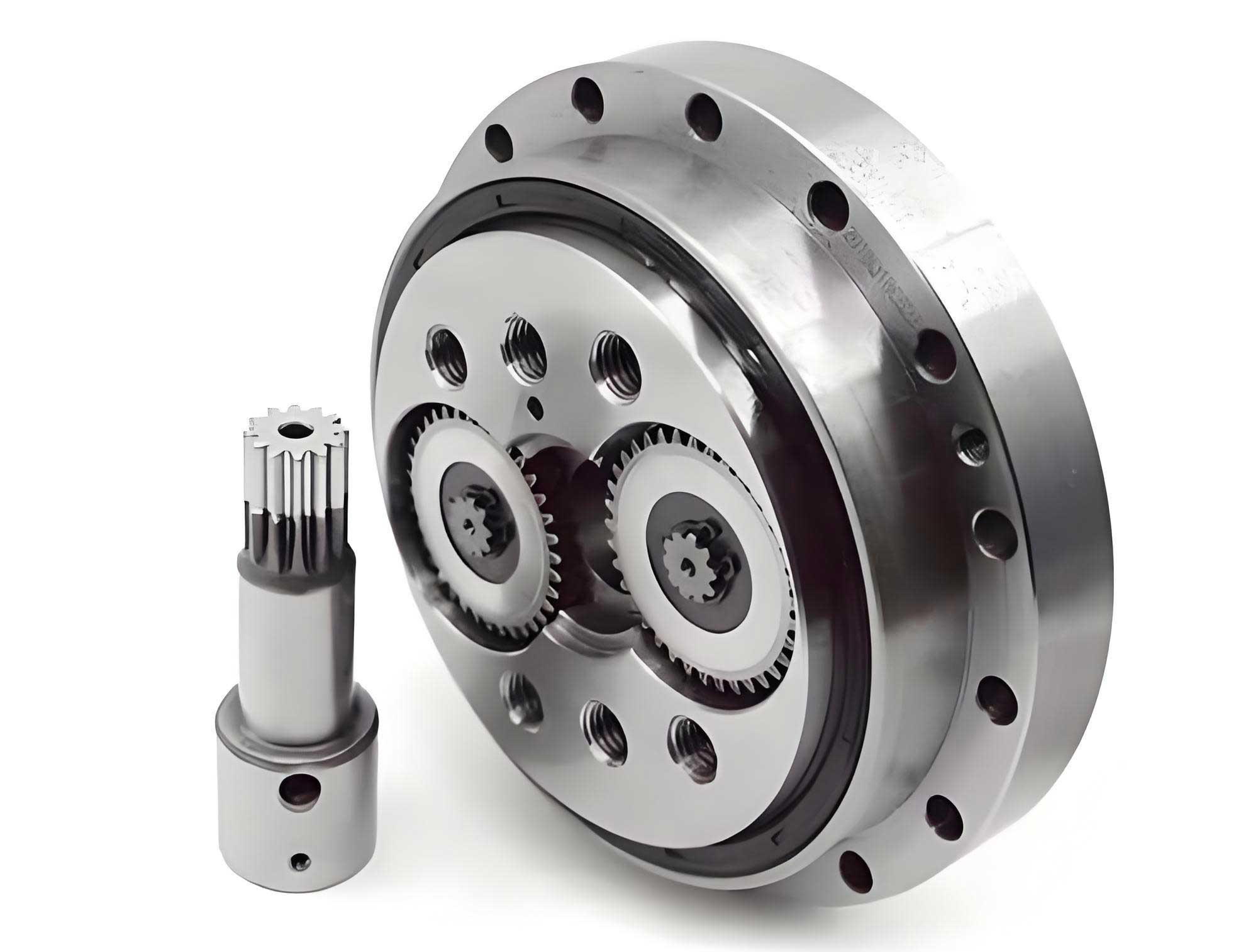
The rotary vector reducer assembly involves multiple stages, each with specific parts that must be installed correctly. Common issues include missing gears, bearings, or screws due to oversight. Traditional monitoring methods rely on manual inspection or machine learning techniques that require extensive feature engineering, which can be inefficient and error-prone. In contrast, deep learning automates feature extraction, making it more adaptable to complex assembly scenarios. This system uses two primary deep learning approaches: semantic segmentation for parts with distinct depth variations (e.g., housings, crankshafts) and object detection for small, dispersed components like screws. The choice is driven by the characteristics of the rotary vector reducer parts—some are overlapped and have height differences visible in depth images, while others are minute and blend into the background in color images.
To implement this, I designed the monitoring system around four main assembly stages of the rotary vector reducer. Each stage corresponds to a specific set of parts, and separate deep learning models are trained for each to avoid interference. For semantic segmentation, I employed the U-Net model, which is effective for small datasets and structured scenes like industrial assembly. The model architecture consists of an encoder-decoder network with skip connections, allowing it to capture both high-level and detailed features. The loss function used during training is the cross-entropy loss, defined as:
$$ L_{seg} = -\frac{1}{N} \sum_{i=1}^{N} \sum_{c=1}^{C} y_{i,c} \log(\hat{y}_{i,c}) $$
where \( N \) is the number of pixels, \( C \) is the number of classes, \( y_{i,c} \) is the ground truth label, and \( \hat{y}_{i,c} \) is the predicted probability for pixel \( i \) belonging to class \( c \). This ensures accurate pixel-wise classification for parts like the rotary vector reducer’s housing and planetary gears.
For object detection, I utilized the YOLOv3 model, a single-stage detector known for its speed and accuracy. It incorporates a feature pyramid network (FPN) and residual blocks to handle multiple scales. The loss function in YOLOv3 combines classification loss, localization loss, and confidence loss:
$$ L_{det} = \lambda_{coord} \sum_{i=1}^{S^2} \sum_{j=1}^{B} \mathbb{1}_{ij}^{obj} \left[ (x_i – \hat{x}_i)^2 + (y_i – \hat{y}_i)^2 + (w_i – \hat{w}_i)^2 + (h_i – \hat{h}_i)^2 \right] + \lambda_{obj} \sum_{i=1}^{S^2} \sum_{j=1}^{B} \mathbb{1}_{ij}^{obj} \left( C_i – \hat{C}_i \right)^2 + \lambda_{noobj} \sum_{i=1}^{S^2} \sum_{j=1}^{B} \mathbb{1}_{ij}^{noobj} \left( C_i – \hat{C}_i \right)^2 + \sum_{i=1}^{S^2} \sum_{j=1}^{B} \mathbb{1}_{ij}^{obj} \sum_{c \in classes} \left( p_i(c) – \hat{p}_i(c) \right)^2 $$
where \( S^2 \) is the grid size, \( B \) is the number of bounding boxes, \( \mathbb{1}_{ij}^{obj} \) indicates if the \( j \)-th box in cell \( i \) contains an object, \( (x, y, w, h) \) are bounding box coordinates, \( C \) is confidence, and \( p(c) \) is class probability. This enables the detection of screws in the rotary vector reducer assembly with high precision.
The dataset preparation involved both virtual and real data. For virtual data, I created 3D models of the rotary vector reducer using SolidWorks, assigned color labels to each part in 3ds Max, and rendered depth images and corresponding label images using Open Scene Graph (OSG). This generated 360 images per assembly stage, each of size 224×224 pixels. For real data, I captured images with the RGB-D camera, applied inpaining algorithms to fix depth artifacts, and manually annotated them. Data augmentation techniques like rotation, mirroring, and noise addition were used to expand the real dataset to 100 images per stage. The table below summarizes the dataset statistics for the rotary vector reducer assembly stages:
| Assembly Stage | Virtual Images | Real Images (After Augmentation) | Total Images |
|---|---|---|---|
| Stage 1 | 360 | 100 | 460 |
| Stage 2 | 360 | 100 | 460 |
| Stage 3 | 360 | 100 | 460 |
| Stage 4 | 360 | 100 | 460 |
Training was conducted on the PaddlePaddle deep learning platform. For semantic segmentation, I used pre-trained weights from COCO and fine-tuned with virtual data, then real data. The training parameters included 1000 epochs for virtual data and 500 for real data, with a learning rate of 0.005 and batch size of 2. For object detection, YOLOv3 was trained with 500 epochs, a learning rate of 0.0005, and batch size of 2. The performance metrics are shown in the following tables. For semantic segmentation, the average accuracy and mean Intersection over Union (IoU) across stages are:
| Assembly Stage | Average Accuracy | Average IoU |
|---|---|---|
| Stage 1 | 95.82% | 76.39% |
| Stage 2 | 96.96% | 82.83% |
| Stage 3 | 96.77% | 85.77% |
| Stage 4 | 96.99% | 79.54% |
The IoU is calculated as:
$$ \text{IoU} = \frac{\text{Area of Overlap}}{\text{Area of Union}} $$
For object detection focused on screws in Stage 3, the results were:
| Metric | Value |
|---|---|
| Precision | 99.8% |
| Recall | 99.7% |
| F1-Score | 99.75% |
The F1-Score is derived from precision and recall:
$$ F1 = 2 \times \frac{\text{Precision} \times \text{Recall}}{\text{Precision} + \text{Recall}} $$
In the software implementation, the image prediction module loads the trained models and processes real-time feeds from the RGB-D camera. The system compares predicted part counts with expected standards for each rotary vector reducer assembly stage. For instance, in Stage 4, if two pinions are required but only one is detected, the software flags a missing pinion. Similarly, in Stage 3, it checks for four screws and alerts if any are absent. The real-time performance is evaluated based on processing speed, with an average inference time of 0.1 seconds per image on a system with an Intel i5-6300HQ CPU and 8GB RAM, meeting practical assembly line requirements.
To further analyze the system’s robustness, I conducted experiments with various lighting conditions and occlusions common in industrial settings. The deep learning models demonstrated adaptability, maintaining accuracy above 95% for the rotary vector reducer parts. This is attributed to the depth images’ invariance to lighting changes and the models’ ability to learn hierarchical features. The integration of virtual data also enhanced generalization, as shown by the high IoU scores. Additionally, the software includes features for saving prediction results with timestamps, enabling traceability and quality control audits for rotary vector reducer production.
In conclusion, this deep learning-based monitoring system effectively addresses missing part issues in rotary vector reducer assembly. By leveraging semantic segmentation and object detection, it achieves high accuracy and real-time performance. The use of both virtual and real datasets ensures model robustness, while the modular software design allows for scalability to other mechanical products. Future work could involve extending the system to detect misalignments or improper fittings, and incorporating reinforcement learning for adaptive monitoring. Overall, this approach represents a significant step towards intelligent manufacturing, where rotary vector reducers and similar components can be assembled with greater precision and efficiency.
The success of this system underscores the potential of deep learning in industrial automation. As rotary vector reducers continue to be vital in robotics, such monitoring solutions will play a crucial role in maintaining quality standards. The methods described here—from data synthesis to model deployment—can be adapted for various assembly lines, contributing to the broader adoption of AI in manufacturing. With ongoing advancements in deep learning, we can expect even more sophisticated systems that further reduce errors and enhance productivity in rotary vector reducer assembly and beyond.