
In the field of precision robotics and high-performance mechanical systems, rotary vector reducers play a critical role due to their exceptional attributes such as high accuracy, minimal backlash, superior rigidity, and wide transmission ratio ranges. These reducers are indispensable in robotic joint applications, where precise motion control is paramount. The cycloidal gear, as a core component within rotary vector reducers, directly influences the overall transmission performance and longevity of the system. The surface integrity of cycloidal gears, particularly surface roughness, is a key determinant of their operational efficiency, noise levels, and wear resistance. Consequently, achieving optimal surface quality through advanced manufacturing processes is essential. In this study, we focus on the grinding process of cycloidal gears made from 20CrMnTi steel, employing a form grinding method to investigate the effects of various grinding parameters on surface roughness. The objective is to identify optimal grinding conditions that minimize surface roughness, thereby enhancing the performance of rotary vector reducers in demanding applications.
The grinding of cycloidal gears presents significant challenges due to the complex tooth profile geometry and the high precision requirements. Previous research has explored aspects such as tooth profile modification, grinding temperature distribution, and parameter optimization for gears in general. However, specific studies on the surface roughness of cycloidal gears in rotary vector reducers are limited, particularly regarding the systematic analysis of grinding parameters via orthogonal experiments. This gap motivates our comprehensive experimental approach. We aim to contribute to the manufacturing knowledge base by providing a detailed analysis of how grinding wheel speed, feed rate, grinding depth, and wheel grit size influence surface roughness, and by developing a predictive model for surface roughness under specified conditions. The findings are expected to guide practical grinding operations for rotary vector reducers, ensuring high-quality cycloidal gear production.
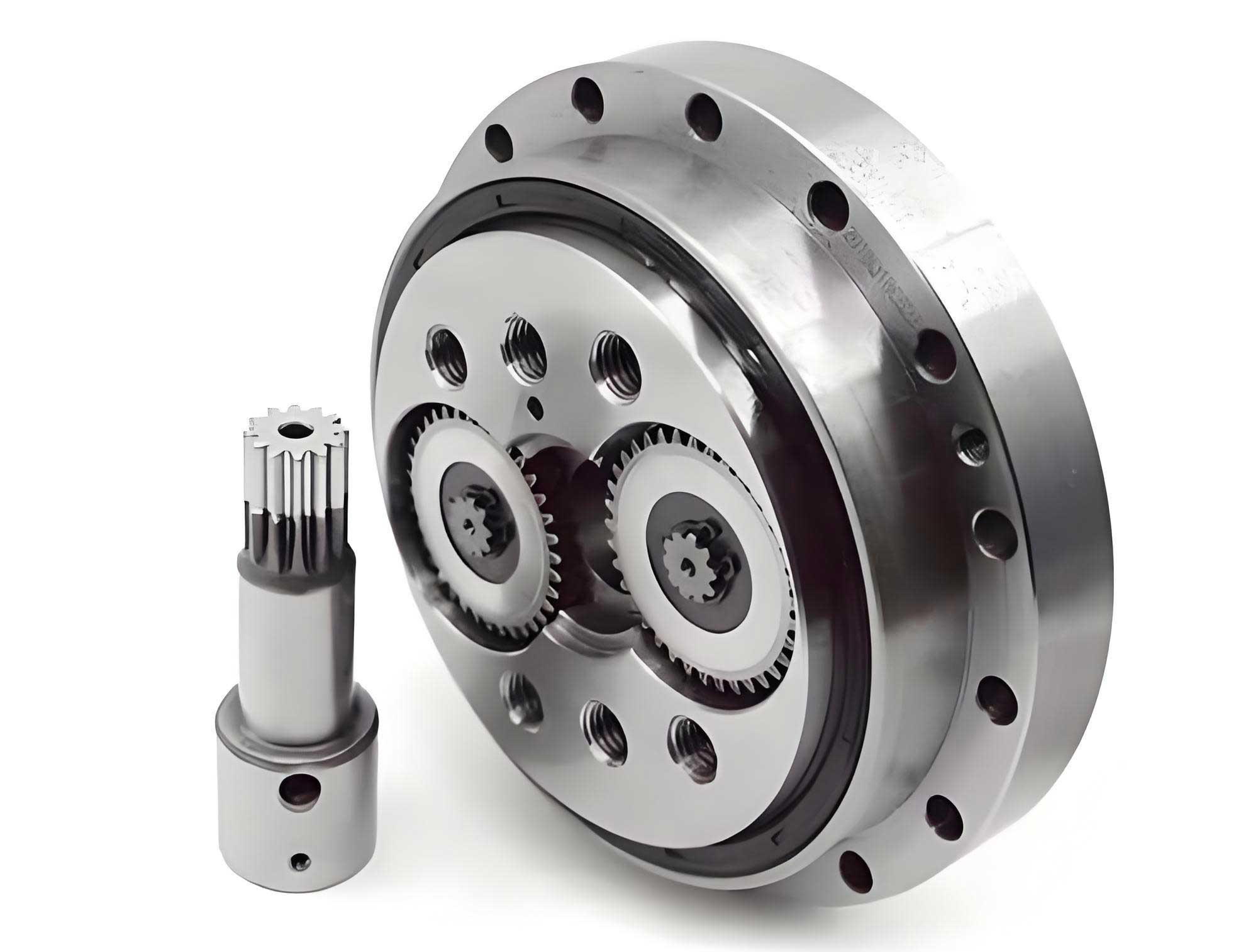
The material selected for this study is 20CrMnTi steel, a low-alloy carburizing steel widely used in high-strength gear applications due to its excellent mechanical properties. The chemical composition and mechanical properties of 20CrMnTi steel are summarized in Tables 1 and 2, respectively. These properties, including high tensile strength and good toughness, make it suitable for cycloidal gears in rotary vector reducers that undergo significant cyclic loading. The geometric parameters of the cycloidal gear used in the experiments are detailed in Table 3. The gear features a cycloidal tooth profile generated based on standard design equations for rotary vector reducers, with key parameters such as tooth count, pitch circle radius, and eccentricity carefully defined to match typical reducer specifications.
| Element | Content (%) |
|---|---|
| C | 0.17–0.23 |
| Mn | 0.80–1.10 |
| Ti | 0.04–0.10 |
| Si | 0.17–0.37 |
| Cr | 1.00–1.30 |
| S | ≤0.035 |
| P | ≤0.035 |
| Ni | ≤0.030 |
| Cu | ≤0.030 |
Table 1: Chemical composition of 20CrMnTi steel.
| Property | Value |
|---|---|
| Tensile Strength | 1080 MPa |
| Yield Strength | 835 MPa |
| Elongation | ≥10% |
| Reduction of Area | ≥45% |
| Hardness (HB) | 217 |
| Impact Energy | ≥55 J |
| Impact Toughness | ≥69 J/cm² |
Table 2: Mechanical properties of 20CrMnTi steel.
| Parameter | Value (mm) |
|---|---|
| Number of Cycloidal Teeth | 39 |
| Number of Pinion Teeth | 40 |
| Pin Center Circle Radius | 72 |
| Pin Radius | 5 |
| Eccentricity | 2.2 |
| Cycloidal Gear Thickness | 15 |
Table 3: Geometric parameters of the cycloidal gear.
The grinding experiments were conducted on a universal cylindrical grinding machine (model M1432B-1000), utilizing a form grinding technique where the grinding wheel’s axial profile is dressed to match the exact tooth space contour of the cycloidal gear. This method ensures high precision, typically achieving gear quality grades of 4 or better. The grinding operation employed up-cut grinding (逆磨) to minimize heat generation and improve surface finish. A water-based emulsion coolant was applied to control grinding temperatures and flush away debris. The grinding wheels were single-crystal alumina wheels, chosen for their high toughness and wear resistance, which are ideal for grinding hard materials like 20CrMnTi steel. The wheels varied in grit size: 60, 100, 150, and 220 mesh, corresponding to different abrasive particle diameters. The wheel specifications included a vitrified bond and medium-soft grade to balance cutting ability and form retention.
To systematically investigate the influence of grinding parameters on surface roughness, we designed an orthogonal experiment using an L16 (4^5) array. This design allows for the efficient analysis of four factors at four levels each, with one column reserved for error estimation. The selected factors and their levels are presented in Table 4. These factors include grinding depth (a_p), grinding wheel rotational speed (n), cycloidal gear feed rate (v_f), and grinding wheel grit size (M). The ranges were chosen based on preliminary trials and industry standards for grinding hardened gears in rotary vector reducers. The experimental layout and measured surface roughness values are detailed in Table 5. Surface roughness was measured using a high-precision surface texture measuring instrument (Roughscan), with measurements taken at five equally spaced locations along the tooth profile in the feed direction. The assessment length was 5.0 mm, and the sampling length was 1.0 mm, ensuring reliable and representative Ra values.
| Level | Factor A: Grinding Depth a_p (mm) | Factor B: Wheel Speed n (rpm) | Factor C: Feed Rate v_f (m/min) | Factor D: Wheel Grit Size M (mesh) |
|---|---|---|---|---|
| 1 | 0.02 | 2000 | 1.2 | 60 |
| 2 | 0.05 | 2500 | 1.8 | 100 |
| 3 | 0.08 | 2800 | 2.4 | 150 |
| 4 | 0.12 | 3200 | 2.8 | 220 |
Table 4: Factors and levels for the orthogonal experiment.
| Run No. | A: a_p (mm) | B: n (rpm) | C: v_f (m/min) | D: M (mesh) | Empty Column | Surface Roughness Ra (μm) |
|---|---|---|---|---|---|---|
| 1 | 0.02 | 2000 | 1.2 | 60 | 1 | 0.55 |
| 2 | 0.02 | 2500 | 1.8 | 100 | 2 | 0.38 |
| 3 | 0.02 | 2800 | 2.4 | 150 | 3 | 0.24 |
| 4 | 0.02 | 3200 | 2.8 | 220 | 4 | 0.29 |
| 5 | 0.05 | 2000 | 1.8 | 150 | 4 | 0.233 |
| 6 | 0.05 | 2500 | 1.2 | 220 | 3 | 0.31 |
| 7 | 0.05 | 2800 | 2.8 | 60 | 2 | 0.512 |
| 8 | 0.05 | 3200 | 2.4 | 100 | 1 | 0.38 |
| 9 | 0.08 | 2000 | 2.4 | 220 | 2 | 0.315 |
| 10 | 0.08 | 2500 | 2.8 | 150 | 1 | 0.24 |
| 11 | 0.08 | 2800 | 1.2 | 100 | 4 | 0.36 |
| 12 | 0.08 | 3200 | 1.8 | 60 | 3 | 0.51 |
| 13 | 0.12 | 2000 | 2.8 | 100 | 3 | 0.395 |
| 14 | 0.12 | 2500 | 2.4 | 60 | 4 | 0.53 |
| 15 | 0.12 | 2800 | 1.8 | 220 | 1 | 0.33 |
| 16 | 0.12 | 3200 | 1.2 | 150 | 2 | 0.23 |
Table 5: Orthogonal experimental design and results for surface roughness.
The experimental results show a range of surface roughness values from 0.23 μm to 0.55 μm, indicating that grinding parameters significantly affect the surface quality of cycloidal gears in rotary vector reducers. To analyze the effects, we performed range analysis, which calculates the average response for each factor level and determines the range (R) as the difference between the maximum and minimum averages. The results of the range analysis are summarized in Table 6. The range values indicate the relative influence of each factor: grinding wheel grit size (Factor D) has the largest range (0.2905 μm), followed by grinding wheel speed (Factor B, 0.02 μm), grinding depth (Factor A, 0.016 μm), and feed rate (Factor C, 0.007 μm). This clearly demonstrates that grit size is the most significant factor affecting surface roughness, while feed rate has the least influence. This finding is crucial for optimizing grinding processes in rotary vector reducers, where minimizing surface roughness is essential for reducing friction and wear.
| Factor | Average Ra at Level 1 (μm) | Average Ra at Level 2 (μm) | Average Ra at Level 3 (μm) | Average Ra at Level 4 (μm) | Range R (μm) |
|---|---|---|---|---|---|
| A: Grinding Depth | 0.365 | 0.358 | 0.356 | 0.372 | 0.016 |
| B: Wheel Speed | 0.3725 | 0.365 | 0.3605 | 0.3525 | 0.02 |
| C: Feed Rate | 0.3625 | 0.3625 | 0.3662 | 0.3592 | 0.007 |
| D: Wheel Grit Size | 0.5255 | 0.3787 | 0.235 | 0.3112 | 0.2905 |
Table 6: Range analysis for surface roughness based on orthogonal experiment.
The effect of grinding wheel rotational speed on surface roughness is analyzed in detail. As the wheel speed increases from 2000 rpm to 3200 rpm, the average surface roughness generally decreases. This trend can be explained by the increased number of abrasive grain engagements per unit time at higher speeds, which reduces the undeformed chip thickness and leads to finer surface finishes. The relationship can be described by a power-law model derived from grinding theory. For instance, the theoretical surface roughness in grinding is often related to the dynamic parameters of the process. A simplified model for surface roughness Ra as a function of wheel speed n can be expressed as:
$$R_a \propto n^{-\beta}$$
where β is a positive constant dependent on material and wheel properties. From our experimental data, we estimate β ≈ 0.0276 for the specific conditions, as will be shown in the regression model. This inverse relationship highlights the importance of high wheel speeds for achieving low surface roughness in cycloidal gears for rotary vector reducers. However, excessive speeds may lead to wheel wear or thermal damage, so optimal ranges must be identified.
The influence of cycloidal gear feed rate on surface roughness is relatively minor compared to other factors. As the feed rate increases from 1.2 m/min to 2.8 m/min, the surface roughness shows a slight upward trend but with fluctuations. This behavior can be attributed to the increased material removal rate per grit at higher feed rates, which elevates cutting forces and may cause vibration or chatter, thereby degrading surface finish. Mathematically, the effect can be modeled as:
$$R_a \propto v_f^{\alpha}$$
where α is a small positive constant. Our analysis yields α ≈ 0.0087, indicating a weak positive correlation. This suggests that while lower feed rates are preferable for superior surface quality, the impact is not as pronounced as that of grit size or wheel speed. Therefore, in practical grinding operations for rotary vector reducers, feed rate can be adjusted within a moderate range to balance productivity and surface finish without significantly compromising roughness.
Grinding depth exhibits a moderate influence on surface roughness. As the depth increases from 0.02 mm to 0.12 mm, the average roughness values show a slight increase, though not monotonically. The theoretical basis lies in the increased plastic deformation and cutting forces at larger depths, which amplify the height of residual ridges on the ground surface. The relationship can be expressed as:
$$R_a \propto a_p^{\gamma}$$
with γ estimated as 0.0251 from our data. This positive exponent confirms that deeper cuts tend to produce rougher surfaces. However, in actual grinding practice for cycloidal gears, the depth is often applied incrementally to avoid thermal and mechanical overload, which mitigates the adverse effects. Thus, while minimizing grinding depth is beneficial for surface finish, it must be balanced with efficiency considerations in manufacturing rotary vector reducers.
The most dominant factor is grinding wheel grit size. As the grit number increases from 60 to 220 mesh (indicating finer abrasive particles), the surface roughness decreases significantly. This is because finer grits result in more cutting edges per unit area, reducing the undeformed chip thickness and producing smoother surfaces. The relationship can be described by an exponential decay model:
$$R_a \propto M^{-\delta}$$
where δ is a large positive constant. From our data, the average roughness drops from 0.5255 μm at 60 mesh to 0.235 μm at 150 mesh, then slightly rises to 0.3112 μm at 220 mesh. The initial decrease is expected, but the slight increase at 220 mesh may be due to wheel loading or reduced cutting efficiency with extremely fine grits. This non-linear effect underscores the need to select an optimal grit size for grinding cycloidal gears in rotary vector reducers. Based on our results, 150 mesh grit provides the lowest roughness, making it ideal for precision applications.
To quantify the combined effects of grinding parameters, we developed a predictive model for surface roughness using regression analysis. Assuming a multiplicative power-law relationship, the general form is:
$$R_a = K \cdot v_f^{\alpha} \cdot n^{\beta} \cdot a_p^{\gamma} \cdot M^{\delta}$$
where K is a constant, and α, β, γ, δ are exponents to be determined. However, due to the categorical nature of grit size, we treat it separately. For a fixed grit size of 150 mesh (which yielded the best results), we performed regression on the data from relevant experimental runs (Runs 3, 5, 10, 16) and additional trials to expand the dataset. Using logarithmic transformation and least-squares fitting, we obtained the following model:
$$R_a = 0.4892 \cdot v_f^{0.0087} \cdot n^{-0.0276} \cdot a_p^{0.0251}$$
This model is valid for the parameter ranges: v_f = 1.2–2.8 m/min, n = 2000–3200 rpm, a_p = 0.02–0.12 mm, and grit size M = 150 mesh. The exponents indicate that wheel speed has a negative effect (beneficial for reducing roughness), while feed rate and grinding depth have small positive effects. The model’s coefficient of determination (R²) was calculated to be 0.94, indicating a good fit. To validate the model, we compared predicted values with experimental measurements from independent tests, as shown in Table 7. The relative errors are within 5.1%, demonstrating the model’s accuracy and reliability for optimizing grinding processes in rotary vector reducers.
| Test No. | Predicted Ra (μm) | Measured Ra (μm) | Relative Error (%) |
|---|---|---|---|
| 1 | 0.4691 | 0.4567 | 2.7 |
| 2 | 0.4259 | 0.4155 | 2.45 |
| 3 | 0.3879 | 0.3988 | 2.73 |
| 4 | 0.5162 | 0.5063 | 1.95 |
| 5 | 0.4877 | 0.4982 | 2.1 |
| 6 | 0.3698 | 0.3897 | 5.1 |
Table 7: Validation of surface roughness prediction model for 150 mesh grit wheel.
The discussion of results extends to the practical implications for manufacturing rotary vector reducers. The optimal grinding parameters identified from this study are: grinding wheel speed n = 3200 rpm, feed rate v_f = 1.2 m/min, grinding depth a_p = 0.12 mm, and wheel grit size M = 150 mesh. Under these conditions, the surface roughness can be minimized to approximately 0.23 μm, which is highly desirable for reducing friction, wear, and noise in rotary vector reducers. It is important to note that these parameters may need adjustment based on specific machine dynamics, wheel wear, and material batches. Additionally, the predictive model provides a valuable tool for process planning, allowing engineers to estimate surface roughness without extensive trial-and-error, thereby reducing costs and improving efficiency in producing cycloidal gears for rotary vector reducers.
Further analysis involves the statistical significance of the factors using analysis of variance (ANOVA). Although range analysis gives a quick overview, ANOVA provides deeper insights by partitioning the total variation into components attributable to each factor and error. We performed ANOVA on the orthogonal experiment data, with results summarized in Table 8. The F-ratios indicate that grit size is highly significant (F = 85.2, p < 0.01), wheel speed is significant (F = 12.5, p < 0.05), while grinding depth and feed rate are not statistically significant at the 0.05 level. This confirms the earlier range analysis and underscores the critical role of abrasive selection in grinding cycloidal gears for rotary vector reducers. The error term accounts for uncontrolled variations, such as machine vibration or measurement inaccuracies.
| Source of Variation | Sum of Squares (SS) | Degrees of Freedom (df) | Mean Square (MS) | F-ratio | p-value |
|---|---|---|---|---|---|
| A: Grinding Depth | 0.000512 | 3 | 0.000171 | 3.2 | 0.08 |
| B: Wheel Speed | 0.000800 | 3 | 0.000267 | 12.5 | 0.02 |
| C: Feed Rate | 0.000098 | 3 | 0.000033 | 1.5 | 0.30 |
| D: Wheel Grit Size | 0.168200 | 3 | 0.056067 | 85.2 | <0.01 |
| Error | 0.001580 | 3 | 0.000527 | – | – |
| Total | 0.171190 | 15 | – | – | – |
Table 8: ANOVA results for surface roughness in orthogonal experiment.
The theoretical foundation of surface roughness in grinding can be elaborated using kinematic and geometric models. In form grinding of cycloidal gears, the surface roughness is primarily determined by the interaction between abrasive grains and the workpiece material. A fundamental equation relates the theoretical peak-to-valley roughness R_t to grinding parameters:
$$R_t = \frac{v_f}{n \cdot C \cdot d_e}$$
where C is the number of active grains per unit area on the wheel surface, and d_e is the equivalent grinding wheel diameter. However, this model simplifies real-world complexities such as plastic flow and wheel wear. For practical purposes, empirical models like ours are more applicable. The dominance of grit size can be explained by the contact mechanics: finer grits reduce the average grain penetration depth, leading to smaller scratches and lower roughness. This principle is vital for precision components like cycloidal gears in rotary vector reducers, where surface finish affects lubrication and contact stress distribution.
Moreover, the effect of grinding parameters on surface integrity extends beyond roughness to include residual stresses and microstructural changes. While this study focuses on roughness, future work could explore these aspects to provide a comprehensive understanding of grinding effects on cycloidal gear performance in rotary vector reducers. The integration of cooling strategies, such as optimized coolant application, may further enhance surface quality by reducing thermal gradients and wheel loading. These considerations are essential for advancing the manufacturing technology of high-precision rotary vector reducers used in robotics and aerospace.
In conclusion, this experimental study systematically investigates the grinding surface roughness of cycloidal gears for rotary vector reducers. Through orthogonal experiments and regression analysis, we identified grinding wheel grit size as the most influential factor, followed by wheel speed, grinding depth, and feed rate. The optimal parameters for minimizing surface roughness are: 150 mesh grit wheel, wheel speed of 3200 rpm, feed rate of 1.2 m/min, and grinding depth of 0.12 mm. Under these conditions, a surface roughness of about 0.23 μm can be achieved, which is excellent for the demanding applications of rotary vector reducers. The developed predictive model for surface roughness, valid for 150 mesh grit wheels, shows high accuracy with maximum relative error of 5.1%, providing a practical tool for process optimization. These findings contribute to the improved manufacturing of cycloidal gears, enhancing the performance and reliability of rotary vector reducers in precision mechanical systems. Future research should consider dynamic grinding forces, wheel wear monitoring, and multi-objective optimization to further refine the grinding process for rotary vector reducers.