
My analysis focuses on the mechanical behavior of critical components within a high-precision RV reducer, specifically the RV-40E model, under operational loading conditions. As a core component in industrial robotic arms, the performance and reliability of the RV reducer are paramount. The forces and deformations experienced by its internal parts during power transmission directly influence its positional accuracy and longevity. Therefore, a detailed investigation into the stress distribution and dynamic characteristics of these components provides essential theoretical guidance for optimizing the design and enhancing the overall precision of the RV reducer.
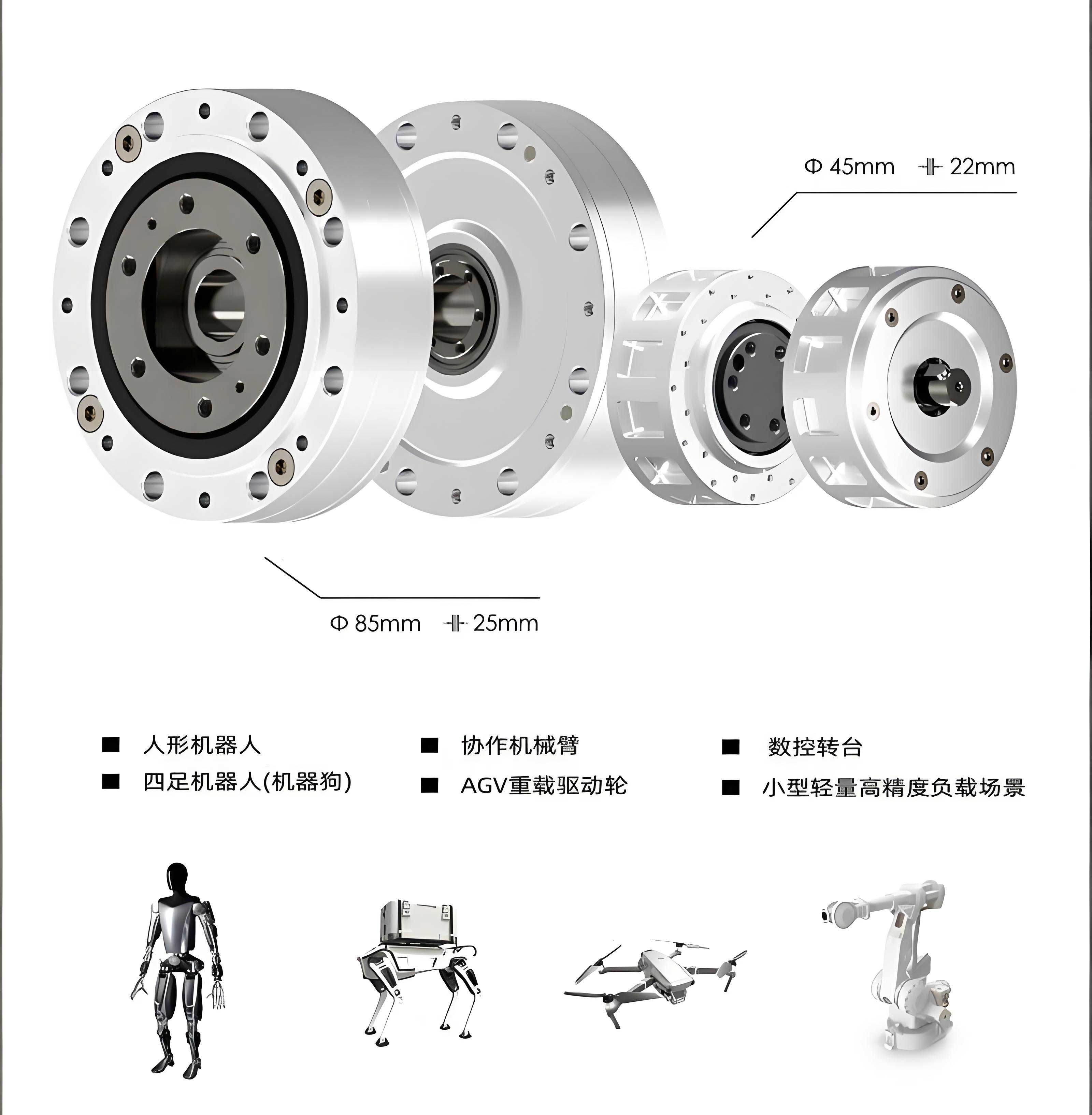
The RV reducer is renowned for its compact two-stage reduction mechanism, combining a primary involute planetary gear stage with a secondary cycloidal pin gear stage. This design achieves high reduction ratios, excellent torsional stiffness, and high positioning accuracy within a small envelope. The transmission principle can be summarized as follows: Input rotation is delivered to the sun gear (input shaft). This drives multiple planet gears in the first-stage planetary gear train. Each planet gear is integrated with a crank shaft. The rotation of the planet gears causes the crank shafts to revolve, which in turn drive the cycloid discs (or wobble plates) in an eccentric motion. These cycloid discs mesh with a stationary ring of needle rollers (pin gear) housed in the pin housing, converting the eccentric motion into a reduced rotational output of the planet carrier (output flange).
For the finite element analysis (FEA), I developed three-dimensional solid models of the critical assemblies: the input shaft assembly (including the sun gear and planet gears) and the cycloid disc. The commercial CAD and CAE software Siemens NX was utilized for both geometric modeling and subsequent simulation tasks. The material assigned to all components for this study is alloy steel 20CrMo, commonly used in high-strength gearing applications. Its isotropic material properties are defined as follows:
- Density, $\rho = 7.9 \text{ g/cm}^3 = 7900 \text{ kg/m}^3$
- Young’s Modulus, $E = 206 \text{ GPa}$
- Poisson’s Ratio, $\nu = 0.3$
- Shear Modulus, $G = 79.23 \text{ GPa}$ (calculated from $G = \frac{E}{2(1+\nu)}$)
The material is assumed to be homogeneous, continuous, and linearly elastic for the scope of this static and modal analysis. Friction in gear meshes is neglected to simplify the contact problem and focus on the primary load paths.
Methodology: Boundary Conditions and Load Cases
Establishing realistic boundary conditions and loads is crucial for meaningful simulation results. For the RV reducer input stage analysis, I defined the following constraints and loads within the NX Nastran solver environment.
Input Stage (Sun Gear and Planet Gear) Model
The input shaft, representing the sun gear, is constrained using a cylindrical joint. This allows rotation only about its central axis ($R_z$), while all translational degrees of freedom ($T_x, T_y, T_z$) and the other two rotational degrees ($R_x, R_y$) are fixed. A “Body-to-Body” surface contact condition was defined between the tooth flanks of the sun gear and the planet gear, with a default penetration tolerance to simulate the meshing action. The planet gear’s inner spline, which connects to the crank shaft in the full assembly, is assigned a fixed constraint, simulating its connection to the rotating crank shaft. The load is applied as a pure torque ($T_{input}$) on the free end of the input shaft, simulating the drive from a servo motor.
Cycloid Disc Model
For the cycloid disc’s static analysis, the central bore, which fits onto the output bearing and is connected to the planet carrier, is assigned a fixed constraint. Torque is applied to the inner surfaces of the crank pin holes, representing the driving force from the eccentric crank shafts. For the subsequent modal analysis, a cylindrical joint constraint is applied at the central bore to allow free rotation about the central axis, which is essential for extracting meaningful free-vibration modes.
The magnitude of the input torque is derived from the rated power and speed of the RV reducer. The relationship between power ($P$), speed ($n$), and torque ($T$) is given by:
$$ T = 9550 \times \frac{P}{n} $$
where $T$ is in N·mm, $P$ is in kW, and $n$ is in rpm. For the RV-40E with a total reduction ratio $i = 105$, the input speed is related to the output speed by $n_{input} = i \times n_{output}$. To ensure the analysis covers a range within the reducer’s capacity and to verify result consistency, I evaluated three distinct load cases, all well within the rated torque of 40,000 N·m. The calculated input torques are summarized below.
| Output Power, $P$ (kW) | Output Speed, $n_{output}$ (rpm) | Input Torque, $T_{input}$ (N·mm) |
|---|---|---|
| 0.6 | 10 | 5,457 |
| 0.8 | 15 | 4,851 |
| 1.0 | 20 | 4,548 |
Static Finite Element Analysis of the Input Stage
The static structural analysis for the sun-planet gear pair was solved for each load case defined in Table 1. The primary outputs of interest are the von Mises stress (an indicator of yield inception under multi-axial loading), elastic strain, and nodal displacement. The maximum values extracted from the simulation results for each load case are consolidated in Table 2.
| Input Torque, $T_{input}$ (N·mm) | Max. von Mises Stress (MPa) | Max. Elastic Strain ($\mu$m/m) | Max. Axial Displacement ($\mu$m) | Max. Radial Displacement (mm) |
|---|---|---|---|---|
| 5,457 | 168.87 | 710.5 | 0.2232 | 0.084 |
| 4,851 | 149.78 | 630.1 | 0.2058 | 0.083 |
| 4,548 | 139.50 | 586.9 | 0.2024 | 0.083 |
The analysis reveals a clear linear correlation between the applied input torque and the mechanical response. The maximum von Mises stress, elastic strain, and axial displacement all decrease proportionally with the reduction in applied torque. This linear trend validates the assumption of linear elastic material behavior within this load range. The location of maximum stress and strain is consistently identified at the mid-region of the contact zone between the sun gear and planet gear teeth, which is the expected critical point for bending and contact stress.
A key finding is the magnitude of the maximum stress. With a yield strength ($\sigma_y$) of approximately 685 MPa for 20CrMo, the calculated maximum stress of 168.87 MPa (under the highest load) provides a significant safety factor ($SF$), which can be expressed as:
$$ SF = \frac{\sigma_y}{\sigma_{max}} \approx \frac{685}{168.87} \approx 4.06 $$
This confirms that the gear teeth possess substantial strength reserve under the specified operational loads. The displacement results show that radial displacements (both horizontal and vertical) are orders of magnitude larger than axial displacements, which is consistent with the primary bending mode of the gear teeth under radial meshing forces.
Static and Modal Analysis of the Cycloid Disc
The cycloid disc is a core force-transmitting element in the RV reducer, subject to complex, time-varying loads from multiple crank pins and its interaction with the needle rollers.
Static Analysis Under Load
For the static analysis, a fixed constraint was applied at the central bore, and a torque of 5,457 N·mm was distributed among the crank pin holes. The resulting stress and displacement fields provide insight into the load distribution. The maximum stress concentrations are observed at two primary locations: 1) the edges of the central bore, and 2) the fillet regions at the root of the cycloid lobe teeth where they contact the needle rollers. The stress at the lobe roots is distributed relatively uniformly around the disc’s perimeter. The maximum total displacement occurs at the outer edges of the cycloid lobes, and the deformation pattern exhibits symmetry about the disc’s central axes, which aligns with the symmetric application of forces from the crank pins.
Modal Analysis: Natural Frequencies and Mode Shapes
To understand the dynamic characteristics and potential resonance risks of the cycloid disc, a modal analysis was performed. The analysis extracts the structure’s natural frequencies and corresponding mode shapes of free vibration, assuming a cylindrical joint constraint at the central bore. The first six mode shapes and their natural frequencies were solved using the Lanczos method and are detailed in Table 3.
| Mode Order | Natural Frequency, $f_n$ (Hz) | Mode Shape Description |
|---|---|---|
| 1 | 2,082.83 | In-plane lateral swinging (X-direction) |
| 2 | 2,275.00 | In-plane lateral swinging (Y-direction, orthogonal to Mode 1) |
| 3 | 2,493.69 | Out-of-plane bending (Rocking about an in-plane axis) |
| 4 | 2,846.85 | In-plane distortional deformation (Torsional-like distortion within the plane) |
| 5 | 2,933.82 | Higher-order out-of-plane bending |
| 6 | 3,986.27 | Axial rotation about the central axis |
A critical observation from the mode shape plots is the distribution of deformation energy. In all extracted modes, the amplitude of deformation (indicated by color contours in the software) is significantly higher in the outer lobe region of the cycloid disc compared to its central hub region. This indicates that under dynamic excitation, the cycloid lobes are more susceptible to vibratory response. This is a vital insight for fatigue life prediction, suggesting that the lobe roots and profiles are the most likely locations for initiating fatigue cracks due to cyclic bending stresses during the RV reducer‘s operation. Engineers must ensure that the manufacturing process, especially the grinding of the cycloid profile and the root fillet, is of the highest quality to minimize stress risers in this critical region.
Synthesis and Implications for RV Reducer Design
The integrated finite element analysis of both the input stage and the cycloid disc within the RV reducer framework yields several important conclusions and design implications:
- Gear Tooth Strength Validation: The stress levels in the involute gear teeth of the input stage are well within the yield limit of the chosen material under the analyzed operational loads. The linear response to load variation confirms predictable behavior. The primary failure mode for these gears under overload conditions would likely be surface contact fatigue (pitting) or bending fatigue at the tooth root, areas that could be the focus of more detailed contact fatigue analysis.
- Cycloid Disc Stress Concentrations: The static analysis of the cycloid disc clearly identifies the stress-critical zones: the central bore interface and the root fillets of the cycloid lobes. These areas demand careful attention during design. Optimizing the fit and surface treatment of the central bore and implementing a optimized, smooth root fillet profile for the cycloid teeth are essential steps to reduce stress concentration factors and enhance fatigue life.
- Dynamic Vulnerability of Cycloid Lobes: The modal analysis provides a crucial dynamic perspective. The pronounced deformation of the outer lobes during vibration highlights their dynamic sensitivity. In the design of the RV reducer, it is important to ensure that the operational excitation frequencies (e.g., gear mesh frequencies, motor rotational frequencies multiplied by the reduction ratio) do not coincide with these natural frequencies to avoid resonance, which could lead to excessive noise, vibration, and accelerated failure. Furthermore, this finding underscores the importance of the cycloid disc’s material and geometric integrity for the dynamic stability of the entire reducer.
- Pathway for Optimization: The models and methodologies established here serve as a foundation for parametric optimization studies. Key geometric parameters can be varied systematically—such as the module and profile shift of the involute gears, the cycloid disc’s wall thickness, lobe geometry modification coefficient, and pin diameter—to observe their effect on stress distribution, stiffness, and natural frequencies. The goal is to achieve an optimal balance between strength, weight, stiffness, and dynamic performance for the RV reducer.
Future work will involve more sophisticated analyses to build upon this foundation. This includes transient dynamic analysis to simulate the actual start-stop and load fluctuation conditions, advanced nonlinear contact analysis to more accurately capture the pressure distribution between the cycloid disc and needle rollers, and coupled thermal-structural analysis to investigate the effects of frictional heat generation on deformations and stress. Furthermore, performing a full-system multi-body dynamics (MBD) simulation incorporating flexible bodies based on these FEA results would provide a comprehensive understanding of the load sharing among planets, the system’s torsional stiffness, and the transmission error under dynamic conditions. Ultimately, the insights gained from such detailed computational studies are indispensable for advancing the design and manufacturing of high-performance, reliable RV reducers capable of meeting the stringent demands of precision robotics and automation.